
Mrs Pabodie, I presume?

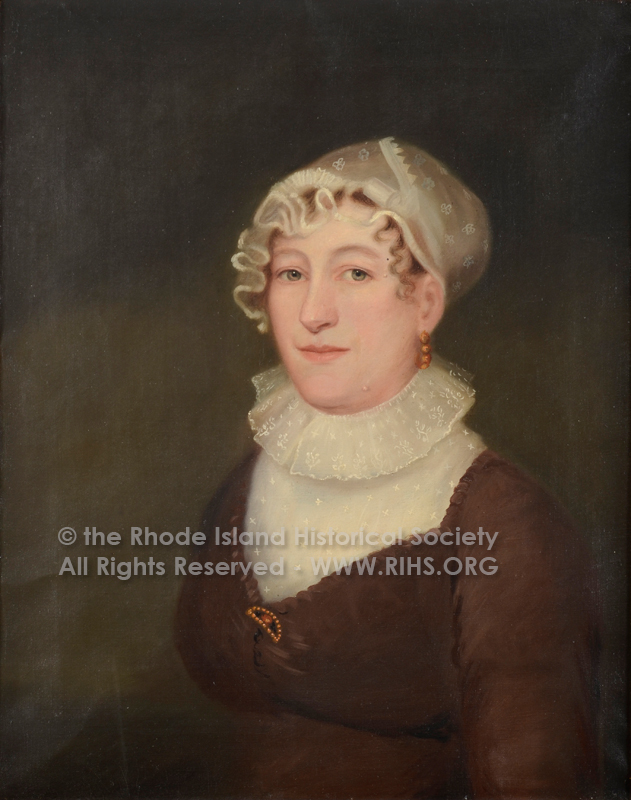
Mrs William (Jane) Pabodie. oil on canvas, 1813. RIHS 1970.60.2

Remember Mrs Pabodie? She appeared a week ago today in Providence after an intense sewing effort left your author with numb fingers. The process was as straightforward as these things ever are, manipulating fabrics to do your bidding once you think you have the right materials.

It took more rounds of white muslins from Burnley and Trowbridge than I care to count, and a variety of book muslins from Wm Booth Draper, just for the chemisette and cap. The laces came from Farmhouse Fabrics in the most expensive small package I’ve yet ordered that did not contain antique jewelry.

Mrs Pabodie attempts to remember when she was born (1771). Photo by J. D. Kay

The gown is a wool and silk blend remnant from Wm Booth Draper, just enough to make a gown (even at my height) though I admit the front hem will need some piecing or a ruffle to give it the proper length. Still, the thing more or less works, though as I compare the details to the original painting, I admit we’re still in beta.

I was joined by three friends from different eras (because you know me: if it’s not didactic, we’re not doing it): a sailor who on the run from a Newport press gang in 1765; Reverend Enos Hitchcock of the Beneficient Congregational Church in 1785; and Sissieretta Jones, soprano of Providence, around 1880. Each of the characters described their lives and their clothing, and I will admit that the Annual Meeting audience may not have been fully prepared for some of what they heard– I’m not certain they had ever considered how apt “balancing a sheep on my head” might be in describing Reverend Hitchcock’s wig.

Mrs Pabodie points out East Side landmarks to a visitor examining the theatre curtain backdrop painted around 1810. Photo by J. D. Kay

In the end, they were entertained, and may even have learned something, as we celebrated 2016’s interpretive theme, Fashioning Rhode Island.
Frivolous Friday: The Pabodie Project

Mrs William (Jane) Pabodie. oil on canvas, 1813. RIHS 1970.60.2

Jane Jewett Pabodie, born around 1771, died 23 March 1846 is buried in Swan Point Cemetery on the Seekonk River in Providence. She was the wife of William Pabodie– which one? Well, it’s hard to tell until I really dig into the genealogy. At the moment I am so besotted with this image that all I can think about is what she’s wearing!

What she’s wearing….about that. I have some work– and some thinking– to do. The cap is slightly confounding. It’s a chance to learn a great deal more about early federal caps, which is good. I don’t understand it, which is unfortunate. The asymmetrical nature of the cap is new to me- or at least I cannot think of another example, so feel free to school me, people. But really: it is asymmetrical! With a ruffle on what is the right side of her head, and a… pinked? Van Dyked? Prairie pointed? band that runs from her left ear around to the back of her right ear? I’m confused. It would make more sense if the cap had slipped, but why would the Pabodies pay for a painting that recorded such a thing?

Honestly, I think the only way to really understand the cap is to make the cap. In muslin first, thankyouverymuch, I’m not that crazy.

Detail, Mrs William Pabodie. Oil on canvas, 1813. RIHS

The chemisette is more straightforward, being made of a sheer figured or embroidered cotton with a slightly gathered collar embellished with floral whitework embroidery. That I think can manage, at least in the basic construction (fabric, well, I’m looking).

Of course, why do I feel the need to manage all of this, with a deadline now less than eight weeks away? For a program, of course– I have only to write the copy for it. The idea (for me, anyway) is to replicate a portrait as closely as I can. Now, Mrs Pabodie and I are not exactly the same age, but I think I can pull this off…the cap, more troubling.

It’s an interesting project for me, not so much from the sewing point of view, but from a conceptual standpoint.

How close can I get? What does exactitude mean?

If I want to represent a character, what’s more important: understanding the clothing, or understanding Jane Pabodie? Constrained as I am by modern materials, unable to match these exactly, how do I navigate choices based on suppositions of what an artist meant to represent? Just my kind of conundrum.