Details: we sweat them in our historical clothing, our impressions, our writing. I try hard to pay attention to them, but in my work, I have a lot of details to manage. Some fall away– I can no longer tell the ranks of men in daguerreotypes immediately, or recognize a Colt revolver at 10 paces, but there was a time when I could. I have managed to retain at least a general understanding of how military units are organized, a general sense of various units from my state in wars before 1939, and the uniforms associated with those units. (And I know which side a man’s coat buttons on.)
What’s wrong with this image? Missouri State Guard uniform coat of Col. Austin M. Standish (Confederate). Missouri Historical Society 1916-045-0001
This helps in my work: knowing what HBT is, knowing what various patches signify, knowing how units were structured and the campaigns they were part of helps me be a better cataloger, curator, and exhibit developer. My job is take the details and make them matter by telling stories about the people who wore the HBT or the machinists’ mate patch or carried an ensign or wore an officer’s coat as part of the 14th Rhode Island Heavy Artillery (colored) in the Civil War.
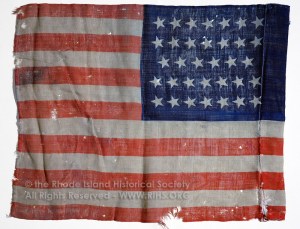
U.S. Flag, regimental. 14th Regiment Rhode Island Heavy Artillery. Belonged to Joseph Carey Whiting, Jr., 1st Lt., Co. B 14th R.I. Heavy Artillery. RIHS 1962.24.1
People matter more than things, but 154 years later, all we have are things those people owned, used, wore, and carried. The things now represent the people. So when someone working on a exhibit says, “any epaulets will do” while pointing at the shoulder boards on a Lieutenant’s coat, I’m not just taken aback, I’m upset, and reply, “If it’s just for color, you can buy them.” Because “any old epaulet [sic]” being loaned by a museum goes through a laborious process of loan approval, packing, delivery and installation. For that time investment alone, “any old epaulet” should not do: museums are not prop closets.
General’s Epaulets of William Clark. Missouri Historical Society. 1924-004-0006
We can’t assume that the public doesn’t know or doesn’t care– they often know more than we do, just think of the wildly detailed knowledge some of us have about very particular things– so we owe it to them, and to the people of the past, to use museum objects as more than visual accents.
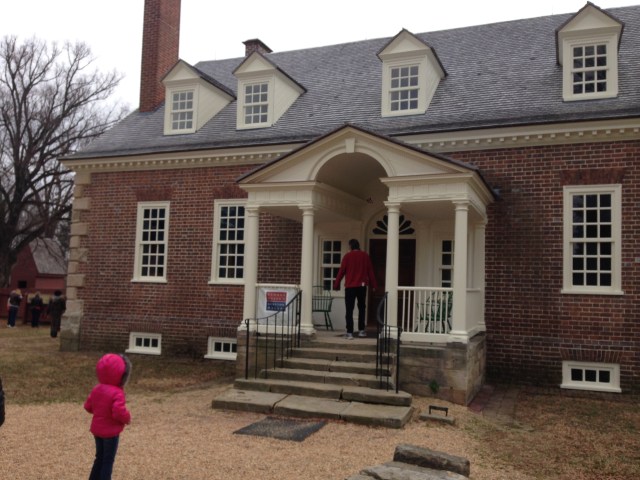
Gunston Hall has been on my list of must-visit places for some time, and now I can cross it off my list. I was impressed by their Room Use Study and remain so. They’ve also done some decent work on slavery, and it shows on their website. So my hopes were high. You know where this is going, right? Yup.
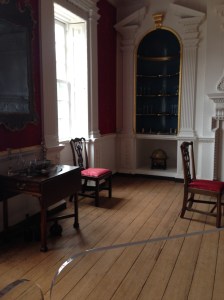
The room in which Martha Washington and Mrs Mason may have had a “chit-chat” about the two Georges.
Pretty sure the guided tour is dead. Also pretty sure most museums need to look long and hard at the actual execution of their mission. Granted, this was another one of those January R&R visits, when it is entirely likely that the multiple “Out of Order” signs were a mere mid-winter fluke. But day-um, I was underwhelmed.
Granted, this house is older than “mine.” And smaller. And I didn’t ask any questions on the tour because I fear my tone will be far too telling. But there was a small, excited-in-a-good-way child on the tour, and several other adults. When asked by the docent what we were interested in, the group settled on “life.”
WHO touched that railing? THAT’S why I should care?
We ended up with the incantation of “many famous people have sat in this room.” “Many famous people have touched this stair rail.” I might have heard an audible intake of breath when we were told something was original; my right eyebrow shot up in an expression well known to my friends.
The house is lovely, of course, Georgian balance and all that, and nicely decorated, whether the chinoiserie paper in the dining chamber or the Virginia-Chesapeake Neat and Plain office. But why the default emphasis is on famous people touched this, stepped here, slept here, I do not know. My docents do it, too, sometimes. But what troubles me more is what I came away without: A sense of George Mason and his family.
Red damask on the walls, because “they could have had it.” Infelicitous phrasing.
Most troubling to me, being Of a Certain Age, was the statement that Mason’s second marriage, to Sarah Brent, was “for friendship and companionship.”
Really?
George and Sarah sign a marriage agreement several days before they are wed, protecting in a limited way Sarah’s individual property. Under the terms of this contract, Sarah gives ownership of her slaves to her husband for the length of her marriage, but regains possession of them should her husband die and there be no offspring between them. Under these same conditions, Sarah is promised as dower 400 acres of her husband’s land at Dogues Neck.
Over the years, it has been pointed out that the marriage agreement between Sarah and George indicates that their relationship was more business-like and convenient, rather than loving. However, the marriage compact also can be seen as a fair solution between two practical people who want to safeguard their property for future generations — Mason for his children and Sarah for the sons and daughters of her sister Jean in Dumfries. In Sarah’s will of 1794, she indeed does pass on to these children and one of their offspring the slaves she regains upon the death of her husband.
Really?
That looks to me like a sensible arrangement between two mature adults. The way that a 50-year-old approaches marriage and relationships in any century will be different. Even in the 18th century, a woman of 50 has an established identity, knowledge of the world, and experience in running a household, if not a business.
Why yes, I do have some baggage, why do you ask?
To suggest that sensibility excludes or precludes sex is to miss the point of Jane Austen completely, and is ageist in the absence of evidence. In all likelihood, Sarah is peri-menopausal at least and menopausal at most (it varies widely; some 50-year-old women are still fertile, shocking though that may seem). That doesn’t mean she’s asexual, and while George Mason may well have (probably did) take sexual advantage of the women he owned, that doesn’t mean he’s not interested in, and expecting, a sexual relationship with his second wife.
What all of this suggests to me is a reluctance in museums to talk about sex, unless there are children from a marriage, in which case one can just assume the couple were busy in bed and not actually address it…all in all, a weird thing, and one that turns up in my own museum from time to time.
This is not to suggest that I didn’t enjoy the tour, the house, or the landscape. But I felt dissatisfied, as if the real meat of the place was not to be found on the tour. Exploring the upstairs on our own was much more fun– I would have liked some object labels up there, and downstairs, too– and had more of an air of exploration and discovery.
And that’s what the guided tour kills: discovering for yourself. It doesn’t have to be a full-blown you-paid-for-it Museum Hack bonding experience. It doesn’t need to be a handout with “How many squirrels can you find?”
Exploring, reading labels, listening, smelling, touching: using our senses to learn about a place, a space, an object, a person, will be engaging enough.
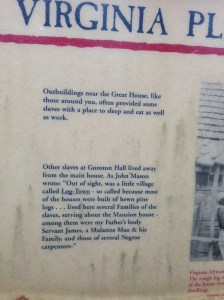
With so much good, deep, content on the website, I know Gunston Hall has the material a great tour and historic house museum is made of. I know, from reading the labels about slavery at the site and reading the text about slavery on the web, that they know more, do more, and understand more about the enslaved people than their permanent exhibitions indicate.
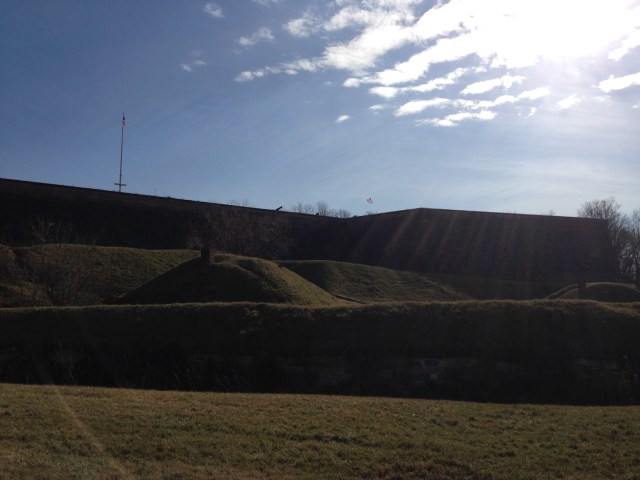
Like an energetic Golden Retriever, I need to be walked daily, almost without regard to weather, and I have a fondness for water that I fear makes me a questionable house guest-cum-nurse. Fortunately for me, Drunk Tailor has a granular knowledge of his surroundings that allows him to recalibrate his understanding of the places he likes to suit my needs: hence a Sunday trip to Fort Washington, Maryland. Plenty of room to wander, a wide* meandering river, defensive weapons installations.
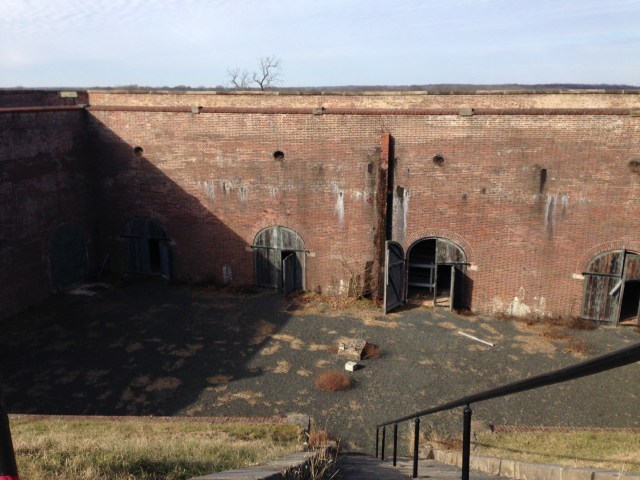
It’s a large site and we only explored the main fort structure, the shore by the lighthouse, and the visitors’ center (I’ve seen plenty of Endicott batteries before, both on the Potomac and on Narragansett Bay). It started out well enough: the curious tripping stick figure sign warned us of the wooden bridge into the fort, and reminded me of a friend with a fondness for fonts and curious graphic design.
Guardhouse, batteries, masonry walls, stables, earthworks, former ditches, the remains of powder houses: all good stuff. The signs were what one comes to expect from the NPS: UV-damaged labels, slightly behind the times graphically, indicative of the slow pace and underfunding of the preservation of our national heritage.
Drunk Tailor’s memories of Fort Washington include a first-person living history event set on the (literal) eve of the Civil War, with men portraying member of a Texas-based unit wondering how they would ever get home, and responding to a woman’s inquiries about General Lee and Grant with the suggestion that reading Harper’s would bring her up to date with current events. Now, we are in January and my expectations are low in the cultural heritage off-season: this is the time for maintenance, upgrades, rest and refurbishment.
All the pew. Plus some spinning.
What I did not expect– though I should have– was the leftover daily event roster from some time in 2016.
Boom! Goes the cannon, et cetera. Because Boom! is easy. Add in a side of spinning and we are good to go, right? We got something for the ladies. (You know where this is going, right?)
The best thing I can say for Fort Washington is that I was spared endless racks of brown sticks displayed with only the barest of identifying labels and no interpretation**. But here we are at a site with over 200 years of history and just the vaguest hints in the visitor center of decades of use and change over time. And I like military history. I like weapons. But the more I visit the more I marvel at the way we underestimate our visitors’ capacity for understanding and interest in the past.
Bigger Booms
As we drove away from Fort Washington, I began to think that once again, we are asking the wrong questions. Instead of questions that can be answered, “Guns Got Bigger,” why not ask some of the following:
What was daily life like for the men stationed here?
What material differences did officers and enlisted men experience?
Could enlisted men get married? Where were their wives?
How much did soldiers get paid?
What was the typical term of enlistment? Did that change over time?
Where were the stables? What were the horses used for?
How was the fort supplied? Where were the kitchens?
Where were the mess halls? What was a typical diet?
How did rations differ for men and officers?
Did any of the British officers or enlisted men remember the area around Washington, D.C. from their service in the Revolutionary War? To what degree might that have influenced the way the War of 1812 was fought?
What about that court martial, Captain Dyson? How was it run? What testimony did Dyson give?
Perhaps the most salient question to ask, on the Monday of inauguration week, is why do we care so little for our shared past that we accept the level of funding and staffing that gives us this level of interpretation? Don’t we, as a people, and our history, matter more than this?
*For the East Coast. The Potomac ain’t no Mississippi.
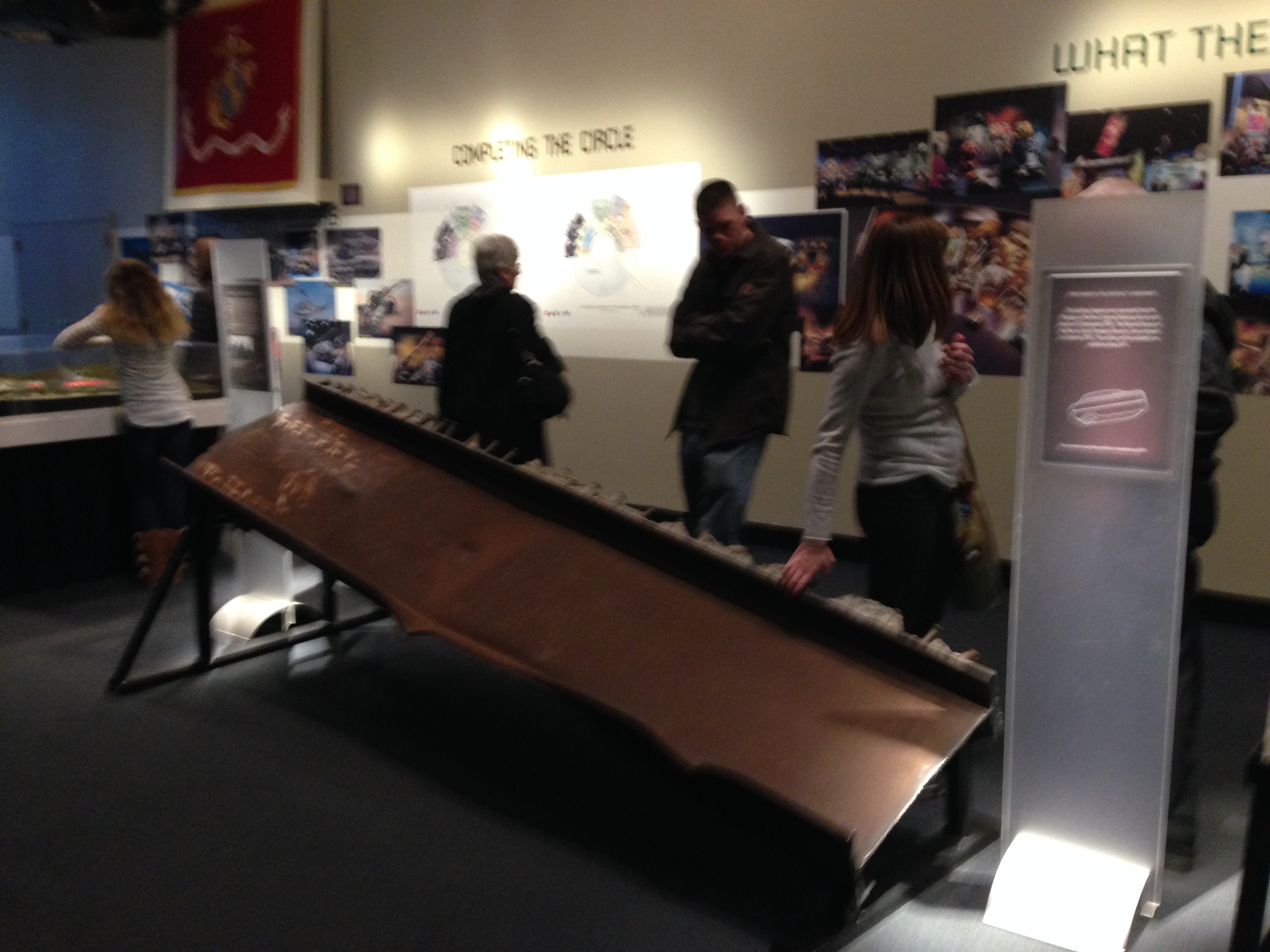
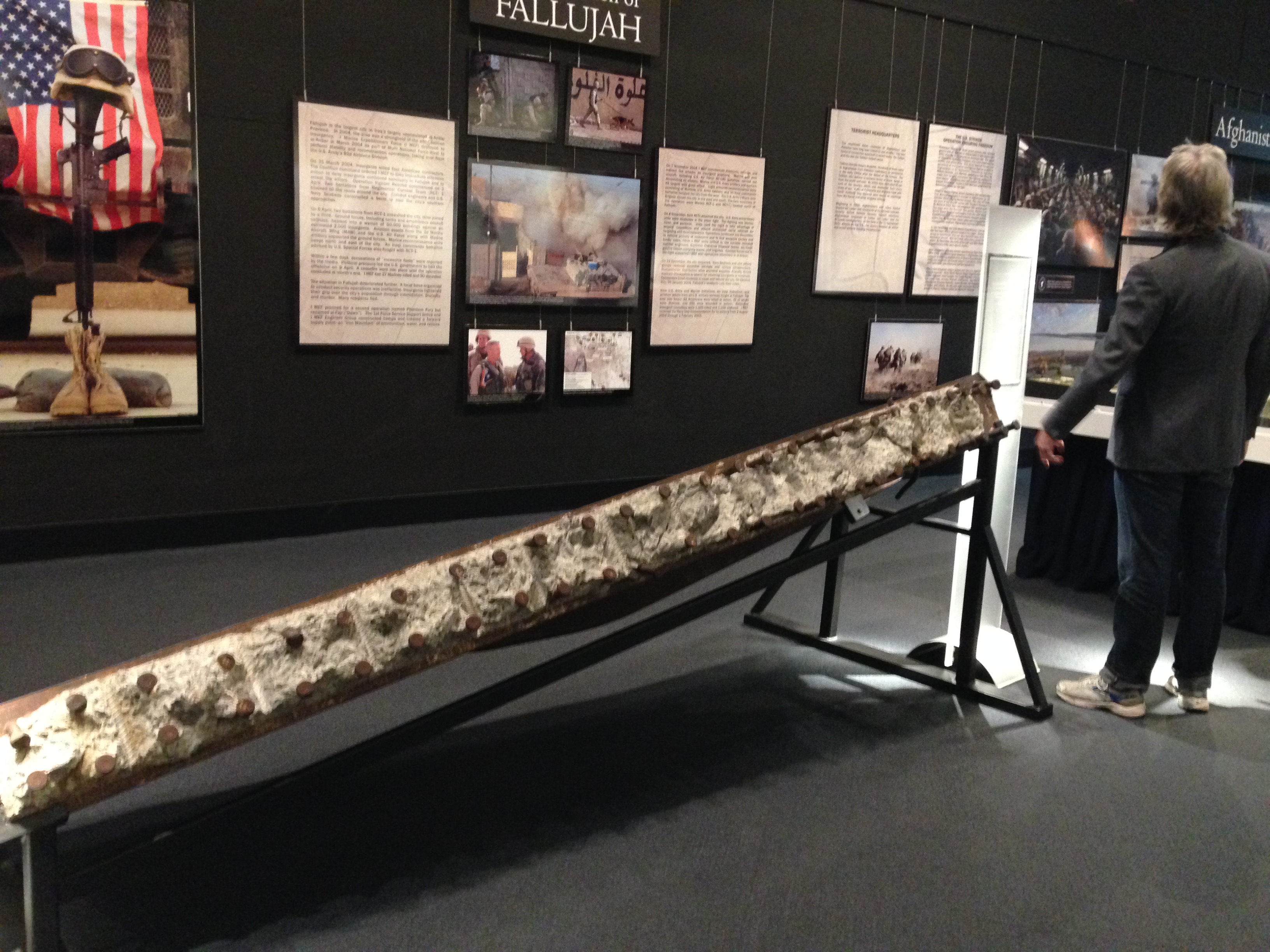
Do you know what this is? Do you think it’s real? Here’s a clue: it’s a relic of an iconic event in early 21st-century North America.
On the last visit to the National Marine Corps Museum, I watched the tourists circle objects at the end of the traditional galleries and displays, and overheard a woman ask her companions:
What’s this a replica of?
Reader, I cringed– and not for the sentence construction.
What’s this a replica of?
And then I stepped back. I thought that for someone my age it would be obvious. Here, have some additional museum context.
In a museum where everything is real, how does a visitor come to ask not only if that World Trade Center steel beam is a replica, but what is it replicating? I’m not sure semiotics can save us here. My first, New York Times-reading, media-soaked, Northeast Corridor response was, How can you miss that? How can you not recognize that, let alone mistake the steel and concrete relic for a replica?
Ah, hubris. There is a label, though I have seen better. Would it be more helpful in a larger font, turned perpendicularly to the I-beam? Possibly. But the lesson that’s deeper than label formatting and placement is recognizing how much we take for granted. Our visitors, even those we assume to be educated consumers of media and information, may not share our knowledge base. They may not read objects or images as readily as we think they do; we certainly cannot assume they’re all taking away the same information– and that has nothing to do with education or background.
Everyone truly sees the world differently. How, and what, we choose to put on a label should always be grounded in remembering that we do not all share the same information. Context is critical, and probably would have made these relics more real, and less replica.










 Kirsten Hammerstrom
You must be logged in to post a comment.