Safe as Houses

Collections staff climb wobbly ladders all too often

Someone brought up the Plimoth Plantation workers concerns for safety, and how those outweighed the low wages in their drive to unionize. Uneven streets, low staffing levels and safety requirements placed on them– watching open fires– meant that they were unable to leave the houses even for “nature breaks.” These are all legitimate concerns and the expectation that workers will tolerate unforgiving, dangerous, or humiliating conditions because “it’s all for a good cause” is ridiculous (and, apparently, a darned good way to inspire a union).

The union effort I was part of was not driven solely by low wages. There were other factors, including an executive director with a large but fragile ego, who was inclined to operate rather whimsically. When the drive failed, the need for union was by no means diminished, especially given the retaliations that followed, including the case of a woman who went on maternity leave, only to find on her return that her job had not been saved for her, despite the museum’s need to comply with the FMLA and assurances made before she went on maternity leave.

Bad management makes it hard to get out of bed.

Do not think that cannot happen today, because changes to the terms of employment happen all the time in museums, even when the leave alternate work schedules have been negotiated and put in writing. Museums and their directors are, in general, no more benevolent than any other employer.

But safety seems basic, right? Well….would you like to be the sole person working in a 16,000SF historic house? Granted, no open fires, but you are still expected to answer the door and you will find that people will force their way into the house, even when you tell them the museum is closed. Lucky for you, none of them were threatening.

Some are more equal than others

Except of course the one who was. When the concerns were brought to the executive director, there was a surprising lack of support– It’s one incident. He’s crazy, so what? You’re overreacting. That’s the best neighborhood in [small town redacted]. House staff asked for mirrors at the door and minimum staffing levels of two. Someone suggested maybe Boy Scouts would be good to have come in on the weekend afternoons when the staff person is alone– Boy Scouts need service hours for college applications, after all. In less than a year, the house manager resigned. The exterior lights around the house were not fixed or replaced, and it was pitch dark and empty on the walk to the parking lot. Only when the executive director’s husband said, “Gosh, the parking lot seems kinda rapey when so it’s so dark” did the parking lot lights get replaced– but only the lot, because she used it to park in when she went out to dinner with board members.

The same employer expected staff to come to work even when the water had been shut off at the site all day for repair work; fortunately, they could be convinced to close sites to the public on those occasions. I have worked in modern museum and research facilities without heat, light, or water because no quarter was given, and no exceptions were made for you to work at a different, functioning site.

Toodles might as well have been on security

For years, I was the on-call person for all alarms at the collections facilities. This meant that in the middle of the night, I had to go to the sites if the alarms were tripped. I had to go in alone, and was expected to sweep the facility and site for intruders. Eventually, I talked the police into a policy of staying with me until the sweep was complete, but I can assure you that a 16,000SF facility is creepy AF at 3:00 in the morning when the security alarm has gone off and you don’t know if someone has broken in or not.

Employers send very clear signals about how much they value employees and they punish employees in ways both small and large. Punishing an entire division, and putting the director put on six months probation because the director and division staff tried to follow the employee handbook and procedures to deal with a new hire who turned out to be incompetent and unwilling to work? Not great. The new hire was transferred to another division where the same behaviour played out, and caused great frustration to her new supervisor and colleagues. Eventually, she quit when it became clear that she was going to be let go and could no longer manipulate the system. For a division director to be told, in a meeting with the executive director, that “This isn’t your fault, and this isn’t about you– you’re here because of what other people did,” is not reassuring in the least. Punishing people for trying to follow the rules when the HR staff won’t will not generate good morale, or retention.
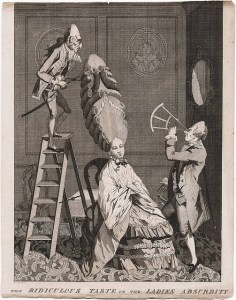
Because I said so, that’s why

Employee leaves are another serious pressure point in museums. Often no one extra is hired and no tasks are reduced, but are instead spread across a variety of people. Sadly, when someone like a registrar takes an extended leave, and the museum refuses to reduce collecting or loans, someone has to process all the paperwork. Asking people who are already doing two jobs to take on a third is not uncommon. Directors reveal a great deal about themselves in the response they have when they’re approached with a request to reduce some of the workload because the person covering is burning out. Dismissing the request with “It’s just a few more weeks,” 10 weeks into a 16 week leave with major program planning starting on top of all the other tasks is not helpful, supportive, or collaborative.

Directors who say, “I’m the director, I always win,” when direct reports disagree with them, may find their direct reports seeking work elsewhere. I’ve heard directors complain about having to “seek consensus,” and chafe at having to convince boards to support changes to staff structure. Directors who chastise front line staff in front of the public and shake their fingers in the staff member’s face– and then turn out to be wrong about what they’re upset about, but refuse to apologize– are not as uncommon as you might hope.

Safety. Consistency. Respect. That’s all employees want, no matter where they work. They want policies that are applied equitably, and workplaces that do not place them in danger either by condition of the site or the attitude of the management. When any employer fails to provide those conditions, the result will be low morale and high turnover. The cost of those is significant, both in declining visitor experience and increased training.

Objectivity

Recently I’ve had more than my share of time to think about museums and objects, and what they mean to me and why I love them, and have dedicated my life to them, albeit a bit accidentally.

Transferware in open storage, Metropolitan Museum of Art, May 2013.

In the hours I spent alone in a curatorial office, listening to the murmur of school tours on the other side of the door, I began to see that curation and registration are means of managing the evidence locker of the future. We collect, tag, and maintain the means by which the future will understand the past, and it’s our job to be a neutral as we can—to refrain from laying the thumb of our prejudices on the scale—as we collect objects, images, and documents. It’s a game of forecasting, trying to guess what will best explain us and our time to the future, as well as Monday morning quarterbacking as we both weed and augment what was collected in the past to better reflect how we understand history now.

I was always a stickler for good data and record editing (and have raccoon-eyed photos of a catalog launch to prove it), and I make unkind sport of museum databases on a regular basis when I see misidentified and misdated objects. Good data matters—it’s everything, really—because if you don’t know what you have, and where it is, you might as well not have it. But more than that, compendia of data can show you things you didn’t expect to find.

RIFA Record 4925

Yale’s Rhode Island Furniture Archive is a good example of how a massive amount of data can be used. Take this record of side chair possibly made by John Carlile and Sons, and scroll down. That’s a lot of associated chairs. And they all look very similar. Examining the materials, especially secondary woods, of a labeled chair and comparing the style, make, and materials with other very similar chairs can help identify chairs, associate them with a maker, and provide a sense of Carlile’s production volume.

And Carlile’s easy! Looking at hundreds of pieces of furniture with some location provenance, reading probate inventories and other documents helped untangle James Halyburton or “Ally Burton” as a maker.


James Halyburton in the RIFA

When you can see enough things at once, you can discern patterns and better understand exactly what it is you’re seeing. Good data makes that possible, makes concrete what was once solely seen as connoisseurship, and helps bring unknown stories, unrecognized people, to light. Data analysis is a powerful tool for better understanding the past: that’s why museum collections matter, and why I think it’s so important for museums to make their data accessible. It’s one of the ways we understand our collective past.

Milliner’s Shop Redux: A big, visual project

The complete ensemble, under supervision.

When I first moved to Providence, I lived in Fox Point, a slightly fringy-dingy neighborhood of Portuguese and Cape Verdean immigrants and their descendants that was cheap enough for students (and even today remains imperfectly gentrified: Providence, I love you dearly). As my then-boyfriend and I walked my dog, we passed a man whom I later came to know as the Block Captain, who remarked to my boyfriend, “Beeg wooman.” Any project I take on is, therefore, big, since I am nearly six feet tall.

Although I have schemes for a Big New Century Project (a complete 1585 ensemble), I’ll take a shortcut instead to my current enthusiasm and write about last weekend and the 1811 fashion plate reconstruction, which happily includes one of my favorite visual sources, early 19th century fashion plates — thanks to Scene in the Past’s albums and Ackemann’s Repository on the Internet Archive.

I’ve written about the canezou plate before, but not since I (mostly) completed it on the trip up to Salem. This 1811 plate appealed to me first because of the bonnet (checks!) and the necklace (lapis!), but then realized that the canezou and its petticoat were within my ability to complete.

The ensemble also seemed suitable for a summer day in Salem, which, while usually more humid than hot, calls for cool, lightweight, clothing that can withstand a potentially sweat-drenched day without melting.

From start to finish was three weeks: canezou, bodiced petticoat, necklace, bonnet, and shoe trims, all a vernacular rendition of a high-fashion image, adapted to the materials at hand– though I did have to order bonnet taffeta from India, which arrived just in time– much faster than I could have expected in 1811 Salem!

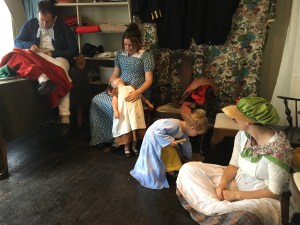
Setting up the shop for the fourth time was as much fun as the first time, and a little easier, given the practice I’ve had. I shared the shop with a tailor, Mr. B, of hat-making renown which made for a nice contrast interpreting men’s and women’s fashions and purchasing habits.

Packing up hat stands, bonnets, accessories, and furniture and driving them 470 miles is a kind of madness, but interpreting women in business and early shopping is one of my favorite historical enterprises.

I Fall to Pieces: Extant Garment Fragments

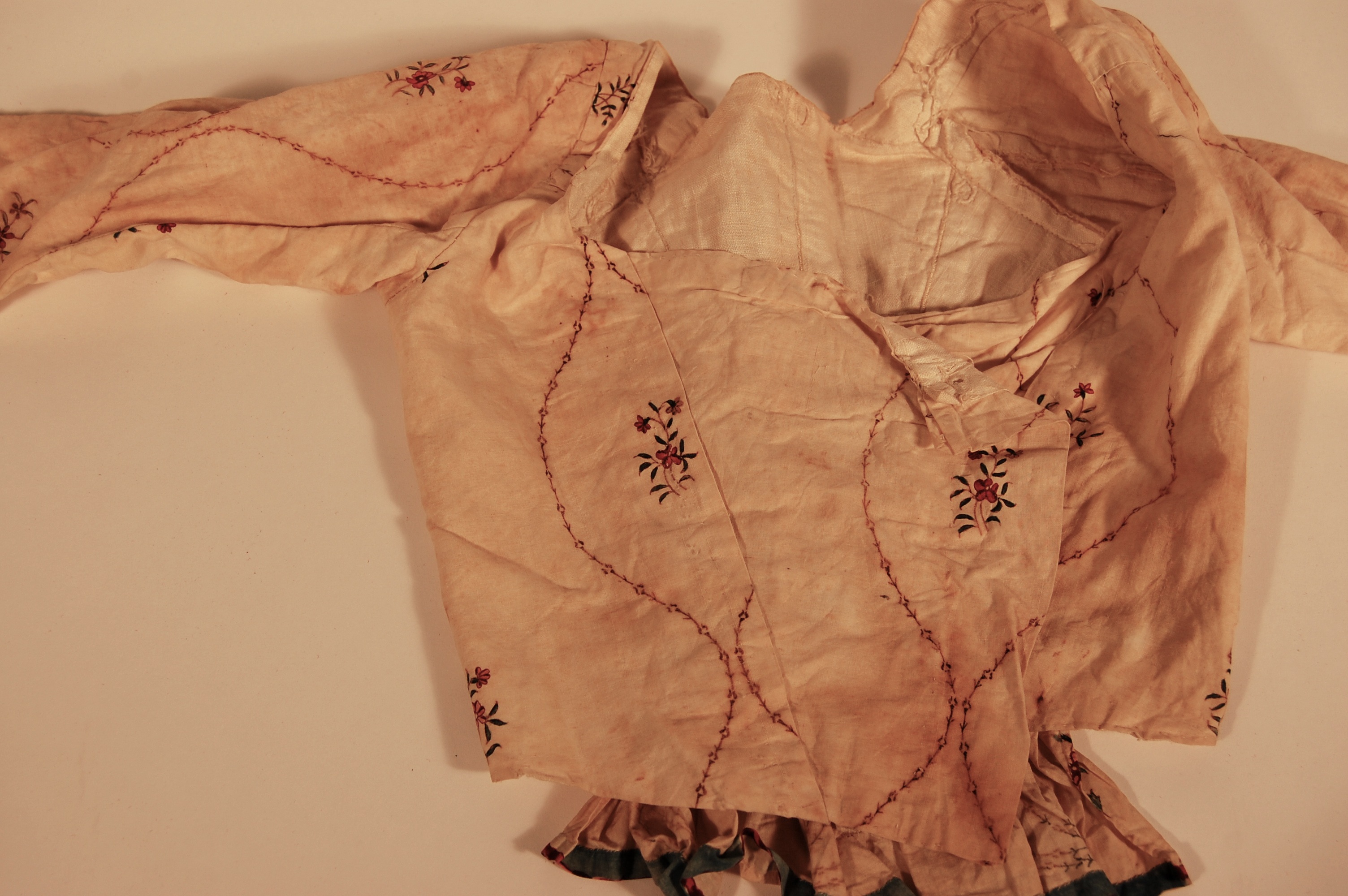
Bodice, painted Indian cotton, 1780-1795 RIHS 1990.36.27
Bodice, painted Indian cotton, 1780-1795
RIHS 1990.36.27

Once upon a time, not very long ago, when I worked in a historic house museum, I was asked to present at a conference in Worcester. I chose to talk about these fragments, and I still like to think about them. The delicate fabric was saved as a pair of sleeves, a bodice with a tiny peplum, a skirt.

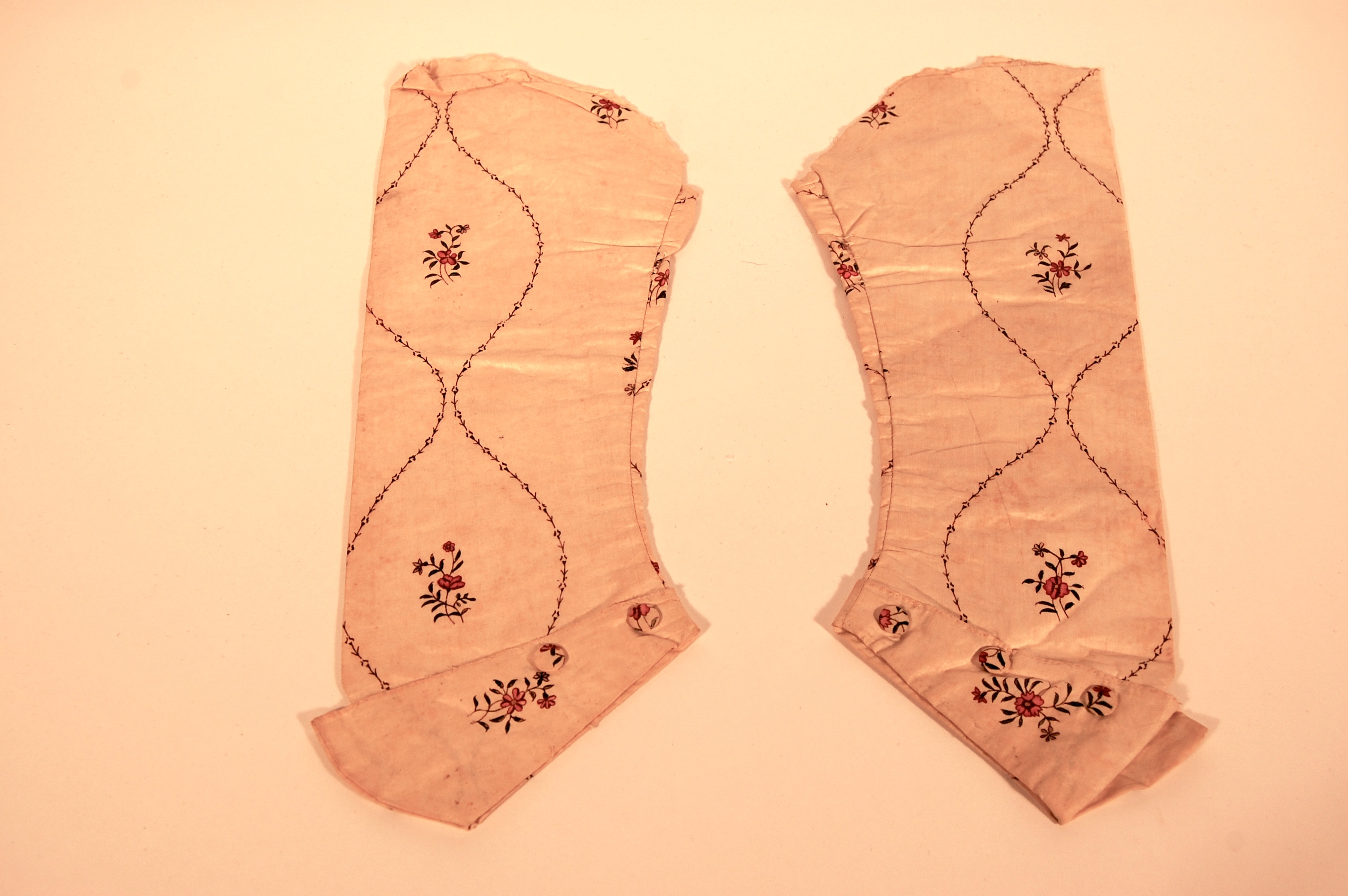
Sleeves, removed from bodice 1990.36.27. RIHS 1990.36.25A-B
Sleeves, removed from bodice 1990.36.27.
RIHS 1990.36.25A-B

The pieces appear to have been part of a pieced-back closed-front gown with a matching petticoat circa 1785. I think someone decided (quite rightly) that the style was too passé for 1795, and altered the gown significantly.

Not only is there evidence of new sleeves being fitted into the gown’s armscyes, we have the sleeves-that-used-to-be. And my dear! No one is wearing sleeves like that this season!

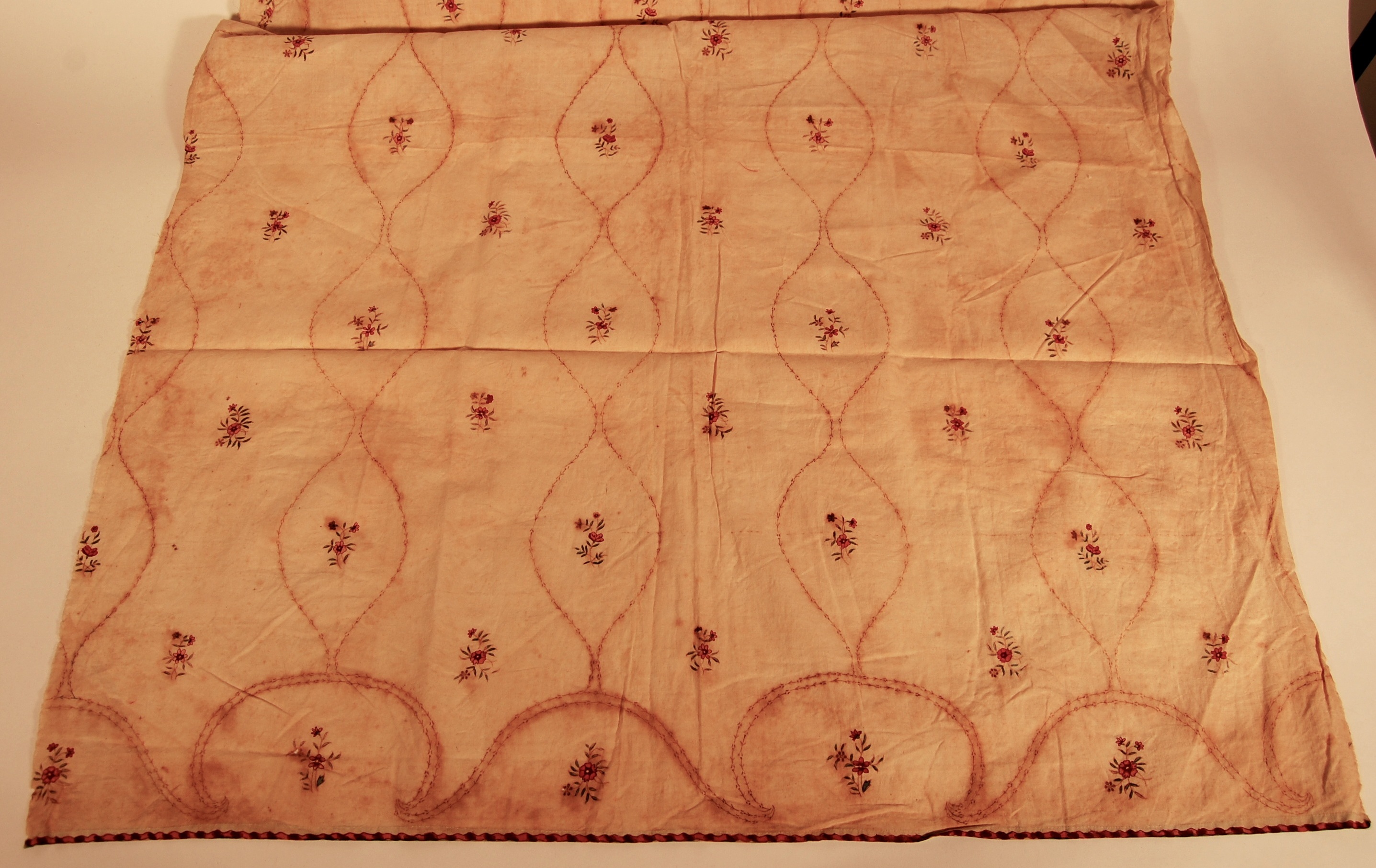
I find these garments in limbo really fascinating. Was that bodice finished and worn with a matching petticoat? (Yes, there’s a panel of that left, too; what a lovely hem!)

Skirt panel, painted Indian cotton. RIHS 1990.36.33
Skirt panel, painted Indian cotton.
RIHS 1990.36.33

Who wore the gown? Was it Sally Brown, born in 1773? And did she alter it, or did her sister’s mantua maker, Nancy Smith? We can only guess at this point, as so many documents remain in private hands. The alterations are not as finely done as the original gown, so I think there are two hands at work here– whose were those hands? There’s always more to think about and learn.

In case you’re wondering, thanks to the Met, we can see what the gown probably looked like in its first incarnation, and then what the alterations were meant to achieve. (Link to the gown on the left; link to the gown on the right.)