Mary Adams

Mary Adams, 1754, YCBA

Meet Mary Adams, painted in 1754. She looks to be a certain age, does she not? But she’s still rocking some style. I like black, and wore black clothes almost exclusively for years from high school on, despite the relentless taunts of  feral sixth-grade boys. (My nickname was Boots. Costuming and living history is but another episode of dressing funny…)

But I digress.

Mary was a happy find this morning, because I knew I’d seen this little detail somewhere…and here it is:
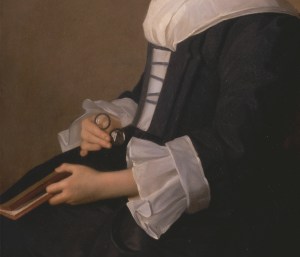
Detail, Mary Adams, 1754,B1981.25.513, YCBA

Did you catch that? It looks remarkably like Mary has laced her gown over her kerchief, and not over a stomacher. I’m doing a little dance, thankyouverymuch, because that is how I roll. Or lace, as the case may be. Look, too, at the top of the lacing: her gown is pulling. Yes. Imperfections, how I adore thee.

Snark aside, it’s a kind of relief. Looking at Copley and Feke and all their sleek silken women is like flipping through Vogue in the doctor’s office waiting room: after a while, I start to feel woefully inadequate in all ways. From the Richard III gown’s wiggly seams to my inability to pin my dresses straight, and heck, the generally asymmetrical rumpled-ness of my presentations… you can get to feeling very low, as Thompson and Thomson observe in Prisoners of the Sun.
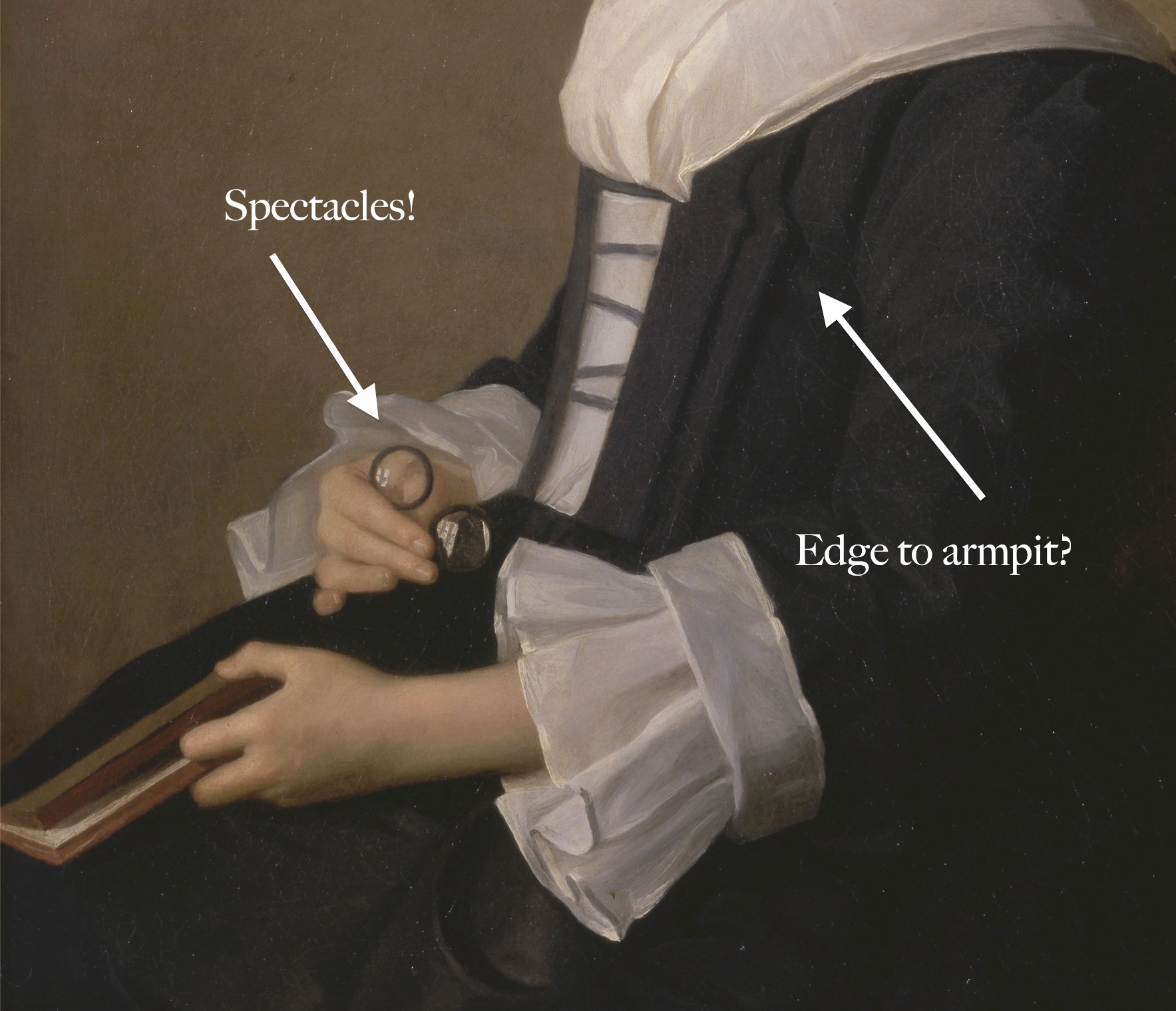
Details!
Details!

So among the things  I note in the painting is the depth of the pull at the top of the gown.  Hmm. I feel better about how my flesh and gown relate in the armpit area now.

But if the pull line starts over beyond the robings, that helps a costumer figure out where to put the lace holes and how to arrange the gown. I also like the asymmetry of blue lace zig-zagging down the kerchief. When I work that out on Richard III, and alter my red calico gown, I’ll use Mary’s portrait as a reference.

Finally, and perhaps best, of all, Mary can read. And she need spectacles. That wonderful pair in her hand look like they are cousins of this pair. All in all, a happy find this morning.

More on Pockets

If you think you don’t like military history, think again. A friend of mine is working on a French and Indian War 250th Anniversary project in Boston, and in the course of his research he got interested in a red velvet grenadier’s cap that I happen to be adjacent to from time to time.

UBM 2006-08-53
UBM 2006-08-53

One thing led to another, fortunately for him and not me, and he ended up calling on the National Army Museum in London. There a curator after my own heart distracted him with one of the coolest things I have ever seen: A Lady’s Pocket made from the decorative panel of a mitre cap, or as they call it, Mitre Pocket.

Here’s their description:

“Front section of a mitre cap made into a ladies pocket, 1760 (c); wool and cotton; on front the emblems for the 70th Regiment of Foot, all sewn as for the period, 1760 (c); back is made of brown cloth; front is bound with red cloth binding.

Note: Hanoverian white horse and ‘Nec Aspera Terrent’ used by 8th (The King’s) Regiment of Foot, later King’s (Liverpool Regiment), which might make the L an initial not a numeral and the XX a company number rather than part of the regimental numeral.”

Grenadier’s cap, 1833.1.1, RIHS

One of the most charming things about the email is that the woman at the NAM sent my friend an image of a gown and pocket, just so he’d be clear about how it would have been worn. He knew anyway, but I thought that was a very nice thing to do.

The cap we’re looking into is this one, said to have been picked up at Bunker Hill. Not for nothin’ (as the locals say), but this cap would make a lovely pocket.

Working the Curtains

Like most people, I have good days and bad days at work. Unlike most people, I sometimes get to use my hobby at work.

MuseumStaff

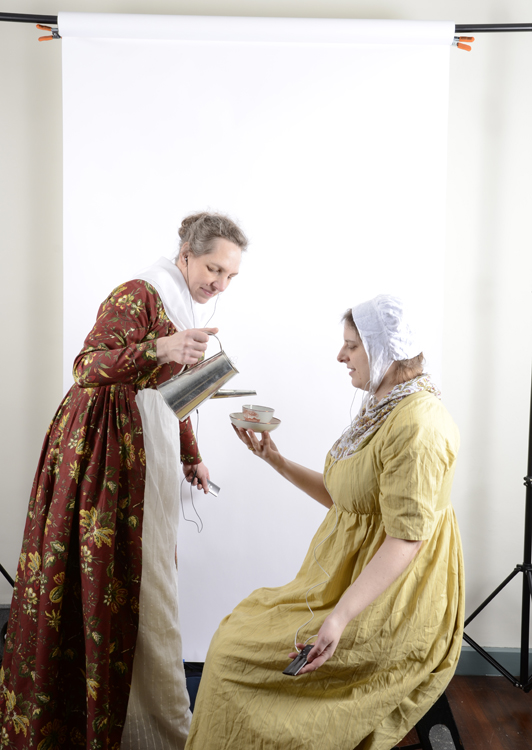
We have a new audio tour at the museum, and one of my colleagues is working on the rack card for the tour. He got an idea that needed people in costume, and lucky for him, my friend and I have wardrobes handy. He dressed, too–those deerskin breeches are really fantastic–and another colleague took the photos.

Taking tea, with a coffee pot.
Taking tea, with a coffee pot. It won’t matter on the card!

This was the first outing for the Curtain-A-Long dress, and its friend IKEA Curtain petticoat. I like it, though I have petticoat issues. Every time I wear any dress, I find some new thing to tweak. Fortunately, the problems are pretty simple to solve and involve channels for petticoat waist ties.

It was a fun morning, playing in the house, and only makes me want to do more living history tours and costumed interpretation. (Apologies to my Library compatriots for being late getting back!)

CityShower
I do love this one,and the original print, too.

When I wear the Curtain Gown, I think of the Sandby drawing of Sarah Hough, and I think of well-turned out housemaids. It would be a great deal of fun to develop more behind-the-scenes tours. After attending the first-person interpretation workshop, I had hoped to work on more tour ideas. Not yet, but I’ll get there someday this year!

We probably won’t actually spray filthy water on those lovely breeches, though. It would be a shame, and I know who made them!

Sweet Danish!

That dress!

You know the fabulous 1797 wedding gown from the Danish Museum? It turns up on blogs as the Tidens Toj gown. Many of the links to the pattern and the gown are broken now, but fear not, it only moved. Wouldn’t know anything about museum website links changing…

You may know this already, but it’s here now. The National Museum of Denmark has a nice set of Pinterest boards,  which is how I found the dress. The PDF is still available from the catalog record, and has a link here.

English Dress, 1780

The Fashion History- Future Clothing exhibit is still up, and many of the garments have PDF patterns. There is a pretty post-RevWar era “English Dress,” which also has a pattern. The translation that Google provides is a trifle (no, actually, quite) hilarious. Don’t trust it…you’ll end up with sweaters and wrinkles instead of Brunswicks and pleats.