Busy!

[French Barracks] T. Rowlandson, 1786, Drawings R79 no. 13, Lewis Walpole Library
This is a busy week chez Calash, so here’s an image by Rowlandson, as described by the Lewis Walpole Library:

A view of the interior of busy French barracks shows a more domestic atmosphere than military although weapons and other gear adorn the walls and lay scattered on the floor.

And now you know what can feel like trying to get an exhibit mounted, though at least the cats are only at home and the children are in school.

Fog on the Hudson

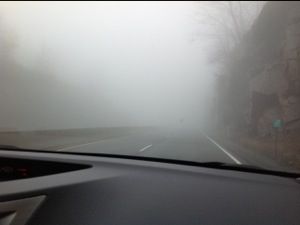
20130421-072045.jpg Up on the Hudson, it gets foggy. We drove through fog, which was probably a cloud, and remarked on how very different from home it is here. And once again, I demonstrated an inability to navigate through anything but a conventional New England rotary: I have over-adapted.

We went to the West Point Museum (far too warm, folks; artifacts and visitors alike will cook at 72+ F) and enjoyed the artifacts and dioramas. It’s a classical museum, chronological and linear as you would expect it to be. I don’t object to this format at all: it supports limited labeling, which I consider a blessing, really, and allows the objects to speak for themselves and leaves room for the visitor to wonder, find a label, and read more. I did take photographs, but forgot the adapter for downloading the camera.

From there we visited Fort Montgomery, which may well be the site of future shivering.
Here, I did not take photos, especially after I was warned off touching the glass by the curator or site superintendent (honest, I didn’t leave a smudge).

The last stop on Friday was at Boscobel, which I knew of from a book at work. The house is as lovely as you would expect from a place furnished by the former curator of American Decorative Arts at the Met, and funded by Lila Wallace’s fortune. It’s a guided house tour, with an audio tour for the grounds. We lasted through the guided tour (there were only the three of us) and a portion of the grounds.

I’m really glad I lifted the no photography rule at work. Boscobel has some lovely objects. I was interested in several for which there are no catalog images online, no postcards, and no images in their books. I couldn’t capture the sense of place in the house, or the room the way I saw it, and I find that archaic and frustrating.

The tour itself was everything you’d expect a tour given by retired women of means to be: genteel, focused on furniture, and docile. To their credit, they do a good job with photographs to explain how the commodes work, and by the second floor our guide had loosened up a little bit in her blue blazer. But there was little about the family and their lives, nothing about the servants, and some basic misapprehensions about how a house of that size worked. (The cast iron cylinder in a water or tea urn was never heated in the parlor fire, and never by the mistress; sparks! fire! mess on mahogany! Nope, it all happened in the kitchen.)

In the end, Boscobel was lovely and I am envious of the decor and some of the objects and details, but as the tour guide noted, I most liked the “imperfect rooms” (the pantry, the kitchen, the bathing area and the servant’s bedroom).

Huzzah for imperfections! Time to dress for the last day of the common, imperfect soldier before we tear off for home.

King of the Coats

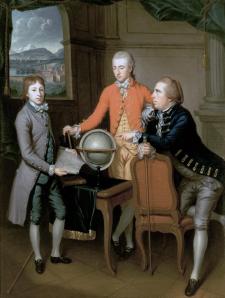
Douglas, 8th Duke of Hamilton on his Grand Tour, © National Museums Scotland A.1991.156

He’s hard to miss, the 8th Duke of Hamilton, in his red coat. I’d hazard it wool, because of the contrast with the sheen of the blue coat his physician, Dr John Moore (at right), is wearing. Dr Moore’s coat gleams like silk; the Duke’s looks dull and woolen. (Look at the way the light strikes the Dr’s shoulder; another clue is the way the button holes are worked.)

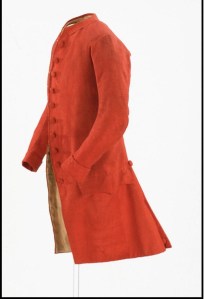
The coat below is a simpler, provincial relative of the Duke’s coat. This is the Amos King coat, owned by Colonial Williamsburg. I love the description:

“Wool plain weave fulled and napped “broadcloth”; twill worsted “shalloon” lining; tabby linen lining center back. Pocket flap lined with twill worsted; sleeves lined with tabby linen; right lower pocket is linen; left pocket is leather; inside pocket on left breast is linen, with broadcloth welt.”

Man's Coat, red broadcloth ca. 1770, CW 1953-59
Man’s Coat, red broadcloth
ca. 1770, CW 1953-59

Shalloon. Tabby. Pocket leather. That paragraph is comprised of many of my favorite fabric and clothing words. And fabrics. And a leather pocket. As you may recall, I have a thing for fabric that is not at all about hoarding, and but rather about establishing reserves. When I see two yards of quality material at discount and purchase it, that yardage becomes part of the Strategic Fabric Reserve so vital to this nation’s safety. (We are all unsafe when a fabric addict is deprived of his or her fix. I’ve got a threaded needle, and I’m not afraid to use it!)

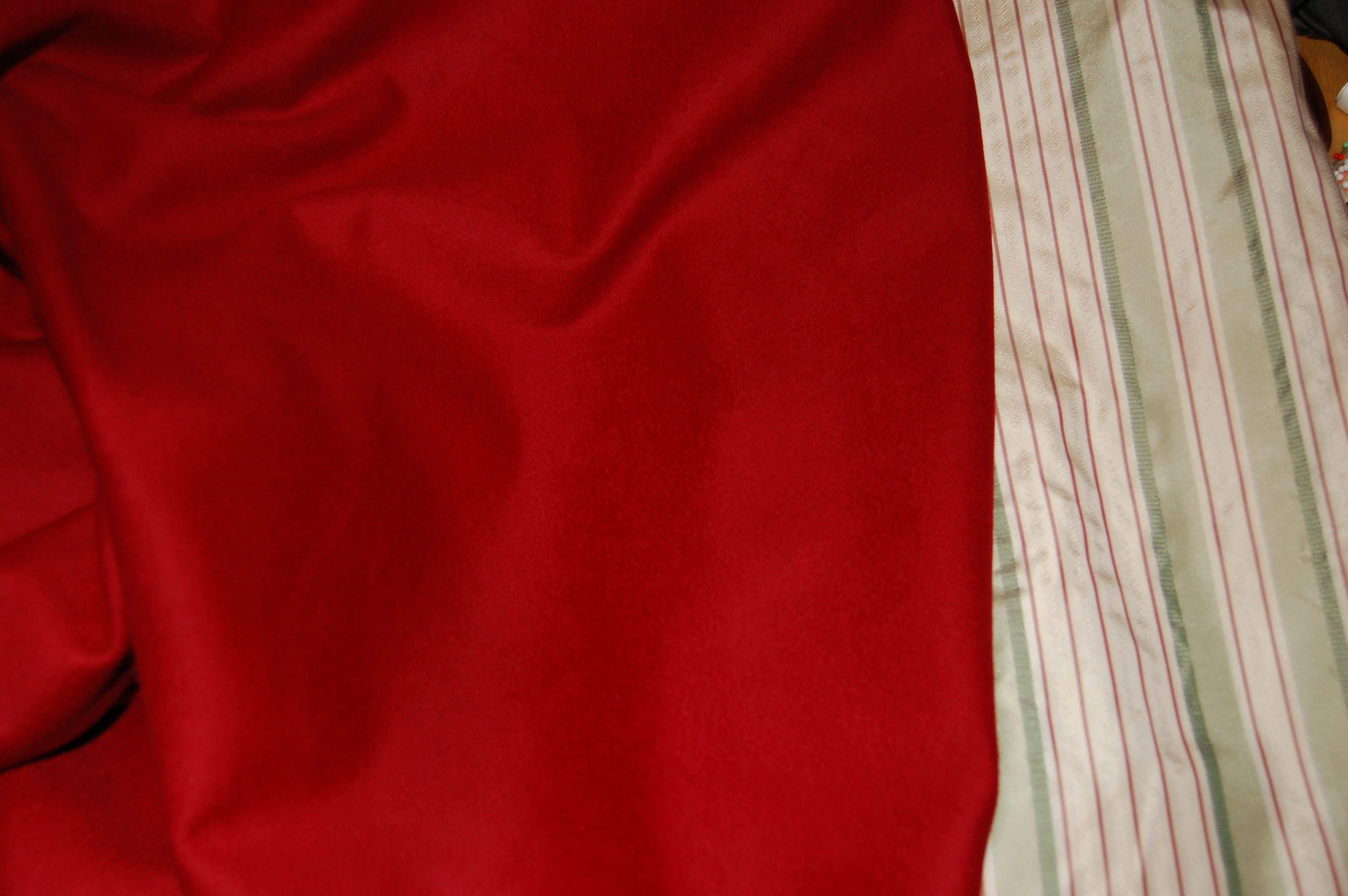
Part of this household's Strategic Fabric Reserve.
Part of this household’s Strategic Fabric Reserve.

Yardage arrived in the patriotic red, white and blue “if it fits, it ships” box on Wednesday, and when opened, we all proceeded to pet the lovely nap of the wool. Mr S wrapped himself in it, and I knew then that I would be making a red broadcloth coat of one kind or another.

It probably won’t be the “Quemans Pattern” coat John Buss mentions, not when I’ve got silk fabric for a waistcoat. The silk is from the remnant table at Artee Fabrics in Pawtucket. With careful cutting and a plain back for at least one waistcoat, there should be just enough to make both a 1770s and a 1790s waistcoat. We’ll get fancy around here eventually.

Over(h)alls, Trousers, & Breeches, oh, my!

Trousers, ca 1793. MMA,1988.342.3

Gentleman can agree to disagree on the attributed date of this garment, just as gentlemen might agree to differ on whether to call these trousers or overalls. It’s all in the crotch length, friends, and we’ll just back away.

But before I return a book of letters to the lender, I wanted to record some of the details that struck me.

Right from the start, the John Buss Letters, edited by Ed Nash, are filled with details. I got excited because, in a slightly random and not at all fabric-hoarding way, I purchased a remnant of grey striped woolen goods from Wm Booth, with the intention of making a jacket or trousers from the fabric.

This notion was rejected by my resident tenant farmer, who has particular ideas about his appearance and the quality of goods which should encase his limbs. Rebuffed from my historic fashion fantasy, I turned for solace to the John Buss letters, determined to make it all up by learning the history of the tenant farmer’s new regiment.

And lo, on page 9, in the very second letter, John writes home to his parents in Leominster, MA on October 1, 1776, saying that “my trowis has got very thin, I should be very glad if mother would make me a pare of striped wooling trowis as son as you can…” My tenant farmer was not impressed by my excitement.

Yes, all my fantasies are documented. But look: John Buss’s trousers are thin, not his breeches. And he’s clear about the difference between trousers, overhalls and breeches. In a February 22, 1778 letter from Valley Forge, Buss tells how he drawd from stores in Bennington “one frock, one Jacket, one Pare overhalls, one of stockings, one Pare of shoes and one shirt. Albany, October 25th., 1777, I drawd a  Red Jacket Quemans Pattern. November 5th., I drawd a pare of Braches and a pare of fresh shoes that was not worth tow shillings.”

Later, Buss requests lining (linen) to make breeches, as he is hot. So he draws clear distinctions between these garment forms. This is a costumer’s dream, really, and for me–oh, those striped wooling trowis! Now I have to make them. Look out, Young Mr…they’re headed your way. And lucky me, I have documentation for that red broadcloth remnant I bought in a random and utterly non-fabric-hoarding way.