[Another] Wild & Crazy Idea

Fashions, 1841. Fashion Plate Collection, Ella Strong Denison Library, Claremont College

Perhaps the Young Mr is correct: I may be crazy.

I have agreed to, at the very least, explore a project and grant funding to recreate an April 17 1841 Suffrage Parade for my workplace. We still have to decide to what lengths we’ll go, but the idea is so appealing that I want to give it a shot. (Orator positions opening soon?)
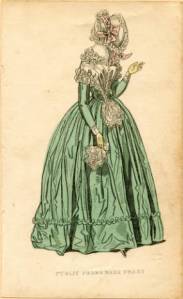
Public promenade dress, 1842. Claremont College
Public promenade dress, 1842. Fashion Plate Collection, Ella Strong Denison Library, Claremont College

Why is this crazy? Another year-specific event, with the event part to organize, plus wardrobe for at least some people? Pure madness, utter delight. Blame it on the Godey’s Lady’s Magazine paper dolls I bought at the Chicago Historical Society all those years ago. It could even mean another corset, and we all know how much I love making corsets. But I was thinking about how at my age in 1841 I’d be accustomed to an earlier style…but the key, as always, is looking. And looking tells me I need more of a waist than I can perhaps achieve with the stays I have in hand.

To my Pinterest board (thanks for so many wonderful leads, Cassidy) mix of extant garments and accessories, I’ve been pinning from fashion plate collections, including the well-cataloged collection at Claremont College Library.

Fashion plates are one of the sources you have to be careful with. Like Vogue, in fact exactly like Vogue, these are high-style images that are as mannered in their rendering as fashion images are today. Waists will be slimmer and skirts rounder, but the silhouette and shapes will be recognizable in extant garments, painted portraits, and thankfully, photography.
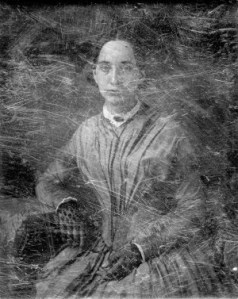
Mrs. Thomas Easterly. Daguerreotype by Thomas M. Easterly. Missouri Historical Society, PHO:17434

The year of the Suffrage March, 1841, is early for photography but not impossible (thank you, M. Daguerre). It’s not the right state, but there is a fantastic collection of images in Missouri. These portraits give a good sense of what people were actually wearing, and what shape their bodies took inside their stays and corsets. (Hot tip: don’t clear daguerreotypes with Scotch-brite pads.)

This is, really, a mad scheme that goes far beyond dress. But a banner painted with an ox and the slogan “I die for Liberty” carried by butchers? A wagonload of disenfranchised Revolutionary War veterans? Enlisting students (not in costume) to follow along behind costumed interpreters marching the known route of the 1841 parade? It’s too tempting not to try.
Bonus: Patterns and plaid!

D-Day: Robert Capa

Robert Capa, American, b. Budapest 1913 - d. Indochina 1954
Robert Capa, American, b. Budapest 1913 – d. Indochina 1954 © International Center of Photography

Once upon a time in the Midwest, I worked in a Department of Photographs and Prints. (That’s where I met Mr S, when he was hired as the first museum Photographer, though he was initially known as the Badger in the Basement for the tenacity with which he defended his studio.)

I am fortunate to have a visual memory, and that’s part of how I got my job, and part of how I got to be an Assistant, and then a full, Photo Editor of the museum’s magazine. I love images, and I love photography, and I suppose I must love photographers, too, since there’s one around here somewhere in this place that I call home.

FRANCE. Normandy. June 6th, 1944. Landing of the American troops on Omaha Beach. Robert Capa, International Center of Photography
FRANCE. Normandy. June 6th, 1944. Landing of the American troops on Omaha Beach. © Robert Capa © International Center of Photography

One of the best assignments was photo editing an article based on the World War II diary and service of a local doctor who served in the Army infantry. He wasn’t the most enlightened or unbiased man, but in the 1940s, I suppose that was sadly normal. I read the piece for placement and image ideas, not for tone or subtlety. North Africa, Monty, Casserine, Messina, Easy Red and Omaha: that’s what I underlined.

My go-to for WWII photography was Robert Capa first and last. There’s Blood and Champagne, but the book I read first was Slightly Out of Focus. It was written by Capa, just as he wrote Images of War. (I discovered these killing time on summer weekends in the air-conditioned fine art reading room of the downtown public library.) Capa did not love war, even as he thrived in the combat photography environment, and said, “If your photographs aren’t good enough, you’re not close enough.” But he also noted, like Cartier-Bresson, that you had to like people to take good photographs of them.

His images are dark: not just the imagery, but the prints themselves. A well-printed Capa has deep, rich, dark tones (D-Day images excepted, thanks to a horrendous processing error), and even decades later, a vintage Capa print has magic.

I called Magnum, back in the days when one called, described what I had seen, cited the books I’d read, listed what I wanted prints of to use in the magazine. I think I knew enough to get a little more: vintage prints of images I hadn’t seen. They arrived, sandwiched in cardboard, in a FedEx envelope.

TALY. Near Troina. August 4-5, 1943. Sicilian peasant telling an American officer which way the Germans had gone. Robert Capa, International Center of Photography
TALY. Near Troina. August 4-5, 1943. Sicilian peasant telling an American officer which way the Germans had gone. R © Robert Capa © International Center of Photography

There were photos like this one, and one of a soldier shaving, using his helmet as a basin. There were images I’d seen, and some I had not. They were dark, and sympathetic, and captured the war and humanity as no other images I’ve seen have ever done.

His portfolio was huge, and includes not just war photography, but fashion and film and humorous photos, too. Holding one of his prints–or at least a print made close to the time when he had shot the negative, and might have been alive–was as close as I was ever going to get to meeting Robert Capa. For all he lived through–escaping Fascism, documenting the Spanish Civil War, the Rape of Nanking, the Blitz, all of World War II– Robert Capa died after stepping on a land mine on the road to Thai Binh in what was then French Indochina.

INDOCHINA. May 25, 1954. Vietnamese troops advancing between Namdinh and Thaibinh. This is one of the last pictures taken by Robert Capa with his Nikon camera before he stepped on a landmine and died at 14.55. © Robert Capa © International Center of Photography

It seems so sad, and yet one has to remember that he died working, doing not just what he loved–taking photographs–but what he had to do. He didn’t love war, but he loved people. The beauty of the images he made almost undoes their purpose, in recording war’s horrors, but the real affection for people that comes through in those contrasty prints redeems the violence, I think, giving us sympathy for the people uprooted, displaced, used and abused by war, whether soldier or civilian. Through that love,Capa found courage and we can find truth. Keep looking: there is more to see.

Street

Street_featuredVideo art has often left me bored. It can be too schlocky, too stupid. Not that I don’t appreciate simple, silly work. The first piece of video art that made an impression on me was at the Museum of Contemporary Art in Chicago. It was  William Wegman’s  Heads With Tails, featuring the ultra-patient Man Ray. This simple video was an excellent introduction to conceptual for a 10-year-old. (I could not have been more than 10 or 12 to tolerate going to a museum with my mother…by 13 and 14 I was going on the bus by myself.)

Flipping a coin and turning a dog around, while hilarious, is not necessarily what everyone thinks of as art; for others, Nam June Paik is a more valid artist.

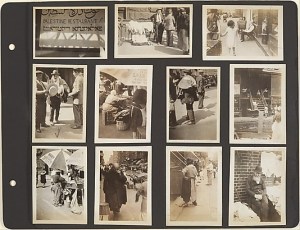
Album page, New York City. Bernice Abbott, 1929-30. MMA 1982.1180.106–.116

I give you James Nares, and his Street project at the Met (which closed 5/27/2013, sorry). There’s a short clip (2:17 out of 60 minutes) if you scroll down the page. This isn’t the section I stumbled upon, but it captures much of the essence of the piece. I think it was the best thing I saw all day, and even better, the video is bracketed by galleries of photos and objects selected by Nares from the Met’s permanent collection.

These are can be found online, though they are not divided or arranged the way they appear in the galleries. Still, you can see connections between the pieces.

For other interesting and rather less famous street still photographers, check out Vivian Maier, orJoe Sterling (who lived around the corner from us when I was growing up).

Please enable flash to view this media. Download the flash player.

Museum Madness and Things to Make

After a day at the Met on Friday, I went to work at my own museum on Monday. We moved paintings, rounded up miniatures for photography, and packed an ax for transport.

Glass at the Met. I hate this stuff.

On Tuesday, I took the MBTA up to Boston to deliver the ax (tomahawk, throwing ax, ax comma belt in Chenhall) to another museum, at the Old State House. I think this show will be very nice, and I had the pleasure of meeting someone whose wife I know through the interwebs: behold the power of the interwebs, and the small size of the reenacting community. Also, my state.)

Then, because I cannot get enough of this stuff, I took the Green line over to the MFA. By now you’re thinking, Kitty, really? How many museums do you need to visit in five days? Should we get you help? But the thing is, objects get me really stoked. Paintings, sculpture, heck, even glass– and I hate glass– make me pretty happy.

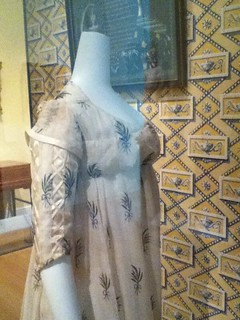
1998.96, overdress or tunic. MFA Boston

I’d just been to the MFA in July, so this trip was to visit some friends among the Copleys and Greenwoods and Blackburns. But I also know that the textiles have to rotate often, and there are dedicated mannequins in the Art of the Americas Wing.  My reward for a return trip? This lovely over dress or tunic.

I love the fabric, and thought immediately of Quinn’s Tree Gown. Hmm. As you can imagine, I will be hot on the trail of something like this fabric as soon as I am done with the menswear on my list. (There is a lot of menswear, but that doesn’t mean I can’t do some real thinking and research in preparation for this tunic…which is all I can do for now.)

It does cross over in the front, and the floral motifs line up across the layers.

There are more photos of the overdress in the MFA set on flickr, and I have a lot more thinking to do about this tunic. It does have a cross-over front, which I like, but the lacing is really striking. This may take another trip to the MFA with a better camera.

Oversleeves, cross front, lacing, diamond-shape piece in the back like a keystone…there’s a lot of detail, and lot to love (and eventually curse while making) in this tunic.