This is That

Mark Rothko: another suicidal abstract bad-boy painter from the middle of the last century, so what?
This is what: a day at the museum when then the last painting in the Napoleon exhibit is presented in such a way that it was, in effect, the same as the last painting I happened to see.

Rothko wasn’t one of my top-ten favorite artists, but he was the top of the list of color-field painters I liked when I was studying art. He’s the kind of artist who grows on you as you mature, the way eating habits change with experience. The article I’m reading now compares his work to Roman villa murals, and that makes sense when you encounter his work. It’s color and not color, depth and surface, immersive. Simply immersive. Rothko creates a world that exists within your own head; his paintings invite you into his mind, which then occupies yours. It’s not always comfortable, given Rothko’s own dark visions. It remarkably effective in its apparent simplicity, the colors hovering over one another, creating depth with saturated color.

The first Rothko I saw must have been in Chicago, though the first one I remember is Red, Orange, Orange on Red in St. Louis; I must have seen the Albright Knox’s not long after they acquired it– the red and black are more familiar and more comfortable, in a way, than the orange and red.

But this is a history blog, you say, a costume blog. Why are we talking about Rothko? We’re talking about Rothko because seeing a Rothko– standing in front of an actual Rothko, taking a breath and looking— is an experience. An emotional experience. Reader, I wept.*

Just as the projected waves washed the walls of the final gallery in the Napoleon exhibit, so too did the blues of this untitled painting move. They vibrated with emotion, and I was immersed in blue, a kind a symphony of color, as close as I will ever come to synesthesia.

And that’s what good exhibits do, what good history does, what accuracy does. It renders the past visible, tactile, sensible, immersive. It catches us, and we fall down. Art, history, culture: if we are sucked into that otherness, hooked by feeling, we are more likely to learn something.

As stood before the Rothko, I noticed a Cornell– and a teenager noticing the Cornell. Joseph Cornell’s boxes were my first obsession, when I skipped school to go to the Art Institute of Chicago to spend my day surrounded by Cornell’s tiny universes, transported to another place.
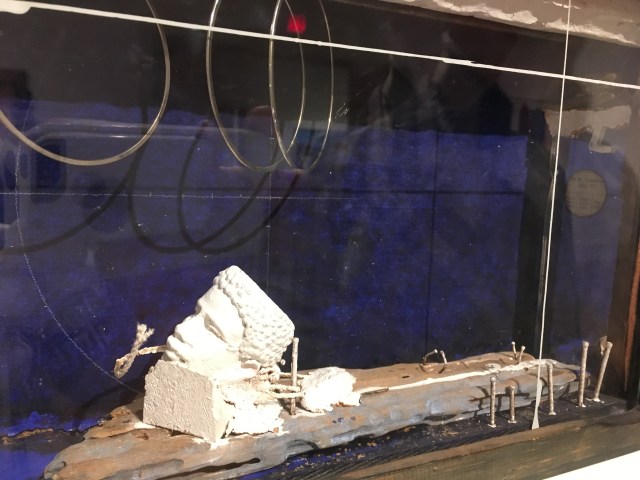
Untitled (Primary Title), painted and papered wood and glass box, with wood, plaster pipe, metal rings, nails, and string by Joseph Cornell, probably 1950s. Virginia Museum of Fine Arts, 96.41

Isn’t that what we’re trying to do, every time we dress in these funny clothes, visit historic sites, reenact the past? Aren’t we all seeking some sublime moment, when this solid present becomes the ether of the past? Sometimes the way to understand that most readily is to study something else entirely– like a Rothko. Or a Cornell. Sometimes the way into a thing is sideways, when understanding and inspiration come from an unfamiliar place, when me make connections we don’t expect.

L’Empereur Napoléon Ier sur son lit de mort, oil on panel by Denzil O. Ibbetson, 1821.

Death and Napoleon and Rothko and Cornell all seem obviously connected to me– and not just through the symbolism of the rich cobalt blues.

*I do this in museums: when I walked into the Kaufman Gallery at the NGA, tears welled in my eyes at the sight of so much beauty.

Tripping in Richmond

Visiting the Stately Home: an early touristic diversion

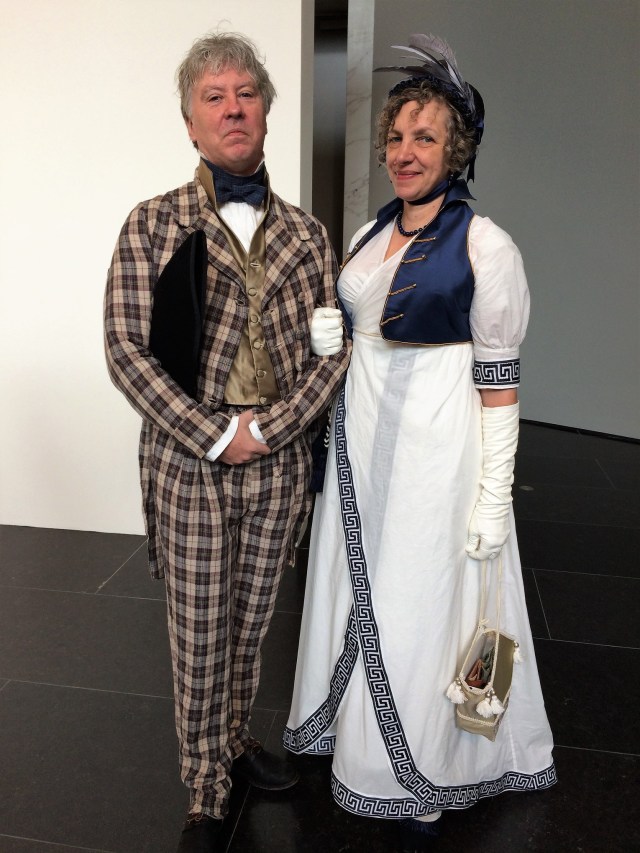
Friday night, Drunk Tailor and I waited until the worst of rush hour in NOVA was over and headed south to Richmond, surprised not to be engulfed in a terrific thunderstorm of the kind we are becoming accustomed to driving in. We had planned a weekend trip to see the Napoleon: Power and Splendor exhibition at the Virginia Museum of Fine Arts. It’s a traveling exhibit, but this is the first time I’ve been close enough to see it, and we had the added benefit of being able to attend in costume with the Regency Society of Virginia. (Reader: I required a new outfit.)

The idea of visiting a museum in costume is incredibly appealing, and all the more so when you can visit galleries of objects from the time period your costume replicates. Add to that the layer of traveling on the weekend in the clothes from the time when tourism first became a “thing” (at least among the monied classes), and you have a recipe for an excellent adventure.

(Somehow, while often at events together, Drunk Tailor and I are rarely seen “together,” so images like this are nice to have.)

If you are going to play the tourist, especially if you are visiting the “spoils” of the former emperor, you have to dress appropriately. American tourists today may travel in camo crocs and backwards baseball caps, but people in the past dressed for touring and it seemed appropriate to dress for this trip.

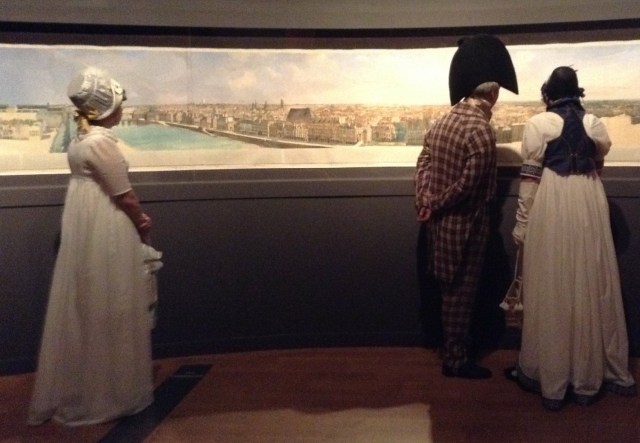
Admiring the panorama. (Cropped only to enhance periodicity)

This trip, with the fun of visiting in period clothes, reminds me of the books still in storage, and the books I have yet to read — one on early country house tourism— that document the changes in how people spent their time and consumed goods, and the reasonably concurrent rise of both the museum and the department store.

Raptures about the mounting, I think, but we might as well we shopping.

Peale and Zola have more in common than you might think, or at least Mr. Peale and Mr. Selfridge. These compendia of material goods are similarly structured — both organized around themes or types, whether ladies’ lingerie or Oceanic art– and have similar aims of edification and [cultural] consumption.

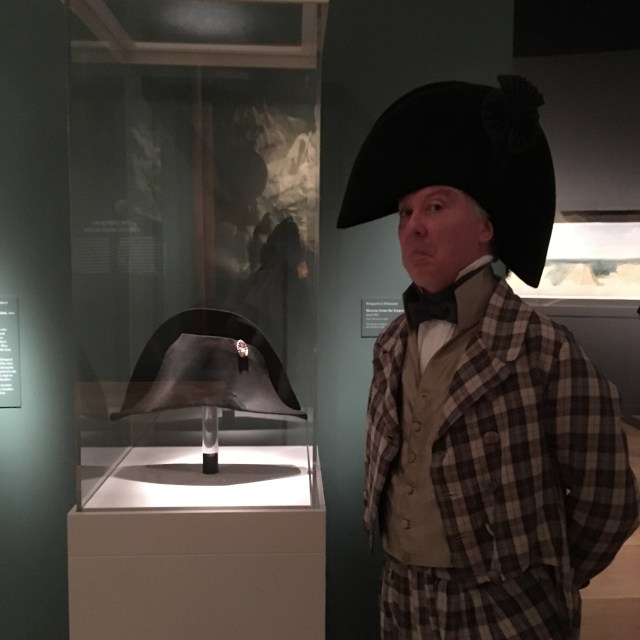
When your hat sees its cousin in a case….

All in all, an excellent trip, with much to see and talk about. After finishing our tour of the Napoleon exhibit, we lunched (another experience similar to the department store) and toured more of the museum, and had a day well spent.

Wrap it up, I’ll take it

To be honest, I would love to wrap my self up and take this silk, but it is for a museum to display, so instead the box is wrapped and ready to ship.

I was lucky to be included in a message group started by a friend asking if any of us had a banyan or wrapping gown to loan. Well, no… but I can make one!

So I did.

My version is based on this 1750-1760 example at the Victoria and Albert Museum, of silk designed by Anna Maria Garthwaite ca. 1740-1750. To be honest, this is one of my favorite gowns, despite the fact that it bears no practical relationship to any part of my daily or living history life. A girl can dream, though…

Just a little bit scary, despite being able to get more silk if I really messed up.

In particular, I like the way the style combines the t-shape of a basic banyan with the pleats used to shape European women’s gowns. Tricky, right?

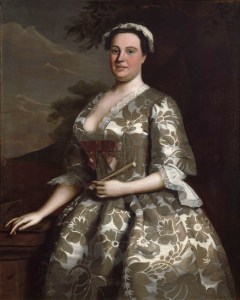
Ann Shippen Willing, oil on canvas by Robert Feke, 1746. Winterthur Museum Museum purchase with funds provided by Alfred E. Bissell in memory of Henry Francis du Pont. 1969.0134 A

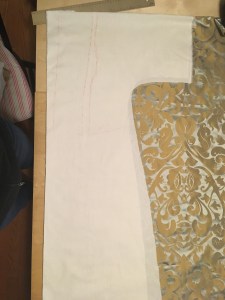
I made a pattern in muslin (it took two) primarily by draping, reading the V&A description, and looking at the original images as large as I could get them. By the time I had a pattern, I was mostly convinced, but still intimidated by the silk. I’ve had my eye on this ever since I saw at the local store, for it reminded me strongly of the Anna Maria Garthwaite silk worn by Ann Shippen Willing (Mrs. Charles Willing) of Philadelphia in this portrait by Robert Feke.

In the interest of economy, I machine sewed the long seams and the interior (lining) pleats, though I would not if I wear to make this for myself. Once the main seams were done, I pleated and pinned again.

Then it was time for my one of my favorite activities, hand-stitching pleats. It’s impressive how the look of a garment changes (and improves) as you continue to work on it. The fullness of the gown with the inserted pleats is pretty impressive and very satisfying to wear. It sounds fabulous as it moves with your body.

Once the gown is fully dressed on a mannequin (that is, over a shift and petticoat), I know it will assume the more correct shape of the green gown at the V&A– it looks better even on me, although it is too small, being made for a mannequin representing an 18th century woman.

Portrait of a Woman Artist, c. 1735
Oil on canvas
40 x 32 5/16 in. (101.7 x 82 cm)
Restricted gift of Mrs. Harold T. Martin in honor of Patrice Marandel, 1981.66
Art Institute of Chicago

Along the way, I found another green silk wrapping gown or banyan, this time worn by a French artist.I can guarantee you I would never wear silk to paint in, but your mileage may vary, and if I had a maidservant and unlimited cash in 1760, perhaps I would emulate the Mademoiselle at left.

Pulling Back the Curtain

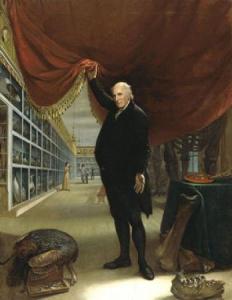
The Artist in His Museum by Charles Wilson Peale. 1822. Coutesy Pennsylvania Academy of Fine Arts.

I read this blog post hoping to find some insights that might help me as I figure out what comes next. I found myself irked instead.

Be Prepared to Struggle.

3. Be prepared to struggle.
The museum education field is not for the faint of heart, or people who want a 9-5 job. One of my mentors advised me that the days are long, but the years are short. The hours will hurt, you will get tired of the near-constant balancing act, and you might even question if you’re making an impact. Hang in there. Find your network (local, regional, or national). Share your vulnerabilities with people you trust. Delegate if you can. Most of all, document your successes and create a portfolio that illustrates why your efforts matter.

What is hidden between those lines? Be prepared for your life to be subservient to the needs of the museum? Be prepared to give everything– but document all you do because you’ll need to prove your value, no matter how much you sacrifice?

Saint Catherine, by Bernardino Luini. State Museum of Azerbaijan. (c) Stourhead; Supplied by The Public Catalogue Foundation. You will not achieve sainthood by sacrificing your sanity to a job.

Why would you put your work ahead of your life? (YES, I KNOW that’s not exactly what that post is suggesting, but that’s how it often ends up.) Encouraging people to work hard is good, but telling them they should expect to, and will, suffer isn’t good. That feeds the beast that chews up and spits out eager, idealistic young people on a routine basis. The museum is definitely not going to tell you it loves you, or visit you in the hospital. You need the time to build your own life, a circle of friends or family, interests of your own to feed your soul. And that means you will need boundaries, and need to have some “evenings, weekends, and holidays” when work is not required or expected– though I know that those hours are required and that people have to work them because they need the money.

Sculpture Hall, after 1913 installation of ceiling lights and before 1928 installation of fountain, c.1920. St. Louis Art Museum

Museum education staff are on the front lines– certainly more so than the curatorial, research, or exhibition design staff– and their work is immediately recognized and experienced by visitors. Museum education staff include a wide range of folks, depending on the organization. Costumed interpreters, gallery guides, program managers and assistants to develop and run fun but educational activities for all ages, curriculum developers who work with teachers to ensure that museu visits and activities for school groups meet the local or common core standards, and lots more. Sometimes the education staff are paid less than the curatorial and collections staff– and they’re pretty underpaid to begin with. Education staff are, to a larger degree than collections staff, expected to work evenings, weekends, and holidays, often without holiday differential pay, and receiving “comp” time instead of overtime.

Now, all that said, the blog post also contains these points

1. Gain skills outside of your intended field.  Learn how to budget. Like, really budget. What would you do with $2,000? How about $250,000? Know the numbers, and know how to speak business. If this isn’t your comfort zone, join the club. Take free online courses (edX is my go-to), and expand your skillset to include some productive surprises.

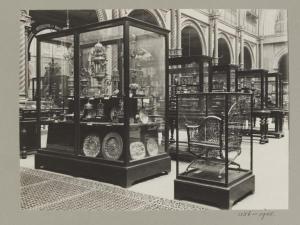
Victoria and Albert Museum, interior view (South Court), late 19th century (V&A PH.1156-1905)

Guess what? Budgeting IS part of your intended field. Sure, educational methods for reaching kids is directly related, but there is hardly a museum job in the world that doesn’t need to deal with money to some degree. The better you understand the way a budget works, the way grant budgets work and what you need to account for, the better you will understand the place you work and why things are the way they are. (Translation: the better you will understand how you are being rewarded– or not.


2. Work hard, be nice.  One of the best things to do when you’re starting out (or moving up) is to do excellent work and share it with your peers, supervisors, friends, and anyone who can provide constructive feedback. The museum world is a teeny-tiny place, so be nice to everyone you meet.

Be nice. As a woman, I often hate hearing that. I’d rephrase this one to “Do the best work you can without killing or compromising yourself, and be generous to the people who help you.” Develop the radar that lets you know when your colleague is using you– and someone will, trust me. Eventually someone will take credit for your work (ask me how I know), or betray a confidence, or a boss will keep moving the goalposts for a promotion, raise, or title change.

The North Court in the late 19th century. Museum no. E.1101-1989. © Victoria and Albert Museum, London

Museums aren’t easy to work in– there’s no field that’s always easy to work in– but we accept far too much because we love what we do. We are charmed, seduced, by the beauty of the objects, the mystery of the concepts, the scale of reach. But like a bad lover, museum administrators and boards can exploit our passion and use it against us. Don’t think they won’t.

If you don’t work in a museum, substitute your position title and/or field for the museum-specific words in this post. I believe everyone should be paid a fair wage, have decent working conditions, and the ability to have a robust and satisfying personal life as well as a job they find meaningful.