The Lewis Walpole Library provides endless amusement, and searching by subject yields some fun. People have had curious relationships with domestic pets for a centuries, and thank goodness cats invented the interwebs so we could get real perspective on this.
Quite aside from the minor domestic comedy of this engraving (I dislike the dark of winter and take my fun where I can), we can learn a lot. The domestic comedy itself helps remind us that while the people of the past saw the world differently, they were as foolish, bawdy and rude (or more so) than we are.
From a material culture perspective, we have (among many things):
a geometrically-patterned floor covering, probably a carpet but possibly painted.
floor-length curtains
looking glasses, paired
a slip-covered easy chair, matching the curtains and the cat’s cushion
two candles (only two!)
glasses with the characteristic straight temple pieces that end in loops
a colored open robe over a white muslin petticoat
a young gentleman in trousers, an old gentleman in breeches
I can imagine this depicting Emma and Mr Knightley (after their marriage) at home after dinner with her father and their young son: Mr Woodhouse in his nightcap and banyan, reading; Mr Knightley upset by the cat, while the Spaniel barks at the excitement. All in all, highly satisfying.
Lot 194, hammer price: $22,500. Estimate:$4,000-$5,000
On November 13, Augusta Auctions held a sale in New York that included some really wonderful things, and chances are good that if you read this blog, you know about some of the items, like the British consul’s coat, some very lovely leather trousers, and my personal favorite, the Rhode Island man’s day suit.
That suit! I’ve heard about that suit from a couple of people, but I’ve never seen it in person. I’ve made a jacket from a pattern taken from the coat, but until the photos turned up on the auction site, I didn’t know what the original looked like. It’s not flashy. You think, it’s a plain brown linen suit, no big deal, until you start to look at the simple, direct construction methods (which I have seen in other Rhode Island garments), and the rather elegant lines. This seems, from the distance at which I have to observe it, very like the boy’s jacket at Connecticut Historical Society. They share similar lines, are similar in color, and probably represent the most common everyday wear of the middling sorts of southeastern New England.
Historians and curators increasingly recognize the importance of the “common everyday” people and their material world, whether it’s Jill Lepore on Jane Franklin Mecom or whoever bought this suit. There are and were more of the 99% than the 1%, and to really understand the past, we have to collect what we can to document the daily lives of the majority of the people.
So of course I wanted this suit very badly. I looked up previous auction results, I poked around in other museum’s catalogs, and looked at our own collections. I prepared a case statement and took it to the Board committee that oversees Collections– when we spend large sums, we have to get approval. The Board committee authorized me to bid, but set a limit based on our acquisitions budget, which is funded from prior sales of duplicate or unrelated material in our collection. (Things like 20th century oriental rugs and mid-Atlantic corner cupboards– we can’t use them, they weren’t made or used in Rhode Island, but were acquired to furnish our house museum, until it was over-furnished. Then we went through a lengthy and formal deaccession process.)
Watching the online bidding, I could tell the sale was hot: there were folks with deep, deep pockets bidding, and I knew early on I would not get the suit. By the time it was all over, the hammer price was $22,500 (it’ll be $27,000 with the buyer’s premium) for a suit with a $4,000 – $5,000 estimate. I should say that it did rawther well, considering, but even in a different budget year, I would not in my wildest dreams have gone as high as the winning bidder did. Every result in this sale felt new, and dangerous, the way the Betty Ring sampler sale prices felt new and dangerous.
These prices feel dangerous because they skew the market and the past in a curious way: when the objects of the everyday become this valuable, this expensive, how can a museum with a mission to interpret the past of a specific people ever hope to compete? I can’t, not even with a concerted effort to develop a donor base that would support an acquisition at more than four times an estimate. What does that do to the market? It puts it squarely in the realm of the 1%.
That 1% is not just oil barons, it’s museums with enormous endowments and revenue streams, like the Met. I’ve posted before about the difference in museum revenue streams and endowments, and how a place like the Met can gross over a billion dollars in revenue in a fiscal year. With money like that, $22,500 is nothing. Museums like the Met and the MFA and the PEM and LACMA can out-bid smaller museums, vacuum up collections, and amass great hoards of material. What the little people have to do is to build relationships, and hope that they can get some of the material before it ever gets to auction. I didn’t have that chance, but it’s the only one I’ll ever have in what seems to be a new market for old things.
This sale also made me think that the museum world is increasingly a winner-take-all world much like politics or business, or even education. There are the haves, with large endowments and major gifts, attracting more gifts and endowments, and then there are the have-nots, with very limited funds and volunteer staffs. Those of us in the middle are feeling the same squeeze that the ever-smaller middle class is feeling, with similar income erosion as what our endowments earn buys us less, and as grant funds are ever harder to get. Programs are more competitive, and there’s less money for the big national endowments (NEA, NEH, IMLS) to give away.
Capitalism and market forces are at work, changing collections and changing how museums can and will operate. We have to radically and rapidly rethink how museums function both in acquiring collections (if we can continue to acquire them at all– there’s a cost not only to acquiring but to keeping) and in making them accessible. The smaller museums have to make better cases for mattering more to their audiences, or culture will be increasingly sequestered in larger, richer places.
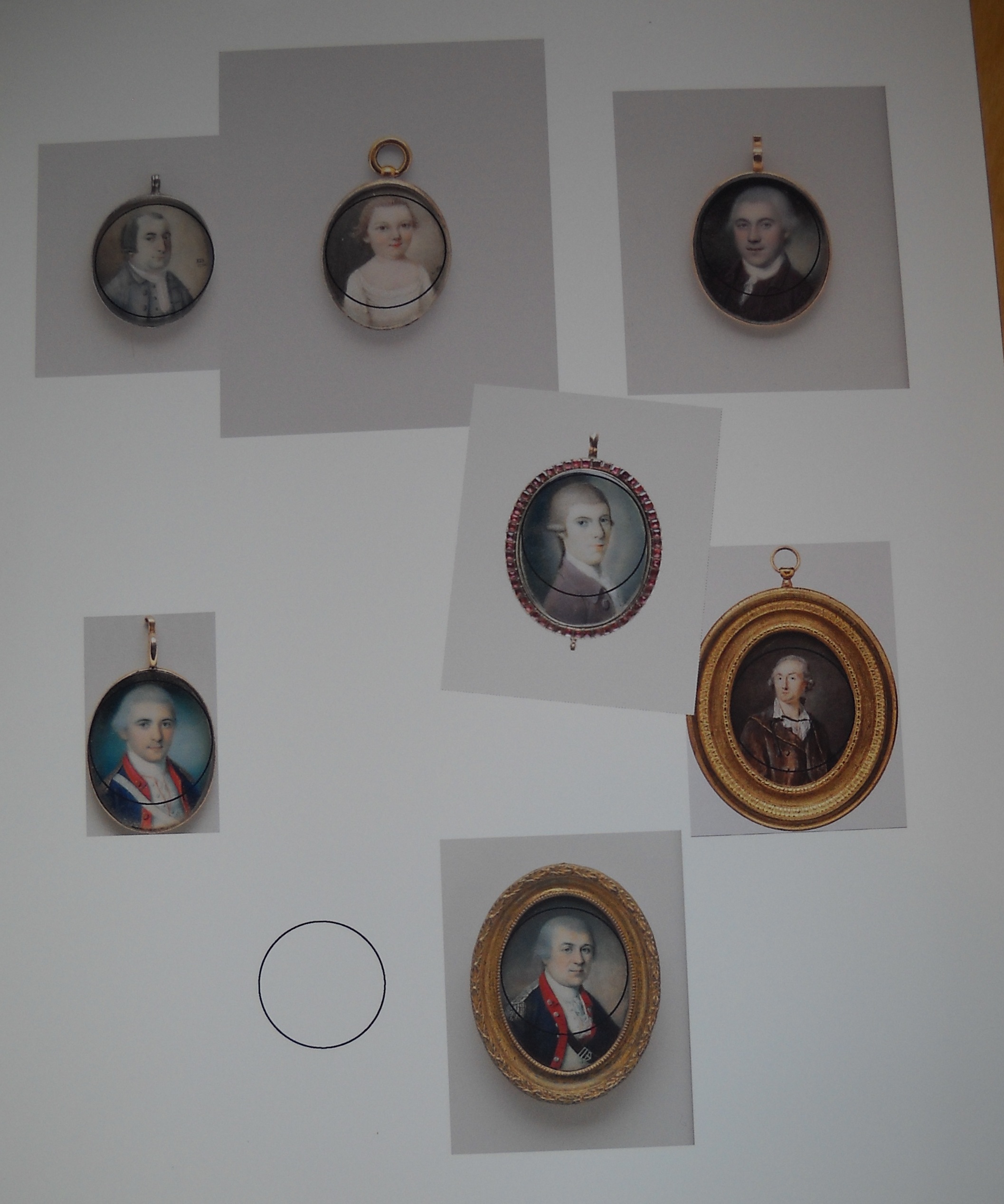
I admired the Pragmatic Costumer’s post on painting miniatures, but recognized that my desire for immediate gratification was going to run headlong into the small workspace formerly known as our dining room, where it would crash into my lack of practice at painting and result in unhappiness for all.
In recognition of my family’s right to peace in our time, I made like an ’80s artist and appropriated images.
Separated and ready for trimming
After selecting gentlemen and an infant from 1761-1776, I downloaded the files and placed them in Illustrator where I could size them to one inch diameter circles. Why so small? Because to test this plan, I used rawther cheap little cabochon kits from Michael’s, and they were only to be found in the one inch size.
After cutting the images out generally, I trimmed them to the black line I created in Illustrator. (I don’t yet have a non-Illustrator answer to this process; I am lucky enough to have an ancient copy of CS Dawn-of-Time; let me think about a workaround.)
Henry Knox, the first trial
Here’s Henry Knox, my first trial. I was willing to ‘sacrifice’ him because although I admire his fortitude in dragging artillery across Massachusetts, he was a beast to Joseph Plumb Martin about post-war bounty land in Maine. I’m Knox-conflicted.
Some squishing and fiddling with the self-adhesive fronts later, here are three of the four miniature miniatures.
Three sandwiched imagesFinished tiny miniatures
Yes, this is so ridiculously easy as to be evil.
What would I do differently next time?
I’d order proper cabochons and fronts in a larger size (I may convert these to bracelets).
I’d give painting a try, perhaps over the winter break at work. I’ll need time to get that right.
I’d string them on actual silk, and not polyester, ribbon. (It was handy, and the proper size).
But for a cheater’s way to miniature jewelry in under an hour, I suppose they could be worse.
Whatever you do, if you follow this example and “appropriate” images, don’t sell them. The Met may have millions in revenue, but it’s still wrong.
Jonkheer Gijsbert Carel Rutger Reinier van Brienen van Ramerus (1771-1821), met zijn vrouw en vier van hun kinderen, Adriaan de Lelie, 1804
Perhaps because I just finished Longbournand have just startedYear of Wonders, servants are on my mind.
In the family portrait at left, the servants are visible (just) to the right of the tree.
The man and woman almost literally mirror the main subjects, Carel Rutger Reinier van B can Ramerus and his wife, positioned as they are in opposite relationship to each other. The servants, too, are surrounded with life, carrying a child and dogs and game.
The woman is holding the infant of the van Ramerus couple, and even without Google Translate (that’s “four of their children”) we can figure this out. How? Because the child is held away from her body, and faces forward. It is a slightly odd arrangement, with the infant so peripheral to the main image, but we’re fortunate, because this composition allows us to see the servants.
Class distinctions are clear in the dress: the female servant wears a cap, kerchief and short gown, the male servant-gamekeeper, perhaps–wears breeches and a jacket from the pervious century, as well as a cocked, and not a tall, hat.
It does remind me strongly of the imperative to continue a family line, and the lot of women to breed and produce male heirs. For all that I love the past, I know I could not live there easily.

![Squatting plump on an unsuspected cat in your chair!! George Cruikshank [1800]. Lewis Walpole Library, Image ID lwlpr09721 Call Number 800.00.00.176+](https://kirstenhammerstrom.com/wp-content/uploads/2023/03/f0d89-lwlpr09721.jpg?w=640&h=444)



 Kirsten Hammerstrom
You must be logged in to post a comment.