It’s so nice to have enabling friends. If it’s not one tipping me off to a sale on fabric at Williamsburg (over now, keep calm) it’s another tipping me off to costume auctions.
My most recent tip-off came from Mr Cooke, about the Whitaker auction coming up April 25 and 26 in New Hope, PA. There are some very nice things from the collections of the Met and LACMA coming up in that sale. It’s hard to understand deaccessions from the outside, so I won’t comment on that part of the sales.
Whitaker’s got copyright notices on their images, so I won’t post them here, but I can assure you, the visit will be worth your while. But my tip to you is this: forget those estimates– from what I’ve seen lately, they’re all too low by a factor of 10.
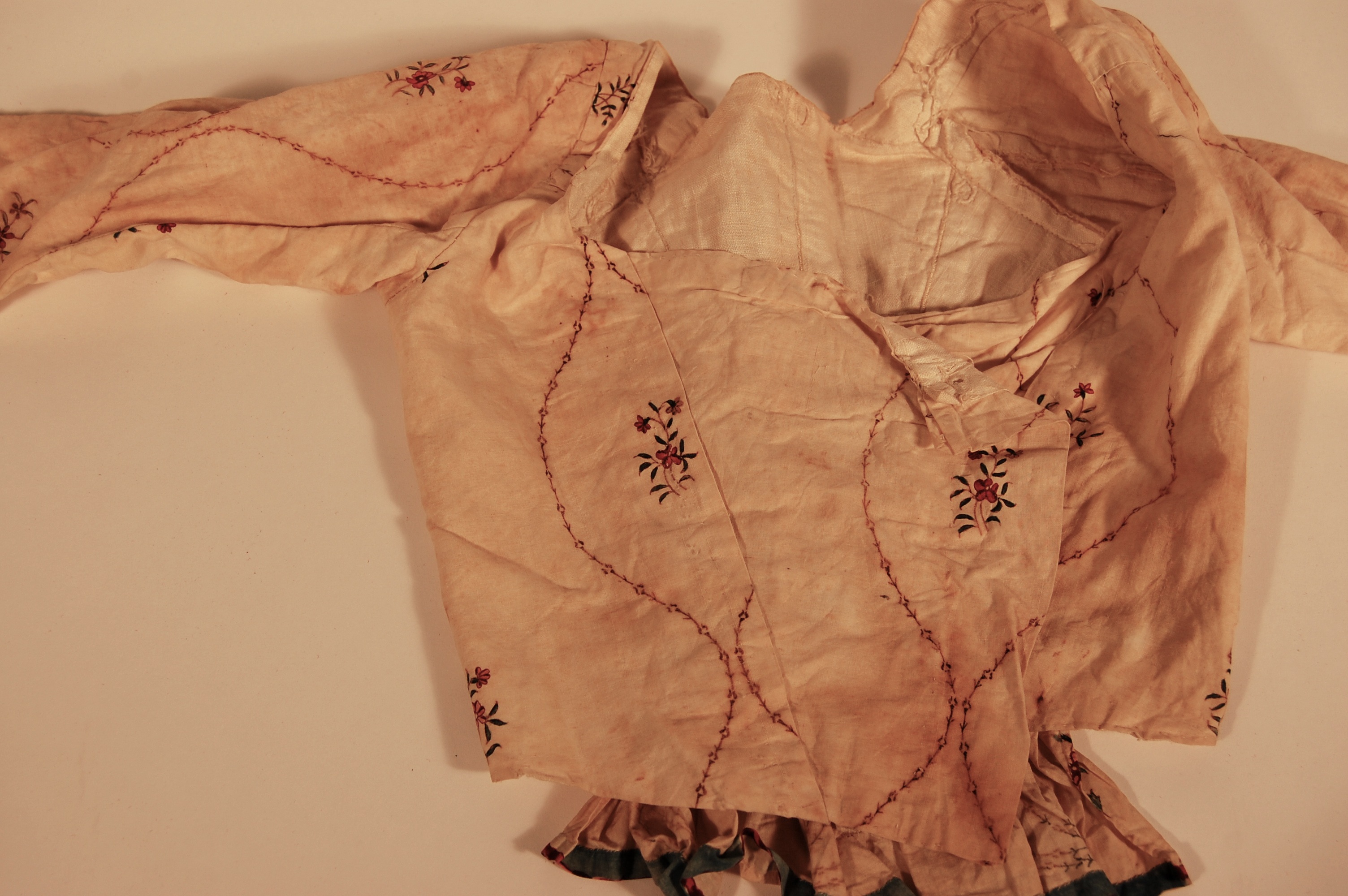
Bodice, painted Indian cotton, 1780-1795 RIHS 1990.36.27
I’ve fallen behind again, as I spent considerable early morning time this past week working on a short presentation for a program in Worcester this past weekend. If you are among the people who do not wake at 4:00 AM panicking about the organization of your thoughts, or whom, exactly, might have worn a heavily-remade bodice, you are lucky indeed.
But I managed to present without falling all over myself, putting out someone’s eye, or causing mayhem and self-embarassment, so, phew! (I do this so much less often than I used to that my anticipatory anxiety is always high.)
Above you can see one of the items I talked about: a re-worked bodice from the collection of the Rhode Island Historical Society.
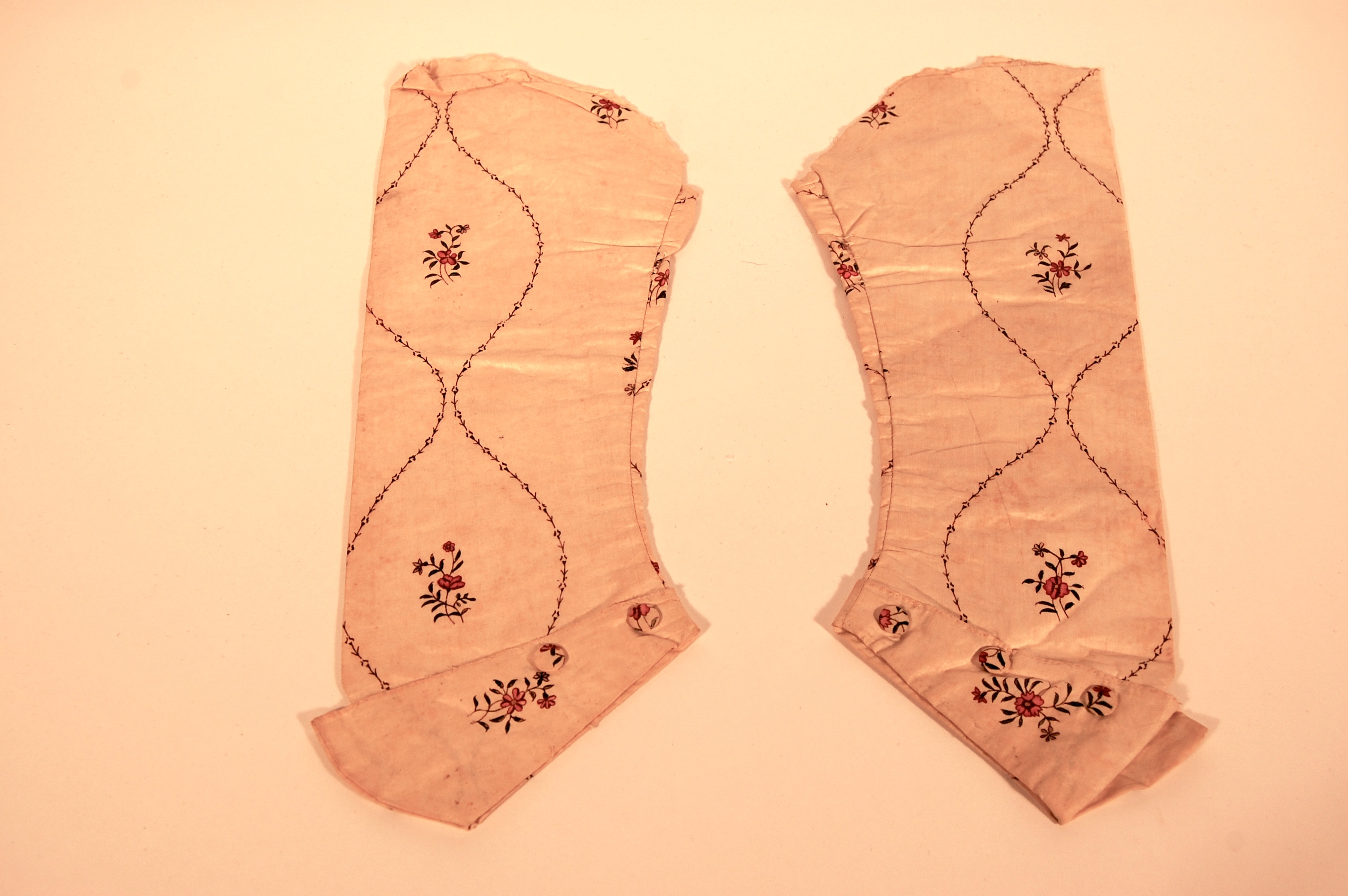
Sleeves, removed from bodice 1990.36.27. RIHS 1990.36.25A-B
I think, once upon a time, that bodice was part of a pieced-back closed-front gown with a matching petticoat.
And then I think someone decided (quite rightly) that the style was too passé for 1795, and altered the gown significantly.
Not only is there evidence of new sleeves being fitted into the gown’s armscyes, we have the sleeves-that-used-to-be. And my dear! No one is wearing sleeves like that this season!
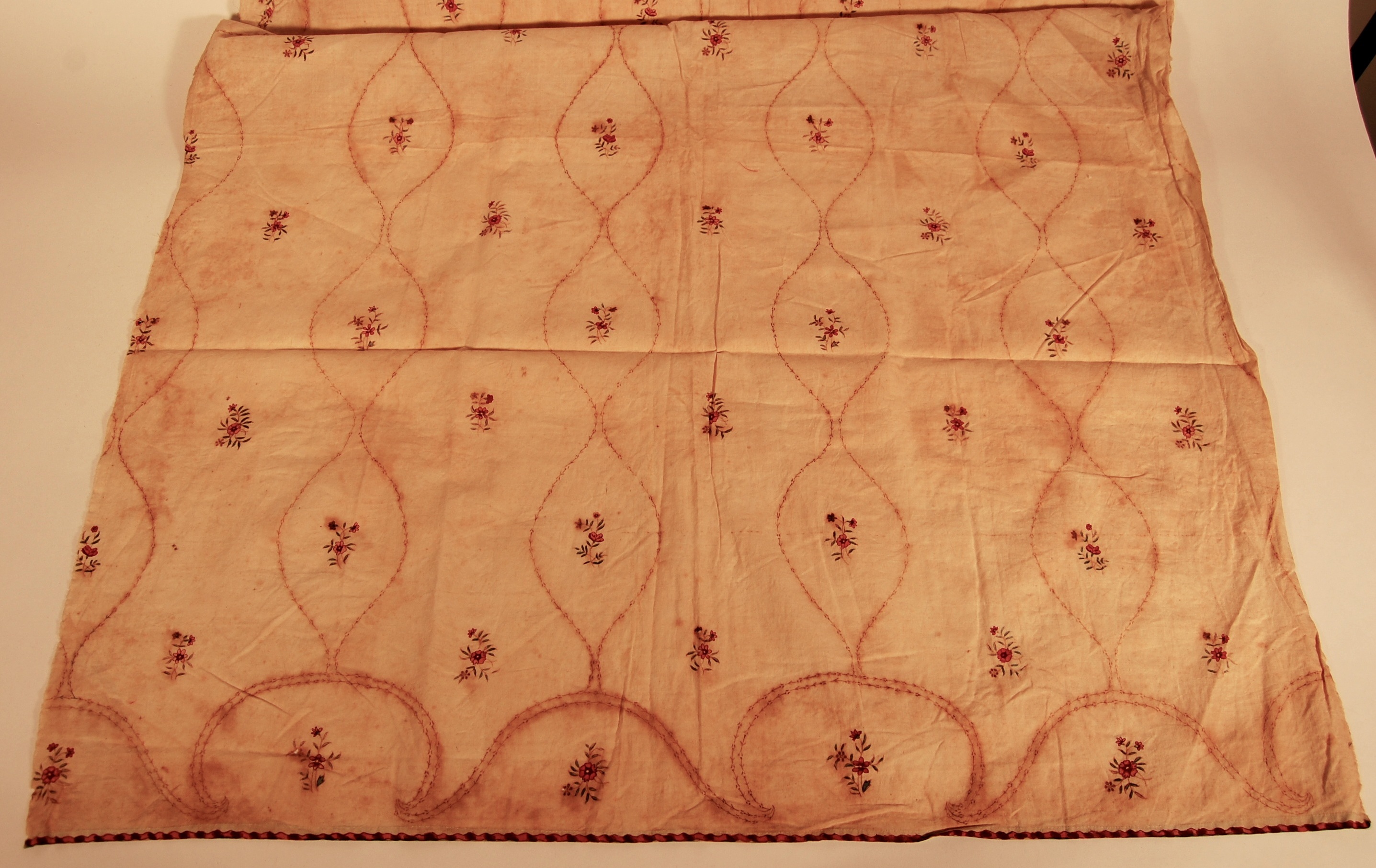
I find these garments in limbo really fascinating. Was that bodice finished and worn with a matching petticoat? (Yes, there’s a panel of that left, too; what a lovely hem!)
Skirt panel, painted Indian cotton. RIHS 1990.36.33
Who wore the gown? Was the woman who wore it originally the same woman who wore it altered? I can only guess at this point, and may never find the smoking diary or mantua-maker’s bill. The alterations are not as finely done as the original gown, so I think there are two hands at work here– whose were those hands? There’s always more to think about and learn.
In case you’re wondering, thanks to the Met, we can see what the gown probably looked like in its first incarnation, and then what the alterations were meant to achieve. (Link to the gown on the left; link to the gown on the right.)
Robe à la Française 1778–85 French linen, silk Purchase, Irene Lewisohn Bequest, 1965 MMA C.I.65.13.2a–c
Yes, I give up. It has been a long week, I am tired of winter and tired of snow and packing books and carpets torn up and tired of bad communication. Fresh content? I am fresh out.
I spent Thursday beating my head against research into the Brown family textile collection, and Providence textiles in general, for a program I seem to part of next Saturday. I hope I’m prepared, but along the way to getting ready, I spent some time in many museum databases beyond our own.
The Met, as always, rocks the party and brings their largesse to us all with their online publications.
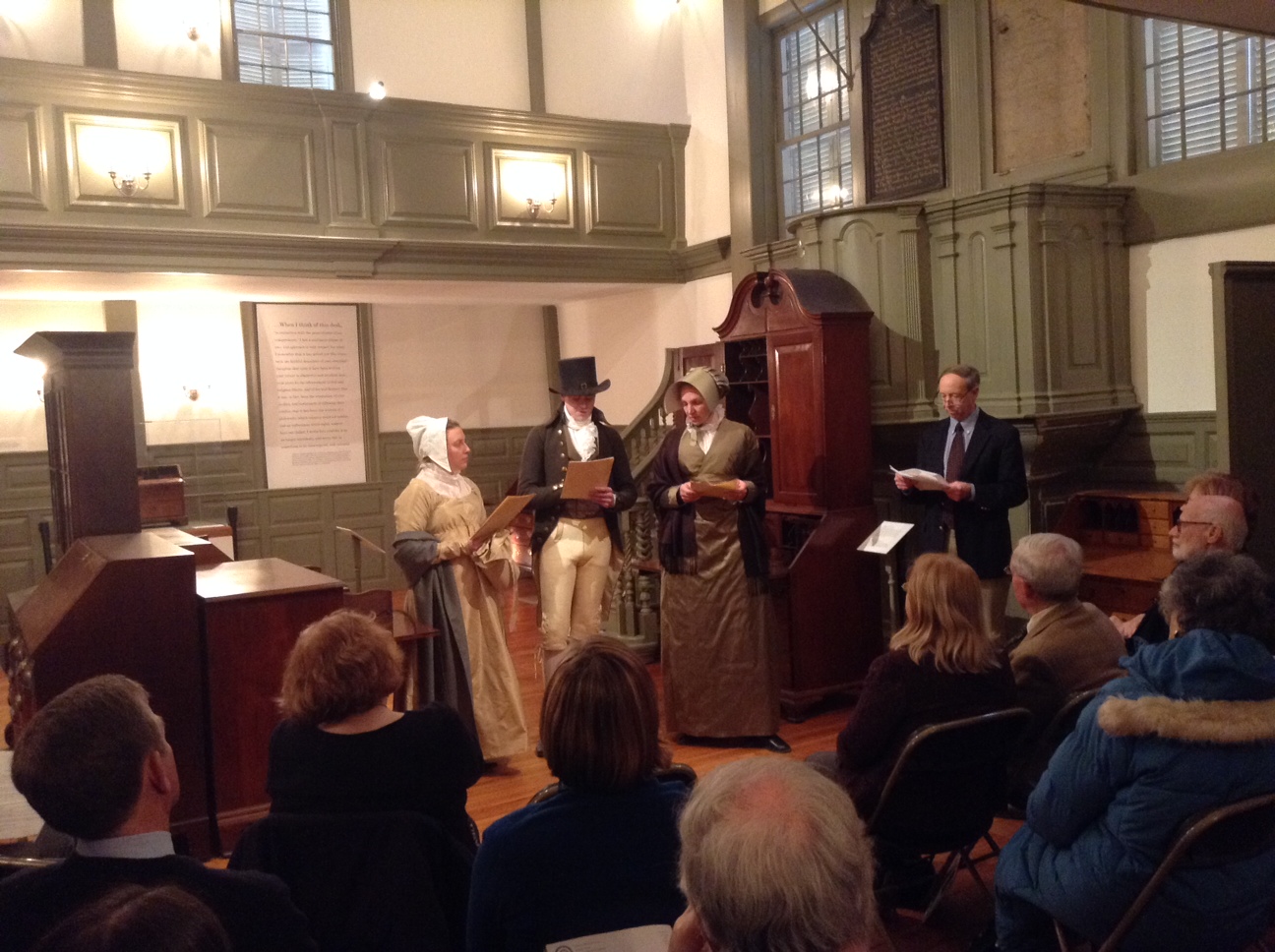
We stood in the Seventh Day Baptist Meeting House behind the NHS’s headquarters building and read excerpts of letters from the Williams Collection.
This is a simple, elegant concept for a program, and works incredibly well if the correspondence have the gift for expression that these people did. Even quotidian details–the price someone wants to get for their dining set, the likelihood of moving one’s mother, who must be carried ‘as carefully as a box of China’–take on humor when read aloud.
Courtesy Newport Historical Society
The best letter might well have been the last one, read by Sew 18th Century. The latest of the selection, the writer described a visit to Newport around 1844, arriving at the dock to the bustle of wagons, walking streets and finding a barber who knew the old fish hawker, the enormous jaw bone of a whale on a street corner, and even lifting the latch to walk inside the Seventh Day Baptist Meeting House where we were standing.
It was a lovely way to end the program, resonant with details the audience could connect with.
My dress turned out all right, and I managed to get it on and keep it on, which seemed a small miracle requiring only two pins.
When I tried it on at home, the front panel didn’t wrinkle, so I think I pulled it too tightly around me on Friday. I kept my bonnet on because I didn’t have time to make a new cap, so made do with the housekeeper’s cap from last fall. The chemisette was made by Cassidy, and saved me from the migratory ‘charms’ of a kerchief. The ‘shawl’ was a gift Christmas from my mother, who rightly saw it as a scarf, but those who wish to keep warm do not quibble when they cannot find exactly what they want. Before I wear the dress again, I have to attend to interior seams of the skirt and scoot the cuffs down to lengthen the sleeves. Four yards of 48-inch wide silk was just enough, but needs a little tweaking when you’re a tall as I am.





 Kirsten Hammerstrom
You must be logged in to post a comment.