Replication and Responsibility

Detail, the John Miner Coat, Stonington Historical Society, 2009.120.001

If I examine and exactly replicate a coat for personal use, what do I owe the museum that owns that coat– anything? I think I owe the museum any information I can share that will improve their records and help build a research file for the future.* I also think I owe them copies of the images I may take, and with digital images, that’s now incredibly easy.

But if I replicate this coat (shoulder intact) for Mr S or the Young Mr, should I give the coat to the Stonington Historical Society when we are done with it? SHS thinks I probably should, but as someone who manages collections, how many replicas do I want, and what standards do I use to judge them?

I think the best course of action is for museums to make patterns of popular or often-requested garments available for purchase, so that anyone who wants to make a replica has all the data they need. Short of that– and funds are often short for that– catalog records with as many measurements and as complete a description as possible will allow dedicated tailors and stitchers to get as close as possible to original garments.

True replicas involve recreating fabrics and using period techniques, and matching a garment measurement to measurement– and in the case of the Miner coat, there is no way to replicate its history. And the amount of work and expertise that would go into a true replica of any historic garment seems enormous– it would constitute a large donation to the museum, even if the garment had been worn.

*For those of you reading the caption on the Miner coat, yes, it needs work, and yes, SHS knows there are problems with that description. I promised to help them with their catalog record.
A Trip to Stonington

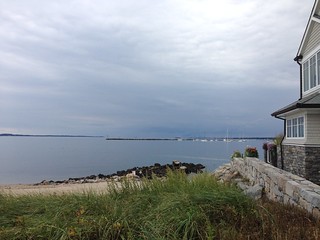
The view from Stonington Point

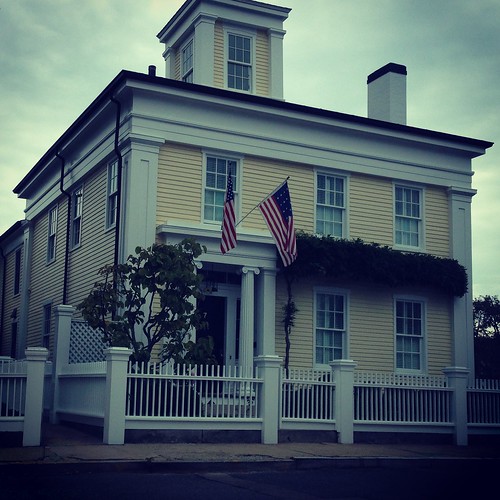
On Tuesday, I drove down to Stonington, CT to visit the Stonington Historical Society’s Lighthouse Museum and look at a coat. Stonington was beautiful as ever, smelling of the ocean and money, and the little Lighthouse Museum was nicely done.

The coat did not disappoint.

It is a truly amazing artifact, having survived despite pretty incredible events. The donor wrote a letter about the coat when he gave it to the SHS in 1914:
“I have heard my father say due to the haste and excitement of the volunteers they failed to properly cool their gun before pouring into its muzzle the powder, which due to the excessive heat of the gun caused the powder to explode prematurely, as you may see by reference to the coat—burned and torn upon the neck and shoulder.” (Coat and letter, Stonington Historical Society, 2009.120.001).

Stonington, CT

As beautiful as the town of Stonington may be, and as much money as there may be on the Connecticut coast, the SHS has a small budget and must use its funds wisely. We had an interesting conversation about the reenactors and museum collections, and what responsibility historical costumers have to the collections that hold clothes they replicate.

The Stamp Act Protest of 2014

Last Saturday, we stepped back in time to 1765 in Newport. I know: Newport always seems to be in a different time than gritty Providence, but this trip was truly different.

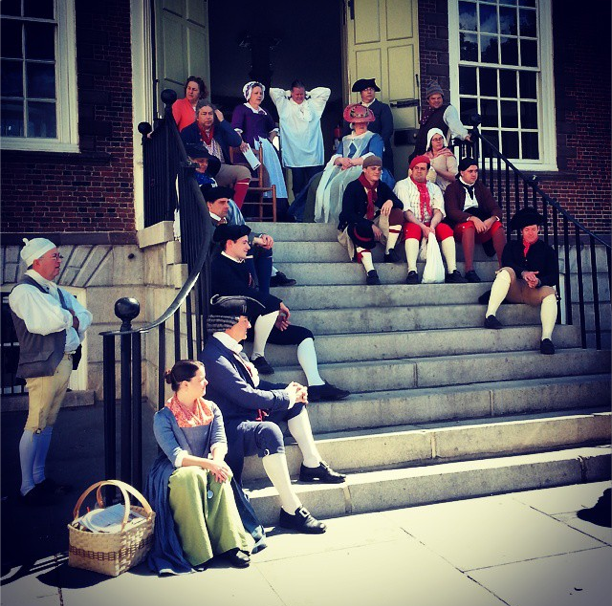
On the Colony House steps

We were headed across the Bay for a Stamp Act Protest (no rioting, per police request). In this effort, we joined a large group of recruits from New England and even beyond, to fill Washington Square and other sites in the city.

18th century sailors prepare to sew a sail
Preparing the ‘sails’ for stitching. I never really noticed the cars till I saw the photos!

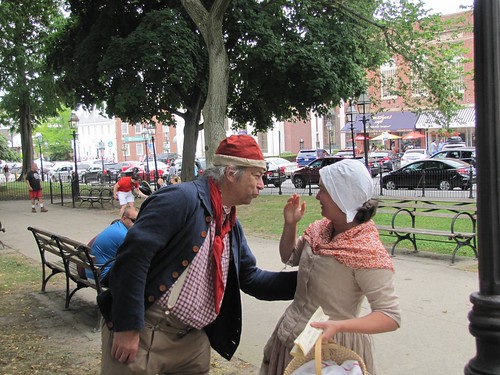
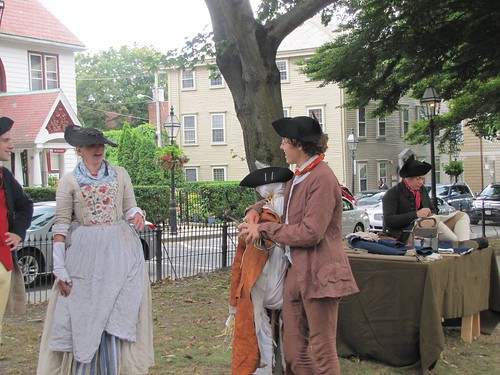
Stationed around the square were sailors mending or making a sail*, an apprentice-less printer, a sleepy apprentice boy, a tailor and his journeyman, a milliner, and leading citizens, one of whom was kind enough to read the newspaper to the apple seller, who wonders what has become of her son.

You must be very careful indeed around the sailors!

Up the street, some very fine ladies were having tea. Their refinement was evident in their appearance and dress, as well as in the elegant setting of their tables. They wanted none of my apples, as they had imported citrus fruits, far better than the apples the island’s trees produce. (Wasted on tea, truly: what one wants to do with a lemon is to find some rum and make a punch.)

18th century tea party in Newport
The Ladies’ Tea
Ladies at a tea table
Seated for tea
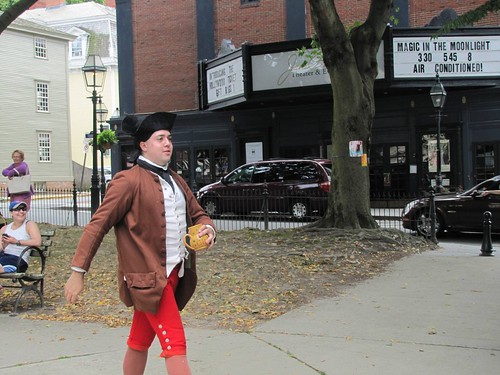
Mr Robinson marches forth

The news was very bad, and tempers flared in the square. Mistress Ellery told me that dinner parties had become impossible to hold: parties nearly come to blows over discussions of taxes, customs, stamps, and the oppressive policies of Mr Robinson, who insists on enforcing the very letter and penny of the law. (He was quite insulting on the quality of my apples, indeed, spitting one upon me even as he continued to eat it!)

The apprentice boy had charge of the effigy; the tailor sewed on.

As the afternoon wore on, the debate grew more intense and the crowd more heated. And effigy of Mr Howard was made, paraded, and hung, and then the crowd of protesters dispersed to the White Horse Tavern.

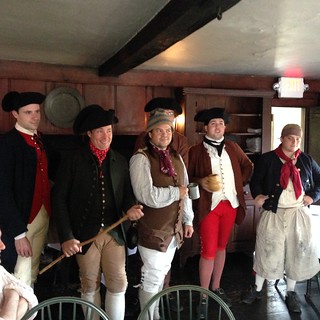
18th century men at the White Horse Tavern in Newport
Fortified!

Tensions seemed to dissipate, though when the runner came, the protesters– now fortified with ale, porter and cider–ran down the street to “plunder” Mr Howard’s house, played here by the Wanton-Lyman-Hazard House.

18th century people at Want-Lyman-Hazard House
Ignoring the mistress of the house, protesters dashed to the back.

Although the mistress of the house tried to reason with them, the crowd would not be dissuaded, convinced of their mission (and perhaps more fortified than you would expect after just one glass). They carried their loot to the front of the Colony House, and heaped it up, glorying in their success.

The goods!
More goods!

In the end, the house was not looted, tensions were dissipated, and the protesters dispersed into the afternoon. We were well-rewarded with cheese and ale at the Colony House, and enjoyed discussing the events of 1765 and 2014 with the public and Newport Historical Society staff members.

*Yes, Virginia, they do look like tents. That’s because they are tents. Someday, Light Infantry soldiers will sleep beneath that canvas. But for now, keep stitching!

Disappearing Act

Being_A_Sandby

As you can see in this Sandby-like image, we went, briefly, to Sturbridge for Redcoats & Rebels, so that Mr S could wear the Andes Candies Coat and the Ugly Dog Coat in the Military Fashion Show and so that I could see Sew 18th Century again. (Thanks to her for the photo!). We didn’t realize how tired we were until we sat down.

It was then that I began to process the exclamation about Fort Plain and “We’ll make a bunch of the Ugly Dog coats,” which spun quickly to the research that needed to be done on the shape and type of lace and the regiment the coats were initially meant for.

Mr S says Mr HC rolled this out in the safest place possible: The Great Meeting House, in front of the public, where no harm could come to the one who suggested all that detailed sewing for Mr S and the Young Mr.

Afterwards, as we walked through the camps, I was glad we had not camped or spent more time: tired, I have even less patience for candelabra and spinning wheels in camp.

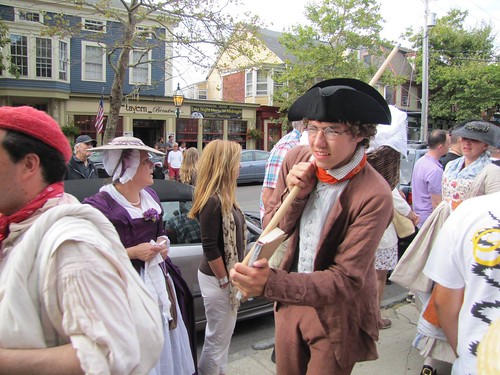
Instead, we enjoyed walking in the village. Just before the photo above was taken, Mr FC (at left) had been stopped by a family, who had many questions for him. My favorite moment was the little girl, perhaps 4 or 5, who held out her hand to him and said, “We found a cricket skin!” There are few men better suited to rolling with that that Mr FC, who took it all in stride.

After our stroll, yes, we exited through the gift shop. But I had a goal, a half-pint tin measure. Half of that is a gill, and multiplying up takes me to pints and even quarts, which means I get a little more sophisticated in camp cooking. Porridge, boiled flour puddings, dried pea soup will all be easier to get less wrong in a kettle with a basic measuring device. Yes, gills are the measure for rum, but I don’t recommend mixing it with hose water.