To Philadelphia, Again

Pennsylvania Packet (Philadelphia), June 28, 1781

This time, unoccupied. I’ll be representing Rebecca Flower Young at the Museum of the American Revolution’s Flower’s Artificers event this coming weekend, and to get ready, I’ve been reading research material generously shared by museum staff, as well as Marla Miller’s classic Betsy Ross and the Making of America, which mentions Rebecca Young in the context of the competitive world of Continental Army contractors in 1780s Philadelphia.

Rebecca Flower Young (1739-1819) was an older sister of Benjamin Flower (1748-1781), Lieutenant Colonel in the Continental Army. Before the war, she lived in Philadelphia with her husband, William Young, a goldsmith, and their five children. The family fled Philadelphia for Lebanon, PA in September 1777 as the British Army advanced to occupy the city; it would not have been safe for them, given their ardent Whig politics and relationship to Benjamin, commissary general of military stores. After William Young’s death in February, 1778, Colonel Flower secured a house for his sister on Walnut Street, and work as a contractor providing supplies for the Continental Army.

 

Rebecca made drum cases and shirts, cap linings and cartridges, and multiple Continental standards. From the quantities she produced– 500 cap linings for light horsemen– it is possible she hired assistants in addition to her children. Her 17-year-old son William made “five hundred dozen of Priming wires and brushes” in 1780, aiding the war effort through the supply chain rather than as a foot soldier, a condition that was likely a relief, given Rebecca’s status as a widow. She also let a room in the Walnut Street house, the boarder’s rent providing a relatively steady and reliable income.
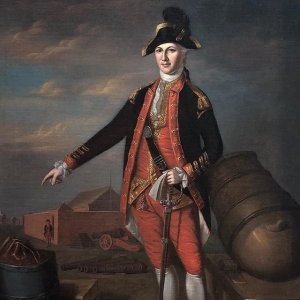
Col. Benjamin Flower, oil on canvas by Charles Willson Peale. Star-Spangled Banner House, Baltimore, MD.

We have no idea what Rebecca Young looked like, of course, though there is a portrait of her brother, Benjamin, in his uniform, as well as a portrait miniature sold at Freeman’s.

With only written sources about her work to guide me, I have waffled back and forth about Rebecca Young’s material world. In the end, I have made a much-needed new shift and cap for this weekend, as well as a gown (that, of this writing, requires only one cuff and the skirt hem). After reading Miller on Betsy Ross, I was of two minds: first, that the material world of these women was shabby and out-of-date, given the privations of the occupation and the war-driven inflation and second, that their status as contractors gave them an income that allowed them to afford new things. Still, with five children, new anything would have been a stretch, so I remain undecided and firmly ambivalent about the appropriateness of this gown. Scissors, needles, pins: those tools are much easier to understand than personal circumstances.

We approach representing the past with preconceptions that are hard to shake: the images we have in mind are dominated by representations of people at the far ends of the economic spectrum. It’s as if we had only the Saks Fifth Avenue and Old Navy websites to help us understand American clothing today. The wildly divergent economic and material situations tell us little about the people in the middle, who make up the vast majority of the population. 

Research and primary source materials on Rebecca Flower Young were provided by Matthew Skic of the Museum of the American Revolution; compiled information used by gallery educators at the MoAR was compiled and provided by Katherine Becnel of the MoAR.

Pilgrimage

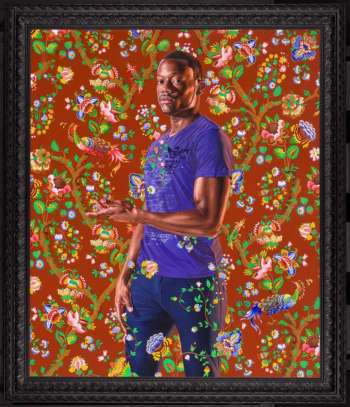
Former President Barack Obama Oil on canvas by Kehinde Wiley, 2018. National Portrait Gallery (Washington, D.C.)

Note: This was written some weeks before the Kim Sajet’s piece in The Atlantic appeared. Upon reading that, I decided to publish this essay.

Kehinde Wiley’s official portrait of President Obama hangs on a partial wall fronted by a velvet rope. Stanchions create an approach to the portrait, and people are lined up as if they’re waiting for communion, waiting to approach an altar. Which they are. The portrait is more vivid, more alive, in person than in print or online. The line of people–still long, still rapt, months after the painting was installed– is as moving as the portrait itself.

I knew I would like the portrait because I like the artist. The first Wiley I saw was at the MFA Boston, John, 1st Baron Byron hangs in a long hallway of a gallery, the chinoiserie background red and vibrant, loud the way 18th century wallpaper could be. Tendrils wrap around the subject’s legs, flat against the navy blue chinos, and without regard to the light that reflects from his palm. It stopped me in my tracks.

John, 1st Baron Byron. oil on canvas by Kehinde Wiley. Museum of Fine Arts, Boston.2013.633

Obama’s portrait pricked my eyes with tears, not only for what I missed– the cool intelligence, the restraint, the reasonable domestic policies–but for the line of supplicants. There was a crowd of people who were moved the way I was moved, by the representation of a person. They were moved because of what the painting stood for, and how it represented the embodiment of an idea.

Shepard Fairey’s “Hope” portrait collage captures the beginning of the idea, Wiley’s portrait the mature realization. A copy of Fairey’s 2008 poster hung in my Providence living room, flatter than the original collage, stylized to a near caricature. Wiley’s portrait would suffer as a poster, print rendering the floral background lifeless, draining it of the light that saturates the portrait in person. The portrait glows on the gallery wall: Wiley has captured “hope” in paint and made it feel alive.

HOPE, by Shepard Fairey. Screenprint, 2008.

That light and life captivate viewers and draw them to the painting; they respond not only to what they know it represents, but to how the idea and accomplishment are represented. Watching people get in line to see a painting– no other presidential portrait, no other portrait, captured people’s attention and interest this way– proves not the popularity of a past president but the power of an object.

Wiley’s portrait, suffused with light, may be a modern altarpiece to the cult of celebrity, drawing crowds to worship an idol created by the media. Or it may be the physical representation of quintessentially American ideals of equality and progress, depicting a god of the mythical post-racial present. Or perhaps it’s a superficial representation of a superficial success, thin paint to match a thin pre-presidential resume. How we interpret an object is colored by our biases, but our response is not: our response is intuitive and automatic. That’s what I see in the queue to view Wiley’s portrait: people responding instinctively to beauty.

Sometimes I forget that no matter how interpretation and meaning layer an object, the first response is instinctive. It may be so fast we (almost) miss it, an impulse leaping across a synapse, but it is often the most honest response; the one we need to pay attention to so we can better understand how an object is presented to us or the public. The power is intrinsic to the object, whether an inlaid table or a portrait: the maker speaks to us through the object. Wiley’s portrait and the crowd who came to see it reminded me of that basic truth: the power is in the object. A curator’s label and presentation are secondary to the immediate response of the viewer to the object. There’s nothing like the real thing.

Come Dancing

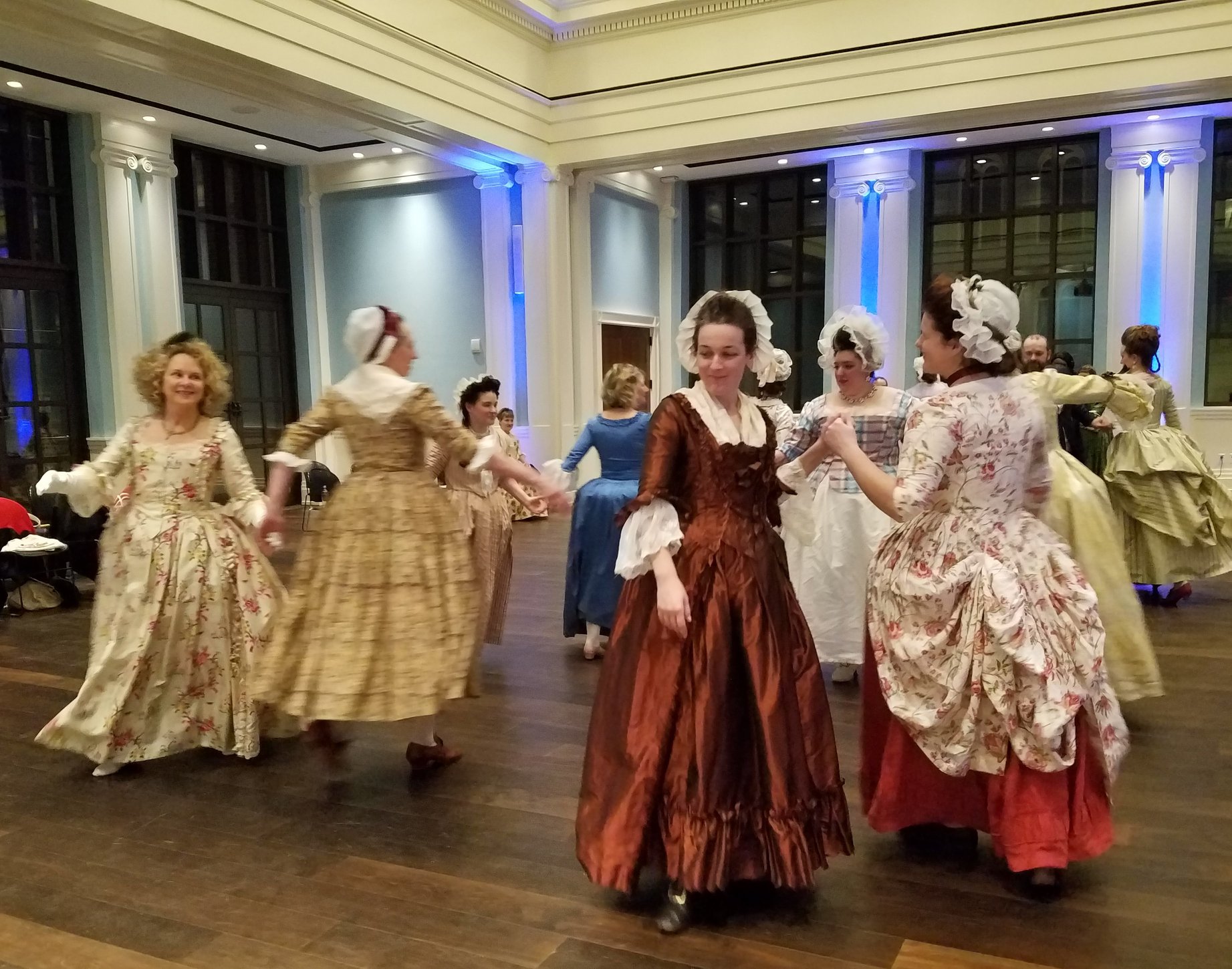
There haven’t been as many chances to dance as I’d like of late, so when I got the Museum of the American Revolution’s invitation to come dancing at their January History After Hours event, I said yes. Luckily, I had to be in Philadelphia for the next day anyway, so out came the 1780 appropriate dress and the fancier shoes, along with my resolve not to be a wallflower, and off I went. I very nearly made it on time, but I dressed as fast as I could, and managed to join the crowd with my dress pinned and my hair tamed.

As at past balls, I was rescued by a kind soul (and excellent dancer) who took me through the steps and saved me from my occasional pattern dyslexia. (Reversing can be tricky– they didn’t let me drive the forklift much in school because my brain sometimes struggles to process a mirror image.) But Miss V was a gracious partner, and reader, I confess: I greatly enjoyed myself.

One aspect of historical dancing that has always appealed to me is the relationship between classical ballet and traditional English country dances. While you won’t find tutus on Jane Austen’s dance floor, you will find balancé and glissade, and the use of positions. This connection between two things I love, and the way movement can connect us to the past, makes me enjoy these dances even more. Using steps I learned and practiced endlessly decades ago in a hobby I pursue today is a very personal reminder of the persistence of the past.

An evening of dancing, with the best dance caller and instructor I’ve yet had the pleasure to meet, was a welcome winter treat.


Many thanks to Miss G.J. for the use of the photos, and deep honours to Miss V.D. as a partner, and Mr. N.V d.M., dancing master.

“Been employed these several years past”

Part One of a Series

Occupied Philadelphia at the MoAR is one of my favorite events. It’s not too far, in an urban setting, and makes visible the history of the Revolution that’s hard to get at, the history of everyday people. Last year, I portrayed a follower of the 17th Regiment of Foot and a petty thief; this year, I wanted to do portray a woman in business. I’d settled on a milliner because that’s a trade I know well enough to portray–though I could not find documentary evidence of women in the millinery trade during the early months of the Occupation, nor could I satisfactorily justify selling hats, bonnets, and jewelry to a population facing inflation and food shortages. Happily, just two weeks before we’d have to pack the car, the program manager posted exactly what I needed, but had missed by not looking late enough into October: an ad placed by a woman in business.

Advertisement placed by Elizabeth Weed, Pennsylvania Evening Post, Thursday, October 23, 1777.

This is what I’m always looking for: someone to be, a solid place to start the research that takes me from the general to the specific. Who was Elizabeth Weed? She was only a little tricky to find. Records documenting Elizabeth Delaplaine Dickinson Weed Nevell are scarce. Based on the date of her first marriage, to William Dickinson, in 1755, she was probably born between 1730 and 1735, making her about 44 to 47 in 1777. She was widowed by 1768, the year she married George Weed, who had lately been the superintendent of the Pennsylvania Hospital until 1767, and was then a practicing pharmacist. Weed, born in 1714, had studied and practiced medicine in Connecticut and “West New Jersey” before moving to Philadelphia around 1760. After his death on February 1, 1777, Elizabeth Weed prepared and sold the medicines George Weed taught her to prepare, and, presumably, to dispense.

Portraying a widow six months after the death of her husband seemed plausible: I have a grey wool tabby gown (with a Fort Ticonderoga white wash stain) that seemed reasonable enough for “second mourning”– until I discovered that Elizabeth Weed had purchased a house for £600 just before she married her third husband, Thomas Nevell. A widow of means was going to require a new gown and accessories in addition to the materials of her trade– two research rabbit holes at once (plus Thomas Nevell, since he provided Drunk Tailor with an ideal role for the weekend).

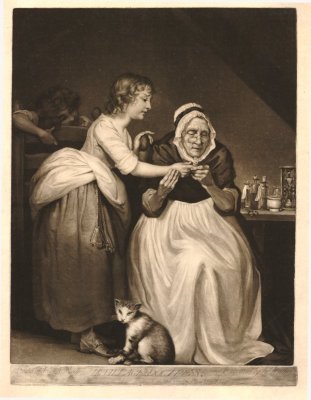
Period prints provided some guidance, and since widows took up the trade of ‘doctress’ often enough, some provided a glimpse not only of clothing, but also of the material culture of 18th century pharmaceutical practice. Fortunately, I had a gown-length remnant of black and white silk in the strategic fabric reserve, as well as a remnant of black silk for a mantelet.

Portrait of Mr. and Mrs. Thomas Mifflin (Sarah Morris). Oil on ticking by John Singleton Copley, 1773. Philadelphia Museum of Art, EW1999-45-1

When she married George Weed, Elizabeth had already lost one husband, so an English gown with robings seemed a reasonable choice. Mrs. Thomas Mifflin’s grey silk gown lurked in my memory as inspiration (or justification) for the style of gown, though not for the meaning.

In many ways, the material trappings of widowhood were the easiest part of this project. I’d done some research on late colonial and early Federal mourning customs in a previous life, and had a sense of what was expected of bereaved widows in the 18th century. Clothing and accessories would signal status, and guide the behaviour of others towards me (in this case, keeping Thomas Nevell at a respectable distance). I could have chosen a gown already in my wardrobe (grey wool, green wool, blue wool) but inhabiting the world of the widow from the skin was important to me as a means of fleshing out a real person for whom I had scant information.