Waistcoat Wanting? Workshop!

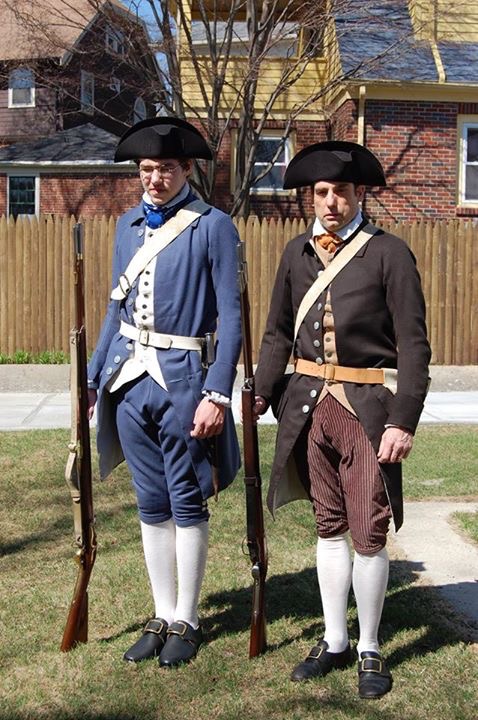
Gentlemen of Rhode Island

I managed, with sore fingers and considerable snake-eyed concentration, to get breeches and coats finished enough to send these two off to Battle Road better dressed than ever before. I’m pleased indeed with how the blue suit turned out, and planned to make a blue wool waistcoat to complete the set. Except…the Young Mr prefers some contrast in his clothing (a change from his prior preference for complete camouflage) and now wishes for white. I ask you.

Mr S is need of a new waistcoat himself, and he’s registered for a workshop with Henry Cooke to make a new waistcoat for himself. He was awfully taken with Mr B’s clothes two Saturdays ago, when he dressed as George Claghorn, the Naval contractor who supervised the building of the USS Constitution

Plush. No, really, it's made of plush *and* it's fancy, at least for us.
Plush. No, really, it’s made of plush.

.

L’Hermione is coming to Boston and Newport in July, and then we have An Afternoon in 1790 planned, with What Cheer Day not far behind, so there’s plenty of need for new waistcoats in a variety of styles– 1780, 1780, 1800 each have their variations.

Why not join us May 2nd and 3rd in Providence, and make your own fabulous waistcoat? There’s still a space or two left! Register here.

History Camp Next Weekend!

Gradient--Boston2015

Where will you be on March 28th, now that the LTB muster is cancelled? How about HistoryCamp 2015? You can register here for free if you volunteer or for a nominal fee otherwise.

You can check out sessions here, but I know there’s a really good one on living history…because I’ll be presenting along with Elizabeth Sulock of Newport Historical Society in the Risky Business: Living History Events in Tradition Museums session. There’s a lot of other good stuff, too, so if you’re in the area, why not register so you can check it out?

Blue Coats and Shiny Buttons

Once upon a time, I worked (twice) for an interim boss I called (behind his back) Shiny Buttons. You know I’m in a coastal state, so you can guess what he wore: a navy blue blazer with brass buttons. It’s a uniform of its own kind, even in civilian life. For a new show at work, one of the things we’re looking at are blue coats and shiny buttons.

It got very “Hey, sailor!” in painting storage earlier this week, as we pulled out portraits looking for gents in blue coats. Sea captains are definitely representing.

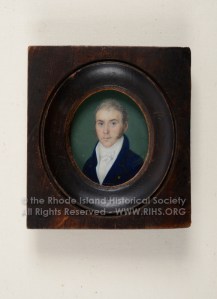
Captain John Gladding, 1810-1820. Miniature. RIHS 1980.80.1
Philip Crapo, ca. 1801. Miniature attributed to Thomas Young. RIHS 1906.3.4

There are other gents in blue, and it’s interesting to see the proliferation of style across time.

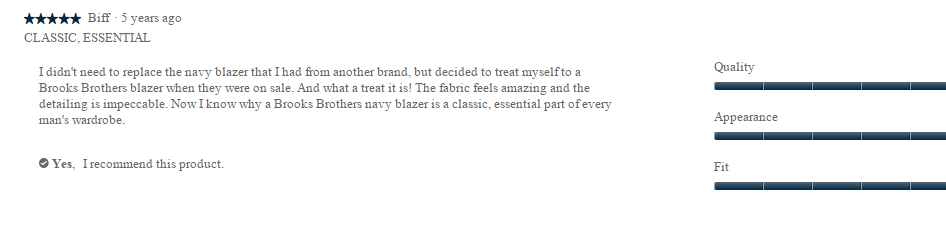
It’s a classic look, often seen in the preppier enclaves. It’s an easy target, but don’t you love this review of a Brooks Brothers blue blazer by Biff? Timeless.
Biff

Glaciers in the House

IceDamFeb2015

I don’t mean the ice dams and icicles that plagued the house and streaked the service ell’s windows as they melted: I mean change.

I’m reading The Half Has Never Been Told (it kept selling out, so I only just got a copy), and thinking about the representation of a past that people would rather forget, and sometimes actively deny in the North– and the South, as you will tell from reading African-American History Fail.

Change in historic houses can be glacially-paced, as staff and docents alike resist changes to interpretation. Resistance to change is usually about comfort and confrontation, especially when the change is large.

I get that: Oh no, new stuff to learn. What was wrong with what we did before? But docents and staff get comfortable and loose sight of the context of the content they present. They say some interesting stuff.

Most jaw-dropping of all: Sometimes I like to pretend I’m Mrs Owner of the House. That one was creepy, to me. But it did give me some insight into the “ooh, wish I lived here” backwardly aspirational tour motivation.

How would you feel if living here meant you owned and traded slaves? Defended the slave trade in Congress? If a small girl had the care of your horses? We don’t ask those specific questions, but I think we need to. Slavery is slavery.

In the 1790 census of Rhode Island, there are 948 slaves, representing 1.3% of the population. That would be 13,000 people of Rhode Island’s total population today, less than the city of Central Falls (19,383 in the last census, and one of our smallest towns).

We think it’s a small number, but to those 948 people, being enslaved was everything. I don’t necessarily want to make our visitors feel personal guilt about slavery– that’s up to them–but I do want to them to think about what slavery meant, and what it did, as an economic system.

I want visitors to understand that the beauty of the house they see is built in part on the ugly and forced exploitation of a class of people. If they relate that to the rest of the world they inhabit today, even better. I think we owe at least this much to every site where enslaved people worked or lived.