That Belongs in a Museum

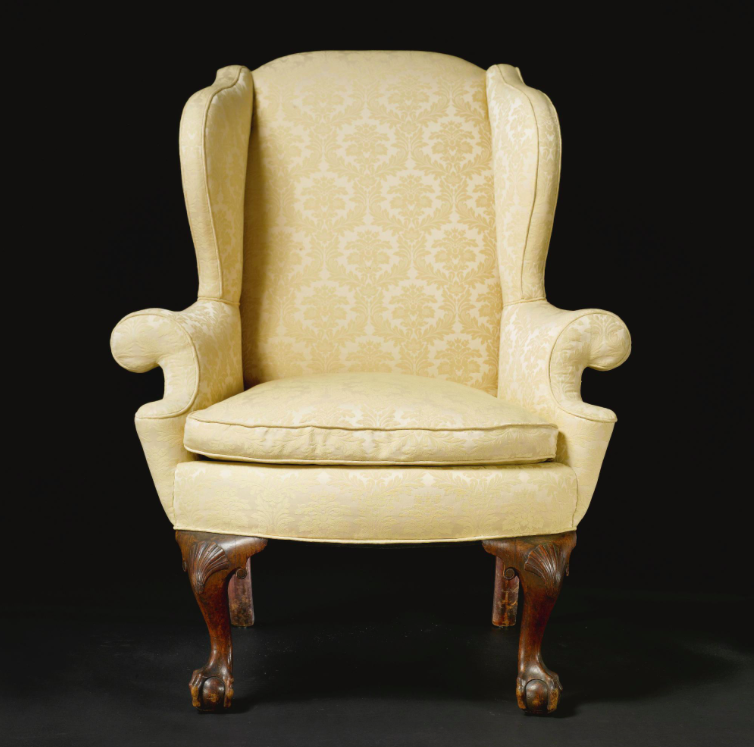
Sotheby's Sale 8278, Lot 586. Easy Chair, Philadelphia ca 1770
Sotheby’s Sale 8446, Lot 20. Easy Chair, Philadelphia ca 1770

We’re taking a brief break from this week’s nightlife programming to bring you this special report. Regular snark resumes with the next post.

It’s not a secret that I work in a museum. I operate in a world of objects that cannot be touched, sat upon, slept in, worn– you get the idea. Well, sometimes things that I believe belong in a museum don’t end up in one. Sometimes beautiful objects with great stories and deep resonance with the museum I think they belong in don’t make it there. Sometimes museum professionals take phone calls from irate family members who are incensed that you’re even talking to someone in the family about how to organize their materials. Sometimes objects do make it,  but then, before the paperwork is executed, the gift is rescinded. People get weird about stuff.

Sometimes they get weird about stuff because of what it’s worth. Eleven years ago, a family chose not to fight over objects, but instead sold their family furniture. They grossed nearly $13 million. Thirteen Million Dollars: Enough for a baker’s dozen of Dr. Evils. With chairs that sell for $204,000 (Sale 8278, lot 586), it’s no wonder people get weird about stuff because of money.

Lot 586. It’s a pity the catalog is no longer available online, but even Sotheby’s has to conserve server space. It was a beautiful chair: a 1763 upholstered easy chair– upholstered by Plunket Fleeson of Philadelphia.* I pored over that catalog page in the Important Americana sale catalog. It would have come in just before Christmas, or just after, slick clay-coated pages printed with fine ink. When the auction catalogs arrive at work, we stand in the kitchen-mail room and bury our noses deep in the gutter: smells like money.**

Staircase Group (Portrait of Raphaelle Peale and Titian Ramsay Peale I) Charles Willson Peale. Philadelphia Museum of Art, E1945-1-1
Staircase Group (Portrait of Raphaelle Peale and Titian Ramsay Peale I)
Charles Willson Peale. Philadelphia Museum of Art, E1945-1-1

I wanted that chair, Lot 586, that walnut easy chair made in Philadelphia. Wrong town, you say? Mais non, Philadelphia was the place to buy fancy goods– especially upholstered goods– in the 18th century. Providence merchants were trading with Philadelphia, the town that set the style for the colonies.*** It was sophisticated, urbane, refined. So, when Sarah Brown was pregnant with their first child, John Brown sent to Philadelphia for an easy chair. It would be the best.

He’d already ordered a tea table and roundabout chairs from Newport at the time of his marriage in 1760. These objects were about more than function: they were signifiers of taste and sensibility as much as wealth. So, as the time came closer for Sarah’s confinement, John Brown became increasingly agitated with Plunket Fleeson, who was delaying the delivery of the chair. John Brown was concerned for Sarah’s comfort postpartum, and said so in a letter. I can’t quote or link to it, because it’s in private hands, quoted in the catalog entry for lot 586.****

So what about that chair? Well… I got permission from the Authorities (a Board-level committee, with the support of the Executive Director) and we bid on the chair by phone. You know already we were not the winning bid. We were willing to bid a lot– really, a lot of money for us– for this chair.

Why?

Not because it’s worth so much. Not because of Plunket Fleeson, or the quality of the carvings, or the craftsmanship, really.

Because Sarah Brown sat in that chair cradling her son, James Brown, in 1763. She sat in that chair with the children who came after him, the babies who lived, and the babies who died.

Because that chair told a story about a family, about a relationship between a husband and wife, a man and a woman, at its most basic level.

That chair told a story about love.

Even I am a sucker for love.

Love is why people get weird about stuff, about the chairs, the family photos, the workbaskets, heck– the drill presses. We imbue objects with meaning, with memories, that substitute for the people we love when they’re gone. Sometimes it’s a t-shirt that smells of a lover. Sometimes it’s sewing basket used by three generations of women. And sometimes it’s a chair.

In the case of the easy chair, imagining the cradling comfort of the chair and the memories it recalls is simple. In the case of, say, shield back side chairs, the leap is a little harder. But perhaps– just perhaps– arranged around a festively set table, those chairs conjure memories of holiday meals, birthday dinners, graduation parties. Maybe those chairs take you back to the people and times when you felt loved.

Or maybe they’re worth $100,000, and you consign them to auction.

But if you value the story as much as the object, here’s the funny thing: you can keep that memory forever, and share the story with everyone, if you give that object to a museum.*****

When people really love an object and are fighting with their families over who gets to keep the things, I don’t play Solomon. I tell them a story about memory, and preservation, and about endurance. Sometimes I can convince them. Sometimes I can’t.

When I can’t, I tell them I understand, and that my priority– and my institution’s priority– is not things, but people. They can keep their object: we’ll be here when they’re ready. It’s all true, and I do mean it.

But inside, I feel like Indiana Jones, soaking wet on the deck of a pitching ship.

That belongs in a museum.

When-you-visit-home-and-see-your-parents-outdated-computer

*If money were no object, I’d buy it for that name alone.

**The quality decreased in 2008, when the financial crisis hit everybody hard, but the paper weight and ink have been creeping back up in quality of late.

***I know, it sounds crazy now, but it was true. At the time of the American Revolution, it was the second largest English speaking city in the world, after London.

****You are correct, sir: I’d like the letter book it’s in, too.

*****Subject to acceptance. Some rules and regulations apply. Leaning is touching. Don’t lick it.

Reflecting Fashion

Whilst serving as the commandant for a research-paper writing prison*, I spent some time perusing the Met’s digital collections, in particular the Costume Institute’s collection of Men’s Fashion Plates, because, you know, stuff.

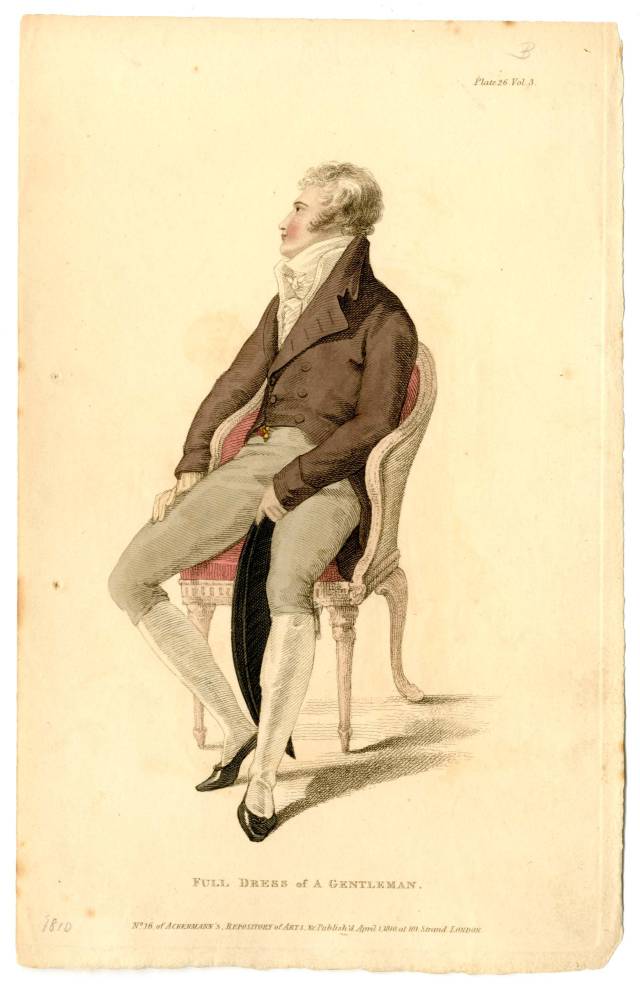
I stopped at Plate 002, because I knew I’d seen that coat somewhere before. Why, yes: at the MFA in the Art of the Americas Wing, where I recently spent a pleasant afternoon with the Drunk Tailor. After some initial joy at discovering dust on a teapot, we got down to the business of setting off proximity alarms, reading labels, and contemplating  the occasional neck stock.

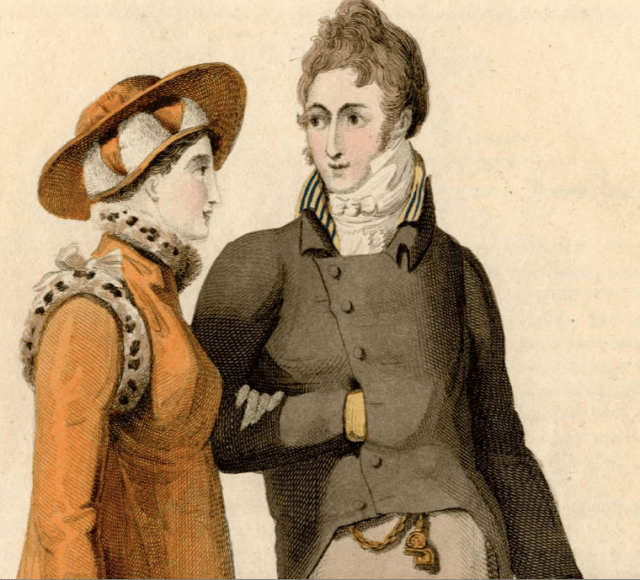
Mr Myers stopped me, though: what a handsome coat. High shoulder seams, long cuffs, buttoned all the way up. Nifty high-waisted grey trousers, too, and what seems to be a yellow waist coat. The portrait is dated 1814, and the fashion plate 1807.

Detail, 1807 fashion plate

Hmmmm…

Men's Wear 1790-1829, Plate 005, 1807. Gift of Woodman Thompson, Metropolitan Museum of Art
Men’s Wear 1790-1829, Plate 005, 1807. Gift of Woodman Thompson, Metropolitan Museum of Art

The brown M-notch collar coat is clearly a thing in 1807. It’s popular in 1802. So popular. 1802 on the left. On the right, 1812.


And our friend Sully paints one in 1814.

After seeing Copley and other early American painters use English prints as references for portraiture, I wondered if Sully was at all influenced by fashion plates, and then to what degree American men and their tailors were influenced by published fashion plates.

Portrait of the Artist. Thomas Sully, 1821. Metropolitan Museum of Art, 94.23.3

Brown coats are clearly classic: Sully’s got one himself in 1821. I’m sure there’s a dissertation out there somewhere on the influence of fashion plates on American men’s  fashion and representation in portraiture–  I can almost remember stumbling across the reference. So that echoes and re-echoes and reflects through time even as I recall not just the the folk wisdom about brown suits, but the significance of well-tailored suit. Maybe from 1802-1821, brown is the new black.


*Ah, teenagers. The Young Mr failed to complete a paper by the due date, so I spent some quality time ensuring he got back on track.

Objectification

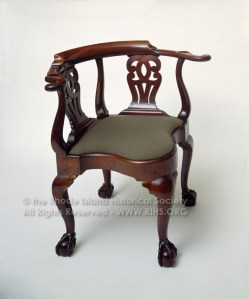
Corner chair. Mahogany with fabric-covered slip seat. John Goddard, 1763. RIHS 1990.36.1 RHix5136

I’ve had more alone time than usual at work, which is to say, I’ve been the only living creature in 16,000 SF for multiple consecutive days, which allows me both time to get lots of work done but also permits my mind to wander more than it might otherwise. One of the ideas I continually return to is about the objectification of objects. That’s a terrible phrase, isn’t it? What is the essential thingness of any given thing?

Let’s take chairs: I really like chairs, which is to say that I have, at last, succumbed to the seductive qualities of chairs.[i] But what makes a chair a chair?

Most simply, a chair is to be sat upon. Keeps your rump off the cold, cold ground. Supports your legs and back. Sometimes a chair is for lolling. Sometimes it’s for working. Sometimes it’s for projecting power. But essential, a chair is for sitting.

If use– specifically human use[ii]– is what chairs are for, what happens when a chair is removed from use, and placed on display in a museum?[iii] And what difference does it make whether that chair is on a white plinth in an art museum, or in a historic house, or in the historic house where it was used? When is a chair most a chair, other than the times you are sitting in one?

As I said: a lot of alone time.

servant mannequin in 18th century room
That’s no ghost, that’s my kid. Corner chair just in front of the ghost.

Within a historic house, it seems that the ideal situation is the chair in the room in the house.

That would seem to maximize the “realness” of the thing, right? But we don’t always have the chair, and even when we do, we may not know which room it was used in most often.

The way a chair is displayed and understood in an art museum: Object of Beauty is very different from the way a chair is displayed and understood in a history: Who Sat Here? It’s a conundrum though, because just as the chair become Beautiful Thing in an art museum, it can become Story from the Past in a history museum. Neither presentation/interpretation really gets at Chairness, which is really best experienced by sitting in the chair yourself.

Did I mention I spend a lot of time alone with objects?

Storeroom, Rhode Island Historical Society. RHix17 399

The way that I think these questions about Chairness relate to living history is by realizing that just as museums fetishize objects on white pedestals, living history interpreters/reenactors sometimes fetishize objects without contextualizing them. You know: Muskets. Clothes. Spinning Wheels.[iv]

Putting the chair in the room where it was used gives it context, and the visitor a new perspective that wouldn’t be gained from a white pedestal, or from the curb. The same is true of the things that we carry as interpreters. Context matters. It’s how meaning is derived and understood. Like repetition, isolation can rob an object—or a person—of meaning. Not that I’m lonely. I have all those chairs, after all.

____________________________

[i] Not to get too weird, though: I won’t rhapsodize (yet) about the sensual curve of a chair leg, or a delicate, finely-turned ankle, as I have heard some (fetishistic?) curators so. Yet: there’s still time.

[ii] Sorry cats: chairs were not actually made for you. Now get down!

[iii] If you know anything about art history and theory, you can probably guess which decade I was in graduate seminars.

[iv] My *favorite* thing to see in a military setting.

Good Grief

1803 dress and hair
Pre-sweat melted hair

I had my doubts about this event, since we were interpreting the death and mourning of John Brown a full month after it actually happened, and initially resisted somewhat strenuously. But people change, and by the time I was operating a motor vehicle at high speed on I-90 six months later, I could be– and was– convinced. Knowing little, if anything, about early Federal mourning customs mattered not at all. There’s always time to learn, right? Well… if you read fast enough, you can do anything.

Esther and Kitty draping the mirrors

Despite the bustle, Esther and I found time to cover many of the mirrors with sheets, and the portraits with black crepe; this is a time of reflection, not vanity. It gave our rooms a gloomy mien, and reminded us of our short span on this earth.

Visitors in the front hall of the John Brown House, Providence RI
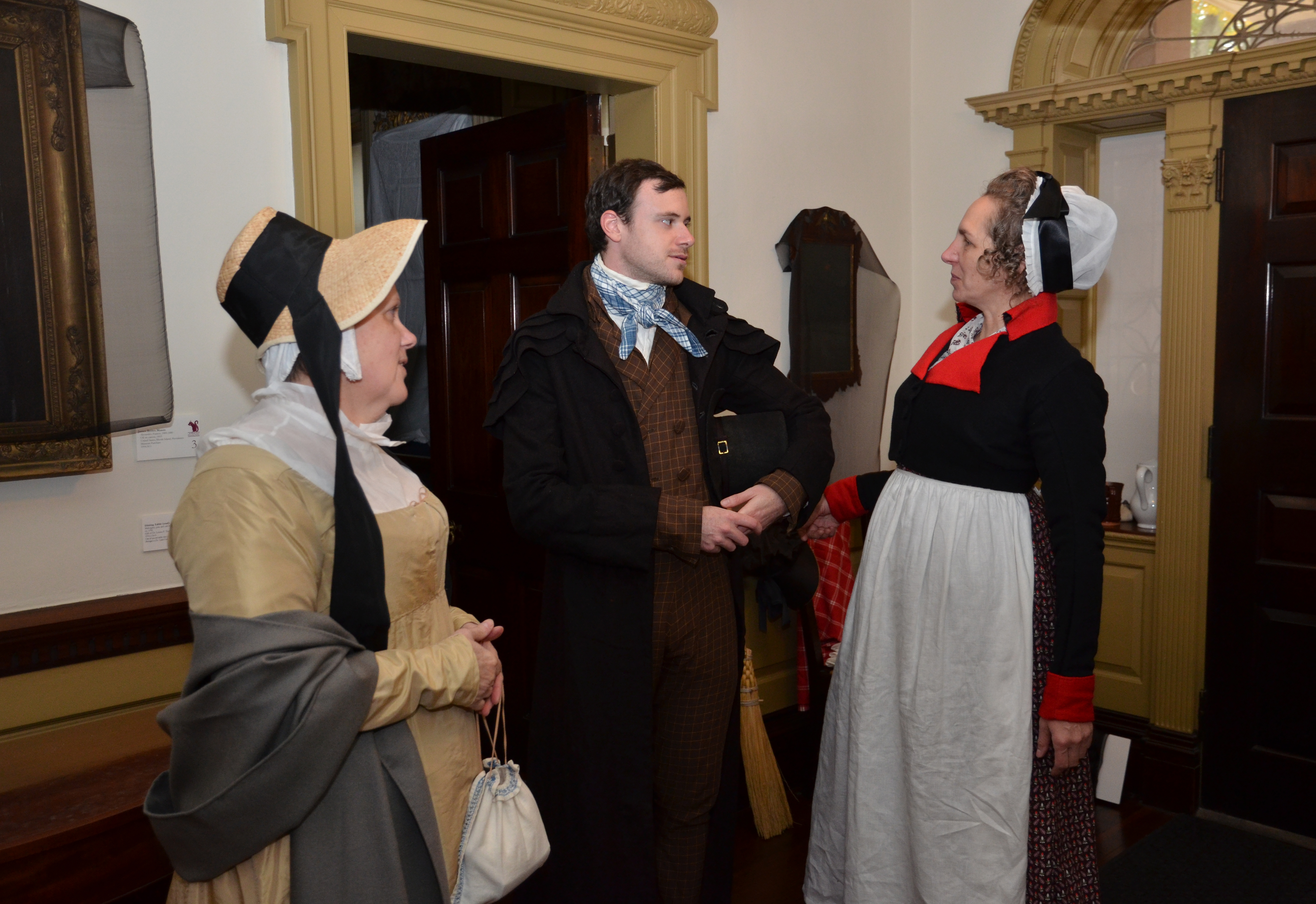
We had many callers

We did have many callers Saturday afternoon, as John Brown was such a significant figure in Providence. He accumulated significant wealth, as Mr and Mrs Thurber attested when they came to inquire about the profits from the voyage Mr T had invested in– $30,000!

Callers pay respects to Mr Brown
Mr and Mrs Thurber pay their respects to Mr Brown

Thirty thousand is a fine sum indeed, though one wonders where Mrs Thurber might spend those proceeds. While a generally refined person, she made many inquiries about sherry, so I was relieved I’d had the foresight to lock away the decanters. So many people call during a time of grief that you cannot be too careful.

1803 ladies ponder fashion plates
Considering mourning dress options

The mantua maker came to call, bringing black silks and plates for the ladies to choose from. We have had a mix of joy and sorrow in this house, and it is only of late that Mrs Francis (on the left, in blue), has left behind her more matronly garb following the death of her beloved husband John Francis in 1796. It was a crushing blow for her, but she does seem to have recovered now.

1803 woman and baby
Mrs H and her darling daughter, Anna

Mrs Herreshoff was with us, visiting from Point Pleasant in Bristol, and her mother found baby Anna, now just more than five months old, a great consolation indeed. Anna was dressed in mourning for her grand-papa, though she will not remember him. Despite the many callers, baby Anna was truly an angel.

Historical minister and coffin
The Congregational minister called.

The ladies upstairs were a respite for us servants, though we were comforted by the visiting minister from the Congregational church. They cannot make up their minds to a new minister, now that their beloved Dr Hitchcock has left them for heaven. They try on new ones for size nearly every week, and while that is not my congregation, I do think the Reverend Cooke is an excellent choice, combining devotion with humor.

costumed interpreters
The sexton’s son came to inquire if Mrs B wished rent the hearse

A more troublesome caller was Mr Richard Hoppin, son of the sexton at First Baptist church. They do possess the sole hearse in our town, and kindly (for a fee) provide it in times of need. I’m not certain of Mr Hoppin’s stability, for he was inclined to– well, to hop!– in our hallway, a most inappropriate action. The widow did seem to cause him fright (she is a formidable personage, as one would be, after so many years married to Mr Brown), so perhaps he was merely addled by his encounter with her. She wisely inquired after the solidity and soundness of the hearse, for Mr Brown was a substantial figure.

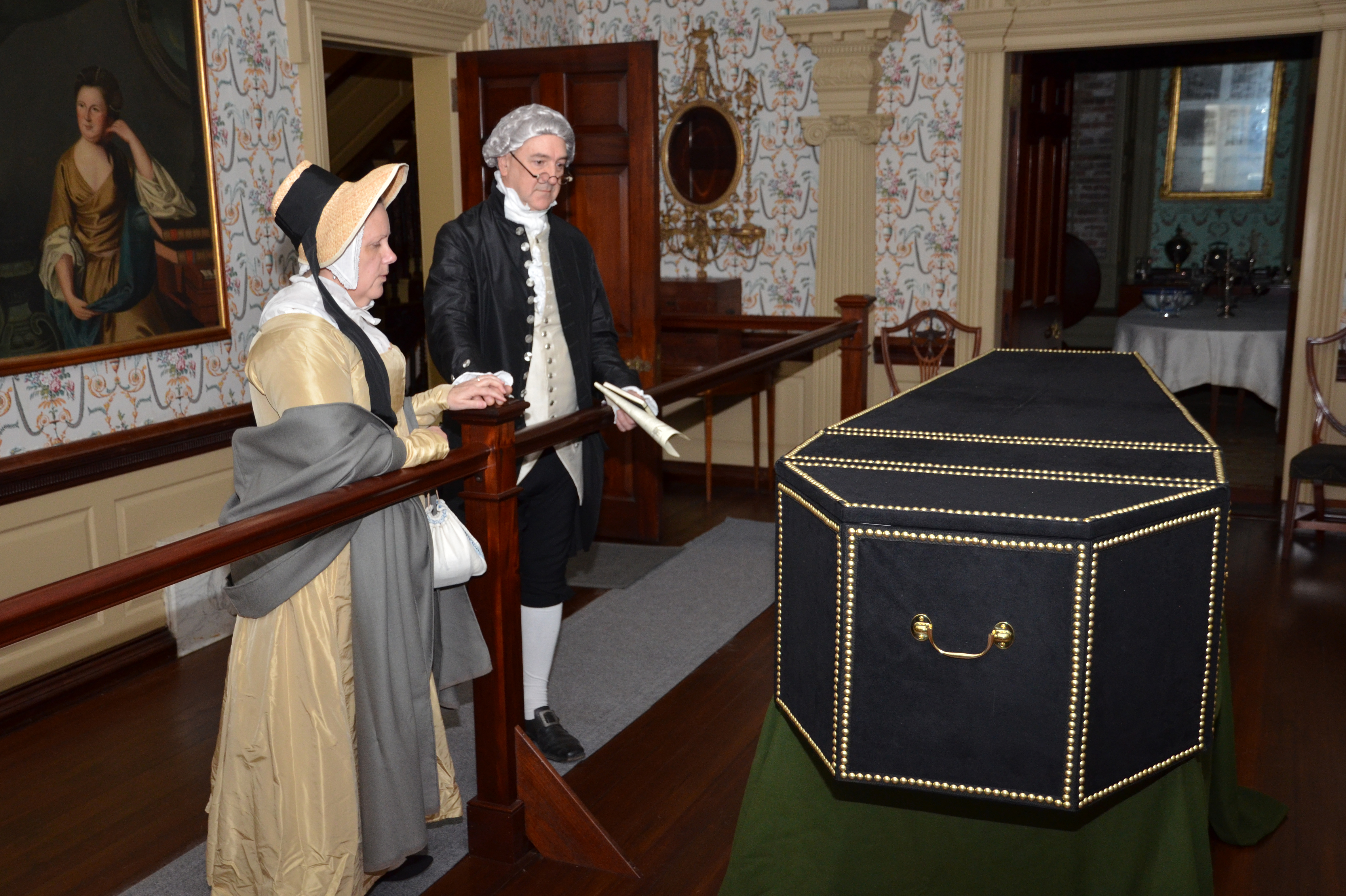
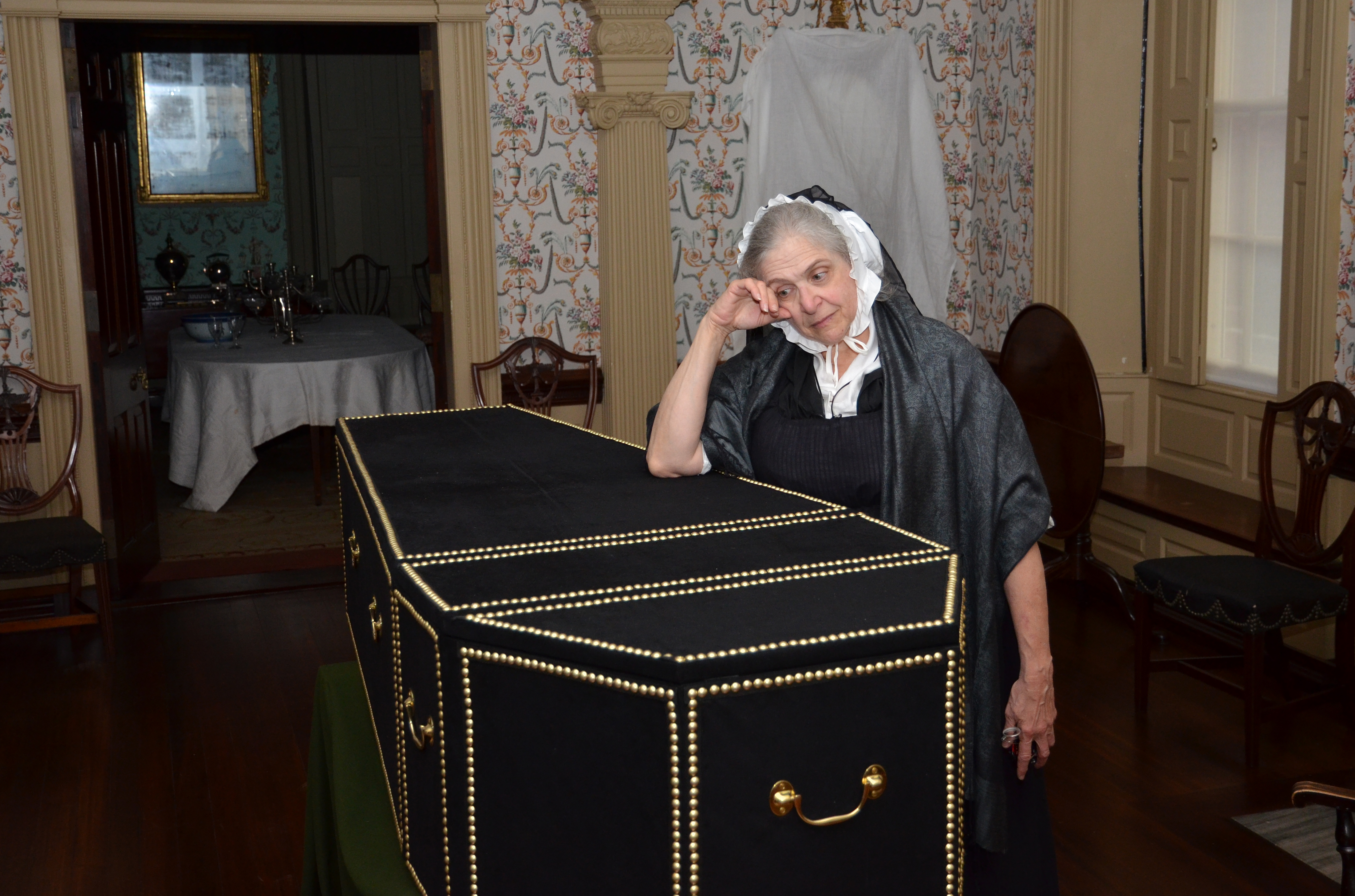
1803 widow and coffin
The widow Mrs Brown reflects upon her late husband

Mr Brown was a great support to us all, and his absence will truly be noted in our household and in our town. I do expect the house will feel empty without his presence, and that Esther, Goody and I will much remark upon the quiet as we go about our tasks.

costumed interpreters on the steps of the John Brown House
The obligatory group photo finale.

From an administrative and managerial stance, this What Cheer Day was different: we cut the interpreted day in half, running the event from 1:00 till 4:00, but still saw about the same number of visitors as we had in a six-hour day. A shorter day meant interpreters were somewhat less exhausted by the close of the day (costumed staff who started their day at 5:00 AM excepted), and the schedule did not have to be as detailed as in previous years. We also reprised a “make your own miniature” activity from the August George Washington 1790 event, and brought in period musicians, who played in the Washington Wallpaper room while people colored miniatures. We also put out an exhibit of memorial art and mourning jewelry, to help contextualize the miniature activity. Since we’ll be leaving the coffin on display and the mirrors and portraits draped through next weekend, a small display (three cases, labels finally finished at 11 AM on the day of the event) seemed like a good idea and opportunity. Upsides: chance to show off the collection, engage people in a hands-on activity, multi-sensory experiences. Downsides: Slightly more to accomplish than hands to do the work, still short a servant, always a little rough the first time you change topics. Unexpected bonus: slightly bumpy transitions in personal life make a suitably sad housekeeper. Score!