
Hell is a Hand Basket

Gentle Reader: Remember the post on semiotics? We need to go back to that once more.

Just what are we looking at here?
copley_john-singleton-mrs-daniel-rogers-middleton-collection

John Singleton Copley.
Portrait of Mrs. Daniel Rogers (Elizabeth Gorham Rogers), 1762
50 X 40, oil on canvas.
Middleton Collection, Wake Forest University
HC1991.1.1

Hmm…. 1762. Does that dress look like 1762 to you? Or does it resemble a 17th century garment? Check out those sleeves: scallops. The shift sleeves: super full. The line of the gown at the neck: a shallow scoop. The front of the bodice: closed.

Are those the hallmarks of a typical 1762 gown in New England, England, or France? You are correct, sir: They are not.

What’s happening here? What is Copley doing, and why?

He’s making his subject look good, reflecting her wealth and status. He’s flattering her by painting her in a faux-17th century gown, a “Vandyke costume, a popular artistic convention in England related to the vogue for fancy dress and masquerade.”* 1762 seems a trifle late for this convention, but in 1757, James McArdell produces a mezzotint of Thomas Hudson’s portrait of the Duchess of Ancaster. Henry Pelham wrote to Copley in 1776 that he had purchased one of those mezzotints, suggesting their use as references for Colonial American painters. Reynolda House has a nice explication of this style of dress in the Thëus portrait they own of Mrs. Thomas Lynch, shown below.
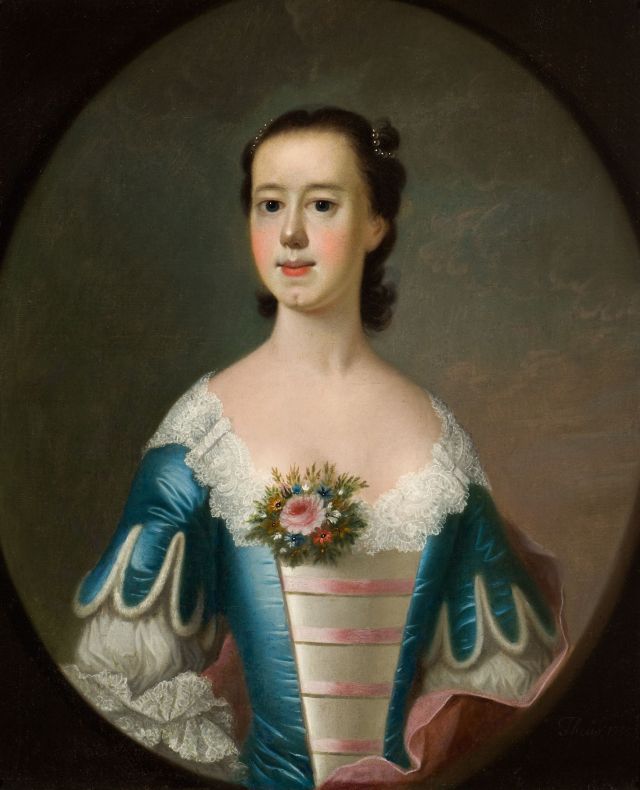
Mrs. Thomas Lynch, oil on canvas by Jeremiah Thëus, 1755. Reynolda House, 1972.2.1

There was also a convention of portraying women in “timeless draperies,” following the school of Peter Lely and Godfrey Kneller, both late 17th-century English painters who produced portraits with generalized costumes.
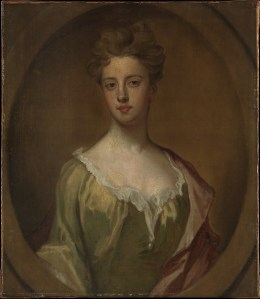
Lady Mary Berkely, wife of Thomas Chambers. oil on canvas by Sir Godfrey Kneller, ca. 1700. Metropolitan Museum of Art, 96.30.6

This portrait by Kneller (born in Germany, he worked in England) explains a lot, doesn’t it? And this timeless convention persists for some time, and the stylization of the facial features and hair is copied by English and colonial American painters. John Smibert, long familiar to many of you, was a leading practitioner of this style of portrait, and his work would have been well known to Copley and his sitters.
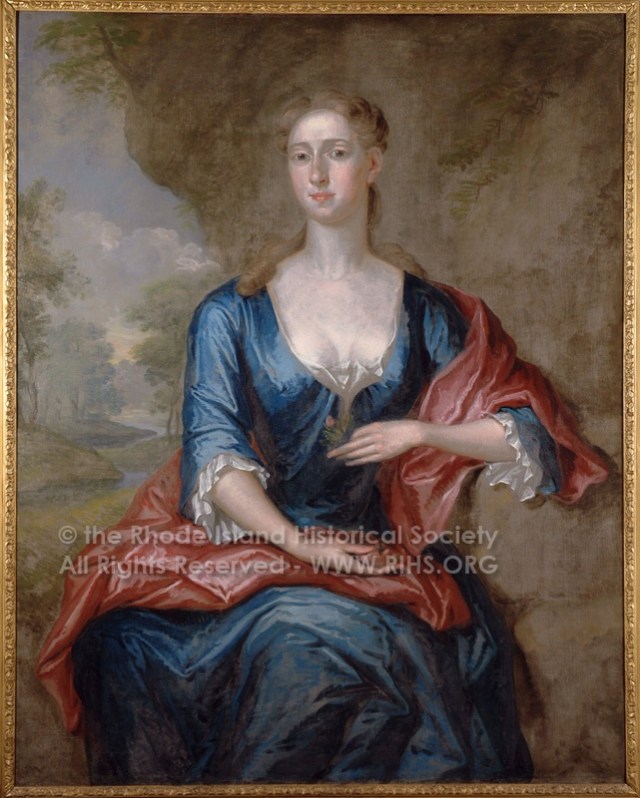
Mrs Samuel Browne by Smibert, RIHS 1891.2.2

Blackburn’s portrait of Mary Sylvester adopts two conventions at once, in a way: she’s in timeless-style drapery and fancy dress as a shepherdess. Let’s remember, too, that there’s symbolism in the shepherdess imagery, referencing pastoral innocence and Mary Sylvester’s unmarried, presumably virginal, status. Don’t believe me? Read the catalog entry, written (at the very least) under the supervision of actual, degree-toting art historians.

Mary Sylvester, oil on canvas by Joseph Blackburn, 1754. Metropolitan Museum of Art, 16.68.2

Where does that leave us with Mrs. Rogers? She’s portrayed in what is essentially fancy dress, holding her straw hat in her left hand (much as Mary Sylvester is) with a basket over her right forearm. You will note the open work of the basket, the delicate arches and the fineness of the base. What’s in it? Something gauzy, as light as the drape around her shoulders, with a square of dark blue silk and a fine white silk ribbon. Honestly I am not entirely certain — the resolution of the image is dreadful.

But what’s NOT in the basket? A redware or pewter mug, sewing, keys, bottle, food, candy, toys, or, really, anything of a very concrete or practical nature.

Is this image a justification for carrying a [nearly empty ] basket on the streets of Boston? Of course it is–as long as you justify walking the streets of Boston in imaginary or fancy dress.

*p.106, Ribeiro, Aileen. “‘The Whole Art of Dress’: Costume in the Work of John Singleton Copley.” John Singleton Copley in America, Metropolitan Museum of Art, 1995.
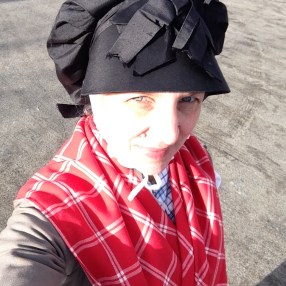
Fashion, Fantasy, and Intention

Fort-based: as military as I get.

I am not a costumer, not really. But I’m not really a re-enactor in the classical sense: I no longer roll with a military unit and my military experiences are typically fort-based domestic activities. My favorite events have me representing women’s work in the past, the quotidian experiences of ordinary people. Documentation is my thing: what happened on a particular day, in a particular place. Who was there? What were typical clothes? The foods in season? The gossip of the day?

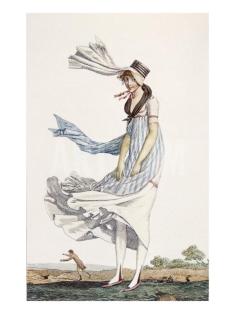
A Lady's Summer Promenade Dress, 1800.
A Lady’s Summer Promenade Dress, 1800.

And yet. Everything I do is really a fantasy, even when it’s work. We are not [yet, always] using the actual words people spoke or wrote. We typically inhabit characters who are grounded in fact but for whom we do not have full documentation. We are representations. We are playing, more than we are being.

I could easily be persuaded to take a walk along a sea wall  or coast to collect seaweed samples for pressing. This would inch me into Austen territory, especially if my friends will join me. I’ve even gone to the lengths of acquiring an appropriate hat, and to make another gown is but nothing in the pursuit of happiness.

Mary Gunning, Countess of Coventry. Jean-Étienne Liotard,.
Woman in a Turkish interior Pastel on vellum, Jean-Étienne Liotard, 1749. Museum of Art and History, Geneva.

If I could truly be a fabulist, I might be tempted to adopt a style a la Turque, for a portrait by Copley or for my paramour. This portrait by Liotard– who was known for his Ottoman works—  is a great temptation, with her patterned overdress and belt with golden clasps, though she is thirty-three years earlier than The Abduction from the Seraglio, Mozart’s comedic and trendy 1782 opera.

If I made myself a Turque (and Reader, it is tempting though useless), I will confess it would be for the multiple pleasures of wearing it, knowing why it had been worn in the past, and for the pleasure of having it taken off me. Because we forget what the European fascination with exoticism and Orientalism meant: they meant sex. The Abduction itself is, in essence, a tale of sex trafficking.

And that is something we do forget about the past, that the clothing we adopt as we portray the past had meaning– sometimes a meaning we miss, when we layer costume upon clothing. Wives and mistresses alike were portrayed a la Turque, and some theorize that this style of portraiture was chosen to portray the sitter in timeless, classic dress. For Copley’s sitters, it was a way to be at the height of London fashion; for Lady Mary Montagu, Turkish dress allowed her to travel freely in the Ottoman Empire. But portraits of women in Turkish dress situated in Turkish interiors were also allusions to polygamy and to sexuality, and there is no way of escaping the fact that paintings of women were largely made for men.

So what, then, of fantasy dressing in the past? What sense can we make of historical representations of “Oriental” fashion? How do we understand what our clothing and our appearance means? Every choice we make is layered with meaning, in the present and in the past.  For women, routinely objectified by society, the meaning of our clothing is particularly important, even when, or perhaps especially, when it is not what we want to focus on.