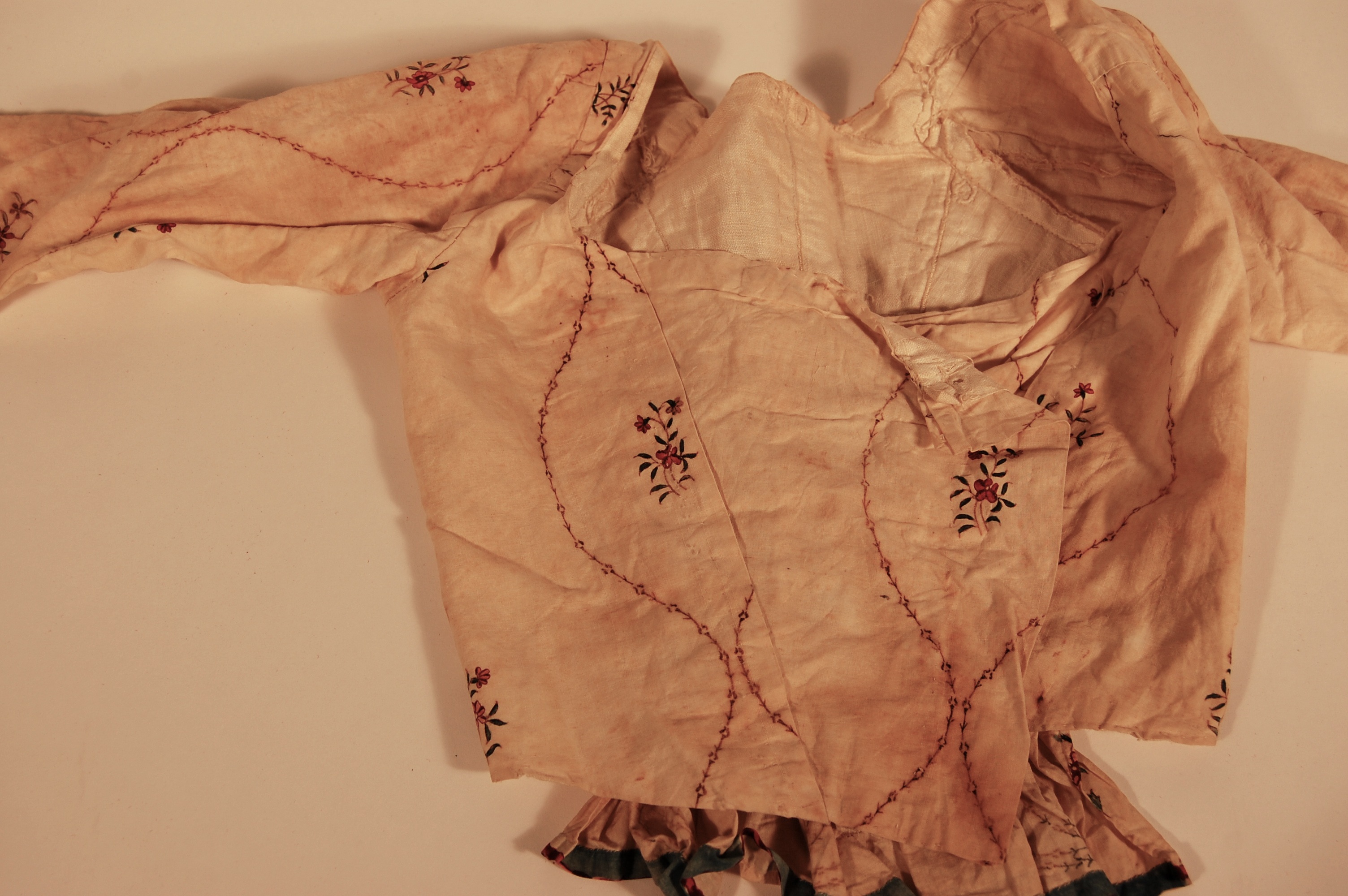
Bodice, painted Indian cotton, 1780-1795 RIHS 1990.36.27
Once upon a time, not very long ago, when I worked in a historic house museum, I was asked to present at a conference in Worcester. I chose to talk about these fragments, and I still like to think about them. The delicate fabric was saved as a pair of sleeves, a bodice with a tiny peplum, a skirt.
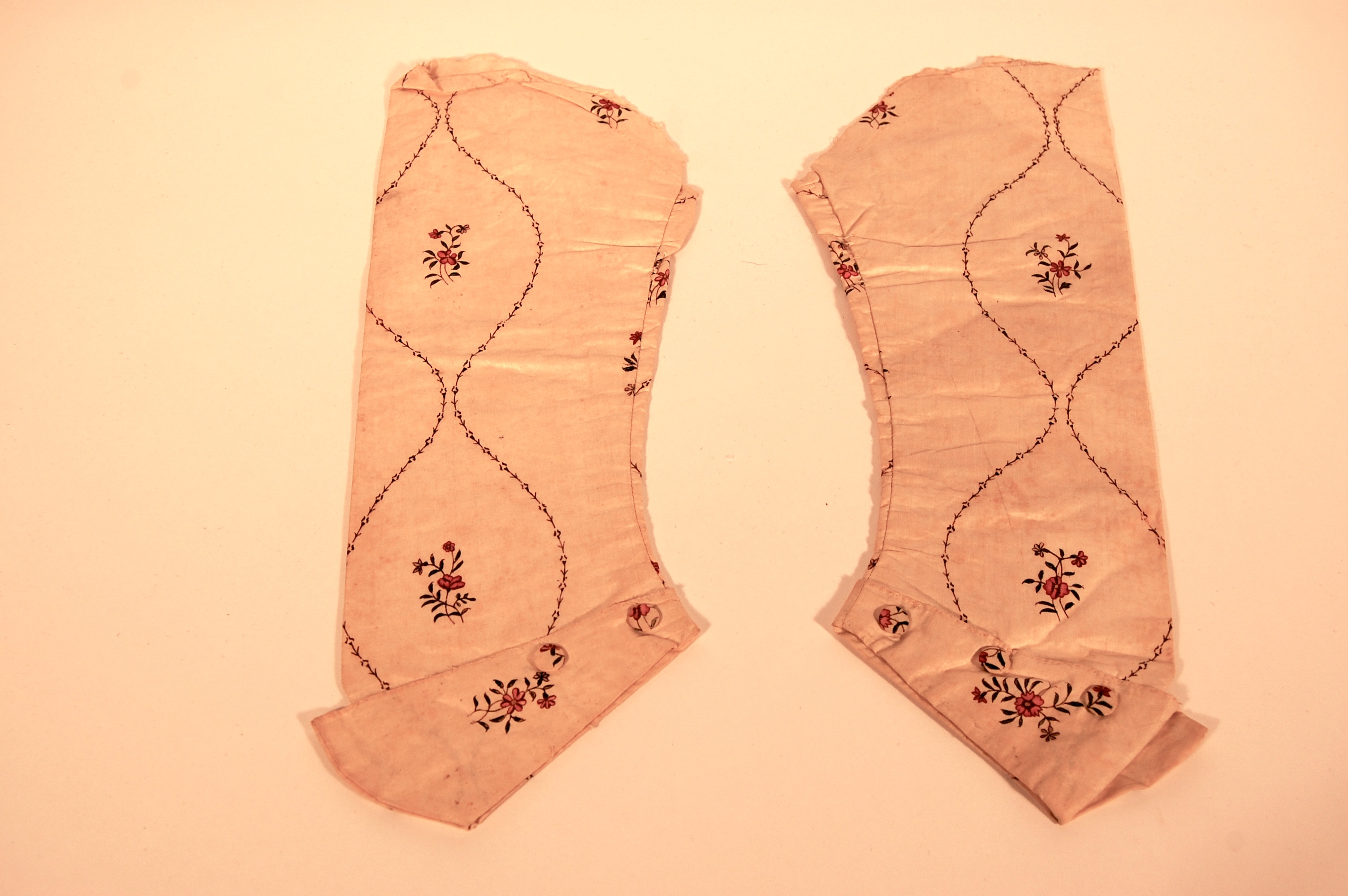
Sleeves, removed from bodice 1990.36.27. RIHS 1990.36.25A-B
The pieces appear to have been part of a pieced-back closed-front gown with a matching petticoat circa 1785. I think someone decided (quite rightly) that the style was too passé for 1795, and altered the gown significantly.
Not only is there evidence of new sleeves being fitted into the gown’s armscyes, we have the sleeves-that-used-to-be. And my dear! No one is wearing sleeves like that this season!
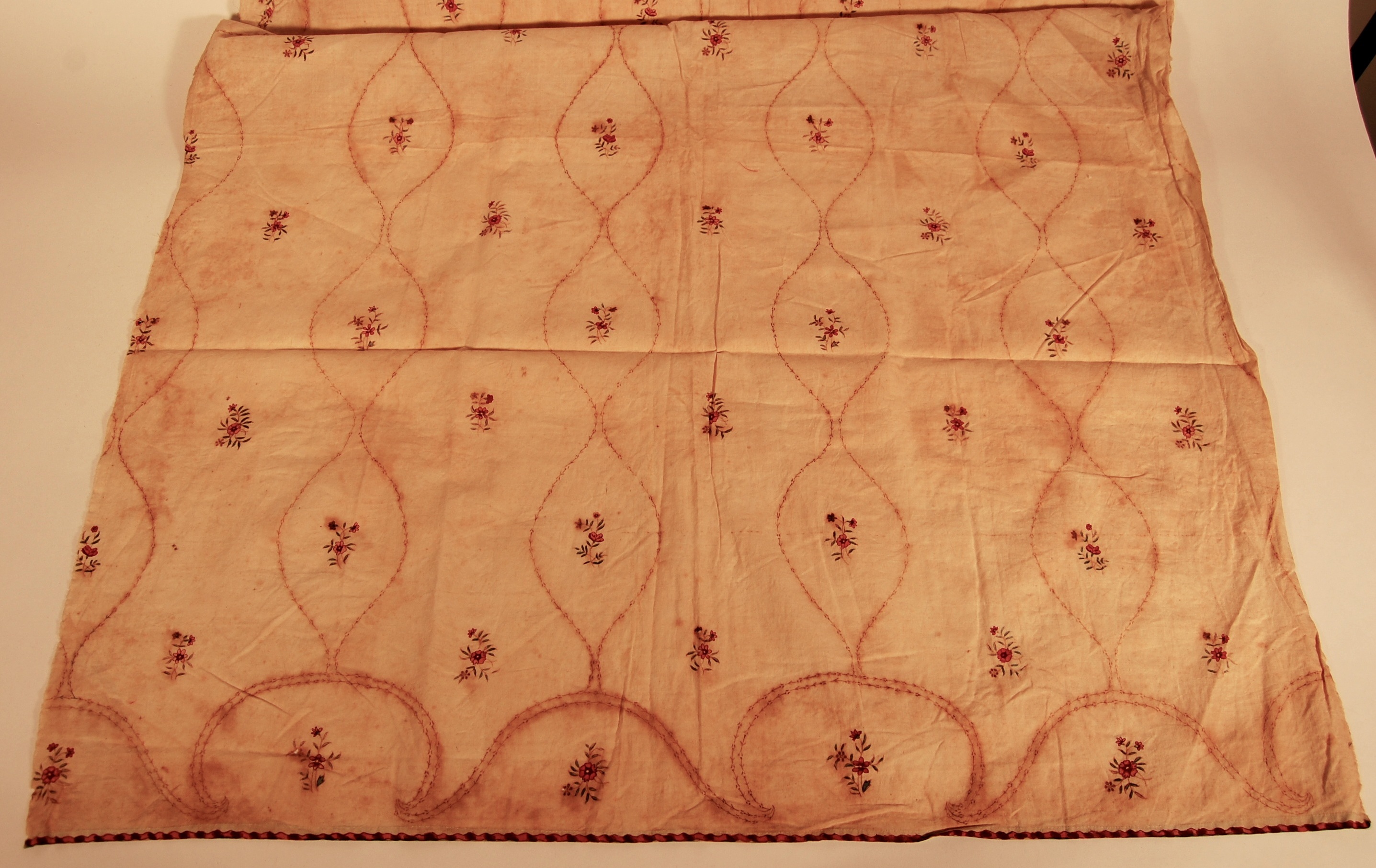
I find these garments in limbo really fascinating. Was that bodice finished and worn with a matching petticoat? (Yes, there’s a panel of that left, too; what a lovely hem!)
Skirt panel, painted Indian cotton. RIHS 1990.36.33
Who wore the gown? Was it Sally Brown, born in 1773? And did she alter it, or did her sister’s mantua maker, Nancy Smith? We can only guess at this point, as so many documents remain in private hands. The alterations are not as finely done as the original gown, so I think there are two hands at work here– whose were those hands? There’s always more to think about and learn.
In case you’re wondering, thanks to the Met, we can see what the gown probably looked like in its first incarnation, and then what the alterations were meant to achieve. (Link to the gown on the left; link to the gown on the right.)
With 400 miles between us, Drunk Tailor and I have few chances to explore the past together, so I was both delighted and nervous when he agreed to join the British Garrison 1775 event at Fort Ticonderoga as one of Captain Delaplace’s servants. Even better, we were also joined by the itinerant Deep North Yankee who wandered around the Fort (possibly seeking roofing shingles, of which he is much in need).
Friday nights are always magical, candle and firelight (and only the warmth of the fire) as we drink cider and talk about history. But morning always comes: Saturday, cold and clear, Mr S and I woke and blinked across the room at each other, and I wondered to what degree I really wanted to ever crawl out of bed…only hunger and an eventual need to pee (and fear of a Sergeant) propelled me.
Yup, you cook ’em on a board.
First order of business: breakfast. Mr S, supplied with his corn meal of choice, made us johnnycakes, which provided perhaps more interpretive than nutritive value. Still, they were warm and tasty and he is the only person I know who can make them; my efforts end up as FEMA disaster sites.
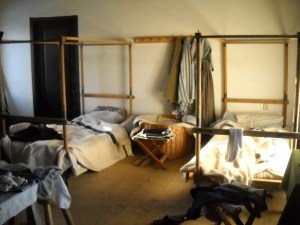
Captain Delaplace’s servants were tasked with cooking for his mess, so Mr S and I got a start. We had a chicken, an onion (I traded onion # 2 for some bacon), butter, carrots, potatoes, a butternut squash, salt, and some port. I don’t know where this English serving woman of 1775 encountered mis en place, but she accidentally introduced coq au vin to the Captain’s table with the dinner meal.
Captain and Mrs Delaplace dining, manservant in attendance
The Captain and his Lady dined on chicken braised in butter and bacon with root vegetables in a port sauce; we servants waited until they were done before we could eat. (Confession: I need to eat a lot, and have a sensory overload problem, so when visitors fully crowded the room, I had to dash across the parade ground for a Clif Bar and an Ativan before I could continue to wait for my dinner.) In the afternoon, dishes were washed at the table, as was common (at least in early New England), dried, and set away, while the Captain’s lady and child played in the cabbage patch between the beds.
When the room was empty, servants were able to eat (huzzay!) and found the meal very tasty indeed. I would certainly make this again, and learned more about cooking– a typically female task I generally try to avoid– than I had expected to. Then we had yet another round of dishes before it was time to tidy the room and make ready for tea or supper.
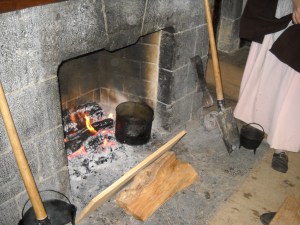
To that end, we cleared the table and broke it apart to reveal the floor and hearth, which needed to be swept of bread crumbs, squash peels, dead leaves, and other detritus. The best way to sweep an unfinished floor in the 18th century (per Hannah Glasse et al) is to strew the floor with wet sand and then sweep. I mixed sand with lavender-infused vinegar and threw it on the floor; this keeps the dust down as you sweep months of dust and dirt out of the corners and from behind tables and chests.
The trick is to sweep in one direction (more or less) from the back of the room to the front, and then to gather up the sand (here in a shovel) and pitch it off the landing. Much was thrown out the door and over the stair rail, just as servants would have done in 1775. (And I am told it is soothing to nearly hit the sergeant, but perhaps that’s merely hearsay, if not heresy.)
When we were done, we restored the table (Drunk Tailor noticed the height of the ceiling, and wondered about hanging birds in cages whist awaiting the return of the tabletop), fully reset with cloth, candlesticks, plates, and knives, ready for the supper we didn’t cook, as we skipped away at the close of the day to find our own meal in Glens Falls, where live music is inescapable on a Saturday night.
But here’s the thing: they didn’t carry the shopping, because they didn’t do the shopping– not the big shopping, anyway.
La Pourvoyeuse, oil on canvas by Jean-Simeon Chardin, 1739. Louvre Museum.
La Pourvoyeuse by Chardin shows a woman returning from market in 1739. No basket. A bundle or bag with a fowl in it, head down. Unwrapped loaves of bread. But clearly a servant.
From waste books, it’s pretty clear that people are sending their “boys” and “girls” (servants or slaves) to fetch liquor. That will come home in bottles, like the ones at the feet of La Pourvoyeuse. And I think it comes home just in their hands, but perhaps- and more likely not– in a basket. A floppy basket, usually for floppy birds.
Balthazar Nebot, active 1730–1762, Spanish, active in Britain (from 1729), Fishmonger’s stall, 1737, Oil on copper, Yale Center for British Art, Paul Mellon Collection
After the meteoric rise of consumerism, after department stores, yes: shopping is more like what we do. But in the pre-ice box and pre-packaged era, meat cannot be bought and frozen, and milk will not last all that long. Things were brought home one at a time, or a few at a time, many times a week. And middle class ladies bought small things– ribbons, almanacks, shoes– and bring them home in their pockets, just in their hands, or, I would guess, wrapped in a bundle of paper (a pair of shoes) or in a band box (a bonnet) if the things are not delivered.
A long winded way to say, I don’t know: but I’m pretty sure middle class ladies sent their servants out frequently so the ladies didn’t carry baskets and the servants used bags, aprons, and their hands.
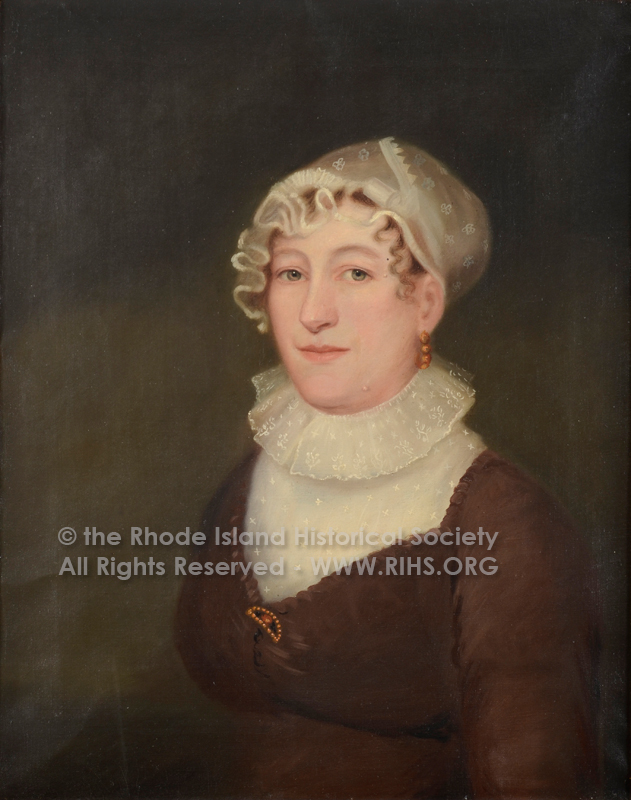
Mrs William (Jane) Pabodie. oil on canvas, 1813. RIHS 1970.60.2
Jane Jewett Pabodie, born around 1771, died 23 March 1846 is buried in Swan Point Cemetery on the Seekonk River in Providence. She was the wife of William Pabodie– which one? Well, it’s hard to tell until I really dig into the genealogy. At the moment I am so besotted with this image that all I can think about is what she’s wearing!
What she’s wearing….about that. I have some work– and some thinking– to do. The cap is slightly confounding. It’s a chance to learn a great deal more about early federal caps, which is good. I don’t understand it, which is unfortunate. The asymmetrical nature of the cap is new to me- or at least I cannot think of another example, so feel free to school me, people. But really: it is asymmetrical! With a ruffle on what is the right side of her head, and a… pinked? Van Dyked? Prairie pointed? band that runs from her left ear around to the back of her right ear? I’m confused. It would make more sense if the cap had slipped, but why would the Pabodies pay for a painting that recorded such a thing?
Honestly, I think the only way to really understand the cap is to make the cap. In muslin first, thankyouverymuch, I’m not that crazy.
Detail, Mrs William Pabodie. Oil on canvas, 1813. RIHS
The chemisette is more straightforward, being made of a sheer figured or embroidered cotton with a slightly gathered collar embellished with floral whitework embroidery. That I think can manage, at least in the basic construction (fabric, well, I’m looking).
Of course, why do I feel the need to manage all of this, with a deadline now less than eight weeks away? For a program, of course– I have only to write the copy for it. The idea (for me, anyway) is to replicate a portrait as closely as I can. Now, Mrs Pabodie and I are not exactly the same age, but I think I can pull this off…the cap, more troubling.
It’s an interesting project for me, not so much from the sewing point of view, but from a conceptual standpoint.
How close can I get? What does exactitude mean?
If I want to represent a character, what’s more important: understanding the clothing, or understanding Jane Pabodie? Constrained as I am by modern materials, unable to match these exactly, how do I navigate choices based on suppositions of what an artist meant to represent? Just my kind of conundrum.






_-_WGA04759.jpg)


 Kirsten Hammerstrom
You must be logged in to post a comment.