Cakes and Honey

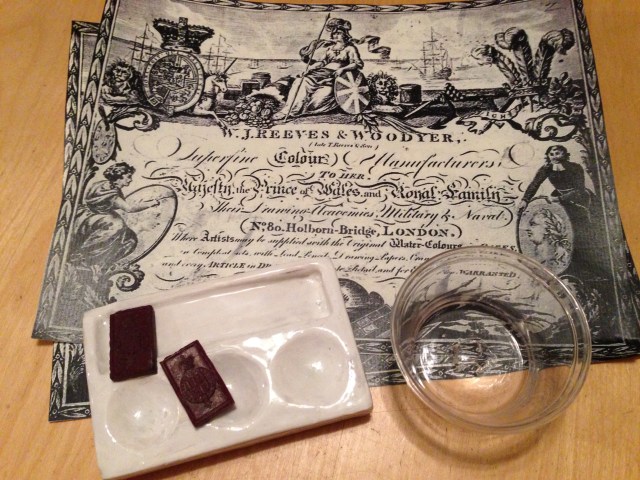
Watercolor cakes: first invented by William Reeves in 1766 and sold in an improved form in 1780, watercolor cakes made painting easier then before. Colors still had to be ground in water to be used (that’s what the rectangular depression is for in the ceramic palette), but that was a step ahead of grinding the pigments with gum arabic yourself. Each pigment (usually a mineral, sometimes not) requires a specific amount of gum arabic, and in the 18th and early 19th century, both gum arabic and gum tragacanth were both used. In this era of experimentation, even gum hedera (from Hedera helix, or English ivy) was used, both as a diluent for animal glue size and in egg white varnish. The variation in gum types and amounts found in watercolor cakes and cake remains gives us an idea of how much experimentation and variation happened in the pre-industrial era of color production.

The Art of Drawing and Painting in Water-Colors, London: 1735.

Recipes (or receipts) were published beginning at least as early as 1730, with the promise of better, richer, and cheaper colors (qualities that did not always coexist easily). It’s not clear whether the watercolors sold in the American colonies were made locally or imported from Great Britain, but my best guess is that prepared watercolors (sold in shells and out of shells) were probably imported, if only because the sellers so often list many other goods.
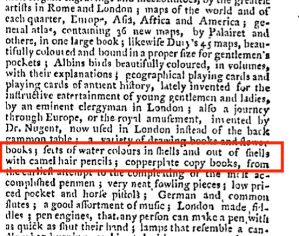
Nicholas Brooks Ad, June 21, 1773 Pennsylvania Packet (Philadelphia).

How watercolors are sold evolves over time and varies by place: In 1771 Boston, John Gore, who specializes in artist’s materials at the Sign of the Painters Arms, offers “Water Colours ready prepar’d in Shells” in addition to a variety of artists’ pigments probably ground with different media to each artist’s specifications.
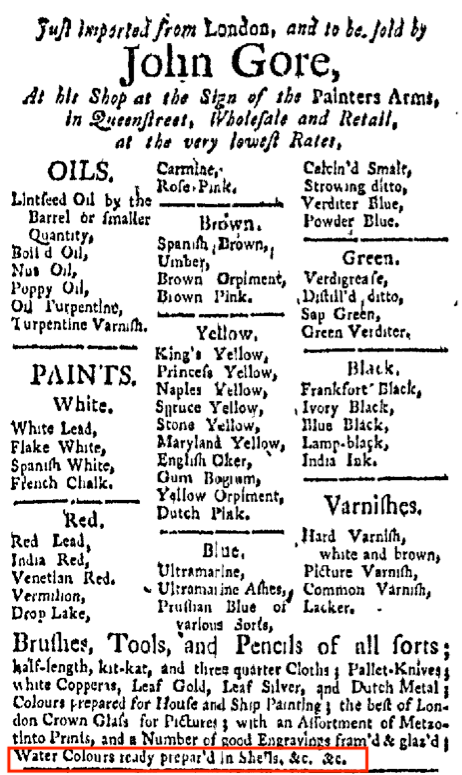
John Gore, Boston Evening Post, March 25, 1771.

Ten years later, Valentine Nutter, Stationer, offers “water colours in drops, shells, or galley pots,” suggesting that some cakes were prepared in ceramic pots or dishes (gallipots) and available in the United States by 1781. What the “drops, shells, or galley pots” looked like exactly is slightly conjectural: drop are probably corked bladders or bottles; shells are probably cockle shells (watercolor being concentrated means one wouldn’t need a cherrystone clam shell, let alone a quahog) but “galley pots” seem more elusive until you consider the Wedgwood paint chest.

blue and white jasper ware paint chest or box for moist watercolours: English, Staffordshire, Etruria, by Wedgwood, c. 1787. National Museum of Scotland, A.1893.84 A

The tiny pots that drop into the oval tray fall within the gallipot definition, and give us an idea of what Mr Nutter might have offered in his New York shop, filled with ground pigment, gum arabic, and a portion of honey to make the cakes re-wettable. Not every artist working in watercolor used honey, as recorded in a 1775 letter from John Singleton Copley to his mother, recording that “Mr. Humphrey tells me he uses no Shugar Candy in his colours.”

Reading the Night

Francois-Robert Ingouf after Sigmund Freudenberger (French, 1747 – 1812 ), La soiree d’hyver, 1774, etching and engraving, Rosenwald Collection 1943.3.4377

Details. It’s all in the details, right? I see this print multiple times every day, and contemplate the little stories in the details of the room.

Francois-Robert Ingouf after Sigmund Freudenberger (French, 1747 – 1812 ), La soiree d’hyver, 1774, etching and engraving, Rosenwald Collection 1943.3.4377

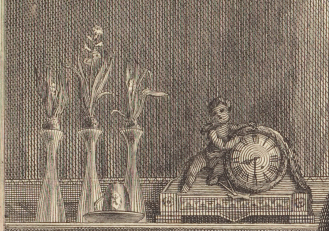
Perhaps the first thing I noticed that jarred my eye (and my thinking) was the row of glass vases for forcing bulbs. They look so modern, don’t they? But the shape is classic– form following function– and findable today. How pleasing that my mother’s winter ritual of filling windowsills and mantles with forcing bulbs can be visually documented to one of my favorite eras–and was, indeed, common in the past. This is one of those “everybody did it” ideas I can endorse.

What else is on the mantle? A clock, undoubtedly ormolu– though it could be much worse. And yes, the cupid on the clock has meaning in this print.

And then there’s this: the hot water urn– or is it?

Tucked into the fire place, I was initially pretty sure that’s a hot water/tea/coffee urn, meant to go with the tea or coffee cup on the mantle (see above; it’s in front of the bulb vases). Hot tea or coffee would be welcome on a cold winter’s evening, and the water would stay warmer tucked close to the fire.

18th Century Cast and Wrought Iron Fireplace Fire Grate

But it could also be a decorative fender, ornamented with urns at the ends. The fireplace grate shown here is English, made ca. 1780 according to the seller) but should you have space cash burning a hole in your pocket, there’s a similar 19th century reproduction of the one in the print for sale on the interwebs, should you care to recreate this image (I know some of you have the clothes). In fact, there are quite few fenders-with-urns, once you start looking, some in bronze and some in steel.

And what of this? Is that an 18th century dog house or covered dog bed? Yes, it is.

The bouillotte candlestand on the table is another nice household detail, illuminating a book lying open on the table set against the wall.

It has taken me some time of looking at period images to accept these candle stands as correct, since my experience with them was grounded in electrified reproductions in suburban Colonial Revival dens and family rooms– a location I will admit I was prejudiced against to begin with, having grown up in a city surrounded by architects devoted to (and buildings by) Mies van der Rohe.

But therein lies the point of looking: what initially seems absurd (Versailles-quality dog beds) or simply anachronistic (candlestands with shades) slides into place when seen and understood, within its proper context.

Reap what you Sew

Too big!

Lampshade: She’s been the Holy Grail of bonnet making.

There were several failures in the winter of 2016, and some revisiting of the Whale-Safe Bonnet as I tried to figure out the brim and the caul. My first efforts made a caul that was waaaaay too small. That’s not necessarily a bad thing, as I’ve made plenty of too-big bonnets. (Too small did not make the move from RI to VA, but trust me: too small a caul was far too small.)

This morning, I took another look at George Stubbs’ paintings of working women. I know the lampshade-like bonnet is pre-1770, but where are we at the end of the Revolutionary War period? Well, BIG was in, obviously. (We can have a healthy debate about the likelihood of these gowned women depicting actual working women, but for now, let’s stick to bonnet brim shapes.)  They’re a little cone-like, aren’t they? With generous (yuuuge) cauls, though.

Now, I have gone about this all a bit backwards, which is to admit that I picked up the shellacked brim of yesteryear that did make the move down to VA, and decided to make it up as a bonnet yesterday. The brim is easy– trace and cut with a seam allowance– but the caul? I winged it, using a selvage edge for the inside of the back drawstring (I like my headwear to be adjustable and pack flat) and economized on fabric to leave plenty of taffeta left over. So there’s nothing particularly well-researched about this, except for all the years of looking and thinking and drawing and making that came before the moment I threw this all together yesterday afternoon watching North by Northwest and drinking a Manhattan.*

Making this up raises more questions: how individually fitted were bonnets to wearers? Did caul and brim size vary depending on wearer? What’s the class line below which a woman doesn’t have a bonnet, but only a hat? How quickly did styles change? The sort-of-conical black bonnet is seen on “older” women in paintings well past the height of the style. But as I’ve asked before, what do we really understand about the portrayal of age in art? Are we really reading the symbols correctly? How well do we grasp the semiotics of the 18th century? All of those questions are present when we try to replicate the past using only visual sources. Yes, there is an extant 18th century black silk bonnet at Colonial Williamsburg, and we can use that in conjunction with images to make the things we wear. But pondering all of these questions makes me think it’s time for another troll through collections in Great Britain, just in case new cataloging has put old bonnets online.

*See my other blog, TipsyMilliner, for more.

Styles Style: Book Recommendation

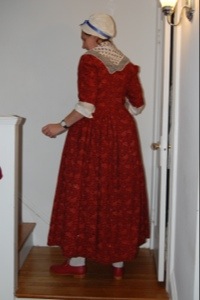
Please forgive the watch– a test shot of a gown from a runaway ad.

This is a quick one, because I’m writing in advance of a trip to New England, but for me, the best secondary source I’ve read that helped me understand the people I was clothing is John Styles’ The Dress of the People. That’s not to say that I haven’t read more, and found period resources and collections of resources equally useful. If you’re doing a poor woman in America, Don Hagist is your man, with Wenches, Wives and Serving Girls (now Wives, Slaves, and Servant Girls. Read Good Wives, Nasty Wenches, and Uneasy Patriarchs for more on period terminology).

I like Styles because he helps us understand the why of people’s clothing, and their wants. For me, context is key (I harp on this a lot) so insight into how many shifts are usual, the fashion for pocket watches, and the activity of the second hand clothes market is really helpful. So despite my love of shiny satin gowns and fashion of all eras, among the few books I didn’t send to storage when I moved was The Dress of the People. I think that’s a strong recommendation.

(researc