The Widow will See You Now

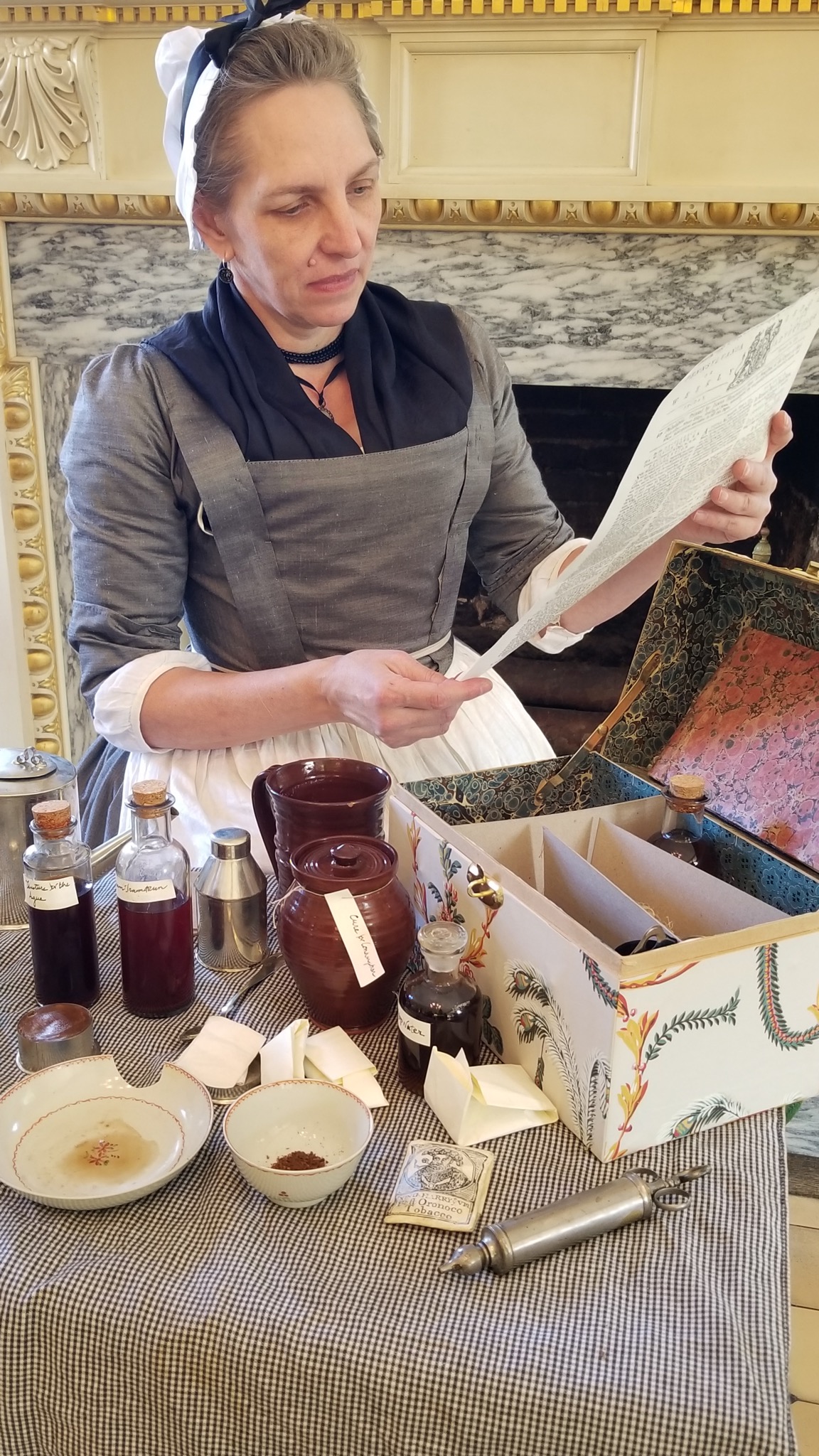
No idea how I lost that pin. Photo by Mike Cirilo. 

Part five: portraying Widow Weed

I almost prefer first person interpretation, largely because it catches visitors a little off-guard, excites their curiosity, and allows me to use more humor in conversation than third person. This time, though, I found that despite the research and thinking I’d put into this portrayal, I couldn’t synthesize the material fast enough to fully immerse myself in first person, having over-scheduled the days leading up to Occupied Philadelphia. 
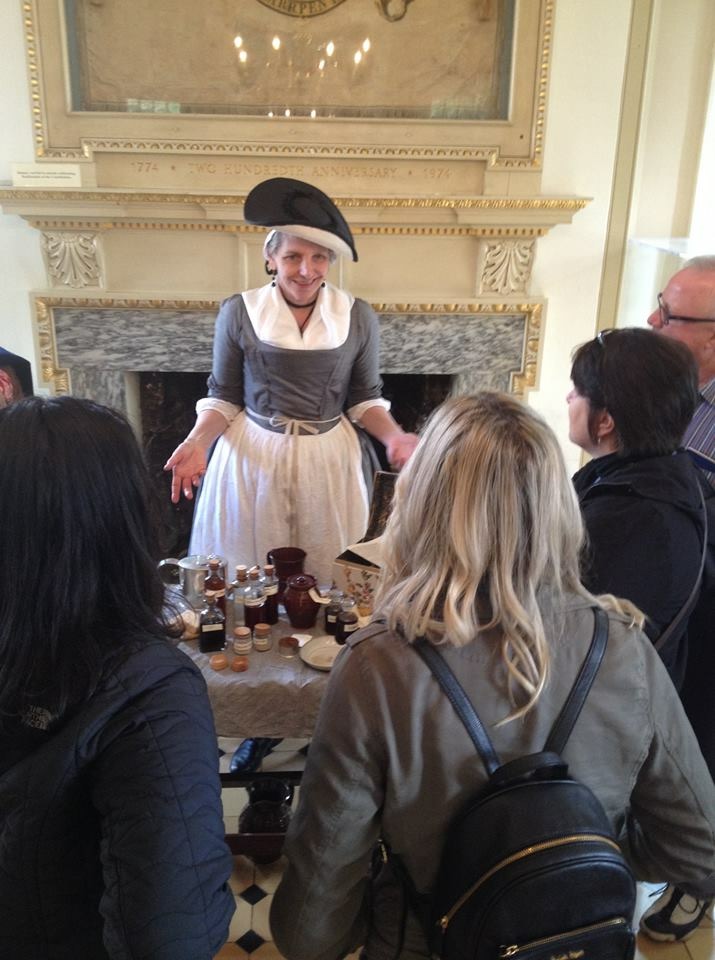
Over the course of talking to 1200 to 1500 people, I was able to synthesize the material, and refine my spiel. Talking about how the remedies could be (relatively) easily made in the kitchen, using ingredients drawn from kitchen gardens, South America, the Caribbean, India and Southeast Asia allowed me to talk about trade networks and the British Empire– a reasonable segue to complaining about a port closed thanks to Mr. Nevell, and a way to explain the effect that has on the city.

One of the most interesting aspects of this portrayal is how well women engaged with it– and enjoyed hearing about a woman with her own business. True, Drunk Tailor was steering women my way, but they also seemed to gravitate on their own. As much as I prefer in situ interpretation over the science fair table style, a table (or counter) offers enough of a barrier to make people feel comfortable approaching. On-street interactions are different, but somehow, indoors, people sometimes react as if one was perfume-spraying staff on a department store cosmetics floor. 
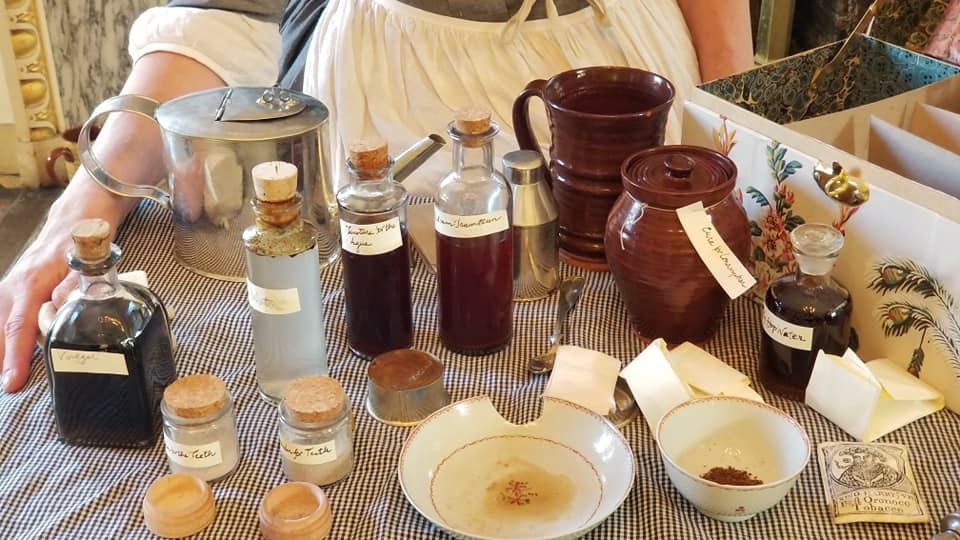
Photo by Mike Cirilo, saucer chip by me.

Not that scent wasn’t an excellent way to engage people! I couldn’t let visitors taste the remedies, but they could smell them, offering the opportunity to play “What’s that smell?” (non-feline edition) and talk about how people use the flavors they’re accustomed to in their medications and treatments. My cats never cared for bubble-gum flavored amoxicillin, but it’s bigger hit with toddlers than the straight-up medicine flavor would be. So, too, with tooth powders past: cinnamon, mace, and nutmeg are the blue raspberry of the yesteryear– though the tooth powders smell much better than they taste. I cannot recommend a weekend of use unless you wish to feel sad each time you clean your teeth.

Mr Nevell finds himself on the list of members of the Company of Carpenters

Drunk Tailor used the relationship between Thomas Nevell and Elizabeth Weed (their third marriage each) to move people around the main room of Carpenters Hall, and to some comic, as well as interpretive, effect. It’s far easier for him to say, “Six months in, six months left, of her mourning” as a means of explaining the grey and black palette of my clothes, allowing me to avoid the “You look like you’re ready for Thanksgiving!” lead in from the public. Confiding in the public that he’s had his eye on me for while lets them in on a secret, and visitors enjoyed trotting over to warn me about his interest, and that’s he’s sold his tools! I am always happy to tell them he’s just the kind of man my mother warned me about, adapting a banter we have used in multiple scenarios. While it’s broad, and nothing like how we really are together, it’s playful enough to engage the public, relax them, and get them comfortable asking questions.
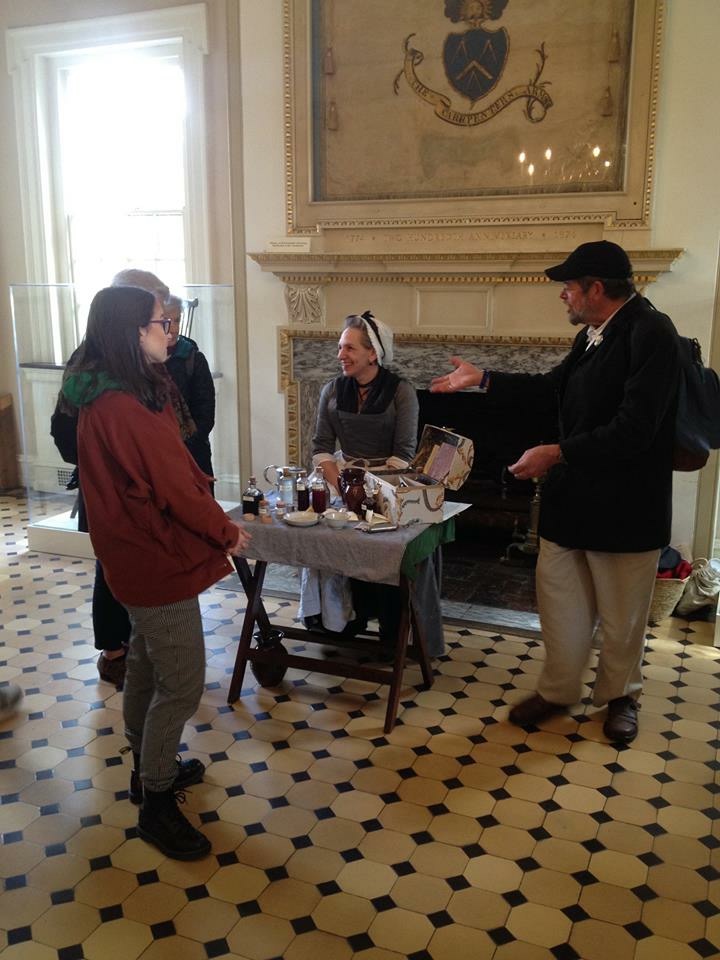
The man on the left talked to me longer than anyone else

There are, as always, things I’d like to change about this presentation. Although I’d like to work on it enough to be more comfortable in first person, I’d miss the third-person ability to refer to 1849 cholera maps and general epidemiology. I definitely need to add a couple inches to the hem of the gown, up my cap game, and trim the mantelet. I’d like to find a wooden box, and add a proper mortar and pestle to the kit– my stainless steel one is perfect for home, but won’t work in public. But on the whole, I’m pleased to have an impression of a woman roughly my age, who can interact well with a character roughly Drunk Tailor’s age. Onward to refinements. 

“shop medicines, ointments, and salves”

Part three of a series
So what did Elizabeth Weed prepare and sell? What remedies were used and preferred in 1777 Philadelphia? And where to look?

The ad is explicit: “The Syrup and Power for the flux, the Syrup of Balsam for coughs and colds, the Royal Balsam, the Bitter Tincture, the Essence of Tar, etc.”

Margaret Hill Morris used William Buchan’s Domestic Medicine as one of her references, but receipts for cures can be found in The Compleat English Housewife, and Hannah Glasse as well. I’ve held a fascination with tooth cleaning and hygiene for some time, so this project was a natural outgrowth of those interests.

Fortunately, ingredients were pretty easy to come by (many already in my kitchen), and a sacrificial pan had been created making wax blocks for sewing kits. We started experiments in earnest October 6th, after coming home from the Draken Harald Harfårge. We did not fully anticipate how much one of the decoctions would smell like the Draken.

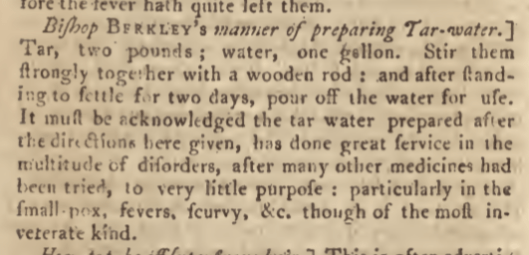
Tar Water was particularly intriguing, since it had been prescribed to John Francis, son of Ann Willing Francis (and eventual husband of Abigail Brown). Francis suffered from poor health, and he and his wife, and mother, all recorded the use of “tar water” in diaries and letters. Eventually I found a receipt that cured me of the notion of drinking tar itself: Tar, two pounds; water, one gallon. After standing to settle for two days, pour off the water for use. 

Well, there it is: water infused with essence of tar, which turns out to be “best Norway Tar,” or pine tar. Decanted, it smells like ships’ ropes coated to protect them from sea water.

So there are recipes to follow (even some of Elizabeth Weed’s own, recorded in the back of Thomas Nevell’s day book); but what does a shop look like? What bottles, pots, jars, and labels are used? The backgrounds of satirical engravings provide some guidance (and some hilarity).

In the background of the print at left, we can see some of the furniture and equipment of the pharmacists’ trade. Wooden pharmacy chests with drawers for ingredients; glass bottles above, with round-topped stoppers; above that, ovoid storage jars, possibly Delftware, for the storage of additional dry materials. A large mortar and pestle sits on the counter in front of the drawers.

Smaller, labeled bottles sit on the table of the Village Doctress, along with an ointment pot (gallipot), as well as scissors and an hourglass. These similar, but simpler, tools help us recognize the lower status of the “doctress” relative to male doctors (as do the way she’s depicted, hunched over her patient, in lappet cap and black neck handkerchief or mantelet, placing her as widowed and aged). With the inheritance of her late husband’s medicines and goods, where does Elizabeth Weed fit between the doctor and the doctress? While it is impossible to say with certainly, it’s likely her material surroundings, and the equipment she had to use, was closer to the well-kitted pharmacy of the “Quaker doctor” print than to the “Village Doctress.”

I Want [peppermint] Candy

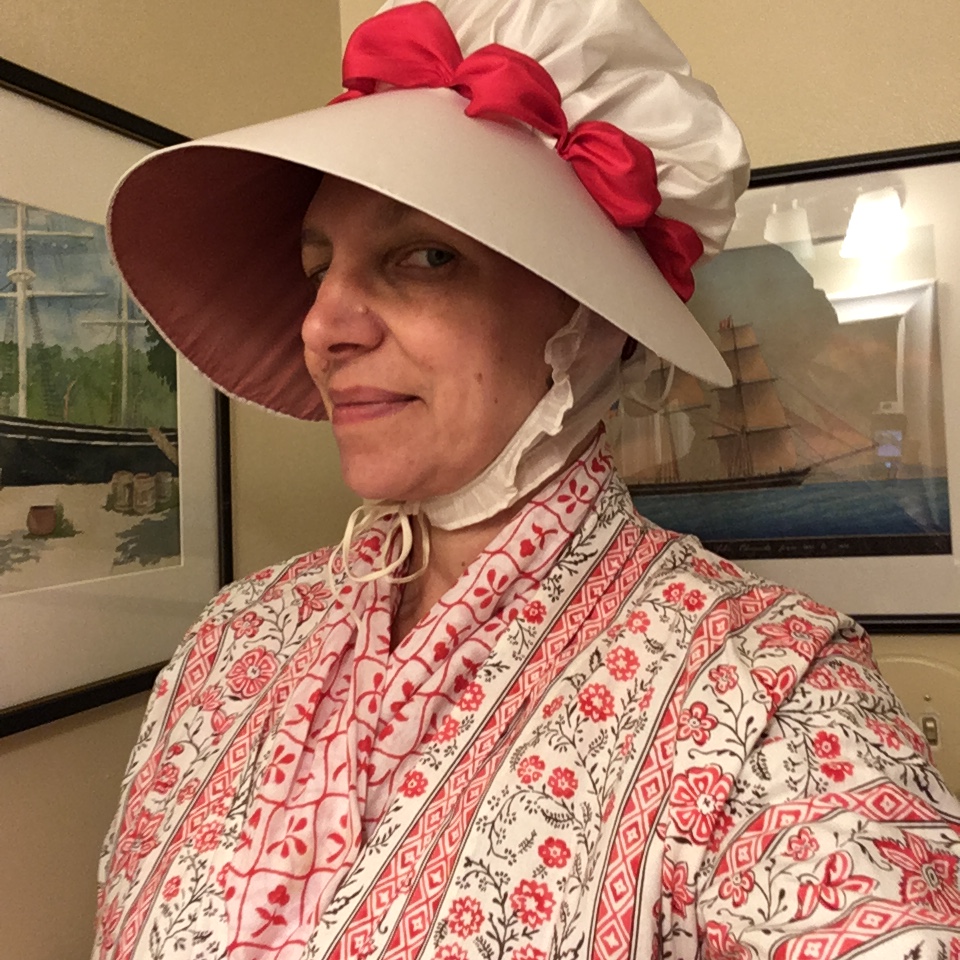
A friend regularly sends me bonnet descriptions from the inventories she’s researching; one description was of a white silk bonnet with a red cherry silk lining from Rowan County, N.C. in the 1770s. Hot stuff, right? Less hot if you made it in white linen, but even North Carolina has winter sometimes. I made two, of course, in sightly different shapes.

Bonnet Number One

Strawberry shortcake? Whipped cream and cherries? You tell me, but I always maintain that bonnets are the cupcakes of costuming: pretty, fluffy, low-calorie and quick to make. 

Once she’d sent me the description, I got hung up on finally finishing my wrapping gown. 

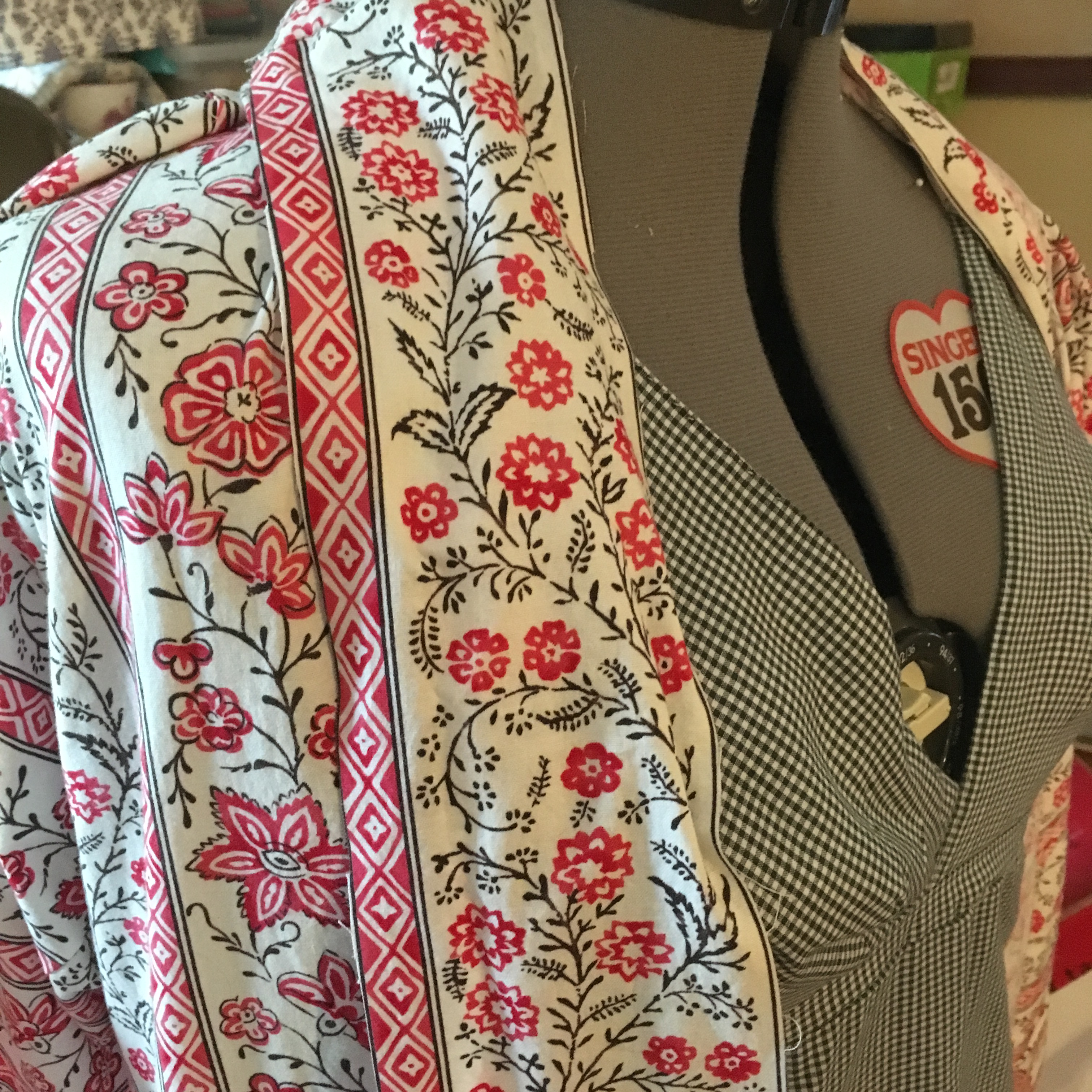
There are enough events where I sleep over that a wrapper for the morning is a useful thing. My characters don’t rate the silk of the one I made for Potts Grove Manor, but I used the same pattern with a reproduction cotton print from Burnley & Trowbridge. I love it– but I do feel a bit like a candy cane. 

Bonnet Number Two, Lampshade Style

Because I’ve seen so many instances of sun shade bonnet (herein known as “lampshade,” making one up in that form seemed like a good idea– and the crowning glory to the red and white striped wrapper. 

Now I really need a cherry red silk quilted petticoat to wear with this ensemble. Some other autumn, when I have more space and time perhaps.