Passing Strange

Inspiration: gown, 1740s (silk) remade 1775-1780. Colonial Williamsburg 2000-133

In representing Magdalen Devine at the Museum of the American Revolution’s Revolutionary Philadelphia event, I decided to make a brown silk gown. This is an easy and solid choice for nearly any (every) woman in any location in the Anglo-American colonies in the latter half of the eighteenth century. If you want another option, go blue. But the reason I chose brown is not just because it’s common, or because I have achieved a certain age, but because both Magdalen Devine and Anne Pearson, although members of the Church of England, were associated with prominent Quakers. 

Magdalen Devine, known to Elizabeth Drinker as “Dilly,” accompanied Drinker on trips to Bath at Bristol, Pennsylvania, where the two visited the waters. In what is now Bucks County, these baths were chalybeate or ferruginous, meaning they contained iron salts. These mineral baths,  initially described as “nasty,” were eventually sought for their medicinal uses. (There is a handy book on American spring resorts called They Took to the Waters: the Forgotten Mineral Spring Resorts of New Jersey and nearby Pennsylvania and Delaware.

Devine and Drinker visited Bath several times in July and August of 1771. Drinker seemed hesitant to take to the waters at first, and while it is not clear whether “Dilly” helped her overcome her nervousness, the two made multiple trips over the course of several weeks. Eventually, Drinker recorded sharing a bed with Devine, so the two must have achieved a level of comfort, if not friendly intimacy, with each other. (You can read the diary entries here.

A Lady, ca. 1747-1752 watercolor by Paul Sandby. Royal Collection Trust, RCN 914415

There is nothing in Drinker’s diary to suggest Devine’s appearance or clothing, which, although disappointing, is normal for a diary of the period. But this level of comfort suggests that Devine projected a pleasing, non-jarring appearance and blended in with Drinker and her family and friends fairly well. This could easily be achieved in a brown, grey, or other dull-colored gown. Any of these colors would have been appropriate for Devine, who by 1771 was likely in or approaching her 50s, having been married in Dublin in 1748. (Lest you think Dublin means Catholic, Devine was married at Saint Catherine’s Church, https://www.saintcatherines.ie/our-story, an Anglican church originally built in 1185 and rebuilt in 1769. The Catholic St. Catherine’s in Dublin was completed in 1858.)

Similarly, milliner and trader Anne Pearson is recorded visiting Dr. John Fothergill in London in February 1771. Fothergill wrote to James Pemberton of Philadelphia:         

“Dear Friend,

I have just got the enclosed in time to send by our valuable acquaintance Nancy Pearson, who has been so obliging as to see us as often as her business would permit. We were pleased with it as she acts the part of a mutual Friend; brings us an account of our esteemed Friends with you, and carries back all the intelligence she can get that may be acceptable to you.” Pemberton Papers, Etting Collection, II, 65, Historical Society of Pennsylvania.

I know this is Anne Pearson, because she wrote to William Logan of Pennsylvania describing her meeting with Dr. Fothergill. Anne was known as “Nancy” to her mother and family. “Nancy” is described in a footnote by editors as “A Quakeress, well esteemed in her ministry,” but I believe they have mistaken the meaning of “mutual Friend.” 
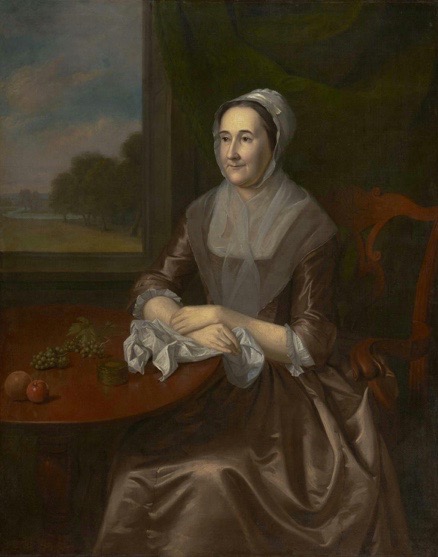
Hannah Lambert Cadwalader (Mrs. Thomas Cadwalader). Oil on canvas by Charles Willson Peale. Philadelphia Museum of Art, 1983-90-2

Did Fothergill assume Anne was a Quaker because she came from Philadelphia? Or did she dress in a manner that suggested she was a Quaker? It would have been easy enough to achieve a level of “plain” dressing with a brown gown and simple accessories like a white handkerchief and apron, and a lappet cap or a relatively unadorned cap. Did Anne and Magdalen (Nancy and Dilly) dress in ways that made their Quaker customers feel at ease? It would be possible to dress both plain and well, with neatly made fine accessories that would appeal to the eyes and instincts of Quakers and Anglicans alike. Perhaps. While there is no way to know for certain, and two passages do not make data, they do suggest something about these businesswomen and their ability to move among and between distinct groups.
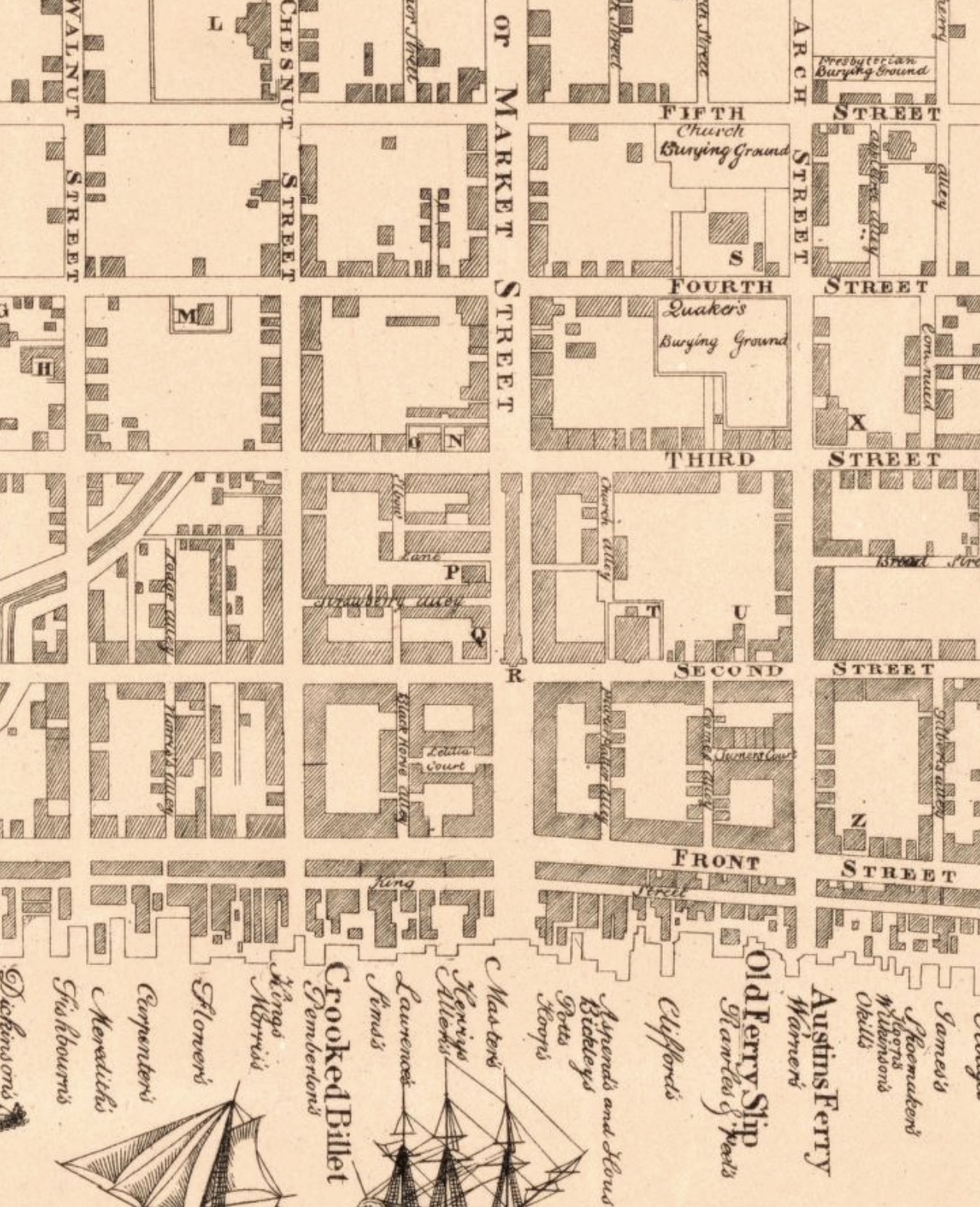
Bending an Elbow at the Seven Stars

detail of an early map of Philadelphia
Detail, map of Philadelphia.

In 1769, Philadelphia had roughly one tavern for every 120 residents. They were clustered most densely in the area Chestnut and High (now Market) Streets, west from the Delaware River to what is now 5th Street. One of the oldest, the Crooked Billet, is called out on the 1762 map of the city by Nicholas Scull, reprinted and now at the Library of Congress. Run for decades by Rebecca Terry, the Crooked Billet primarily served the sailors and men in the maritime trades. Terry was not the only woman with a tavern license in the city—at least three other women, including Sarah Hayes, were long-time tavern keepers.

Sarah Davies Hayes owned two pieces of property on Elbow Lane and another on Chestnut Street; a Quaker, she married Richard Hayes in 1741. He seems to have been a shopkeeper, based on the probate inventory made after his death at the age of 34 in 1748. The inventory includes a side saddle, wearing apparel, a cradle, a fowling piece, and “remains of shop goods.” What kind of shop remains a mystery, as Hayes left no trace in newspaper advertisements beyond an ad placed by his executor in January 1749.  Sarah Hayes bought one piece of property on Elbow Lane in 1761, and the second in 1763; the Chestnut Street property was purchased in 1771. Hayes is listed in tavern license petitions for decades (see the Historical Society of Pennsylvania’s Tavern and Liquor License Records (1746-1863)) and appears in tax lists as an innkeeper or tavern keeper from the 1760s until at least 1780.

img_6337
A sign. It’s only 20″ x 12″ overall.

Tavern keeping was not an unusual occupation for a widow in the 18th century, even if she did not inherit the business from her husband. Some colonies, like Virginia, thought widows particularly well suited to the business, given their skills in household management and stereotype as sensible and moral (and not merry) matrons. In Philadelphia, licenses were issued annually (at a fee of £1/10) to those who successfully passed the scrutiny of the licensing board. (You can see a list of petitioners here.)

The history of the Seven Stars is hard to follow: Benjamin Randolph Boggs (HSP AM.3032) places it at 20 Bank Street, which the Mapping West Philadelphia Project gives as a calculated modern address for property owned by Sarah Hayes, which seems clear enough, though modern streets can be hard to map against historic property lines.* Tyler Putman dug into the history of this parcel and Elbow Lane in general. (Spoiler: there’s nothing to see at 20 Bank Street.) Here’s how Boggs starts his history of the Seven Stars:

                  “A short distance below the White Horse, also on the west side of the lane, at the spot now covered by the structure know as No. 20 Bank street, stood in very early times a small tavern known as the Sign of the Seven Stars, occupying a lot having fifteen frontage and a depth of fifty-six feet. John Eyre, or Eire, purchased the ground as a vacant lot from Ebenezer Large, currier, on September 19th, 1733 … Eyre was a joiner or carpenter by occupation, and upon his lot he erected a brick dwelling in which he kept a tavern, meanwhile working at his trade.”

After Eyre’s death, his widow, Mary, sold all the brick house and all his other property, as ordered in his will. Jacob Shoemaker purchased 20 Bank Street, lot and improvement and almost immediately re-sold the property to Mary Eyre, who continued to keep the tavern. Boggs describes a number of real estate transactions, concluding with the sale of the property and tavern to Thomas Rogers, “who succeeded her as proprietor.” How this squares with Mary Eyre’s appearance in the 1771 list of petitioners who received a tavern license is beyond me. Bogg’s data comes from Philadelphia Deed Books and newspaper advertisements, though he notes that the Seven Stars “may have been open down to the outbreak of the Revolution, but the newspapers of the period disclose nothing further about it.” (HSP AM.3032, Chapter 20, p. 498-499).

malone-1973-0561-frame
Settling the Affairs of the Nation. Winterthur Museum 1973.0561

Who kept the Seven Stars? Was it really at 20 Bank Street? Tax records and directories show a lot of taverns and inns on Elbow Lane, so even if the selection of Seven Stars as a name and Sarah Hayes as a proprietor is somewhat random, I know at least that Hayes, the Seven Stars, and the Lane were all real, existed together over three decades, and overlap in some possibly complicated way involving deeds, ground rents, insurance, and competition. Hayes will do to represent the archetype of the widowed tavern keeper of the Revolutionary City.**

img_5805
Tavern Interior, oil on panel, 1762, John S C Schaak. Sold by Bonhams.

The material world of taverns is much more satisfying to research and compile, though I did get hung up on which shape of bottle held which kind of alcohol, how beer was distributed from the brewery to the customer, and at what level of tavern one would find a Monteith bowl and a silver lemon strainer. The questions are legion: how many glasses? How many mugs? Were basins used on tables the way dishes were washed in early Federal New England? Prices posted or not when the Pennsylvania legislature and provisional government did fix prices in 1778? Some of these questions are answered in paintings from the Sea Captains in Surinam to the John S. C. Shaak Tavern Interior, others can only be guessed at until I find an inventory, if there is one to find.

Then, how do you communicate alcohol to visitors? They can’t taste anything so you can only let them smell the oleosacrum that’s the basis of punch, or the shrubs and cordials popular at the time. Happily, these come in beautiful colors and enhance a table display. My hope with a bench at the table was to invite visitors to sit at the tavern table, and with refinement, perhaps I can achieve that in the future. Reenactors, at least, can bend an elbow at the Seven Stars.

img_6368

*There’s a compelling argument that someone could untangle the confusion between Jacob Shoemaker’s lot, 20 Bank Street, the lot Sarah Hayes owned, and just who owned the Seven Stars, and where, exactly, it was, but I am not that someone.

**If you are thinking at this point that I have a problem with research and perhaps belabor a question, you are correct. My superpower is overthinking anything.

What’s In a Wardrobe?

Ann Bamford & unreadable (below ground) Luke Exall Bamford?

Like Mary Cooley, Mrs. Ann Bamford provides a look into what a woman wore in the 18th century. Born in 1735, Mrs. Bamford’s estate inventory was created after her death at the age of 64 in May, 1799. (She is buried in the St. John the Baptist Churchyard, Borough of Harrow, Greater London. Her gravestone notes she was “An anxious wife and mother,” and records that she was married state to Luke Exall Bamford for 35 years and 17 days. That tells us that the Bamfords married in 1764, when she was 29. I love this detail of the late-20s marriage, actually reasonably typical for women of the period. When Anne Pearson and James Sparks married in 1772, they were roughly 43 and 50, respectively. Older, certainly than Mrs. Bamford when she married (James Sparks’ first marriage was in 1751, when he was 25; and early marriage, but he was by then already a Captain and ship’s master). 

Six years, at most, separate the Ann(e)s, Bamford and Sparks. In 1799, Anne Pearson Sparks is 70 or nearly so, married to a former Captain now gentleman and living in England, so the Bamford probate inventory provides a window into what the fashionable and well-to-lady of a certain age might have owned.

lwlacq000090The inventory, taken by a man,  and now in the collection of the Lewis Walpole Library, may suffer from a lack of feminine insight when it comes to descriptions, but it is comprehensive, listing at least 399 items. It begins: 

  • A Brocaded Sik Nightgown
  • A Gold Laced Jacket and Pettycoat silk grosgrain
  • A pair of pocket hoops
  • Two white petticoats worked at the bottom
  • A Black velvet bonnet
  • A Black Bombazine Negligee and Pettycoat
  • A piece of Printed Muslin for a Gown
  • One sprigged muslin nightgown
  • One Brocaded silk gown unmadeup

In the entire list, there are (among other things):

  • 3 jackets and petticoats, probably riding habits
  • 15 gowns and nightgowns
  • 5 negligees or sacque-back gowns
  • 20 petticoats
  • 14 shifts
  • 28 pairs of sleeve ruffles (various sizes, some worked, some laced)
  • 8 pairs of shoes
  • 3 waistcoats; 2 white, 1 fustian
  • 45 aprons, cloth, muslin, net, worked and embroidered
  • 33 caps, including wired caps and caps “with ribands”
  • 4 bonnets, including one in black velvet and one white
  • 11 hats
  • 26 pairs of stockings, including a pair in green silk
  • 3 stomachers
  • 12 cloaks
  • 58 handkerchiefs of various kinds, some “for wearing,” some worked (embroidered) in gold and silver
  • 5 entries described as“gown unmade up”

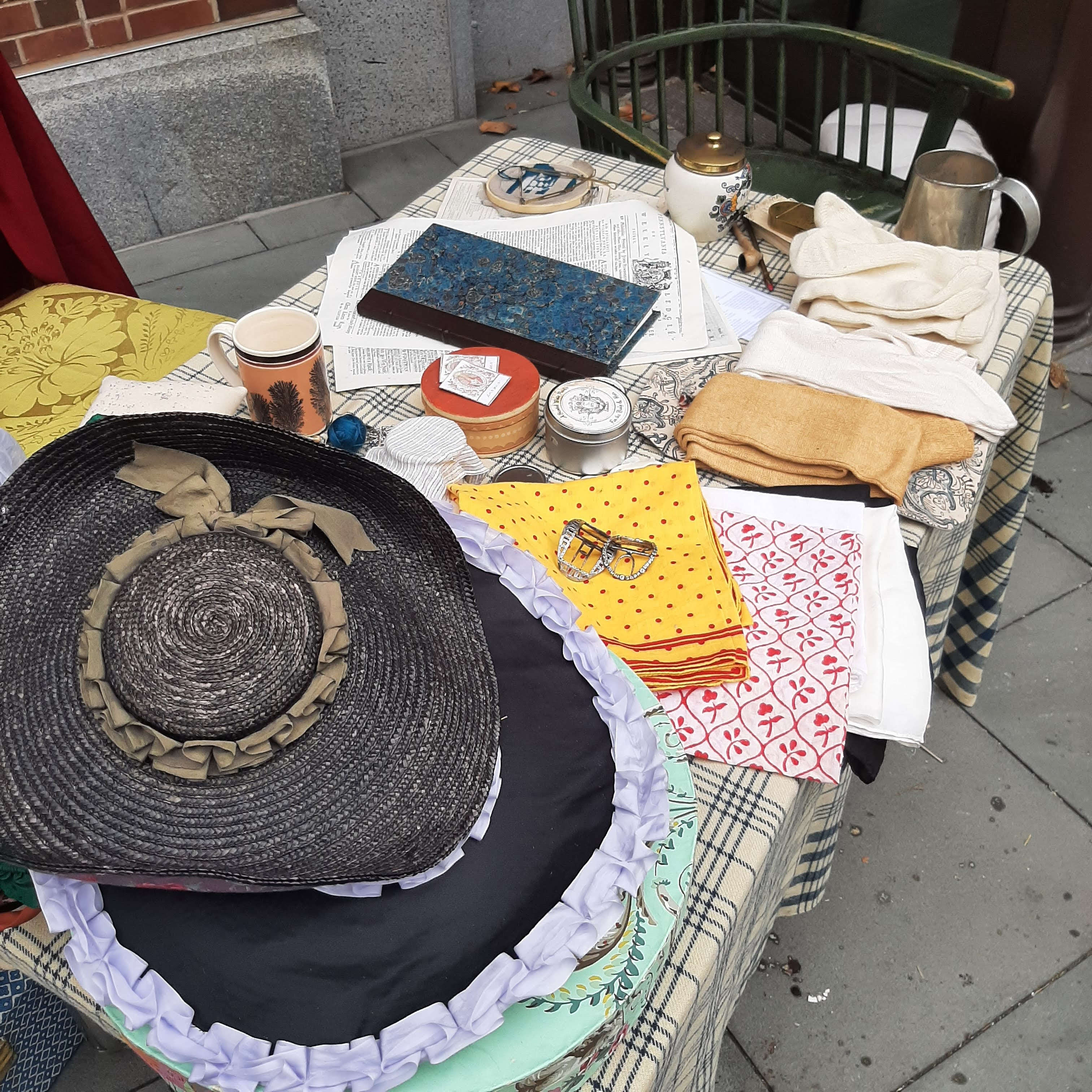
    a stack of 18th century hats and patterned handkerchiefs sit on a check blanket
    I love a stack of hats and handkerchiefs, too! Hats & hankies from Burnley & Trowbridge

There’s no reliable way to know when the gowns were made, or what exact style they are. We cannot know the state of all 45 aprons, the styles of all 33 caps, or 4 bonnets. There’s hope in the five gowns “unmade up.” There’s frivolity and impulse purchasing in 58 handkerchiefs. Fifty-eight! 26 pairs of stockings, one pair of green silk, and one pair of thread with clocks, but the majority seem to be worsted. 

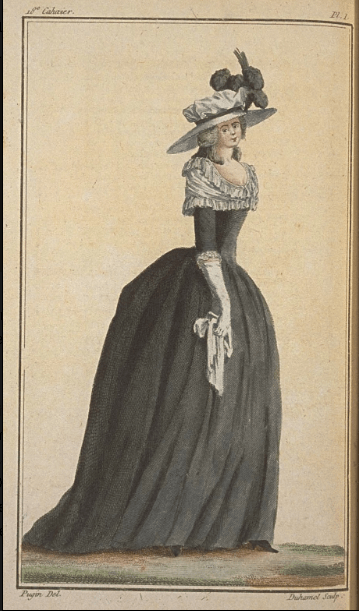
What does Ann Bamford not have? There are no quilted or matelasse petticoats; this may be a function of the list being made in 1799 when the fashionable shape shifted away from the round bell provided by quilted petticoats, but Ann retains a pair of pocket hoops and has no rumps or pads. The infrastructure of a fashionable shape for the 1780s and 1790s seems missing. 

Screen Shot 2024-01-23 at 6.11.36 PM
Cabinet des Modes, August 1, 1786.

It’s likely that the inventory contains clothing from a range of years, possibly dating back to Ann’s marriage. The brocade gowns may well have been reworked from earlier styles, and the jacket-and-petticoat combination in silk grosgrain with lace sounds like the laced and decorated riding habits of the 1760s when Ann was married. As styles changed in the 1770s and 1780s, she might have had additional riding habits made, since they were worn as traveling and visiting costumes and even at home. There are other clues: the black bombazine nightgown and petticoat and the black silk negligee and petticoat suggest mourning, as do the silver silk negligee and petticoat (there is a second silver silk petticoat as well). These would provide stages of mourning, deepest in black and half in silver. English, Ann’s mourning garb might have been worn for deaths in the royal family (like Barbara Johnson) as well as for her own family. (In this context, negligee describes an informal gown, that is, one worn at home, during the day. Nightgowns, or English gowns, were slightly more formal, for day or evening wear. There are subtle distinctions lost to us, but not entirely dissimilar from our “work to evening” outfits where accessories can change an outfit’s meaning.

A Milliner’s Wardrobe

Among the things I ponder about Anne Pearson Sparks is what she wore, and how much clothing she had. She would have seen the latest fashions and fabrics when she traveled to England to buy millinery goods. How did she translate those styles for her Philadelphia customers, like Mrs. Cadwalader, and how did she interpret them for herself? It’s largely unknowable since there are no known images of Anne. Probate inventories provide insights into the quantity and type of clothing women had in the 1770s. They skew higher income since people without wealth had so much less to leave, but given that Anne Pearson owned her own house, and had a £2700 marriage settlement, she certainly had means.

(Above right, Portrait of a woman by Charles Willson Peale, ca 1775. Metropolitan Museum of Art Accession Number: 26.129.2)

The February 1778 inventory of Mary Cooley’s estate, digitized by Colonial Williamsburg, provides an extensive list of clothing and other items owned by a York County (VA) midwife, including 10 gowns, 6 petticoats, 9 shifts, 5 pairs of shoes (4 leather and one black satin), 15 caps, 9 “chex” (checked) aprons, and 4 other aprons, presumably white. The type of gown is not specified, that is, they are not itemized as “nightgowns,” “sacks,” or “negligees,” though there is an additional wrapper. No bedgowns appear on the list, and there is only one pair of stays. Since only items with value (i.e. sale value) were listed, Mary Cooley’s total inventory probably included bedgowns. The clothing worn by the enslaved woman Bett and her child Peter was also probably not on the list. Bett and Peter appear at the end of the list after items typically found in a kitchen, where they probably worked, lived, and slept; it is likely their clothes were few and had no value.

What does Mary Cooley’s list suggest for Anne Pearson?

The gowns include:

  • 1 Brown damask Gown 60
  • 1 black Callimanco Gown 60
  • 1 Striped Holland Gown 70
  • 1 dark ground Callico Do. 70
  • 1 Callico Do. £5 
  • 1 flower’d Do. £7 
  • 1 India brown Persian Do. £3..10/
  • 1 Purple Do. £5 
  • 1 flower’d Crimson Sattin Do. £12
  • 1 Striped Holland Gown 70/

That gives us:

  • 2 Holland (fine linen) gowns suited to the hot, humid Tidewater.
  • 1 Calamanco (glazed woolen) gown, best for winter 
  • 1 Damask (probably silk, could be silk and wool) gown, worth 60 shillings ( £3), so less than the silks
  • 3 Calico (cotton, probably all printed, one with a dark ground), also suited to Tidewater 
  • 3 Silk gowns, in “India brown,” flowered crimson satin, and purple Persian. 
Woman’s Round Gown (Robe à l’anglaise) c. 1775-1780s. Striped cotton plain weave. Accession Number:
1959-113-1 Philadelphia Museum of Art

Linen, wool, silk. Living in Philadelphia, Anne Pearson probably had more wool than Mary Cooley; how many more? Would we swap one linen and cotton for two woolen (stuff or worsted or calamanco) gowns? Would we swap a cotton gown for a riding habit? Anne traveled back and forth between Philadelphia and London for years, and a riding habit or (and?) a Brunswick would make sense for travel. With appearance a key part of advertising her trade and reputation, Anne probably had more than 10 gowns, but call it 10 and add at least a riding habit.

Then we add petticoats. Petticoats expand a wardrobe by matching or contrasting with open robe gowns. Six petticoats! That’s a good number of options, but remember, they need to balance the seasons.

Mary Cooley has:

  • 1 Pink Persian Quilt
  • 1 Black Shalloon Petticoat
  • 1 Blue Callimanco Petticoat
  • 1 India Cotton Petticoat
  • 1 old striped Stuff Quilt
  • 1 blue Quilted Petticoat
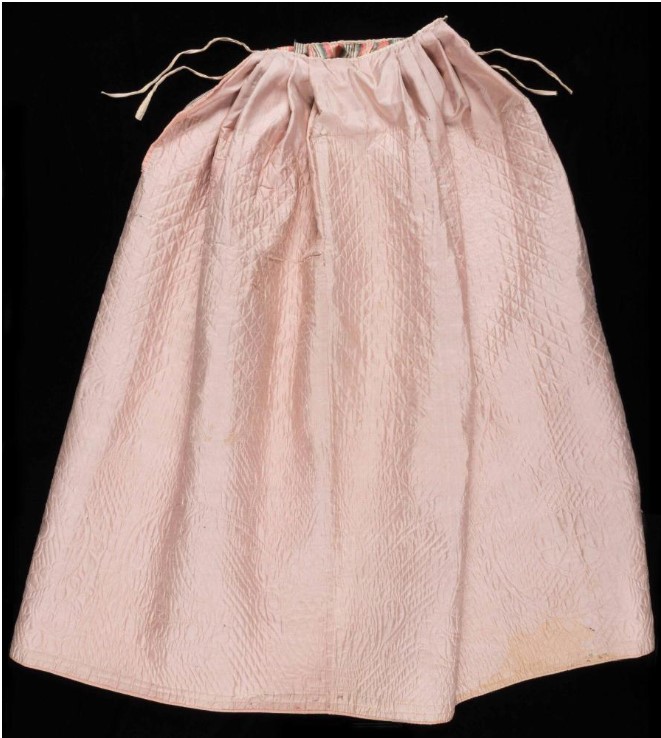
Quilted Petticoat, 1770-1775. Colonial Williamsburg OBJECT NUMBER 1995-191

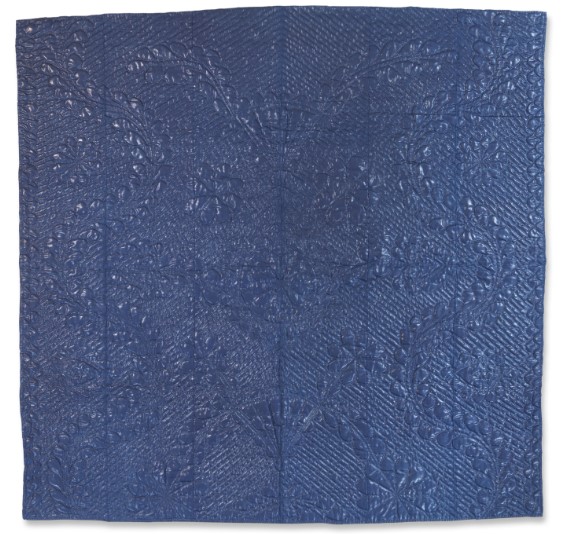
The pink Persian (silk) quilted petticoat certainly came from a milliner’s shop, and was likely made in England; it could easily be worn with those silk gowns. Having the color here helps us begin to imagine the combinations. Pink Persian and brown damask? Black shalloon and black calamanco? Black calamanco and blue calamanco? The India cotton petticoat was probably worn with one of the calico gowns, and we can contemplate striped stuff with a striped Holland gown. In any case, Mary Cooley’s two, possibly three, quilted petticoats helped her keep warm in silk, calico, or linen. The blue calamanco petticoat might also have been quilted; there are many calamanco whole-cloth quilts, and I like to imagine one as vibrant and shining as this quilt or perhaps this one. Quilted or not, under candlelight both gown and petticoat would glisten. 

Deep Indigo Glazed Calamanco Quilt, Probably New England, Late 18th Century