In the Flag-Maker’s Shop

Saturday’s arrangement. Image courtesy of the Museum of the American Revolution

The biggest challenge in interpreting Rebecca Young and the shop she ran was not how flags were made (an appointment at the Cultural Resource Center of the National Museum of the American Indian answered that question*), but rather how to make sewing interesting, and how to create a more interactive experience for ourselves and for visitors. Some of my favorite living history experiences involve playing off other interpreters and the public, especially when trying to convince visitors to pick a side, carry a message, or share a secret. Saturday’s set up made that harder, with Rebecca’s shop of women behind a table (we wanted to be sure to be open to visitors, and not make the dreaded reenactor circle), and with Drunk Tailor rolling cartridges in a niche.

Nobody puts Drunk Tailor in a niche.

But what we saw on Saturday– a day with 800 visitors–was that boys between roughly six and 16 skipped from Drunk Tailor to the tailors, bypassing a table of women altogether. Older men (say, 45+) visiting alone also skipped our table, while the majority of our visitors were girls and women. This was not a surprise. Children begin to develop gender segregation around ages five to six, and sewing is often dismissed as “women’s work,” as the table of tailors experienced. These cultural biases were somewhat compounded by the nature of our work.
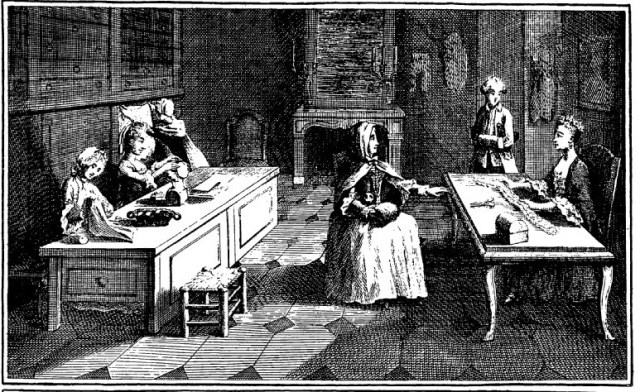
Tailor’s Art: Containing the men’s suits tailor, the skin breeches, the women & children’s body suit, the seamstress & the fashion merchant / by M. de Garsault, National Library of France
Sunday’s set up. Image courtesy of the Museum of the American Revolution

Sewing is one of those tasks that is downward-facing, internal, and meditative (until the thread tangles or snaps). It’s dull to watch, really; the exciting parts of sewing and making are draping, fitting, and cutting. Cutting. There’s something to that.

Combining the desire to interact more with our co-interpreters and the need to disrupt expectations of sewing, we rearranged the tables on Sunday, moving Drunk Tailor to our end of the atrium, postulating that his tea table and powder keg were in the yard of the townhouse, while we pushed our table closer to the tailors and against the railing, pulling our chairs to the side. We also draped shirts and fabric over the railing to display shirts and their component parts, along with bunting. While this “messed up” the atrium, it helped create a context for our work.
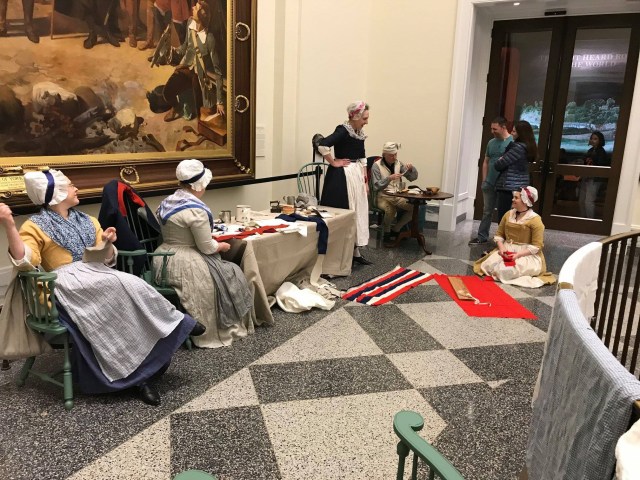
Sunday, workshops in a row (house). Image courtesy of the Museum of the American Revolution

But the best, most participatory change was Mistress V cutting flag strips on the floor, with the help of two young boys. This literally disruptive activity (you had to walk around her) changed perceptions of what we were doing, and helped people imagine assembling a large item (a Continental Standard) in a small rowhouse room.
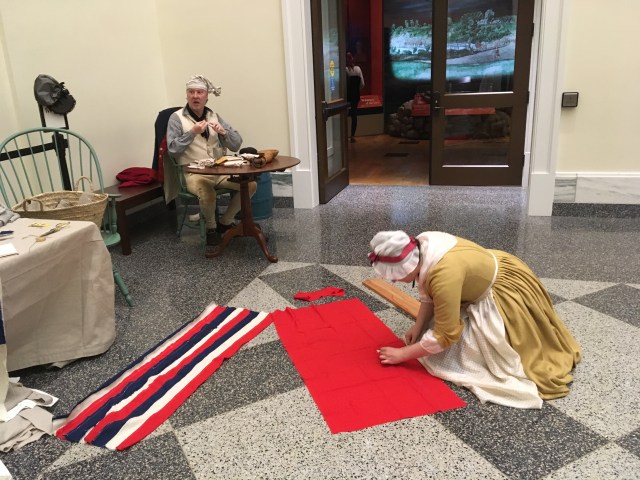
If we take the Betsy Ross house** as an example of a Philadelphia rowhouse, , its exterior dimensions, roughly 16 x 25, yield an interior per-floor area of not more than 400 square feet. The Star-Spangled Banner was 30 x 42 feet; a second “storm” flag was 17 x 25 feet, large enough to cover the floor of a room in Betsy Ross house.

dark wooden drop leaf table with trifid feet
Dining Table (drop-leaf, gateleg table), probably Pennsylvania, 1750-1770. Walnut, oak. Philadelphia Museum of Art, 1994-20-60

While we do not know the exact dimensions of the flags Rebecca Young and her shop produced, it seems likely that any flag would have exceeded the size of a domestic table, since even drop-leaf dining tables of the period are not usually more than 52” x 41” or about 15 square feet (4.3 x 3.5 feet). The limited size of the table, and the need for multiple feet of cutting space makes it likely that flags larger than 3 x 5 feet were cut and pieced on the floor.

This combination of thought experiment and interpretive change up was reasonably successful, giving us greater understanding as we talked about assembling goods in pieces and working in a small shop while interrupting the visitor’s expectations.

*More on this another time.

**You have to start somewhere– and while I’m on #TeamYoung when it comes to flag making, Rebecca’s rented house has long been razed.


Research and primary source materials on Rebecca Flower Young were provided by Matthew Skic of the Museum of the American Revolution; compiled information used by gallery educators at the MoAR was compiled and provided by Katherine Becnel of the MoAR.

Pattern Launch

Last weekend, I had the pleasure of teaching a bed gown workshop at Washington Crossing Historic Park, using a pattern I developed after looking at extant garments, images, and messing about with muslins for several years. What I see– and I know there are different schools of thought– is a shift in the cut of bed gowns over the course of the middle decades of the 18th century. It looks to me as if bed gowns, like gowns, start to have smaller sleeves (for smaller cuffs), and to be a little slimmer in the body.

I’m really happy with bed gown I made, after two earlier iterations (and a wrapper).

The difference is subtle from the front, but the wearing is the test. And I never wore the white one! (Though I still have enough of that fabric to make another bed gown.)

There’s less fabric across the back of the blue bed gown, and I like that better than the more full gown, which I think trends a little earlier than the style of the white one.

Looking at runaway ads, prints, and extant garments, it began to dawn on me that really, the preferred garment fabric was a print, sometimes printed linen (“washed until the flowers have faded nearly white,” in one instance) but often printed cotton, calico, or chintz. In one ad, a servant wearing a dark calico bed gown ran away with a calico gown and a calico bedgown, and must have made a colorful sight with her striped petticoat– and a small looking glass.

In another instance, a woman ran away wearing a gown and a bedgown, trick I wish I’d known about earlier, for active winter events when a cloak was a hindrance. Reading ads and looking at images in a focused way helped me realize what so many people already grasped: that bed gowns are a seriously useful garment. As one test fitter put it, “It’s comfy, like it’s an 18th century sweatshirt.” Proof that the more we consider something, the better we understand it, and the more we may come to value it.

If you’d like to make your own, the pattern is available on Etsy. Full sized paper pattern includes all sizes A to G (finished bust 30″ to 54″) and illustrated instructions.

Bonus: I got adorable squirrel-themed thank yous that liven up my desktop!

Hoods and Caps and Bonnets, oh my!

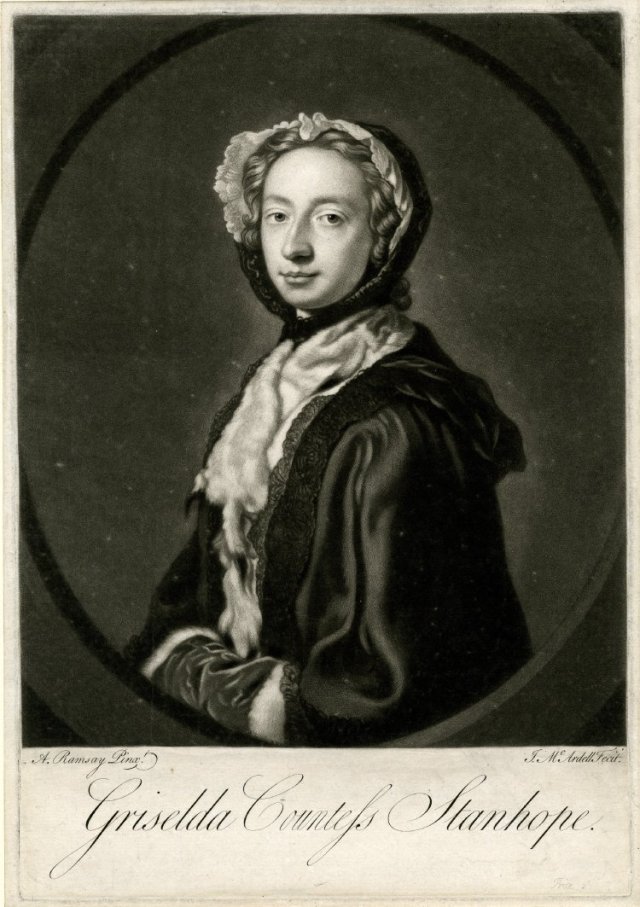
Griselda Countess Stanhope. Mezzotint engraving by James McArdell after Allen Ramsay. British Museum, ca 1760

Let’s take a closer look at Griselda, Countess Stanhope. She wears a hood over a fine white cap, as well as a hooded cloak. Around her neck, she wears a fur tippet, and her hands are snuggled into a muff. While most of the “common” women in the colonies wouldn’t rise to the Countess’s ermine tippet, they did have hoods.

Thomas Howe Ridgate’s inventory taken 19 June 1790 in Charles County Maryland includes “3 velvet and silk hoods,” while Mrs. Elizabeth Lawson’s inventory, taken 3 May 1766 in Prince Georges County Maryland includes one velvet hood and one “Allamod” hood. (She also has “1 old Striped Bonnet,” as well as 2 Womens New Capes, and 1 Womans Life everlasting Petticoat, which bears further investigation.)

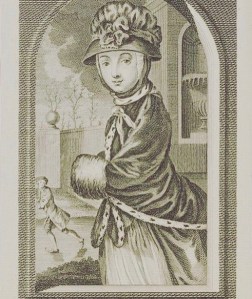
Hoods appear fairly regularly in prints, worn over caps (as in Countess Stanhope), under hats, and even under bonnets, as in this print from the Victoria & Albert Museum.

January, engraving, ca. 1780. E.3520-1953. Victoria & Albert Museum
The mantelet hood worn over the bonnet, hood, and cap layers.

In the images above, I’m wearing a white cap, black silk hood, and black “stuff” bonnet, with a black silk mantlet over a silk neck-handkerchief. The hood needs some tweaking, size-wise, but the layers definitely recreate what we see in the print of “January.” The bonnet has an adjustable caul, so will easily fit over hair, cap, and hood; the hood has a drawstring closure at the neck that helps keep out the wind. Taken altogether, these layers are definitely insulating! Looking like an 18th century engraving is almost a bonus– but when you wear what they wore, you look like they did.