HSF #5: A Peasant’s Jacket

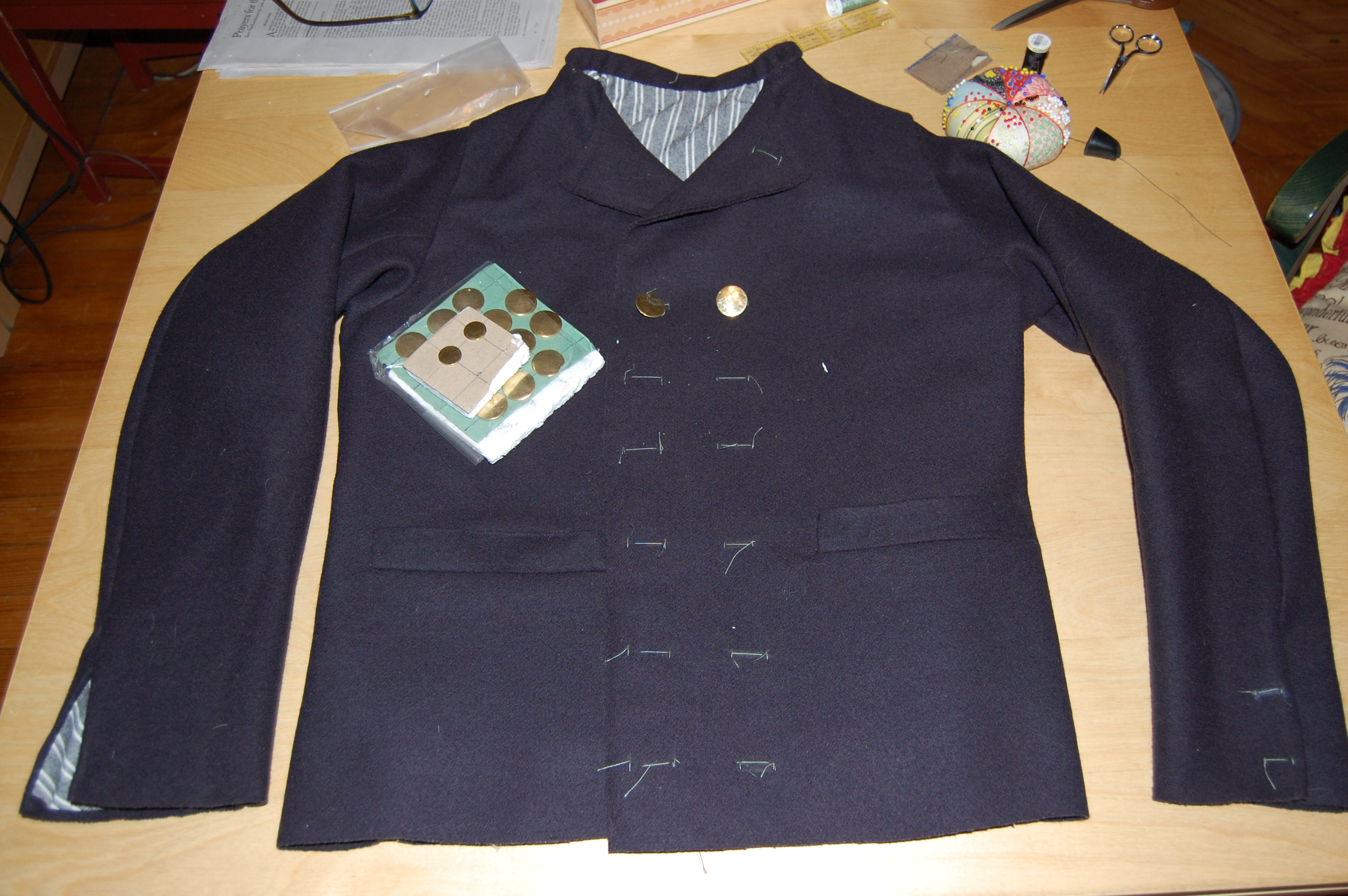
WIth the buttons to be installed

A Workman’s Jacket…not quite done. I had to work Saturday, so there went 7 hours; I got sick, I got tired, so it’s an almost, oh-so-close jacket. Buttons and buttonholes are all we lack. Of course, for a man’s jacket, that’s, you know, a significant lacking. However, I don’t want to have the crack-addled monkey buttonholes again, so I’m not doing them until I’m not rushed or distracted.

You’ve seen it already here, and know that it has chamois pockets. The Facts:

Buttons, with button holes to come

The Challenge: Peasants & Pioneers

Fabric: Blue wool broadcloth, with a blue and white striped linen lining

Pattern: Kannik’s Korner Double-Breasted Short Jacket

Year: It will be worn for 1775, but can be worn from 1760-1800.
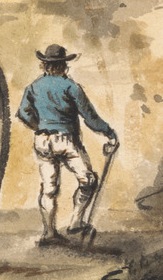
Paul Sandby, A Sandpit. YCBA B1975.3.930

Notions: Linen thread, brass buttons, interfacing, cotton twill stay tape

How historically accurate is it? Well…the fit is a trifle off. It’s better than the base pattern, as I altered the shoulders, but it could use another round of alterations and fitting if the intended wearer would tolerate it.  Still, like the man to the left, the kid is supposed to be working in this, so he’ll need some room.

The edges of the wool are unfinished, as I’ve seen in originals, with the lining turned back. It is all hand sewn. But, I don’t have any documentation for the striped linen lining, (it’s fine for quilted petticoats) so I would not go above 8/10 for this.
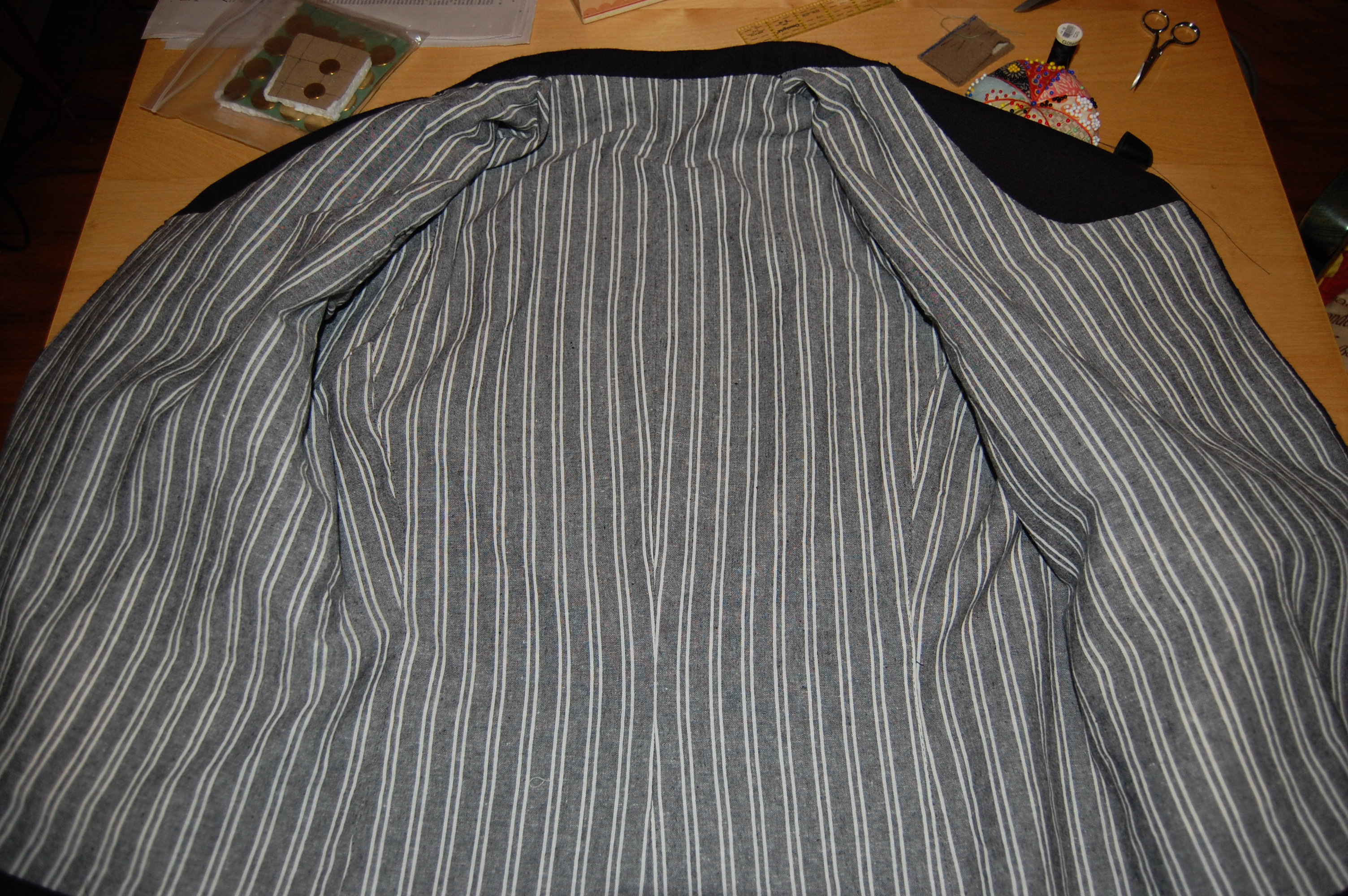
Stripes!
Stripes!

Hours to complete: I can remember about 18 to this point, and the buttonholes will add another 5 to 7. They’re about 20 minutes each, with 16 – 18 to do, plus sewing on buttons. Total time likely to be 22-24 hours.

First worn: To be worn April 13, 2013.

Total cost: $79.36 can be accounted for in materials. The broadcloth was purchased from Wm Booth’s remnants and the buttons are Burnley & Trowbridge: those I have numbers for. The striped linen, purchased at Jo-Ann Fabrics,  was in the stash.
Better Backstitching

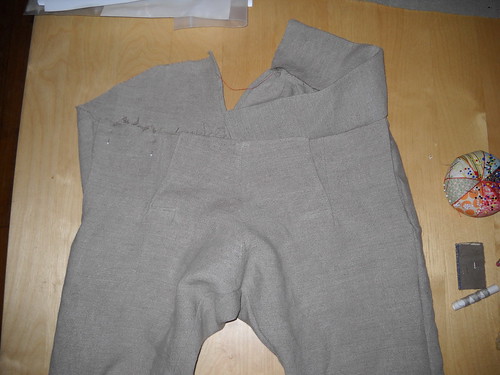
Almost ready for fitting!

Practice: that’s the key. That’s the only key. Just keep stitching…and eventually, the stitches will get smaller and you will get faster.

I spent the week transforming last Monday’s stack of pieces into overalls. This sewing business is amazing! Flat pieces turn into something wearable, and it’s all made out of string in various arrangements. (I may need to get out more…)

The pattern from Henry Cooke goes together very nicely. The pockets are a nice element, and their installation is simpler (I’d call it elegant) than other breeches or trouser pockets I’ve made thus far (this is pair six of breeches/overalls/trousers, pattern four).

That sounds like a lot, doesn’t it? Here’s the spool of thread I bought 18 months ago on the left, and the new one on the right. Along the way, I’ve also used up several spools of colored linen thread, a couple of silk and a few of cotton. The new spool is 1150 feet of linen thread, which seems like a lot to start with. It goes fast, though. The used-up spools were smaller, but when you aim for 10-12 spi, that’s a lot of stitches. Best not to count.

With the fall dropped, you can see the bearer/waistband connection

Very cleverly done, this pocket-bearer-waistband arrangement. My sewing has improved, and luckily for me, these are heavy plain weave linen (acting as osnaburg, here) rather than heavy drill. Heavy drill kills my hands, but this has been pretty pleasant to stitch thus far. Who’s to say what fresh hell the buttonholes will bring–but that’s another week away, at least.

And then it will start all over again on pair number two…but not before I’ve altered the frock coat and possibly breeches, made a jacket and a hunting shirt, and, I hope, a gown. Six weeks to go!

Bloody Overalls

Just started backstitching, already bleeding

But that’s still better than the story I heard yesterday about the incredibly authentic, effluvial-field dipp’d overalls that gave a mender dysentery…you come here for this, right, not the pretty dresses?

My thumb has split– yay, winter!–so everything will be a little trickier. Guess I’ll lay off handling white silk gowns at work, and documents, but the sewing will continue.

The Line of Truth

We went up to the Adjutant’s house yesterday, now that the roads are cleared again, and the lads got measured. Best of all, Mr S got fitted. He has what I ungenerously call “The Hump,” and what the Adjutant describes as “Shoulders Roll Forward.” The Adjutant has tact; I’m the wife, I calls it like I sees it.

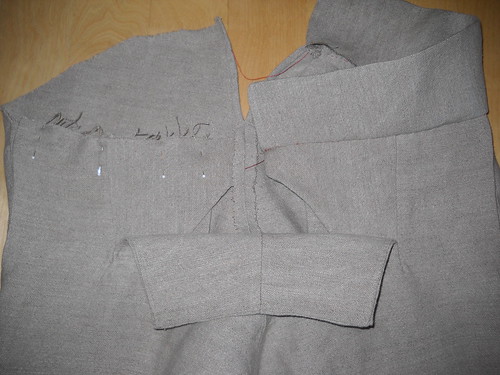
It was really helpful. I knew the coat was too big (Mr S is built more like an 18th century soldier than a 21st century office worker), but I knew it had more wrong with it that too much fabric. At left, see the chalk line? The sleeve seam sits at the shoulder point, where I am told it will be uncomfortable as it rubs, which will also wear out the shirt faster. I knew what to do it the sleeve had been on a gown– unstitch it and re-align it under the shoulder strap, mark it and trim the excess off the head. In a way, that’s just what I will do here. There’s also excess to take out of the upper arm, but that’s not too bad for a garment that I made in a hurry and never really fitted to the wearer. And I have until mid-April to do it.

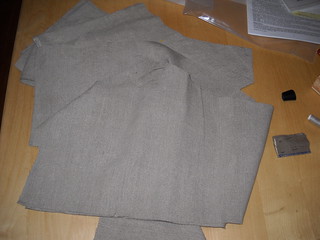
I have two of these greige stacks to transform.

At the same time, I also have to transform two of these piles of pieces into well-fitted, hand-sewn overalls. Despite the pride I’ll feel in accomplishing what I expect will, under guidance, be the best-fitted, most authentic garments I’ve made, saving my green checked apron, there’s a minor measure of terror mixed in to all this…hope those back stitches hold…

Curtains for Gowns as Menswear Beckons

Curtain Along Gown…so close!

Or perhaps bellows, considering it’s soldiers’ clothes I’ll be sewing for a while.  I made significant progress on the Curtain Along gown since last weekend, when it was a mere bodice. It’s meant to be worn with the fluffy Ikea curtain petticoat for maximum “I’m not a window, but I dress like one” effect.  There’s a set on Flickr to show you the pitfalls of 18th century sleevils on Cassandra (without a scapula, poor thing, she can’t really fill a sleeve).

1795-1800, V&A
1795-1800, V&A

It’s based on the chintz gown from the V&A seen here before. For a pattern, I used the Past Patterns Front Closing Gown because I know how it fits. The waistline has been dropped on the bodice just as I did on the wool version I made, to suit my age. There’s more to do than the hem; I plan to add a thin band at the bottom edge of the bodice to carry the drawstring and drop the waist in front just a bit. I think it will fit better, and hide the petticoat’s waistband.

It won’t be done today, but I think I have made enough progress for something I won’t need until the end of May. It’s time now to switch to menswear. We have an overall appointment this afternoon, which could diverge into fitting coats. I’ll be seated at the feet of a master, and for that I am grateful. Scheming about how to get a wool gown down by April while basting and stitching and buttonholing, but grateful nonetheless.