Finished, that’s how, with holes in my fingers and a split in my thumb.
Sure hope it fits…I have tried it on along the way, and it is an open robe, so chances are good it will fit. But after I dressed Cassandra, I did have that “What if…?” moment of dread. There’s a lot of this that’s like art school. Hours laboring alone, hours of studying precedent, craft/technique and theory, and then you have a presentation, i.e. you wear the thing in public. I try not to think about it too much.
I could take this apart for you (the sleeve is more ‘modern’ than the cuff; gowns are not known to have been bound at the hem, though petticoats were; didn’t finish the matching petticoat; did I use the fabric the wrong side out?) but Gentle Reader, I suspect you can supply your own quantity of anxiety, and need not borrow a cup or quart from me.
Let’s talk about the fun parts:
For a while, I hated this gown. Seriously. The closer I got to being done with it, the more I flat-out despised it and found it ugly. Why? Too nice. That’s a respectable gown, that is. It’s the gown your mother would tell you to wear, or the one she thought you ought to change into when she said, “You’re going out in that?” As if you were planning to run away in a red and black calico gown… And I hated the color. Then I thought the wool was too heavy.
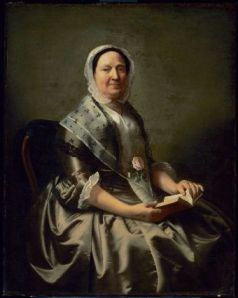
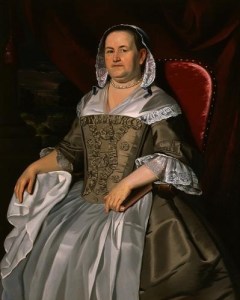
Mrs Sylvanus Bourne, JS Copley, 1766. MMA, 24.79
I am not this old. My impression is not this wealthy. My dress is not silk. But when I look at what I’ve managed to make, and I look at this (my own white apron is coming; I almost finished it yesterday, but the alarm company called and I had to go deal with an early-morning bat) I feel better. I have white mitts, a white kerchief, and there will be a white apron, bats or no bats.
It’s a neat presentation, the brown and white will look well together, and with a black hat or black bonnet. And by the time I’ve sat on dirt and ground some soil into the skirt, and burned a hole into the hem, I’ll probably like this gown.
But it seems so…proper…and that just doesn’t seem like me.
Lady Francis Scott and Lady Eliot, watercolor by Paul Sandy ca. 1770. YCBA, B1977.14.4410
Why a Riding or Shooting Coat Must be Made. A Diversion to take place in Several Acts, with Entertainments for All.
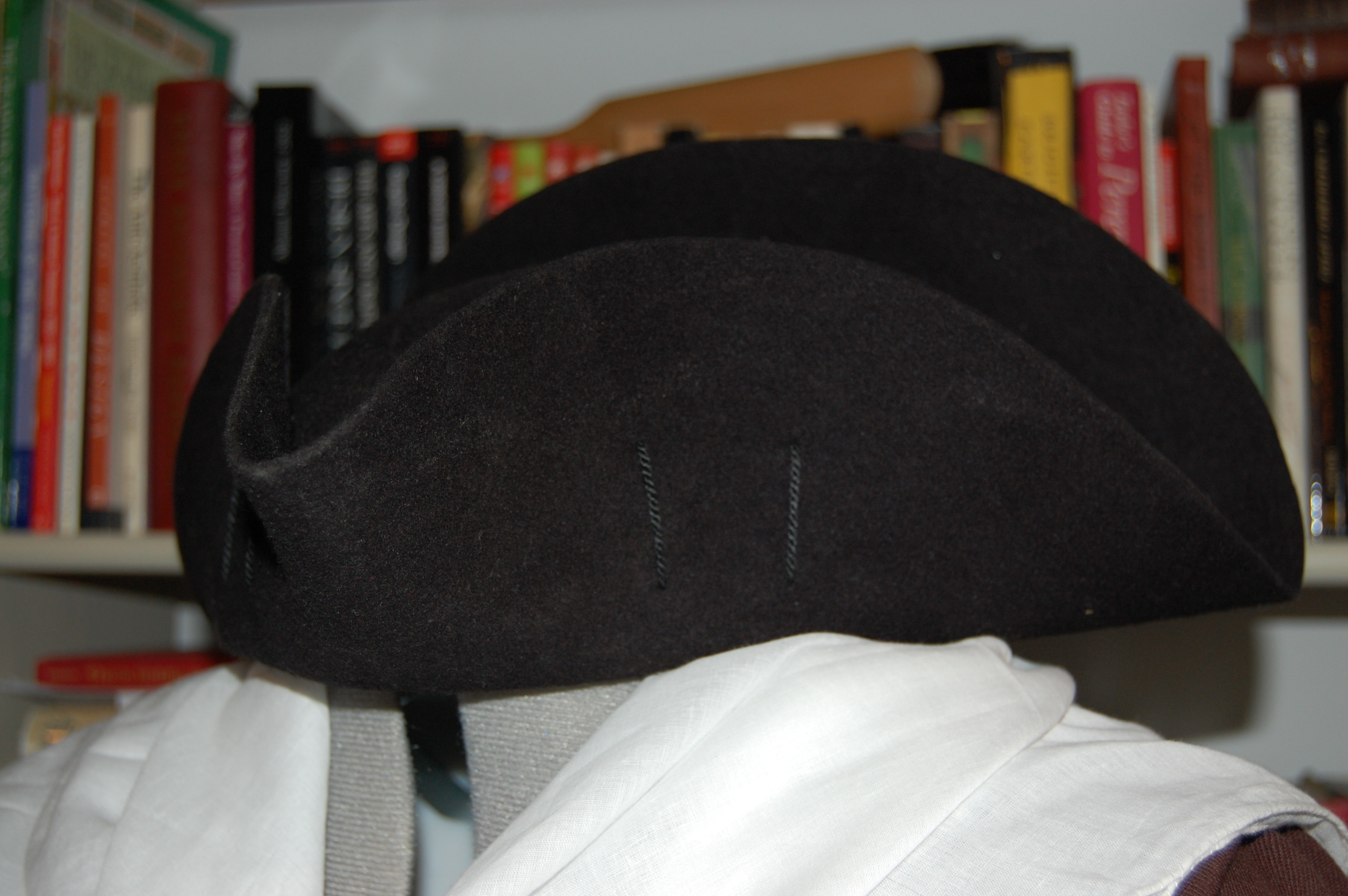
There was a bit of drama chez Calash following the March 23 inspection at Hartwell Tavern. There was a sense that a certain hat was not quite all it could be. There was a feeling that the hat might have been sat upon by the horse employed by the Captain to make the Regimental Garments. (Why else do they smell the way they do?)
The Matt Hat
So the favorite hat maker was contacted, and after negotiations, a hat was ordered. It was thought it would fit Mr S.
It does not.
It does, however, fit me, which means that in order to make use of the hat, I shall have to make myself a riding habit or shooting coat (the more likely item). Poor me, a tailoring exercise.
We could send the hat back, but instead I’ll knit another Monmouth cap, and put “civilian hat” on the birthday or Christmas list.
I got in a lather about not having mitts. I have been trying to knit a pair from the Mara Riley pattern for some time, as in well over a year. It’s just an unfortunate thing. I understand the pattern, I like the yarn I have, the needles are authentic enough for events, and yet: I cannot get these things done. As a result, I get cold. (I don’t mean that to sound whiny.)
There’s debate in some circles about whether or not knitted mitts were worn in New England, though there is a nice pair of black frame-knit mitts at the MFA, with a history of use in Lexington, MA. That’s a long way from what I can knit, a fair distance from what lower-middling Kitty would wear, and vastly unsuitable for a woman following the army. Still, I want mitts.
‘Camblet’ lined with linen, linen lined with cotton. More pix on flickr.
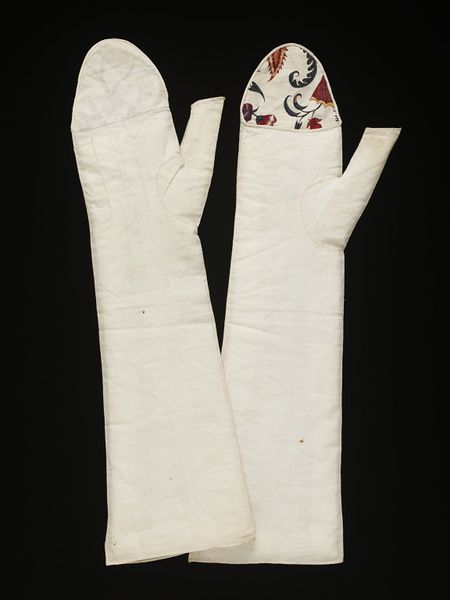
Fortunately I have developed more patience or bloody-mindedness since then. This allowed me to spend the time scaling up the pattern in Costume Close-Up. That’s where I started in the Fall, but things went better this time, and I actually have a pair of mitts.
Two pairs. I have problems, I try to solve them with sewing.
The Challenge: HSF # 7: Accessorize.
Fabric:
Left: Silk and wool “camblet,” lined with light-weight linen, both from Burnley & Trowbridge
Right: White linen from Fabric-Store.com, lined with printed cotton from Wm Booth Draper.
Pattern:
My own, scaled up from Costume Close-Up, available here for you if you have large hands, print it at 100% on 11 x 17 paper. You will need to tweak the thumb placement. Make a muslin. Make two muslins. It’s worth the effort.
Year:
1750-1800. Narrower than that I cannot get, yet.
Notions:
None.
Mittens, 1790-1800. V&A,
How historically accurate is it?
Say 8/10, since I have never examined a pair and don’t know exactly how they were made. Yes, I’ve read the descriptions in Costume Close-Up and Fitting and Proper, but at this foggy insomniac moment, I couldn’t tell you much about those descriptions.
Hours to complete:
The bulk of the time was in the patterning, which took a couple of evenings and 4 muslins. But once you have a pattern that works for you, finishing a pair from cutting to wearing is about 3 hours all by hand. You could cut that significantly using a machine instead of hand back-stitching, and add decorative embroidery, which I really cannot do. Really. Photos to come.
First worn:
To be worn April 13…probably the white linen pair.
Total cost:
Nothing, really, as all fabric was left over in the stash. The pretty printed scraps came in handy.
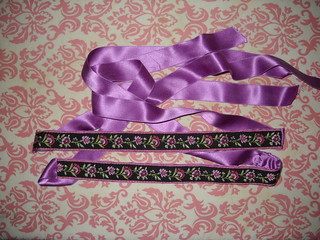
Garters! Jo-Ann plus Wm Booth Draper, but so far no implosion
Oh, I made some garters, too. Easy-peasy. Use the Pragmatic Costumer’s Ten Minute Tutorial. Completely makes up for whatever project you think you just screwed up. The main lilac ribbon is silk, the decorative ribbon is so not silk. These are better than no garters, but I expect my stockings will still droop around my ankles, as required by the laws of physics and reenacting.
Here’s a good question (I love questions): how do you choose which [historic example] to make?
The answer, as almost always: Research.
I start with a date. For Battle Road, the dress must be typical of New England in April, 1775 and appropriate for my impression or persona. As I imagine my character from the past, she’s in her 40s, from the upstart town of Providence, married to a tradesman or craftsman. She has one child, and I haven’t thought about whether or not it’s one only or one surviving—too busy chasing the One Child Who Eats Like Ten.
Providence, 1790. John Fitch, RIHS Map #30Mrs Nathaniel Ellery, 1765, MFA Boston
Living in a port city means my character—we’ll call her Kitty—has access to new goods and ideas, a town where you can buy almost anything, but where staymakers are less common than in Newport. It’s less refined than Newport, brassier, but competitive and striving and with plenty of money in some hands. Providence is where the Gaspee affair was plotted; in 1790, residents from around the world are recorded here—men from Java, living in Providence—it’s polyglot, mercantile, striving.
Given that Kitty is of the middling sort in a town, she can wear linen and wool and camblet and even some silk. Her clothes will be fashionable but not high style, “a thought behind the current moment,” as Lord Peter says of someone’s hat. What’s the purpose of this brown gown? Everyday wear, that, with accessories, can be dressed up, or dressed down. Eventually, who knows, I might manage a crewel work stomacher and nice linen cuff-ruffles for my shift, though a filthy apron, burned skirt, and a striped rough linen petticoat are more likely…
Mrs. James Otis ca. 1760. Wichita Art Museum
Making an everyday dress means not copying the silk dress from Williamsburg, and honestly, I couldn’t wear that wedding cake frosting on my chest, nor what Mrs. Otis has on her stomacher. How about that lovely Norwich wool gown? Well…almost. But I can’t sew that well, and haven’t got fabric that lovely, couldn’t afford it now, wouldn’t have had it then. I have brown wool. Have I seen Mrs. John Brown dressed like one of Copley’s women? Perhaps (if you take Copley as evidence, which you must do carefully.) Have I looked at the lovely brown silk satin and thought, I could do that. Possibly.
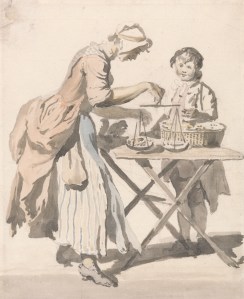
Black Heart Cherries, Paul Sandby, ca. 1759. YCBA B1975.3.206
What we do know is that in New England, gowns are found more often than any other kind of garment (i.e. short gowns or jackets or riding habits). We know that wool is common, but that linen is found in towns and cities, wool more often in the country, and that the pretty, but expensive, cotton prints are popular. Open robes are more common earlier, and “hatchet” cuffs (pleated tubes) predominate. The style is worn by Copley’s women and Sandby’s girls, and it’s seen in images from 1760 on. That means it’s a good choice for a base style for any class level.
Here’s my process, more or less:
Determine the date, that sets the style.
1775 means stomacher front gown.
Determine the character, that sets the fabric and trims.
Kitty’s New England middling, so she’ll have a wool gown with robings but not trims, a plain stomacher, cuffs and not ruffles, and a matching petticoat.
Determine the event, that sets the accessories.
Battle Road is a hard one for me: as a woman, I shouldn’t be there, and as a Rhode Islander, I really shouldn’t be there. (RI militia were stopped at the border by the governor to prevent them joining Massachusetts men after news of the events at Lexington and Concord reached Rhode Island. They did get there eventually and participated in the siege of Boston, but you see what I mean…) So I have to construct a story for how to dress, and the best I can manage is going out, either to a shop or to pay a casual call on family. So what I plan is a matching petticoat, white neck handkerchief, clean check apron, and bonnet over a clean white cap. (This emphasis on clean should remind me to wash and iron a thing or two.)
That’s my story, and I’m stickin’ to it. For now, anyway, till I get a better idea.






 Kirsten Hammerstrom
You must be logged in to post a comment.