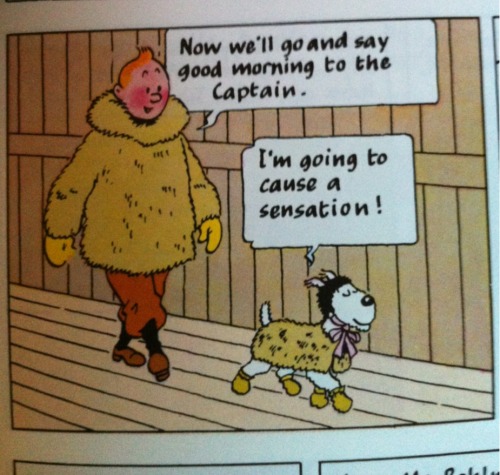
The Shooting Star: Snowy in his “best bib and tucker.”
Chemisette or tucker? By the time The Shooting Star was published in 1941-42, “bib and tucker” had wandered away from their original meanings. Tuckers were worn under women’s and girl’s bodices, taking on the role of neck handerchiefs or fichus, and what some people like to call “modesty pieces,” though the phrase always makes me think of the front panel of desks.
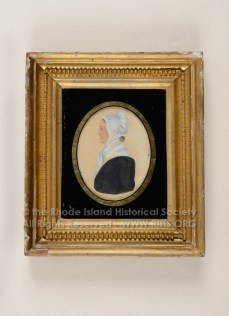
Turns out you probably can. Scrolling through the miniatures gallery, there was Hannah Weaver Peckham in her best tucker, and Miss Rhodes, while later, is also sports a chemisette or tucker. (Mrs Peckham looks a bit cranky, doesn’t she? Perhaps her busk is poking her.)
What you’d call it remains an open question.
The 1933 Oxford dictionary we have in the office defines “tucker” as “A piece of lace or the like, worn by women within or around the top of the bodice of the 17-18th C.”
Phoebe Smith Rhodes, RIHS 1918.3.6
The same dictionary tells me “chemisette” is 1807, from the French, diminutive of chemise. “1. A bodice, more or less like the upper part of a chemise. 2. An article, usually of lace or muslin, made to fill in the open front of a woman’s dress 1844.”
While I think that one could, in Rhode Island in 1800, wear a garment that filled in the upper part of a bodice, I’m not sure what one wold call that garment. The simplest thing to do is to wear a white kerchief like Phoebe Smith Rhodes. Have I ever settled for the simplest thing? Not if I can help it.
In 1777, the uniforms of the Continental Army remained largely uncodified and, well, non-uniform. At Ticonderoga, German accounts from the spring of 1777 state that “Few of the officers in General Gates’ army wore uniforms, and those that were worn were evidently of home manufacture and of all colors. For example, brown coats with sea-green facings, white linings, and silver dragons(epaulettes or shoulder knots), and gray coats with yellow buttons and straw facings, where to be seen in plenty.”
Brown coats with sea green facings. There’s one in our regiment, and it is a lovely thing. The Adjutant thought it would be interesting for the troops to turn out in these coats at Saratoga, an event to which the coat can be documented (being soon after Fort Ticonderoga) and an event that will take place on the historic site. So we’re making them, in a project that started Saturday, and here we are: ready to have the lapel width adjusted, because my eye tells me it is too big, and yes, I’m told that it was cut a but wide. So this morning, a lapel trim is in order.
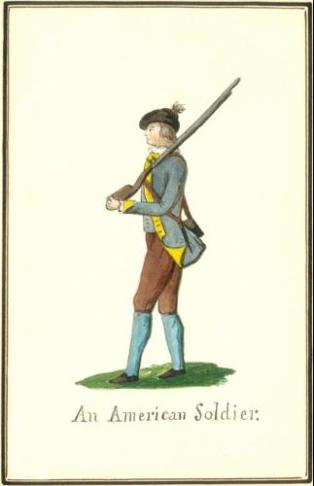
An American Soldier. ca.1852 copy of a ca.1777 watercolor by Hessen-Hanau Captain Friedrich von Germann. Niedersächsisches Staatsarchiv, Wolfenbüttel, Braunschweig
But really, these coats.
Here you can see the style that we’re making, with applied lapels and shanked buttons, simple turn backs on the front skirts, and flat collars. The cuffs are also applied, non-functioning cuffs that come to a point in front. (Also, documented blue stockings!)
These coats will be worn with overalls, waistcoats and shoes, because we know from John Buss’s letters that the regiment was issued overalls and shoes in the summer of 1777. No visible stockings, sadly.
This is the kind of project I can get pretty stoked about, with its combination of aesthetics and documentation. A coat described in a German diary, made in pettable wool broadcloth that will be unlike anything else on the field? Of course I want to help make that vision real.
Imagine a moment on the field, with these documented coats, so unusual (the sea green may have been a faded blue, but sea green is what was seen), worn in a place where they were worn. I don’t need to remind you about the authenticity/commemoration thing, do I? Because it’s pretty clear that’s what’ll happen three weeks from now in New York.
Mabel Ruggles Canfield. Oil on canvas by Ralph Earl, 1796. Litchfield Historical Society, 1917.4.4
In three weeks, I start a three week cycle of events in different decades: Saratoga in 1777 will be followed by Boston in 1763, followed by Providence in 1800. This causes a kind of temporal whiplash, though I know well enough what I should wear for 1777 and 1763, and Mr S’s brown coat will cut out this week so I can begin to sew on Saturday.
Providence in 1800 worries me more, but last Saturday’s conversation with Sharon helped immensely, especially when she said, Think Ralph Earl. So simple, I was embarrassed not to have remembered one of my favorite painters.
I need to think below Ralph Earl’s sitter’s station, but as Mrs Brown’s housekeeper or bossiest maid, these portraits represent the type of people I see, people who live in Providence but aren’t the Browns. Ralph Earl’s world of Connecticut merchants and ministers is much like the world I would see. How much more cosmopolitan was Providence than Stonington or New London? They’re all ports, and Providence is busier, but I think that Ralph Earl is a safe bet for understanding the visual context of the southern New England in the 1790s and the styles people wore.
It is especially helpful because he painted women of about the right age. Mrs Canfield at the top of te page was born in 1760, so she’s just a little younger than my character.
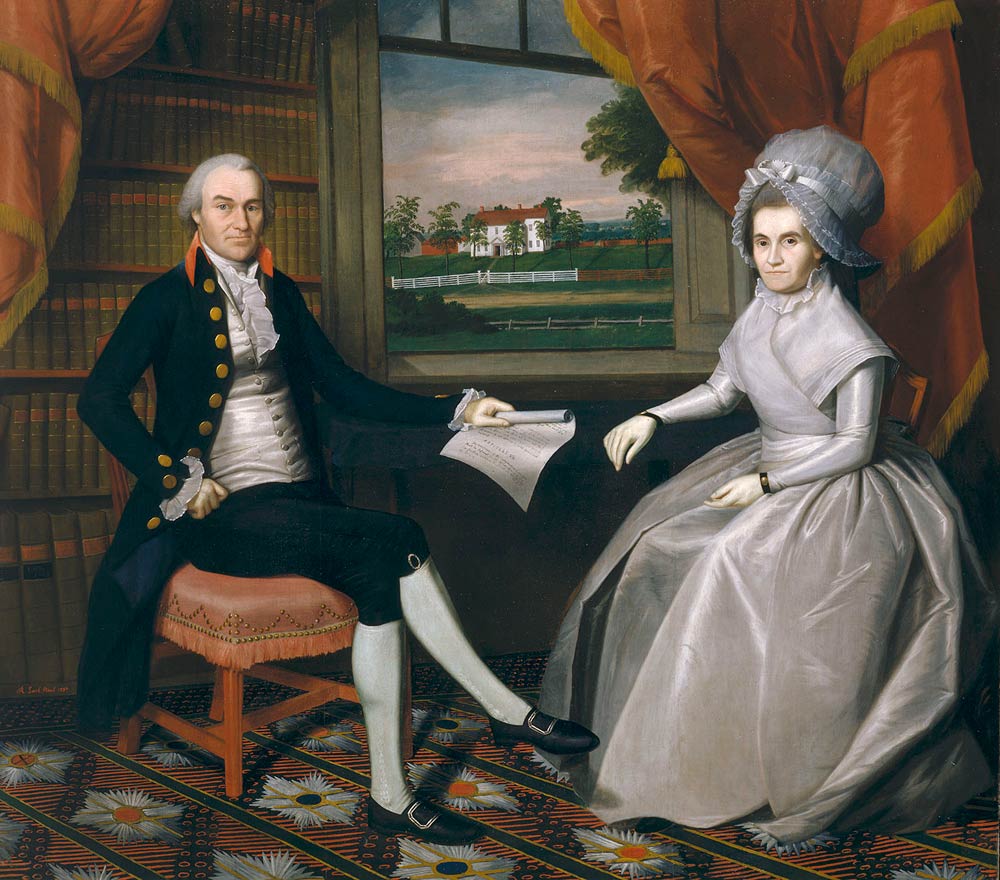
Oiver Ellsworth and Abigail Wolcott Ellsworth. Oil on canvas by Ralph Earl, 1792. Wadsworth Atheneum, 1903.7
Mrs Ellsworth was born in 1756, so she’s a little bit older. Different ages, different styles (yes, styles have also changed between 1792 and 1796). But some constants: long, slim sleeves. White caps and handkerchiefs, layered at the neck. Silk–though that won’t be me–in solid, slightly muted colors.
There’s another Connecticut painter worth looking at: John Brewster, Jr. In this New Republic period, I think it’s really critical to look to American sources for clues to how people projected themselves, how they were seen and wanted to be seen. This is pretty high-falutin’ stuff for a maid, but I’m presuming that I know how to read (because John Brown and his brothers placed an emphasis on education in their own families, and on public education). And if I know how to read, and I work in a house with books and political discussions, chances are good that even in the late 18th century, I have eavesdropped on the discussions and I have read at least the newspapers. I’m living in a certain atmosphere, and how I dress and what I think about will reflect the world around me.
John Brewster and Ruth Avery Brewster. Oil on canvas by John Brewster, Jr. ca. 1795-1800. Old Sturbridge Village.
Dr. John Brewster, seen here with his second wife, Ruth, descended from William Brewster. His wife, Ruth, is obviously literate. These people are signaling education and sensibility to us: sober, well to do, respectable. Brewster is not as good a painter as Ralph Earl, so fabric is harder to read. What is her gown made of? Could be fine wool, could be silk: hard to tell. But see that little edge of shift peeking below that three-quarter sleeve? That’s old school for 1795. But I like the neckline and the color. Burnley & Trowbridge have a light-weight wool that color…
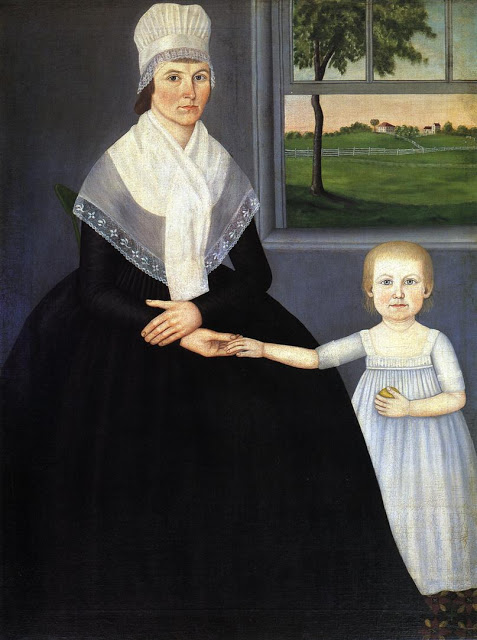
Mother with Son (Lucy Knapp Mygatt and Son, George), 1799. Oil on canvas by John Brewster, Jr. Palmer Museum of Art, Pennsylvania State University
Brewster’s portrait of Lucy Knapp Mygatt and her son, painted in 1799, does, I think, help push the date for the Brewster double portrait earlier: by 1799, the painter in more accomplished and bolder in the full-length portrait. He’s also learned to render fabric somewhat more convincingly.
Long sleeves, white cap and kerchief, high waistline: the styles are consistent, but as you move through the subtleties of class, the expression of the style shifts. Front-closing round gown with a waistline that’s high, but lower than what I’ve made in the past, with long sleeves: settled. Now all I need to decide upon is fabric: probably a lightweight, dark-colored wool, though I haven’t found exactly what I want yet.
I started on the HSF#15 Color Challlenge: White, but haven’t finished the white petticoat yet. It’s a bit short, and pieced in the back, but having seen Sew18thCentury’s curtain along petticoat online, I wanted a bordered petticoat. (There are extant examples in museum collections, and one in Fitting and Proper, if you’re keeping score.) Now that I’ve seen the petticoat in person, I will definitely stick it out for a border….all in good time.
Native Meltons: she’s out there in plain and colored lithographs
I did originally think that I might get this gown completed for HSF # 15, but I did not. I came close, became disheartened, and stopped work on it for a time. Not only did I think I could not adequately document the fabric, I worried about style, fit, and fabrication. At some point, though, I rallied, and finished the gown. Yes, it looks a lot like Emily’s, because it is based on the same print.
Finished! Another garment in the “Am I Blue” Ocean State Line
Fabric:
Indigo Cross Bar Light-Weight Check Irish Linen from Burnley & Trowbridge.
I collected images of checks and “plaids” on a Pinterest board. Remember that plaid doesn’t mean the same thing in the 18th century, but I used the term to help people know what the board included.
Pattern:
My own, based on a fitted lining and draped to the dummy, tried on and tweaked. You can see some construction progress here. Yes, that’s a center-finding ruler. Yes, it has extra pleats. Call it bling for the linen-wearing.
Matching crossbars is crazy, but fun.
Year: Let’s call it 1760. It’s an open robe with robings and cuffs suitable for 1765, but I’m old enough to keep wearing that style. Actually, the double-lapped robings (which I really like the look of) are earlier– see this Pinterest board–but I like the way the fold creates a decorative element in linen and wool. The probable 1750s date for the double lapped robing caused another round of heartache in the documentation land. Oh, well. Carrying on wearing the older style…
Notions:
Does thread count? That’s all this takes.
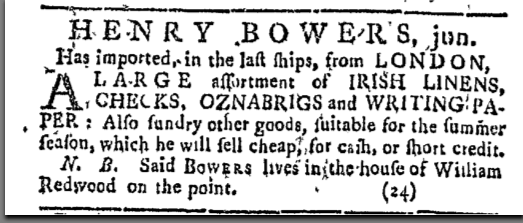
Newport Mercury, 7/11/1774Boston Post Boy, 3/11/1771
How historically accurate is it?
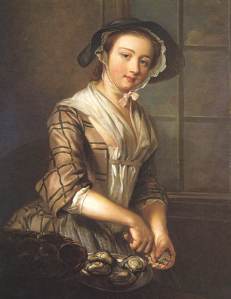
Well…In the right circles, one could argue that for some time. Is that not the circle one wishes to be in? Consider this, then: The gown is hand-sewn using period techniques as much as I can muster. It is based on pictorial examples from the 1750s through the 1760s. I have found newspaper advertisements for “CHECKS” in Newport (Newport Mercury, July 11, 1774) and “checks of all wedths” in Boston (Boston post Boy, March 11, 1771). Wedths means of fabric in all likelihood, not widths of the checks, so while one can find evidence of people wearing what we’d call plaid, mostly silk but the oyster seller is likely linen or cotton…we don’t know exactly what every “checks of all wedths” fabric looked like. I’ll go with 75% accurate and 25% conjecture and choose my wearing venue with care. Yes, I can over-think and rationalize anything.
Hours to complete:
I did this many, many times. It’s like being a carpenter with fabric and pins.
Actual sewing? 16 to 18 hours, I think; it’s a lot of hemming. The body of the gown, the draping and the lining were constructed in about a day while the guys were out doing musket-related things. The agonizing and over-thinking consumed more time. Documentation took, on the whole, perhaps 2 or 3 hours of museum collections and newspaper searching.
First worn:
Not yet! I’m not sure when I will, now that the weather has turned. I meant to have this done for Sturbridge but despaired of the design and fabric. It’ll be wool for Saratoga, so who knows? I’d like a photo, though.









 Kirsten Hammerstrom
You must be logged in to post a comment.