HSF # 24: Re-Do (Thank goodness it’s done!)

Shirt, view number one

Like a zombie, I’ve returned to the Historical Sew Fortnightly with an undead shirt. I was working on it in August 2012, and at long last, it is really complete. So I offer it up as the Re-Do for HSF #11: Squares, Rectangles and Triangles, as it has no curves at all. (Well, aside from any wonky cutting I may have done.) It would also work for HSF #15, White, as it is actually white. Things happened in the basket along the way to getting done, and the half-made body had to washed.

The thing about shirts is that they don’t look like much unless they’re well photographed, preferably on a human or a mannequin with arms. I lack the latter, and the former specimens were not worth asking, since they’d been made to work all weekend.

So, some facts are in order. right?

The Challenge: #22, Re-Do. (# 11 and/or #15)

Fabric: White Linen, 5.3 ounce, I think. It was a while ago.

Pattern: This would have been cut from the Kannik’s Korner shirt pattern, though more by using the pieces to mark and measure and make sure I had all the small squares and bits the pattern takes.

Year: 1770-1790, depending. At their class level, the guys can keep wearing this kind of shirt for a long time. (It will be the Young Mr’s.)

Notions: Two thread buttons, one bone button; all three from my strategic reserve as the new selection of thread buttons has vanished (I blame the cat).

How historically accurate is it? Well, let’s give it 75%. It’s all linen, but the selvedges aren’t right, the stitching is variable and the insides are not all finished correctly. Patience, Iago, patience…there will be time for the last felling over whipstitching. I suppose for the common shirt it is, the coarser linen and variable stitching might boost the accuracy a bit. 82% for intentions, points still taken off for knowing what’s wrong with it.

Hours to complete: Freaking endless. I lost count, but in the end, probably five hours to finish button holes, felling, hems, and side gussets. The problem is that it’s repetitive and boring: back stitch, prick stitch, slip stitch, hem, all in straight lines. And this was shirt number three (four is right behind for Mr S) so the thrill’s gone out a bit.

First worn: Rejected in nearly-finished but unhemmed state by the Young Mr at Fort Lee, thoughit would have stayed in his trousers better than his too-small-clothes, he’ll wear this shirt in February at a celebration of Washington’s birthday.

Total cost: $17.74 for the fabric, I forget for the buttons and there’s always thread in the house. Call it $20 all told.

Sweeping Clean

Sweeper 1746, Etching with some engraving Harris Brisbane Dick Fund, 1953 MMA 53.600.588(56)

This is how we’ve spent our time off: quite a bit of cooking, though I did much in advance (the oven is large enough to cook only a turkey and nothing else, at one time), and even more cleaning and clearing and rearranging. After all, my mother will arrive in three weeks, which is not very much time at all when you have working weekends along the way.

with any luck, there will be a tidied up office/ironing room in which I could sew out of the way of certain felines, but at this point I’d settle for folded laundry and calmer cats. They remain convinced that cleaning is an exercise in cat assassination, though they can offer no proof that any cats have ever succumbed to death by vacuum cleaner.

Servant Girl Plucking a Chicken
Follower of Nicolas Bernard Lépicié, French, 1735–1784
MFA Boston, 65.2650

Living history, reenacting, historic costuming: whatever you want to call what we do most weekends, it runs to a lot of gear, in the end. The year we took my mother to Fort Lee, she remarked on how much baggage we had. “You’ve got lives in two centuries,” she said, and it’ true. We just about do. So how to store all that stuff, while making more and improving what you do have, is a challenge. Most reenactors I know have somewhat cluttered houses, or at the least houses where the historical items are integral to the decor. That is probably the most rational tactic, since most of us love what we do and enjoy how chairs or mugs remind us of fun, if challenging, weekends.

We have tried to be ruthless this weekend chez Calash, channeling deaccession rules (duplicate? unrelated? irrelevant? away it goes!) and hoping that when we are done we will have only what is necessary, useful, and beautiful. Or, at the least, a clean house to survive my mother’s eye.

(Not) Spencer Closure

Jacob Issacs by Ralph Earl, 1788. Dayton Art Institute

No, I still haven’t written to the museum in Sweden– I had fabric shopping to do. Well, not had to, but when someone offers to take you to a new den of iniquity crack house fabric store you haven’t seen before, you go.

Reader, I scored. Mr S will have a new fabulous and toasty waistcoat thanks to a 5/8 of a yard remnant of the coziest Italian double faced wool I have ever petted. It should be a kitten! Mr Isaacs here has a lovely black waistcoat and while I cannot achieve that fabulousness without a new pattern (sigh) and I think that waistcoat is silk, you get the general green-and-black idea. Mr S totally has that hat.

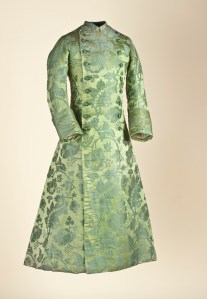
Coat, French, 1790s. MMA 1999.105.2

But in thinking about the Spencer issue (and yes, I scored some on-sale broadcloth so I can make another one on the way to cutting into that K&P wool), I asked Mr Cooke about clasps, since the Spencers I’m interested in are so very clearly grounded in menswear generally, and uniforms particularly. The answer was what I’d expected: buttons and buttonholes or braid loops on dragoons’ and hussars’ coats, hooks and eyes sandwiched between shell and lining on center-front closing uniform coats.

So I went back to look at menswear, because somewhere the phrase “miniature frock coat” rattled in my head, and I knew I wanted to re-draft the pattern for the front anyway, to get closer to the high stand and fall collar of the Swedish original.

The other collection that’s extremely useful is the LACMA collection, because they have patterns up on their website.

Man's Banyan Textile: China; robe: the Netherlands, Textile: 1700–50; robe: 1750–60 (M.2007.211.797)
Man’s Banyan
Textile: 1700–50; robe: 1750–60 (M.2007.211.797)

I’ve already started to crib a new two-part sleeve pattern from a frock coat pattern, so now I think the next step to getting the look I want is to crib from the LACMA banyan pattern. It’s earlier than the Spencer by some 30 years or more, but the neckline looks like a better place to start.

And, bonus, along the way I’ll learn more about menswear to the ultimate benefit of those guys I sew for.

Bust darts from Hell

Spencer ca. 1800. MMS 1991.239.2

It all started out so well, in the muslin, but in the wool, not so much. I cut up a remnant, proving that a yard and a quarter of 60” fabric is enough for a Spencer, even for my arm length (but not less, thanks to that arm length and a respect for the grain).

The pattern I’m using has bust darts, which I haven’t sewn in years. They took some tweaking with the steam iron.

In 18th century clothing, one doesn’t see bust darts; there are some above the bust, shaping gowns at the robings, but for the most part they aren’t needed. Think cones, thanks to the stays. And later in the 18th century, a lot of work is done by gathers and drawstrings, as in the white and black  ca. 1800 French spencer at the Met.

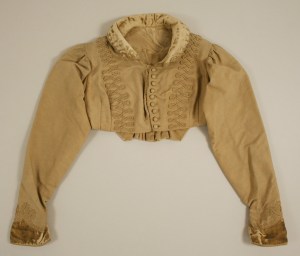
Spencer ca. 1818-1819. MMA 1982.132.3

But if you’ve got an endowment of the non-fiscal kind, and you want your military-inspired garment to fit smoothly over your endowment, what do you do?

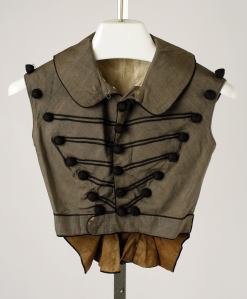
In this example, you hide the bust dart under braid and buttons. Check out that diagonal seam—and that the fabric appears to have been cut on the bias.
Brilliant, right? Gain ease by using the stretchy quality of the bias and hide the shaping under decorative elements.

Here’s an extreme detail.

Spencer, 1813. MMA C.I.39.13.48

In the garment below, of wool, three bust darts of the same length help shape the front. And again, decorative braid hides the shaping. 

It’s only cataloged as “wool,” with no weave given. There is a detail image of the darts and braid as well; I think that might be serge, and not superfine broadcloth. Still, three bust darts help achieve a smooth fit.

The Swedish Spencer at the museum in Lund has but one grainy photo: it’s hard to imagine that it doesn’t have bust darts, but the photo leaves much to the imagination.