HSF # 26: Celebration Spencer

Cassandra in her new Spender.
Cassandra in her new Spencer.

This was supposed to be for #25: One Metre (yard) but things went awry. now it’s cause or #26, Celebration.

Make something that is celebration worthy, make something that celebrates the new skills you have learned this year, or just make something simple that celebrates the fact that you survived HSF ’13!

Heck, I survived the last two weeks of 2013, and that’s reason enough to celebrate. Water at work, relatives at home, high-stress holidays: if you can’t say anything nice, don’t say anything. So on to those pesky facts!

The Challenge: #26, Celebration! with a backward glance at #25, One Metre

Fabric: 34 inches of double-faced Italian wool, bought at Apple Annie Fabrics as a 50% off remnant after she found it in a pile. The collar is lined with black silk taffeta and interfaced with buckram. The sleeves are lined with black silk Persian from Wm Booth Draper, but I used taffeta on the bodice to give it more body. Technically, that’s almost two yards because it’s two kinds of fabric. Initially I didn’t plan to line this, but the edge did not hold as well as expected so I ended up breaking the rules in order to make a better garment. Celebrate rule breaking! Also, better sewing skills!

The pattern pieces on 34 inches of fabric. One cuff is pieced.

Pattern: My own, mostly. I started with the Sense & Sensibility pattern, and then modified it to make the first Spencer, working my way towards the double-breasted broadcloth of the Swedish Spencer. I first modified the lapels, and then, in order to match the arm scye to the sleeve correctly, modified the bodice at the side, and at the shoulder point. I used the Janet Arnold Spencer/riding habit as a reference, and then measured up the Leloir pattern to check my work. The two-part sleeves are borrowed from Henry Cooke’s 1770s man’s frock coat pattern taken from that extant suit; the collar and cuffs came from the same place.

Once I reshaped the sleeves from the elbow to the wrist (as I do not have a gentleman’s forearms of steel), I concentrated on adapting the bodice to make the seam sit properly on the shoulder line. Watching Mr Cooke manipulate Mr S’s garments made this a lot easier to do.
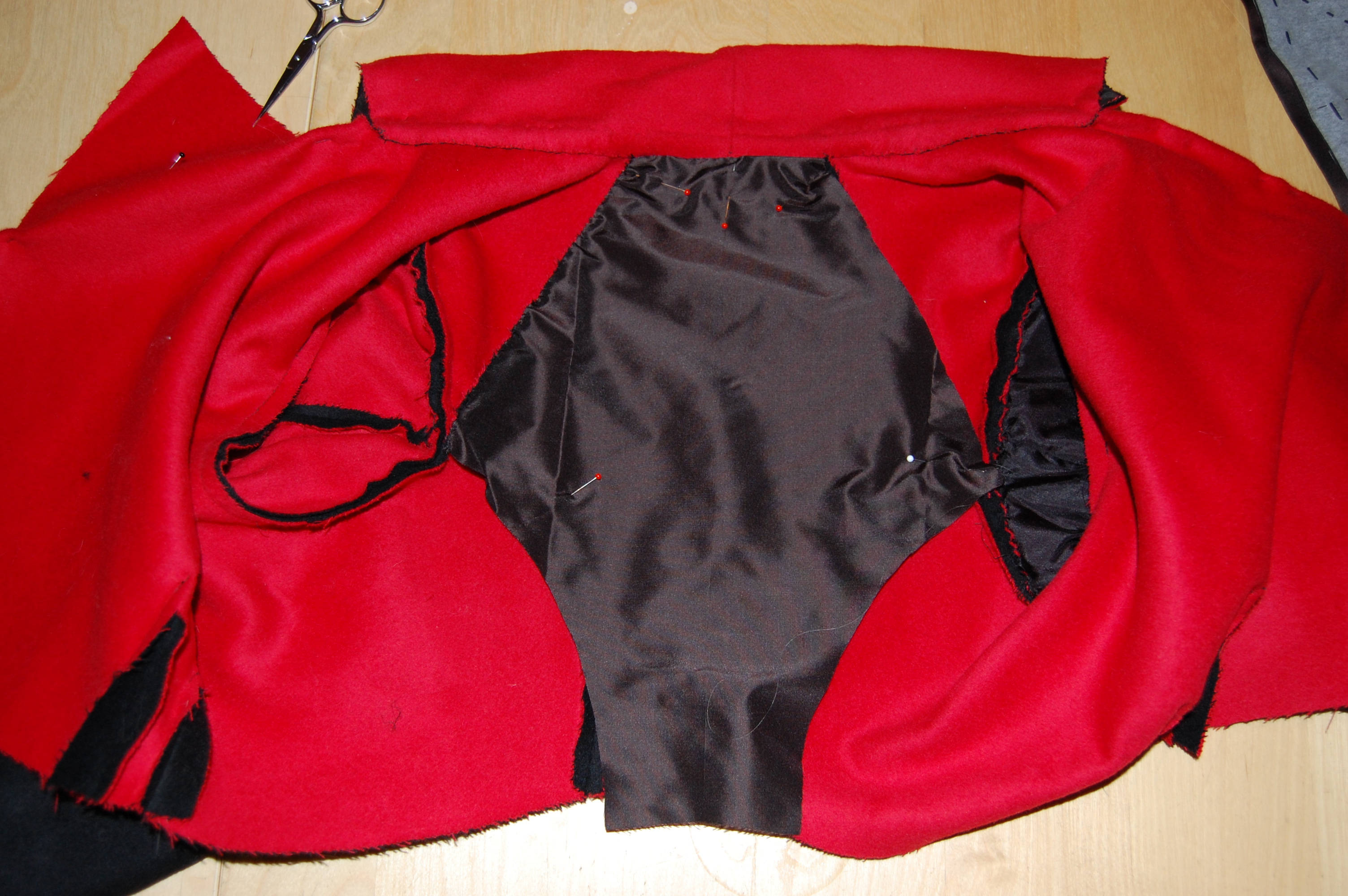
Inside view in progress.

My theory was that if you thought of a Spencer as a miniature frock coat, starting with a man’s pattern might be the way to go. I played with that in a theoretical way, but did not pursue it fully, as I was committed to the double-breasted look.

Year: 1797, if you take the Amazon as the inspiration and marker, which I do. This style, and even the revers, persists for a while, at least in fashion plates. 1797-1800 seems about right. (See the expanded Pinterest board for examples)

Notions: Thread counts, right? Also button molds. But that was it.

How historically accurate is it? This is always the toughest part! I have verified the revers, the style, the fit, and the pattern pieces. The garment is entirely hand-sewn of the most period-appropriate materials I could find. I found reference to a very similar example in a Danish museum; if I had possessed enough fabric for a cape, I would have made one. The inaccuracies will be in details of techniques and the lining materials, which were chosen to ameliorate the very snug fit. Is it 90%, with points off for not being able to time-travel back to buy my fabrics from Providence merchants in 1797? Aside from the Andes Candies coat, I think this is the most accurate and nicest thing I’ve made yet.

The shaped back piece.

Hours to complete: 12 to 18 for the pattern and muslins. Each sleeve took 30 minutes to pin and stitch into the armscye, but the long seams were more time consuming. 12 hours of sewing, perhaps? It seems like more than 30 hours, but once the pattern was done, parts of this moved quickly. (Personally, I love setting sleeves and sewing curvy back pieces.)

First worn: Not yet. As soon as I can talk Mr S into taking photos, I’ll wear it, but right now I have no firm plans for wearing it, which makes me sad. Wouldn’t it be a fun thing to ice skate in? Except for the very authentic way it pulls your shoulders back, which could compromise your balance.

Total cost: $15 for the wool, $6.50 for thread, and $2.80 for button molds; $8 for the amount of silk Persian for the sleeves, the taffeta was in the stash, so $24.30.

The Historical Sew Fortnightly: 2013 review, 2014 plans

The Andes Candies coat at Saratoga

I didn’t get nearly as many things made for the 2013 Historical Sew Fortnightly as I wanted to. Some of the challenges didn’t appeal to me,  but mostly I just couldn’t keep up! Reenacting ate a lot of my life, especially in the late summer and fall. The Andes Candies coat and the What Cheer Day sewing, while totally gratifying, happened when I was thinking about the “Green” color challenge. But, on the positive side, because I’ve waited and played with Spencers, I have a much better pattern plus what I hope will be an entry for HSF #25, the One-Metre Challenge.

Looking ahead to 2014, I can see that July and August are going to be tough. We expect to have a lot going on at work, and the reenacting season will be in full, heavy swing. (Starting July 19th, there are five weeks in a row of events and work. We won’t be able to do everything, so there will be some figuring out to do. Also, our house will be a mess.)

The 2014 Challenges Announced Thus Far:

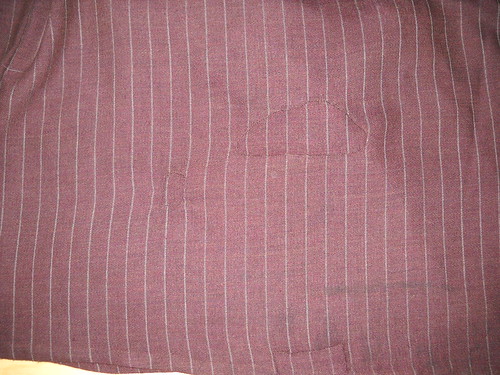
Last year’s mending. This year: more lost buttons.

Challenge #1, Make Do and Mend, will be a chance to fix things I know are awry. There’s a petticoat hem come undone, some binding that needs reattaching, buttons popped off waistcoats, and haversack straps to be shortened. That’s all without even looking: Imagine what I’ll find if I look (or maybe not, it could get ugly). I think this challenge will help me tidy up after last season, and prepare for the next. There was mending last year, too.

Challenge #2, Innovation, is a little more worrying. I’ve got a major dress project underway, and will have to adapt that to this challenge. Fortunately, I think compere fronts on sacques might count as an innovation, so that will help keep me on track.

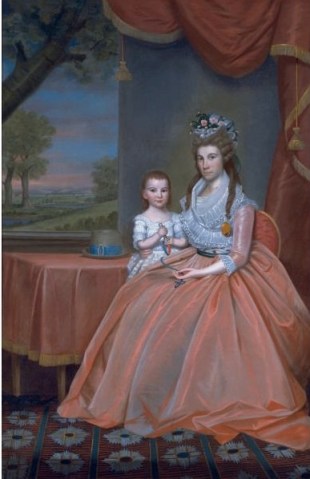
Mrs. Elijah Boardman and her Son, William Whiting Boardman. The Huntington Library, 83.8.15

Challenge #3, Pink! Will probably not be mine. None of the things I plan to make are even remotely pink. I thought I had some pink silk and was about to ditch the sacque for a pink Ralph Earl, but it turns out that silk is more lavender than pink. I looked at some pink silk, but then Sew 18th Century helped convince me to buy the cross-barred silk instead. And, like yellow, pink can be unfortunate on me, unless it is coral. Of course, pink can mean red if you’re making traditional hunting clothes…so this could still get interesting. And I know of a receipt for 5/8 of a yard of pink satin…which sounds to me like a waistcoat.

Challenge #4, Under it All, will probably have to be pocket hoops or other skirt supports for the sacque. I have been working on a faux quilted petticoat, with limited success (it may qualify for make do and mend…), but would need hip pads to round out the silhouette properly. Have you noticed this is a bit out of order? Yes, I need the skirt supports first, but six weeks in advance is plenty of time! Well, from this vantage point, anyway. It’ll look like madness on the other side of New Year’s.

I know I’ll miss deadlines and fall behind, I know I’ll get distracted in the summer and stop reading about all the great things people have made, but thanks to the HSF, I’ve kept more on track and become a better seamstress, than I was a year ago. Many thanks and kudos to the Dreamstress and everyone else around the world who joined in, and will join in, on this international sew-along.

Muff-ed Up

Remember the Amazon? She has the dressed-up dog and the Muff of Doom. I’ve gotten a little obsessed with her, and that obsession has led to some interesting places.

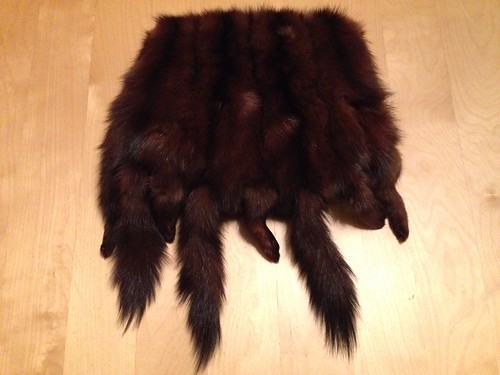
The Muff of Dooms Past. Poor minks.

For one thing, it’s winter, and everybody has cold hands, so everybody is making muffs.

Here at Crazy Scheme Central, I had thought about making the great Ikea sheepskin Muff of Doom, but that’s a place I generally don’t go until after the Christmas madness, when the store in Stoughton does look as if it had been plundered by orcs.

Instead, I bought a Muff of Dooms Past at an antique store. I wouldn’t buy a new real fur anything, and I do feel bad about the poor minks, but at least no new minks were harmed. Or sheep. But golly, it’s soft and delicious and it’s easy to see why people wanted fur, given that we’re essentially hairless mammals. It measures 11 inches high (not including decoration) by 11 inches wide at the narrowest point, and 14 inches wide at the base.

Pupils of nature Maria Caroline Temple delt. ; TS. sculp. London] : Pubd. April 30, 1798, by S.W. Fores, No. 50 Piccadilly, corner of Sachville [sic] St., [1798]. Lewis Walpole Library Call Number 798.04.30.01+

The Muff of Dooms Past is not nearly as large as the Amazon’s muff, or as large as the ones seen in fashion plates and satires.  The sad little tail-and-paw fringe has precedent (see left), though I believe at least one tail has been lost. As far as I can tell, with no label, this is probably a 1950s muff of local manufacture (there is a fur company, now in Warwick, that started in Providence, and is now going out of business). It could be earlier, but the flexibility of the pelts suggests a more recent vintage.

The Met has some fantastic late 18th/early 19th century muffs of a color that screams warmth. The size of the brighter one is just 8 by 7 inches. In case you think that’s anomalous, here’s another muff of similar type and size.

They seem small compared to the Amazon’s muff, and even the Student of Nature’s. And yet, there they are. It’s hard to know exactly where the measurements were taken, and if they include the extreme fluff of the feathers; I tend to think not, but that the measurements are for the firmest part of the muff. (That’s how we would measure, and then include the largest “fluff” measurements in a ‘special measurements’ field with a note.) There is a 1780-1820 swan’s down muff at the V&A with a record but no photo or measurements.

Satires are hard to use: we know they’re depicting some grain of truth, usually in the background details, but also in what they’re portraying. How do we interpret those enormous muffs? They appear over and over, in consecutive years of satirical engravings and fashion plates. Maybe the way to interpret them is to see those muffs as the extreme end of fashion– Alexander McQueen muffs, if you will– and the extant muffs represent the more reasonable dimensions of fashion. I wouldn’t call red feather muffs typical, and I wouldn’t suggest we all carry them. But based on what exists in museum collections, maybe a smaller-than-satire muff is within the bounds of reason for actual use.

Dogs in Coats

[An amazonian dress]. London : Pubd. May 26, 1797, by G.M. Woodward, Berners Street. Lewis Walpole Library Image Number lwlpr08972, Call Number 797.05.26.02
[An amazonian dress]. London : Pubd. May 26, 1797, by G.M. Woodward, Berners Street. Lewis Walpole Library Image Number lwlpr08972, Call Number 797.05.26.02

I was wondering about contrast revers on women’s clothes, and if I could really get away with such a detail on a Spencer, when I happened upon this image on Pinterest. Well found indeed from 1797, and very nice hat as well. Bonus: Giant Muff.

The dog has a coat, too, and now that it’s cold in New England, the local whippets are turning out in their winter coats. Mr S and  I had a slightly crazy notion to dress a dog we know in a canine-scaled replica of a certain very special coat, but would need access to the hound (for measurements) and a particular scrap pile. With those circumstances not in the offing, let’s just be delighted that dogs in 1797 wore coats, and had bows in their topknots, which means that the end of civilization has been coming for a lot longer than previously thought.

Of course it may be that the dog has to dress as a human to keep from being eaten by the ENORMOUS and possibly carnivorous MUFF of DOOM. I think you could make one from the sheepskins at Ikea, if you could settle for white.