Any old Shirts?

DSC_0041
The photos people have of the Millinery Conference at Williamsburg– well, they’re a little envy-inducing. All the silks gowns on such a beautiful site are a little overwhelming if you like historic costumes, but if I was all about silk gowns it might be harder to do what I am doing.

I did discover a fool-proof way to unnerve the teenager in the living history household. If you get dressed in your 18th-century clothing early enough on a Sunday morning, the child will ask, “Um, Mom? Are you just fitting, or do we have an event?” You get one glorious moment to decide whether or not to torture the child before he figures out that even you are not crazy enough to go to an event in March without stockings.

Bridget’s gown is done, but for the hem, which is turned up and about a quarter sewn. I tried it on yesterday to make sure it fit. I threw most caution to the wind and made up the new Golden Scissors English Gown pattern without making  a muslin because I’d checked my own self-fitted pattern pieces to the English Gown pieces and found them nearly identical. Anything likely to need work– shoulder straps– I knew could be done in the lining and not matter terrifically.

Why, you ask, did I bother with a new pattern? In part because my own has migrated (my backs have been trending too wide of late) and because I needed a solid, step-by-step guide to more correct assembly. The sleeve pleats still annoy me, mostly because they get done on a dress form and not on me, but they allow movement and that really counts. DSC_0047
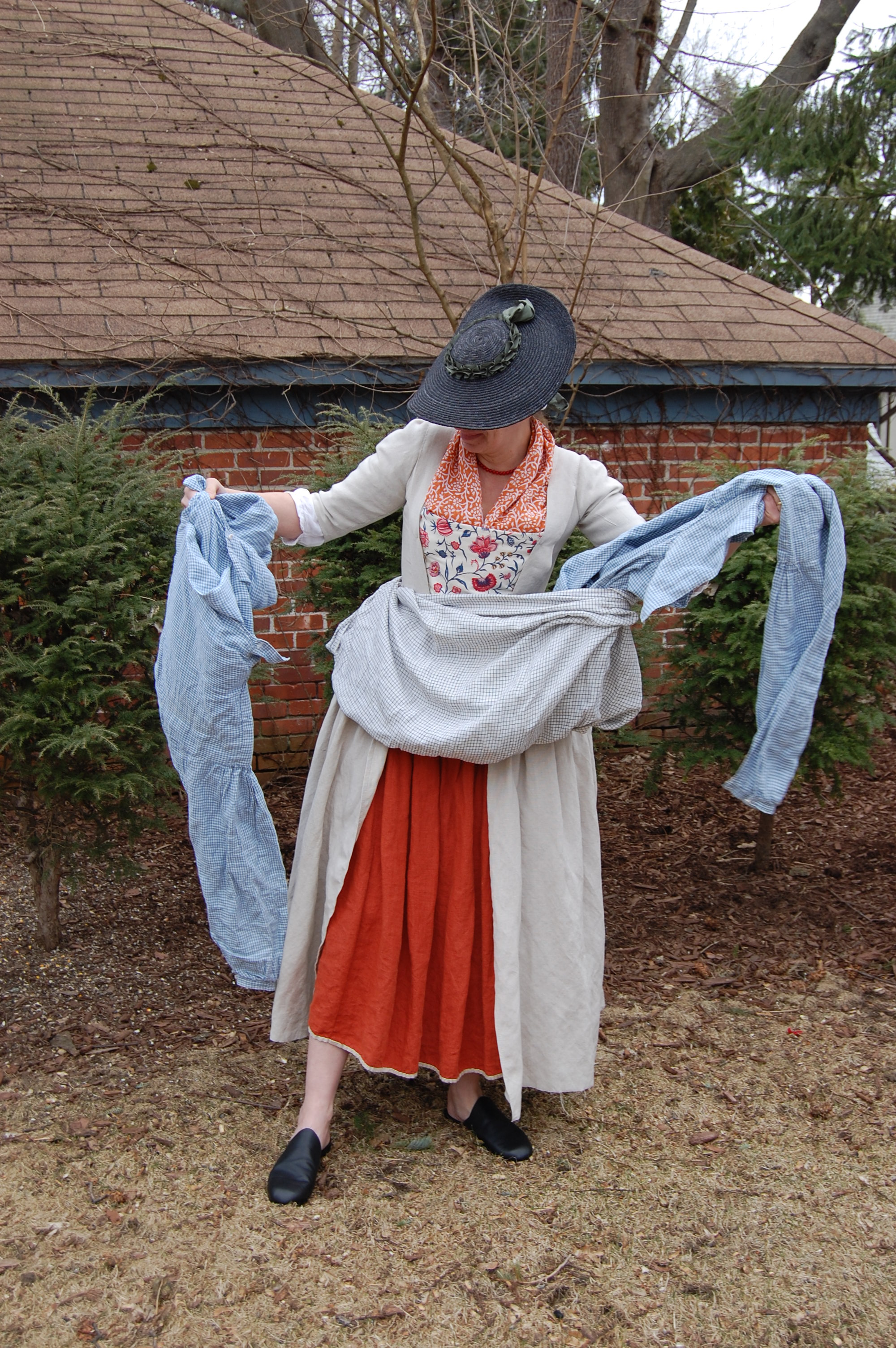
The stomacher front style is a compromise: I want to be able to wear this at events earlier than 1782, so I’m working on the assumption that Bridget didn’t migrate to the more fashionable center-front closing style in the 1780s because she couldn’t.

The accessories are chosen because they were affordable ways to upgrade appearance: it takes hardly any chintz for a stomacher, and a handkerchief is bright but small. The hat is more common than a bonnet among working women, and the mules were chosen because they appear in an engraving of a crippled soldier and his family. All Sandby’s women wear heeled and buckled shoes in styles not to be found ready-made in my size, so  mules are my compromise.

I still think Bridget looks too clean and too pretty, but until I find fabric I like for a bedgown, this will have to do. The details, should you care for them:

Hat, Burnley and Trowbridge, lined with a Wm Booth remnant, trimmed with B&T ribbon. My hair is out up with straight pins from Dobyns & Martin, and under the hat in a lappet cap with the strings tied on top of my head.

The coral necklace is from In the Long Run, I’ll replace the grey poly ribbon with black silk ribbon once it’s in from Wm Booth.

The neckerchief is from B&T, again, and selected because the pattern was similar to the one worn by the young woman in the Domestick Employment: Washing print.

DSC_0051The gown fabric is from the second floor discount loft at the Lorraine mill store in Pawtucket. It’s 100% cotton, yes, it really does flame, and I’ll just have to be careful. (The women who cook in cotton at OSV are probably vastly more graceful than I, and do not fall into things.) It’s a light brown and white tiny check weave, and looks a great deal like a homespun gingham. I chose it because it tends to wrinkle badly and should show the dirt well: in short, I chose it because I don’t expect it to wear particularly well.

The petticoat is from the last of some ‘madder’ linen Burnley & Trowbridge had a few years ago, and the mules are from them; I think the apron linen was, too, but I can’t remember.

Those shirts are blue and white check from Wm Booth, and I have no idea how they got into my apron. Stop asking, or I’ll get my stick.

Fewer Words

unknown artist, A Country Woman, , Pen and black ink and watercolor on laid paper laid down on a contemporary(?) mount, Yale Center for British Art, Paul Mellon Collection. B1975.4.46

Gentle readers, I am indeed posting less often. I don’t have less to say (take pity on Mr S), but I have less time.

I have a new routine, which includes a morning workout and more cooking in the evening. That workout takes up the time when I used to write (and sew—I’m behind there, too). But I need to get stronger, because in about three months (83 days according to the countdown app) I’m getting a new left hip. Yay!

Three years ago, I got a new right hip and I love it. Even though it took a while to get used to (which was really about bone growing around the implant so it wouldn’t be so cold in the winter), the lack of pain was a terrific change.

18 months ago, my surgeon told me plainly that it was just a matter of time before the left one would need to be done. We spent some time looking at the x-rays in January, and it’s a fine thing to see the bone lumps that thunk and clunk as you move. Oh, that’s why climbing stairs is noisy and painful… But stronger I must get, so for while, more Pilates and fewer paragraphs.

Ballet Arthritique

Three men wearing orthopedic apparatus. Etching and engraving by Paul Sandby, 1783. Wellcome Library image L0019751

How was arthritis pain treated in the 18th century? One option was the mustard plaster, which operates on the principle that heat generated by the plaster increases blood flow, which will reduce inflammation. Frankincense supposedly inhibits the production of molecules that cause inflammation and break down cartilage tissue, which leads to joint pain, at least in knees. This level of scientific knowledge wasn’t available to the 18th century physick, but frankincense is an edible aromatic resin with a long history of use in treating ailments including arthritis. At least you (or your breath) would smell good.

The primary ailment treated of was gout, and the remedies above are mostly directed at inflammatory arthritis, the kind where joints grow red and swollen. Think of wealthy, overweight men drinking port with swollen feet propped up on footstools: that’s gout.

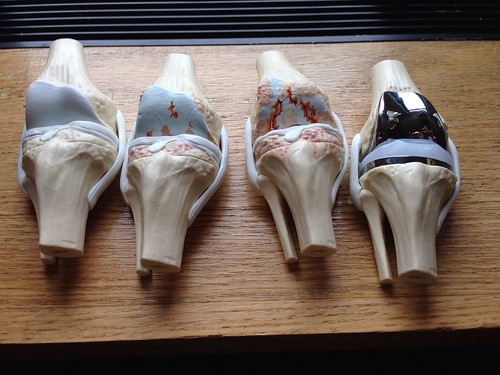
Models showing progressive arthritis in a knee, followed by joint replacement.

Then there’s osteoarthritis, or degenerative joint disease, once included in the catchall and obsolete term, rheumatism. This is a different matter, where changing your diet and icing the joint generally won’t bring much relief. When your cartilage is gone, your bones rub together. Osteophystes or bone spurs form is response to damage or inflammation, and cause both pain and noise.
In the pre-joint replacement era, treating this kind of arthritis was treating chronic pain. (In this era, that’s still the case: absent a TJR or resurfacing, all that’s treated is pain. Once the joint is replaced, there’s nothing left to hurt. It’s a neat little trick.)

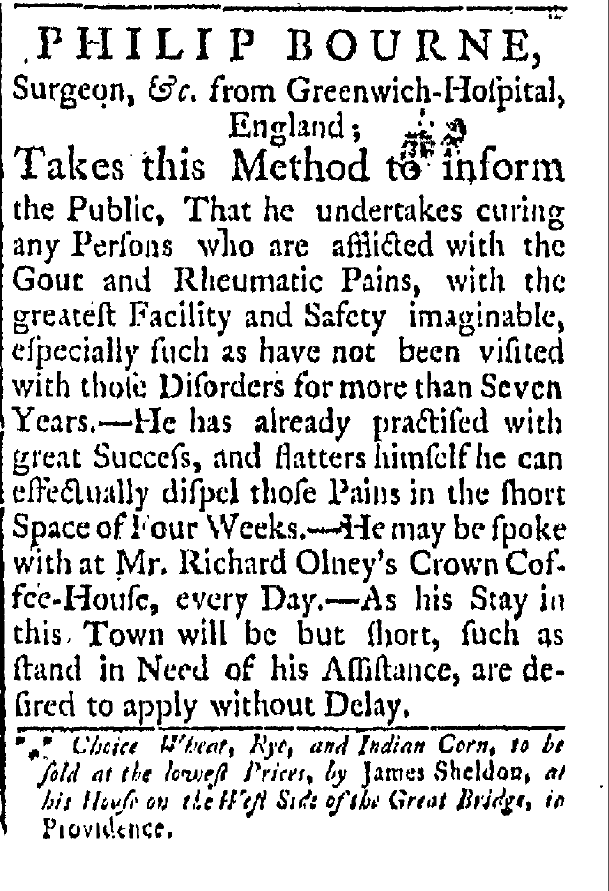
Providence Gazette and Country Journal, June 16, 1764. V II, Issue 87, page 3

In pre-Revolution Boston and Rhode Island, there were various cures advertised promising far more benefit than they were likely to deliver. Phillip Bourne, from Greenwich Hospital in England, promises to “undertake curing any Persons who are afflicted with the Gout and Rheumatic Pains, with the greatest Facility and Safety imaginable.” The caveat about “especially such as have not been visited with those Disorders for more than Seven Years” is particularly nice, since the longer pain persists, the harder it is to treat. He knew his limits, I suppose, if only of his patience, or the amount of time he could safely ‘practice’ in any location.

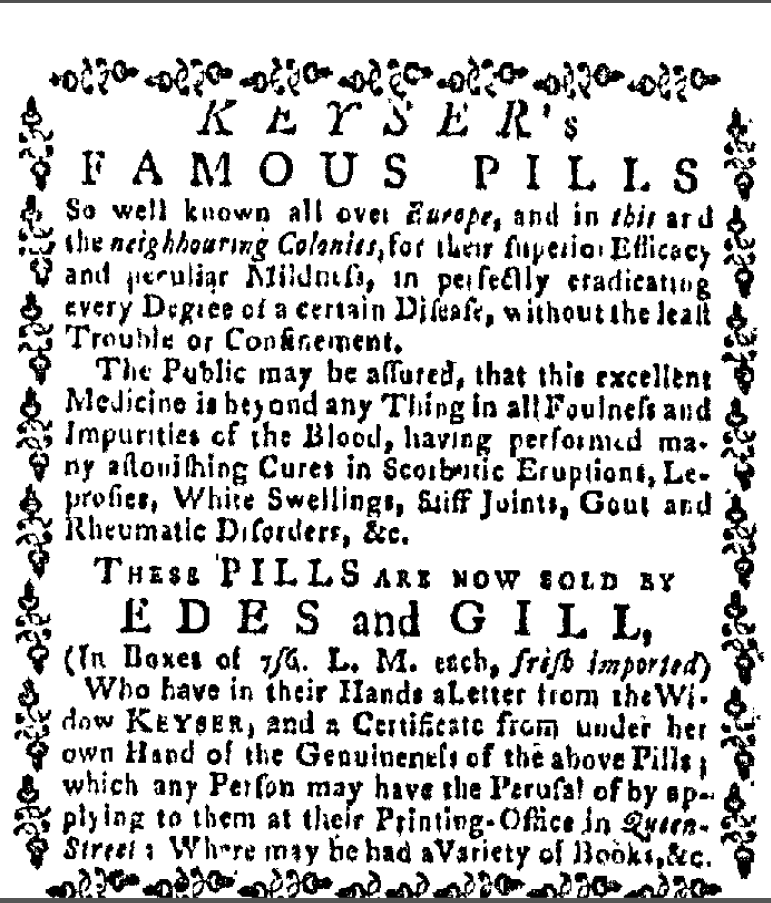
Boston Gazette, February 14, 1774.

Edes and Gill sold Keyser’s Famous Pills, “So well known all over Europe,” and promising much, like Cures for Scorbutic Eruptions, Leprosies, White Swellings, Stiff Joints, Gout and Rheumatic Disorders, etc.” I don’t know about you, but I think I’d prefer to have my scurvy treatments separate from my arthritis treatments.

Ultimately, the best option was probably a crutch or cane, though braces were devised and are still used, along with crutches and canes. All that prevents their use or efficacy is the vanity of the user.

Pinner Aprons

Mr & Mrs Thomas Sandby. Watercolor by Paul Sandby. RCIN 917875, Royal Collection Trust.

On Saturday, Sew 18th Century and I went out for lunch and fabric shopping. Along the way, I brought up pinner aprons, and that I’d seen them in British prints. She said, “You should blog about that!” and I went back to check my sources. Fail! There was an English print after a French original, and that doesn’t count!

So I shelved that idea, and went about looking for more Paul Sandby images of soldiers and maids and tents, and found instead Mr and Mrs Thomas Sandby. Ahem. Pinner apron alert.

Fluke, right? Well, no, not exactly.

Lady Chambers and child. Watercolor by Paul Sandby, RCIN 914409. Royal Collection Trust.

Because here is Lady Chambers and child, with Lady Chambers in a pinner apron.

The thing to note, though, is that “apron” here is a decorative, almost ceremonial garment made of black silk, while the maid engaged in Domestick Employment is wearing a working garment of [probably white] linen.

Domestick employment, washing. Mezzotint by Richard Houston after Phillipe Mercier, 1736-1775. British Museum 1876,0708.23

Well, can I wear a pinner apron as a Continental army laundress or not? Probably not, though I will be going back through all the images of laundering I can find. It would be so useful and protective a garment!

No, instead, it looks as if the black silk pinner apron was a fashion adopted by the British upper class probably in imitation of the aprons worn by young girls. These fleeting, black silk accessories were probably adapted to some other use when the fashion had fallen from favor. (You could make a lot of mitts out of one of those.) Sadly, I don’t care enough about the elite to go chasing inventories and more images, but someone else can. I think I have seen a few other examples of this style, but cannot immediately place them. My sense is that these are not common.

I’m much more interested in laundresses and maids. Doesn’t she look sassy? We could call her Bridget. 

A country girl, full-length, facing front, leaning against a fence & a tree. Watercolor by Paul Sandby. RCIN 914438. Royal Collection Trust