Medical Monday

The view across Nassau St

Today I’m procedure plus seven, and glad to be on this side of the OR. Surgery is never a fun or pretty thing, and even the most rational action (take care of this now, before it gets worse) seems crazy to your self-protective mind (but it’ll hurt!).

I am very fortunate that my surgeon has a sense of humor and a skillful hand, though when the visiting nurse saw the incision and said, “Wow, he’s good. That’s no Rhode Island incision,” I will confess I was of two minds. One, sad that I was not typical of the Ocean State in the way of a mahogany chair, and two, scornful and proud because of course I went to Boston where they can tell left from right, thank you.
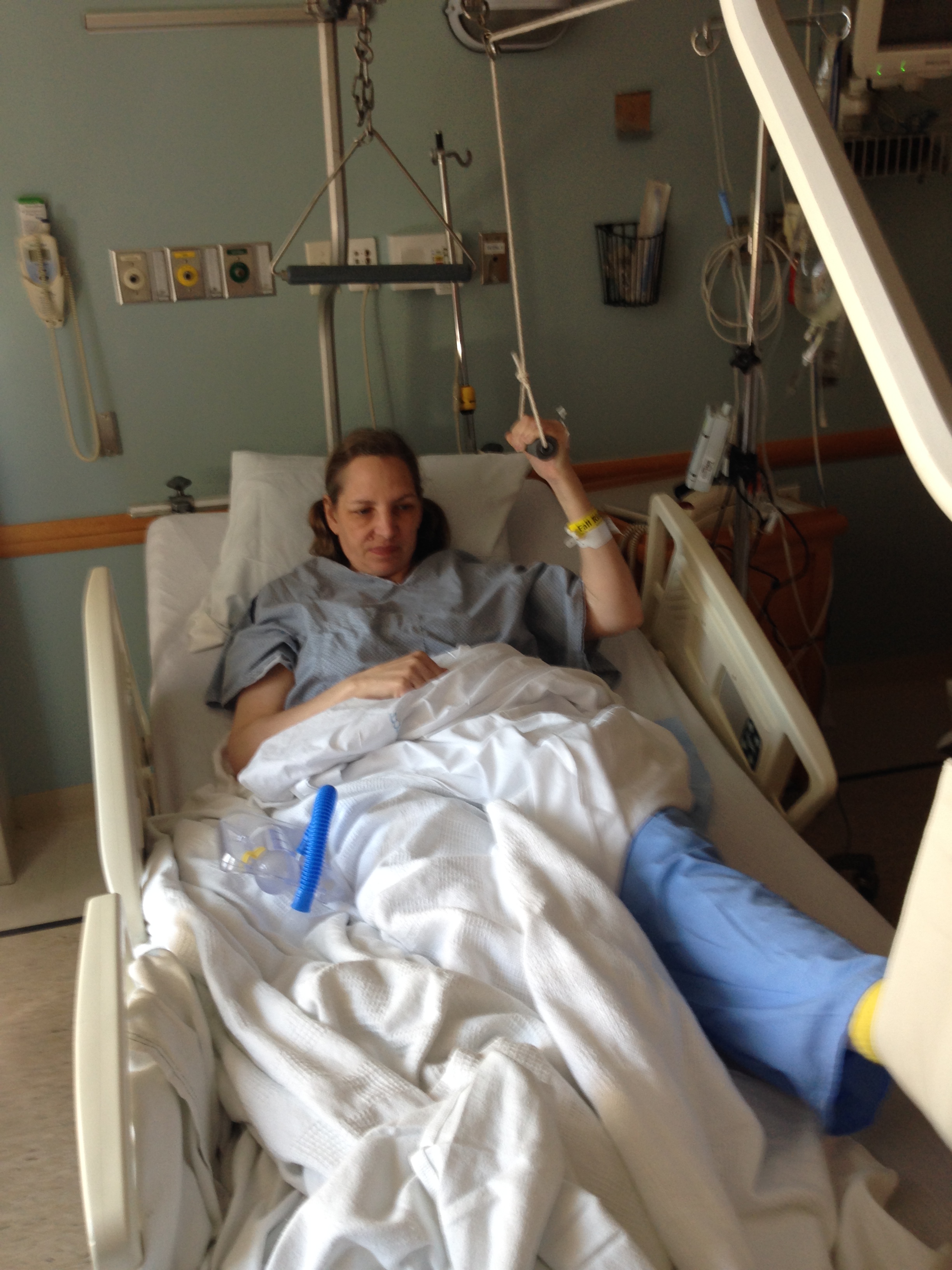
Your foot goes in the sling, and you have to move your leg about.

I’m still not quite ready to read (I work my way through the Times, but I don’t know that it sticks), and I am definitely not ready to sew.

There’s a lot of time spent on physical therapy, reminding muscles that they’re just fine, and can wake up now. In the hospital, you are provided with a trapeze to lift your leg and encouraged to move it about. While oddly old-fashioned, and seemingly borrowed from Foyle’s War, it does work. I can’t slide my leg back-and-forth on the bed, but I can move if someone holds it up just a little bit. (The socks they give you are color coded: yellow is fall risk. I called them duckling feet, and the nurses were entertained.)
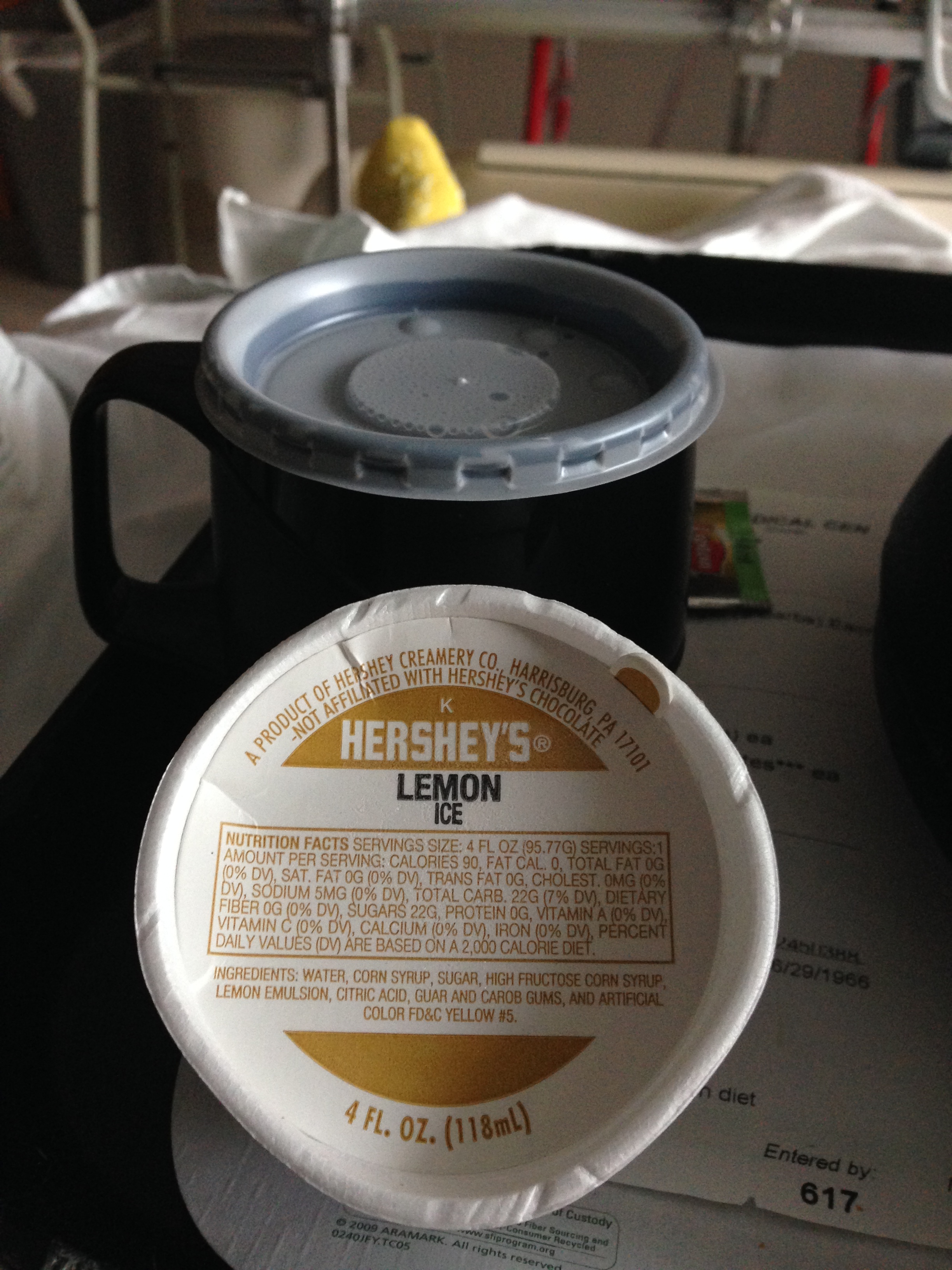
Lemon Ice. Delicious.

The other big focus is meals. In the hospital, you call and order your meal, and it is the only place I know where you can order Lemon Ice for breakfast with fruit and coffee, and where the kitchen will call and wake you up to make sure you place a dinner request before it’s too late.

Time becomes a strange thing: often, it’s measured in the blocks between doses of painkillers, and I find my sense of “early” and “late” are altered. The world gets small, focused as it is on basic needs, and small is how it will stay for a while. Every day is better, and this time around so much better than the last, but it will still be a while before I can really read and write and sew and think.

Thanks to everyone for all of your comments last week! They were very nice to read when I got my phone back on Tuesday, but replying was beyond my ken last week.

No, he didn't eat them
No, he didn’t eat them

The next week or two are going to be cat-like for me: meals, naps, exercise, and today, perhaps a trip to the porch. Fortunately, I have experts here to provide advice. Mr Whiskers understands the importance of meals, and fully appreciated the fragrant salad placed before him on Mother’s Day.

Fortunately, he left the flowers unmolested, and moved on to staring out the window at the birds who sounded like they were saying very rude things about him.

Kitty Calash On Hiatus

A nurse on the ward at the Hospital of St. John and St. Elizabeth Hospital, St. John's Wood. Photograph by Henry Grant, 1954. Museum of London Image Number 008798
A nurse on the ward at the Hospital of St. John and St. Elizabeth Hospital, St. John’s Wood. Photograph by Henry Grant, 1954. Museum of London Image Number 008798

Gentle Readers, you may recall this post. In February, it seemed May would never come, but it has, which means a temporary halt to writing, posting, traveling, and sewing.

Thank you for reading, commenting, and sharing till now: there should be more fun come this summer, sooner if all goes well.

The HFF: Historical Food Fortnightly

2f053ddd402318588e6c094c0ec0e6b4Every now and again Facebook proves itself useful: without following Dobyns & Martin Grocers, I would not have known about this interesting cook-along, the Historical Food Fortnightly.

The challenges look interesting, and I particularly like the seasonal fruit/vegetable one. This seems like a wonderful chance to cook historical recipes using seasonal, local ingredients, and I do like to remind people that historical eating is grounded in seasonal, local, eating. Plus pounds of raisins and sugar and gallons of alcohol.

Your local historical archive (or whichever one contains the works relevant to your interests) can be a great place to get started assembling documentation on local eating. Receipts for foodstuffs can be mixed into other accounts (cotton for your daughter, a parasol, a pair of shoes for your wife, 5/8 yard pink silk satin self) but you can still quantify tea, sugar, spices, Madeira, and flours. I find fresh produce somewhat harder to track–you won’t count what is growing behind your house– but fear not, New Englanders! Some of that hard work has been done for you.

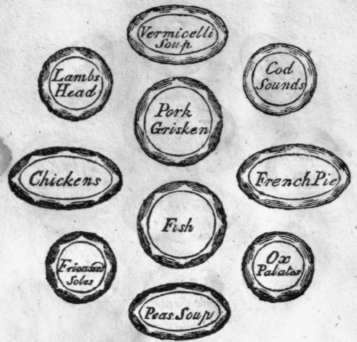
A bill of fare for August

J.L. Bell of the fantastic Boston 1775 blog wrote the book-length historic resource study General George Washington’s Headquarters and Home—Cambridge, Massachusetts, which I read before we went up to the “Washington Takes Command” event last July. (That sentence just seemed crazy, even to me…yes, I read 650 pages plus the event program to prepare for a 6-hour event…)

The report can be downloaded as a PDF, and if you’re looking for food, where you want to go is Chapter 6, Daily Life at Washington’s Headquarters (page 173 and following). On pages 195-197 the Steward’s Purchases are listed, sorted by Fruits, Vegetables and Grain, Spices and Flavorings, etc.

While Washington was maintaining (or causing to have maintained for him) a Genteel Household, the list of purchases is helpful in documenting the variety and types of foods available in Cambridge. I suspect that similar kinds of documentation exist in the historic resource reports or room use studies for places like Gunston Hall.

I cannot manage to keep up with the Historical Sew Fortnightly right now– things went pear-shaped in December— but we have to eat, historically or otherwise!

Pockets 2.0

Pockets the First
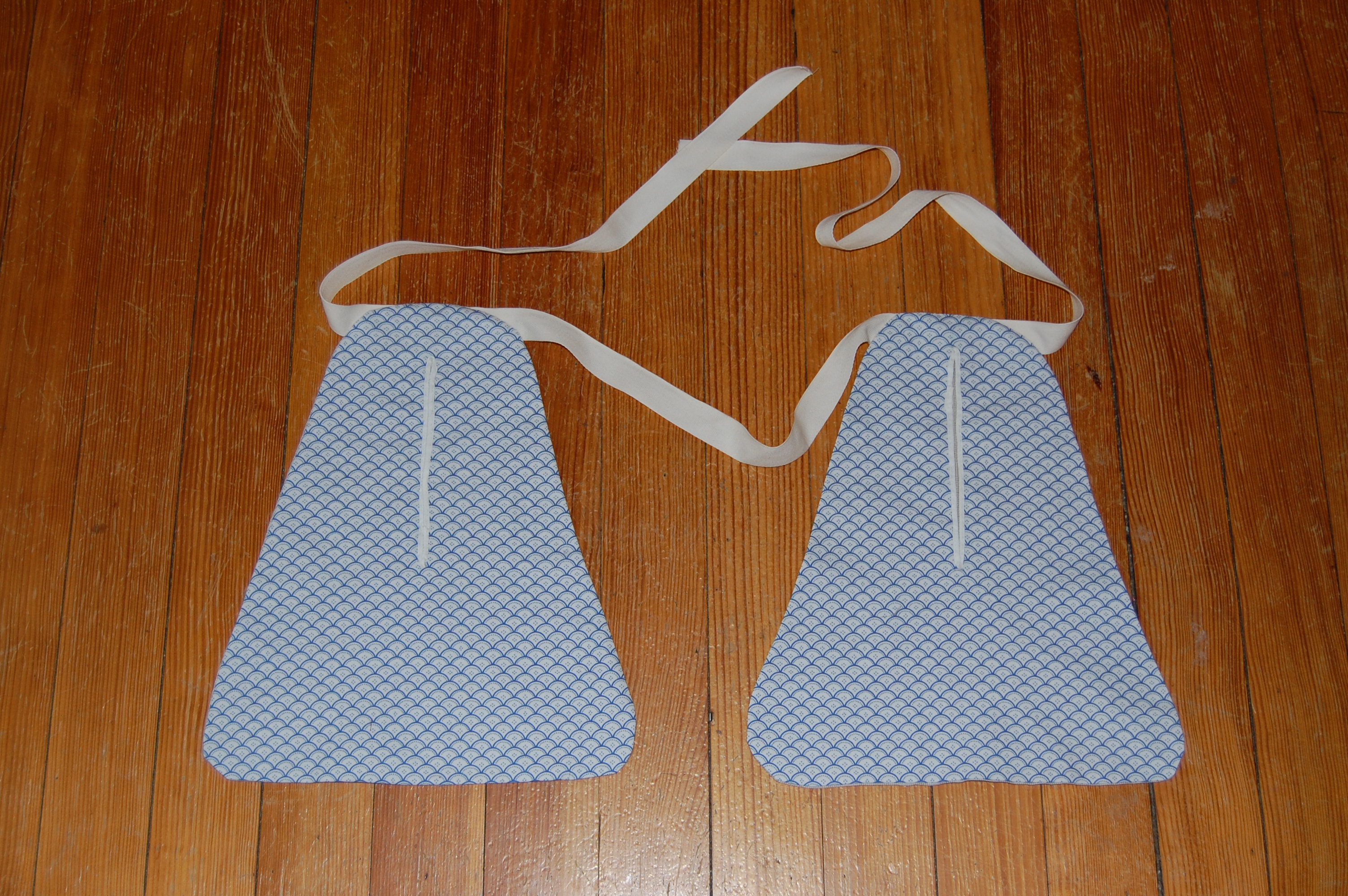
Pockets the First

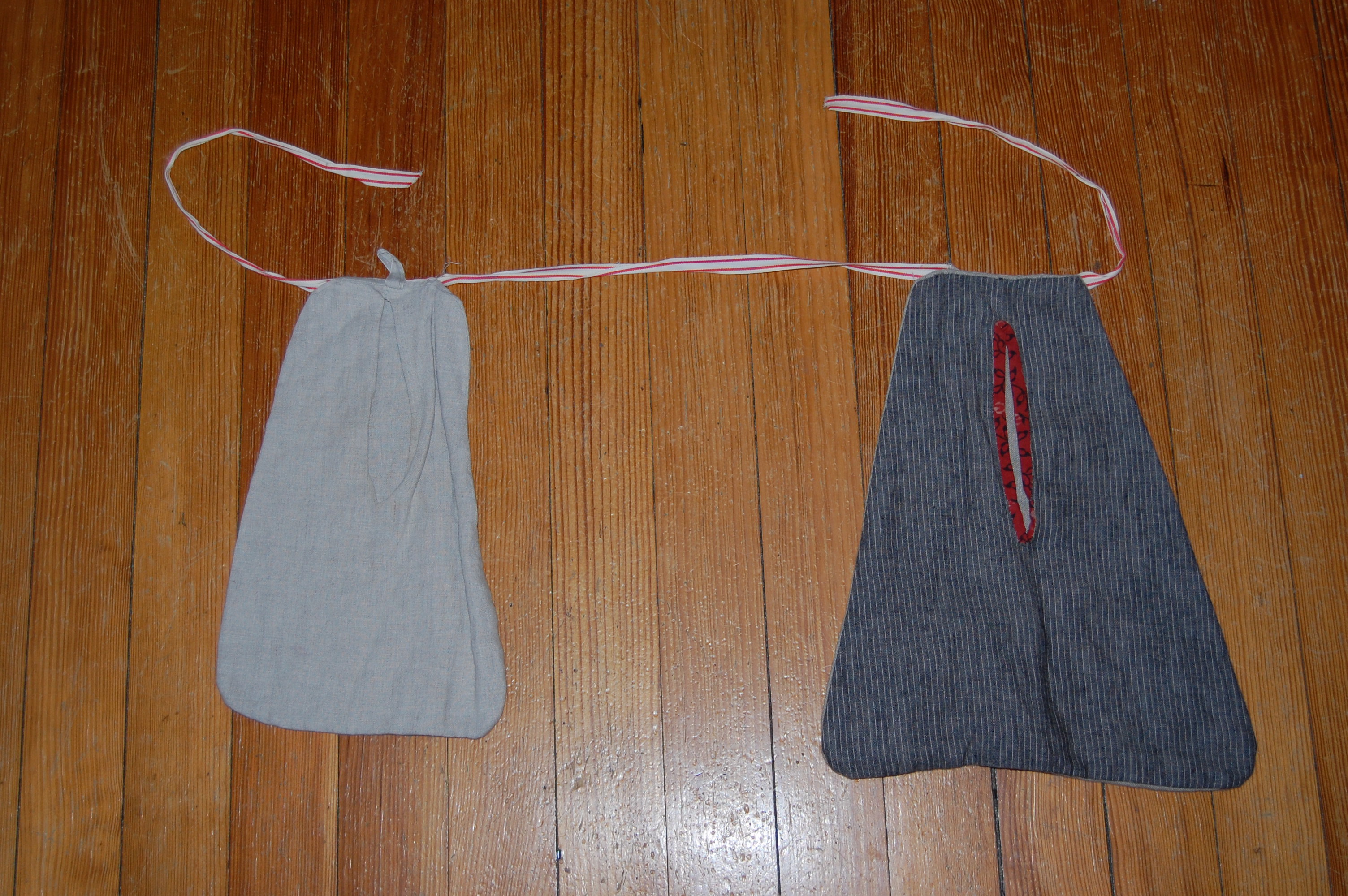
At left, Pockets 1.0 or perhaps beta. The far left pocket, when worn alone, was definitely beta. Then came the striped pocket, and then sewing them both to the tape. That helped– and I use the small pocket for things like wallet, phone, car keys and Band-aids, and the larger pocket for interpretive things. I try to follow the Under the Redcoat kind of model: one pocket is modern, one is historical; that way I don’t pull the car keys out along with the knitting, or am at least less likely to.

Too much stuff.
Too much stuff.

Here’s the stuff I carry in my purse today, actually a backpack-purse, downsized from a messenger bag. That’s a lot of stuff. But if you compare the list to the list of what might have been in an 18th century pocket, you’ll find a lot of similarities.

There’s a pen and a pencil, wallet and checkbook, granola bar, chewing gum, change purse, keys, more keys, and phone. All of those are just modern analogues for paper money, coins, orange or apple, candy, book and notebook, since the phone can fill in for so many things– notebook, money, keys, pen, book…

DSC_0174

The historical assortment is much more attractive, in part because I don’t use these things every day, and they don’t get tangled up and worn in a bag. Mitts, kerchief, hankie, my husband’s pay, knife, thimble, spoon, and knitting (I may never get a pair of stockings knit): these are all accurate to carry, though the knitting needles will have to change before that’s taken out in public.

DSC_0173

All that, or some combination of like things, will go into one pocket, and the modern mess into the other. I fear these new pockets are, for now, too nice for Bridget. I may just stick with my old, mis-matched ones for now.