The Unbearable Sameness of Dressing

One of the arguments I hear against changing the way people dress as civilians at reenactments, particularly the women but sometimes the men, is that “if we all use the same pattern, we’ll all look alike, and that’s not how people dress now or then.”

I have news for you: that is how we dress[ed].

I know, we can’t apply modern thinking to the past– that’s crap historiography. But why do we resist using the same correct patterns for historic garments when we are clearly dressing alike today?

I’ve not yet read a paper on the similarity of women’s dress in Robert Feke or John Copley’s portraits that really convinced me, but if you look at enough of them, you might think there’s only one woman and one dress in all of British North America, because Badger and Greenwood are painting her, too.

Even if those clothes are studio props, what does it say that the sitters wanted to be portrayed in the same clothes? Look, if that’s the only means of getting myself into a Charles James, you bet I’d take it. Or, for a more contemporary analogue, Alexander McQueen.

Luxe et Indigence. Le Bon Genre, 1817

Dressing is about status as much as it is about self-expression, and in the 18th century, dressing signaled refinement, sensibility, and status through the quality of fabric as much as through the cut of clothes. Air Jordans do the same thing today, or North Face jackets, or Kate Spade purses. They show what you can afford, even if you’re eating oatmeal for dinner behind closed doors.

We dress the same now, and we dressed the same then, with variations according to pocketbook. We can’t all afford K&P superfine wool today any more than we could have bought the best wools or prints in the 18th century. But using accurate patterns and fabrics appropriate to our station will create the best impressions possible– even if my gown is cut to the same pattern as my wealthier acquaintance’s.

Gingerbread (in the) House

Illustration by Tasha Tudor

Here we are again, at the time of year known as Impending Parental Visit, which causes a variety of reactions ranging from full-on repaint the kitchen and both baths freak out (whilst nursing an 8-week-old Young Mr) to Eh, she’s got a dog acceptance.

This year, Mr S had the freak out, and has undertaken a living room painting project which he has carried out on weekends since Thanksgiving. It does look good, and I am grateful for his persistence, because this year’s late fall and early winter brought me a serious case of the blues.

That's a happy cat!
happy cat!

I’m in the midst of trying to finish a dress before my mother arrives (my sewing area is really our dining table, with the Strategic Fabric Reserve stowed in sideboards and cupboards). Yesterday, I tried it on: it fits, and looks rather nice (grey wool, and when it’s done, you’ll see it). But it fails in intention: clearly, it is no maid’s dress.

But I felt so much happier in my stays and petticoat that I dug up the wool dress made for farm adventures, put on my apron, and made ginger bread.

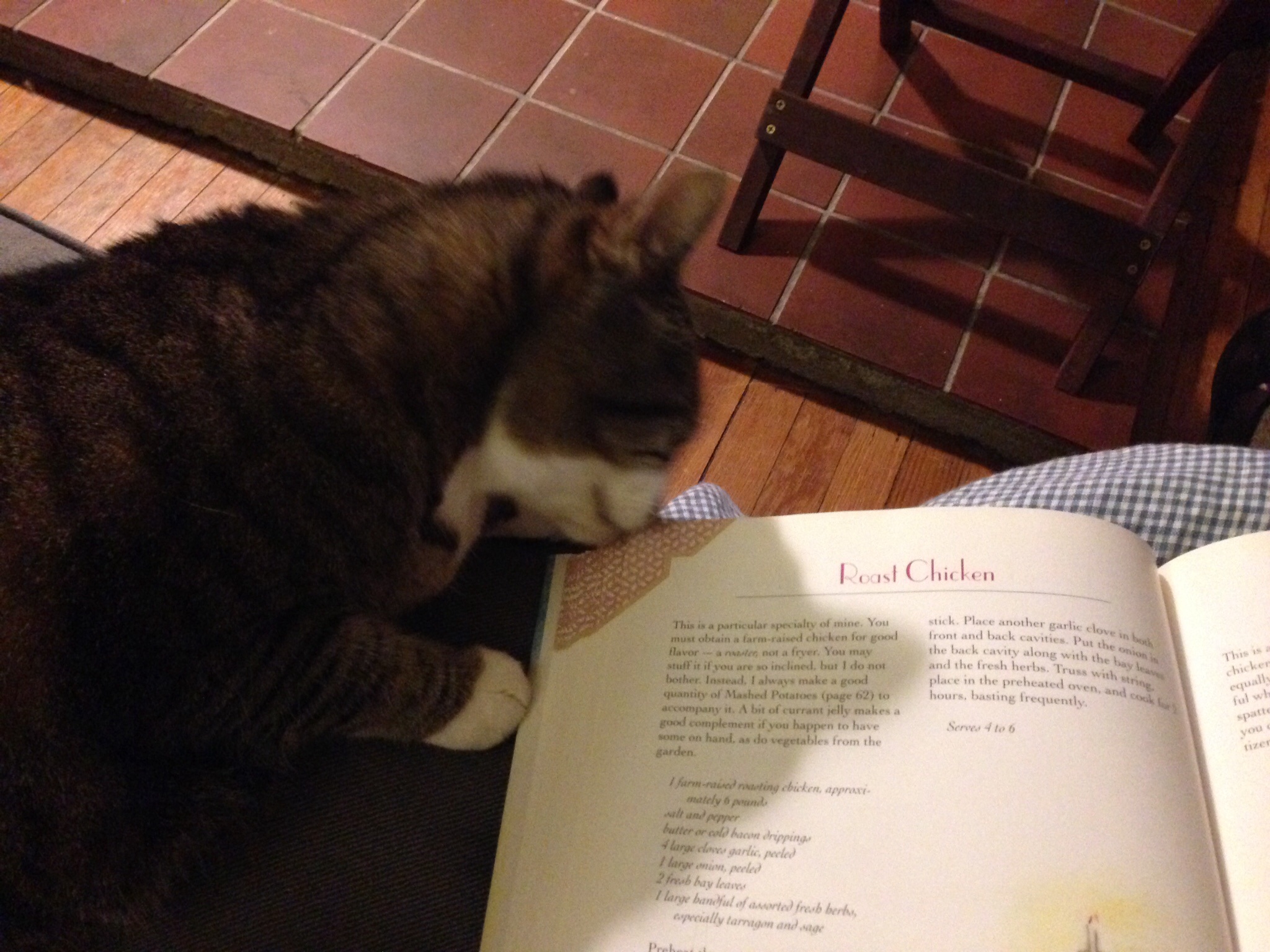
The cat approves of my reading material.

The recipe, which I shared recently with a friend, is an old Rhode Island family receipt, and very similar to the Tasha Tudor cookbook receipt. (The Howling Assistant approved of Tasha’s Roast Chicken receipt. She is a poultry fan.)

When copying over the receipt for my friend, I forgot the hot water, and failed to warn him that this gingerbread cake is best eaten with a fork. Delicious, but sticky, here it is:

1/4 cup butter, room temperature or a little softer
1 cup sugar
1 teaspoon baking soda
1 cup boiling water
Combine the last two ingredients and pour over the butter & sugar.
Add 3/4 cup molasses
Combine well.

Sift into the liquid mixture:
1.5 cups flour
1/2 teaspoon ginger (I use a heaping 1/2 tsp)
1 teaspoon cinnamon
pinch salt

Combine gently. Into the mixture drop one unbeaten egg.
Beat the whole with a hand-cranked eggbeater or whisk.

Pour into greased 9×13 pan, and bake at 350F for 35 to 40 minutes, or until a toothpick comes out clean.

Gingerbread cake
Gingerbread cake

Good with tea, coffee and clementines. I’ve made this perhaps a dozen times, once without the egg, and it’s always edible. (The egg provides some leavening, so made without it, the cake is dense and extra sticky.) Baking it makes the whole house smell good and it’s a simple, one-bowl receipt. For an easy holiday treat to share, I recommend this Rhode Island Gingerbread Cake.

One Coat Two Coat Red Coat Green Coat

I cannot manage to find the button I need to sew onto my real-world everyday winter coat, but I’m pondering and plotting how much broadcloth a Redingote (Redingcoat or Redingcote) would require, and internally debating the merits of red versus green.

Greatcoats have their attractions, and while Mr S would undoubtedly enjoy the warmth of a greatcoat, with a February 14 program in the offing, I am pondering a greatcoat of my own.

I can rationalize [almost] anything, but a Redingcote is a stretch even for me, despite that February program (indoors). I suppose the real appeal of one of these coats, aside from the pleasure of handling delicious green or red wool, is the challenge of making one. I have even found a front view to aid in the patterning.

1813 Hat of velvet and broadcloth coat

What stops me? Some unfinished projects, and a certain feeling of unease about buying quantities of expensive wool. I have two yards of dark green broadcloth, but I’m pretty certain that I will need three to make even the shorter red coat. Without making a firm resolution, I had determined that I wanted to sew down my stash–and I suppose the answer is to sew it down, or put it on Etsy. Or to buy the wool, make the coat, and wear it in the winter. It would be a spur to winter program ideas, after all.

Now, if only I could find the missing button from my winter coat…

The Very Specific Spencer, Finished!

Ta da!
JDK_8197_1

Yes, finished! And just in time, too! The braid arrived in the mail three days before the Spencer was wanted, and fortunately I had finished the garment by then, and the baking could take care of itself after a while, and I managed not to get eggs beaten with sugar on any lovely wool or mohair.

JDK_8210_1

I think it looks well enough with the gown and bonnet, though I am fairly certain the darts are too far to the sides in this iteration. How that happens when you use the same pattern twice I do not know.

You may recall that this is the Spencer where I demonstrated an uncanny ability to sew a collar on upside down. The braid went on pretty quickly, again proving that good materials make good sewing.

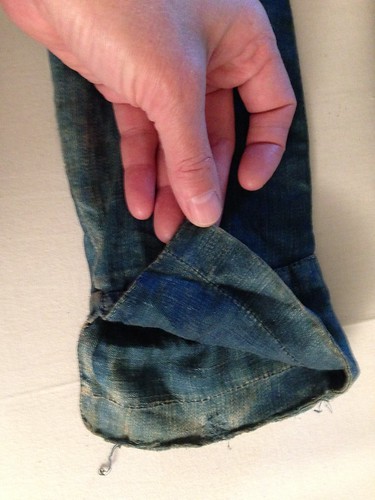
As mentioned previously, the cuffs are pieced, but this is a perfectly accurate way to deal with a shortage of material and/or cuffs.

I’m fairly pleased with how it turned out, and very pleased with how warm it is.  Over the cotton gown, the Spencer was plenty warm– and I certainly wished I had it after we left the house and went down to the river!

On the whole, I suppose I’m pleased…as pleased as I ever am …which means you can expect pattern revisions in the future!