Mopping Up

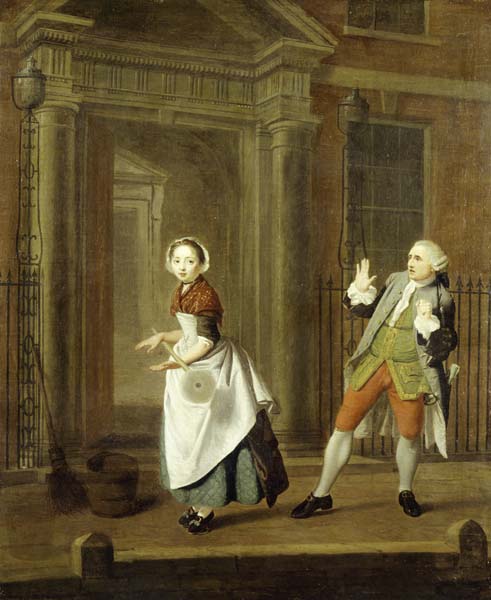
A City Shower. Oil on canvas by Edward Penny, 1764. Museum of London

Springtime sadness is best remedied by scouring[1], so in the best Scandinavian fashion, I have been looking into 18th century cleaning. Dem barracks, right?

First of all, were you wondering about what exactly they “smoked and cleansed” smallpox victims’ rooms with? Brimstone and frankincense.[2] Now you know what Edward Langford would wake up smelling when the house next door was free of smallpox.

But what about those floors? They need to be cleaned. Swept, yes, and scrubbed with sand. But also mopped, and the doorstep mopped.

Tit for Tat. stipple etching, London, Printed for R. Sayer Map, Chart & Printseller N° 53 Fleet Street, as the Act directs Novr 24. 1786. British Museum 1861,0518.958

I have a broom and a whisk broom, and can substitute a kettle for my sad bucket[3] but I lack a suitable mop. Lack never deterred me, whether of skills, knowledge, or supplies, so off to the interwebs and library I went.

I started with Foul Bodies, the 2009 monograph by Kathleen M. Brown. Nothing on floors, sadly.

I remembered the 10th Massachusetts Orderly book from 1782, that was more helpful.

Some part of the Camp and about the long Barracks in particular is relaxing into nastiness. Regimental QuarterMasters have been ordered to have them Clean and keep them so. An Officer of each Company has been ordered to visit the Barracks every day and to Confine & Report those who throw bones of meat Pot Liquor or filth of any kind near the Barracks. Yet all this has been done and no report has been made. it is hatefull to General Howe to Reitterate orders as it ought to be shamefull those who make it necessary.
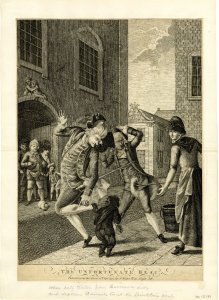
The Unfortunate Beau, etching, Publish'd as the Act directs 12th Sept 1772, by S.Hooper, No.25 Ludgate Hill. British Museum 1991,1214.20
The Unfortunate Beau, etching, Publish’d as the Act directs 12th Sept 1772, by S.Hooper, No.25 Ludgate Hill. British Museum 1991,1214.20

Nastiness. Those barracks sound noisome, don’t they? We can’t have that.

So let’s cast out the bones, sweep the floors of the branches and dirt and grit the men have brought in, and mop them, too, now that it’s spring.

Mop, you say?

What did mops look like the in 18th century?
And how on earth will we acquire one?

Tune in next time for another exciting installment of “historical cleaning instead of cleaning my own house.”


[1] Dude, I have scrubbed baseboards with a toothbrush. Not one of my finer moments, but a memorable one.

[2] Kathleen Brown, Foul Bodies: Cleanliness in Early America. (New Haven: 2009) p. 129

[3] Really really: I meant it when I said keep the bucket wet.
Frugal Friday: Make Do and Mend

In a world of fast fashion, mending is quite out of date (unless you’re a hipster, and I am one of the trilobites of hipsterism), so it is all the more appropriate that I have a gown in need of mending.

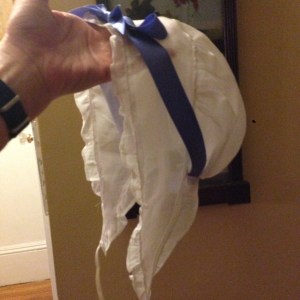
I am still making new things, like the “Bad Squishy” jellyfish cap. It didn’t look so tentacular until I held it up to show it off. As with any cap, the main goal is merely to keep it upon my head–always in doubt.

Tenactularly good. And now I can whip gather.

In just a week I’ll be headed up to Fort Ticonderoga to clean the officers’ quarters and generally represent the women who accompanied the 26th Regiment of Foot— and yes, I know I’m old enough to be the mother of any number of those folks, but there’s no need to point it out all the time. The main thing is the cleaning. And the weather, which looks like it could once again be unseasonably warm. That won’t stop me making another wool gown, which I am making up in a drab wool specifically for dirt and distracting my unsettled mind.

Washing, wearing, and airing

All the same, I pulled out the mother of all wrecked and wreckable gowns, the cotton gingham made for Bridget Connor. This has achieved a pretty nice patina, though I will confess to having washed it last fall after repeated wearings over the course of the summer. I know– not so necessary, but I did. Fear not: the stains remain.

But I wore it vigorously and made it up quickly– to the point of needing to take it off and mend it at Stony Point (was that really two years ago?). Mending is required once again, so that small seam ruptures do not become actual sleeve separations as I dust, sweep, and mop. Yes, of course I’ll be making experimental mops this weekend, why not? There just isn’t enough distraction in the world.

I worried about those eyelets I installed way back when, but was relieved to discover that I had seen a precedent, and that the date was within tolerances for someone of my age to retain in her clothes. The lacings also make dressing significantly easier for me; some days, putting on an open robe takes me back to the button-up and lace-up toys of pre-school, when tying shoelaces was a major accomplishment.

Sometimes a Great Notion

Finished! Cozy, too.

(Think Lead Belly, not Ken Kesey.)

No, I did not take a notion to jump in the river, but I did take a notion to sew slightly more than the quilted waistcoat.

I couldn't resist.
I couldn’t resist.

I got this unshakable great notion, you see, about some wool from the remnant table in Framingham. It was a lovely olive color, and paired up with some plain weave I already had, it reminded me strongly of World War II-era Army uniforms from the ETO, which I had been packing recently in Rhode Island’s alpine north. And yes, if I find a pinker tan for a petticoat, I will procure it.

Since I already have an olive wool petticoat that will also work for this notion, I started on the gown last week, cutting it out on Wednesday night so the table would be clear for Thanksgiving dinner.

The wool was a little slippery to pleat, and the twill slightly dazzling with its sheen. Let’s pretend it’s shalloon, shall we?

A week into the project (after a brief annoying detour attempting to correct my mitt pattern), I have only half the hem and the bottom of the robings to finish. Not too shabby, thanks to a holiday weekend and hours of The Pacific, Band of Brothers, and The Purple Plain. Homage to the color, I suppose.

I'm never not smirking, so thanks for not smacking me.
I’m never not smirking, so thanks for not smacking me.

It fits– which always seems like a miracle, even with a tested pattern– and better yet, it fits over that plush waistcoat.

The rustle of the silk and the swish of the wool are unlike anything I’ve ever worn. I think I shall feel quite fancy– let us hope I shall also feel quite warm.

Cold Comfort Compromises

"Henrietta Diana, Dowager Countess of Stafford", Allan Ramsay, 1759; Glasgow Museums 3026 (c) Glasgow Museums; Supplied by The Public Catalogue Foundation
Henrietta Diana, Dowager Countess of Stafford, Allan Ramsay, 1759(c) Glasgow Museums. Fur: cozy, but not for me. Also too early.

Winter is bearing down upon us, and while I was not in Connecticut last weekend, nor will I be in New Jersey two weekends hence, I do have winter history plans, barring the proverbial 50 feet of snow, which even a Subaru cannot handle. The Noble Train: I could not resist, for, as regular readers know, I prefer my history to hurt.

Still, I try to avoid cold-related illness and extreme discomfort, so I’m making sensible preparations. Of course, I have not finished my quilted petticoat, and lack the time to make a proper hand-quilted silk under-waistcoat. Reader, I have done a terrible thing: I have compromised.

The saddest part of all of this is that the waistcoat I’m making is the most feminine and luxurious item, and the only item even close to lingerie (aside from shifts) that I have ever made myself, or even own, no matter its inaccuracies. There is a kind of irony built into this project, hence a post while the irony is hot.

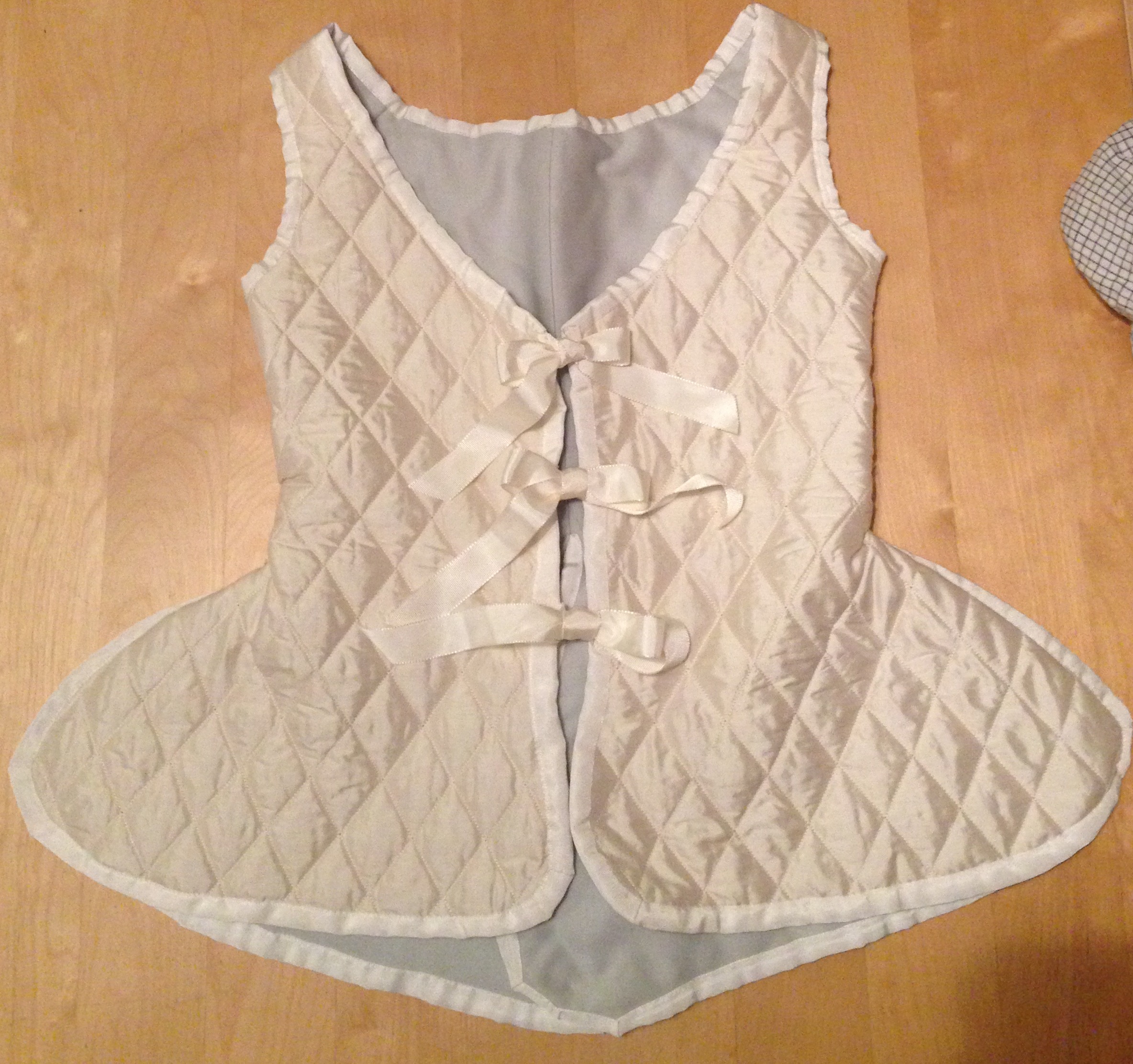
Waistcoat. Silk quilted and bound with silk grosgrain ribbon. ca. 1745. V&A Museum, T.87-1978

The waistcoat: an item of occasional debate, these are not the most common beast in museum collections. Fortunately, Sharon Burnston has a handy article and pattern posted on her website. To be clear, I am not recreating the Atwater-Kent waistcoat. I am cobbling together my own inappropriate but satisfying item. I am also using the absolutely inexcusable excuse that no one will see this garment, as well as previous bouts of pleurisy after long, cold events in stays when I had the merest hint of a cold. (My boss kindly offered to cup me for a cure when I had to take time off work, but I declined. The look on her face suggested a lack of appreciation for my historic ailment.)

But here we are, “confessions of a known bonnet-wearer” and all that, so onward to the project. I started with Sharon Burnston’s scaled diagram of the Atwater-Kent woman’s waistcoat. The shapes are very similar to a basic woman’s jacket of the period, bonus: loose fitting, no sleeves. It was easy enough to pattern up in an afternoon, with limited fitting (I did test it over stays, just in case.)

overview

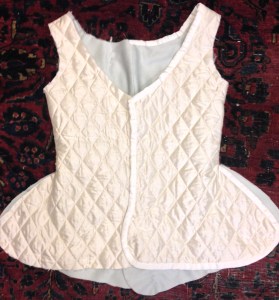
The compromises I made are in the materials: pre-quilted silk (with a cotton backing), lined with wool-cashmere, and bound in silk grosgrain ribbon. The size of the diamonds and the machine quilting, plus the wool lining, make this an inauthentic, inaccurate garment. The shape, construction, and binding are at least correct, as far as they go. But the lusciousness of that remnant table cashmere and the soft colors please me immensely, and I do expect to be warm.

corner

This has been a quick project, with the majority of time spent on the binding. As in the Atwater-Kent waistcoat, I’m top stitching with a running stitch on the inside, folding the ribbon over, and hem stitching on the outside.

Will this feel like a hair shirt of shame under my gown, compromise as it is? Maybe, but at least it’s cashmere.