Making up Monday

From Jaipur, darling.

Sometimes you’re a jerk without meaning to be, usually because you can’t see past your own limited self. I was that jerk on Friday, when my obsession with a missing package led to unfortunate words with both a supplier and worse, my sweetheart, about an unexpected length of fabric lately arrived from India. Would that my brain would work faster, for by the time I’d figured out what to make of it, the conversation had turned, and an additional 300 miles lay between me and the recipient of my confusion and dismay.

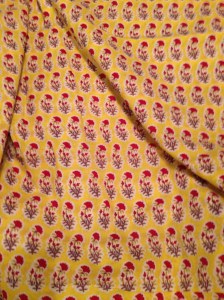
Despite my best intentions and resolve, I am a sentimentalist. This instinct sometimes conflicts with a devotion to honesty, for kindness often lies in elision. Confused? Short story: I don’t wear yellow, but a package arrived Friday with a dress length of printed Indian cotton, red and green flowers on a yellow ground.

“But Kitty,” you say, “Don’t you crave the hideous, the clashing, and the correct? You applaud Our Girl History’s choice of 1770s fashionable pink, though she prefers blue. Yellow is the haute couleur of the 18th century, fashionable everywhere, even in North America. You should leap at the chance to wear it.” (I was not thinking fast at all on Friday evening.) What made me bend my resolve– what will always makes me bend my resolve?

Petticoat fragment. Note yellow, with crudely printed lining. Wintherthur Museum 1959.0118.004
Petticoat fragment. Note the bright yellow, with crudely printed lining. Wintherthur Museum 1959.0118.004

Sentiment, of course, backed by research.

April, that cruel month, brought obsessive searches for Indian cotton print appropriate for the 18th century, as I looked at sample books and extant garments, searching for material to create frankly annoying clothing. Orange and green check with clashing Spencer and bonnet lining isn’t enough: I want to push my representation of the fashion sense of the past closer to truth. People in the past weren’t as matchy-matchy as we are, and their ideas of stylish, attractive, and fashionable were very different from ours. Loud was ladylike, and that’s a style statement I can get behind. Along the way, I ordered fabric in a pink and green (a departure itself) floral print on white ground, yardage now long overdue.

Textile Sample Book, British, 1780. MMA156.41 P34

A friend has been dabbling in these same waters, and made up a new gown for Mount Vernon, satisfyingly loud and clashing with our modern sensibilities about the past. Our mutual friend, also at Mount Vernon, assisted her in choosing a dress length for me, and reader, I was confused and lacking when it arrived. But like any good curator in a social history museum, it was the story that got me. How can I resist a gift from a fellow enthusiast in a pattern chosen by my sweetheart, on the grounds that I don’t wear the color? Reader, I cannot.

Think of Cranford, of lengths of dress muslin requested and never received, and the sentiment embodied in that fabric. Think of women in Providence craving an India print gown, of lovers, husbands, sons, ordering dress lengths at trading ports thousands of miles and long months from home. Think of the affection and thoughtfulness embodied in textiles brought back months after they were requested. Complex meaning is woven into that cotton, giving this dress length interpretive meaning before it is even a garment.

Now what? Now I have to decide which century/event this gets made up for: 1812-1817, 1778, 1804, 1768. There are many choices, but with the meaning embedded in the fabric, I’m most inclined to make something I’d wear often– not that this is particularly housekeeper-appropriate.

And about the research you ask? Yes, small floral print on colored ground is documentable to the 18th century. While early and European, here’s an example of an Indian motif translated by Dutch makers for printing in Sweden. Rhode Island merchants traded in the Baltic, so given the early date of this fabric sample, its arrival in North America could predate 1788 and John Brown’s first ship to China and the far east trade. Possible? Yes. Probable? We can have a lively discussion, in which I will point out the Brown’s love of all things French and French translations of bright, small motif print patterns. The printing factories in Sweden ran until 1771 and produced at least two relevant prints. Would my successful Presbyterian farmer have bought something like this for me in New York or Philadelphia? Would I have worn something so bright and loud? Am I overthinking this? Perhaps, but yellow is a new thought for me.

With especially fond thanks to Miss N and Drunk Tailor, to whom I also owe an apology.

Stay Thy Hand

IMG_6784

Stays. They’re infrastructure: absolutely necessary, a major time commitment, and decidedly unsexy. I am in dire need to two new pairs, one for late 18th century use and one for early 19th century, and each with deadlines looming.

I can manage 19th century attire and Genesee with the chopped-and-dropped corded stays I already have, but New Jersey will not happen at all unless new stays are made. It was like a weekend of penance chez Calash, two straight days of stay mocking up and making.

Of course I bled on them. That’s how I know they’re mine.

IMG_6786

And let’s get this out of the way: I thought backstitching the back seam was a little more difficult on this side, but ascribed it to sore fingers. Wrong! I failed to notice that I was stitching through all the layers, and not leaving one free to fold over and finish.

IMG_0806

A glass of cider and an hour later, I’d rectified the error. These are now fully bound along the bottom edge, and ready for the top edge binding. Somewhere there’s coutil for the straps, and then numerous hand-sewn eyelets later, I will have a finished pair of hand-sewn stays.

New stays deserve a new gown, and since I found this lovely image, I know what that new gown should look like (as well as a portfolio).  Happily, there’s a dress in Cassidy’s book that will serve as a reasonable basis for recreating this image. I’m still pondering the portfolio, and what it might be made of: paper or leather covered pasteboard? As the clock ticks down to June, I suspect I will be using a portfolio I already have on hand.

And then there are the the 18th century stays, with their history of woe.

File_000

I’ve gotten this far with the new 18th century pair, and an interesting business it is. I altered the front side pieces and the stomacher, but cannot see the back well enough (even with a camera and a mirror) to adjust it by myself, so further changes will have to wait until I have some assistance.

The tabs aren’t right in the back, and while the advice is to shorten the stays when the tabs flare this way, I found the fronts were still too low, once again riding at nipple-cutting height. Finally it occurred to me that the problem– slippage–might actually be one of waist. I lengthened the fronts half an inch and nipped the waist in, and found the fit more pleasing.  I suspect the back pieces need to be trimmed a bit before they’ll fit (they’re stitched closed in this version, so you know they’re too big).

Another weekend of work awaits– with focus, those early 19th century stays may be done by then, if there are no more finger injuries.

Frivolous Friday: Something Fishy

Fishing Tackle kit, Winterthur Museum, 1961.0492 A-Y
Fishing Tackle kit, 1820-1860 Winterthur Museum, 1961.0492 A-Y

The best things turn up when I’m looking for something else (in this case, the shell-printed pocket). These serendipitous finds always lead someplace interesting, in this case, to historical fishing (and my personal interest in historical hunting prints).

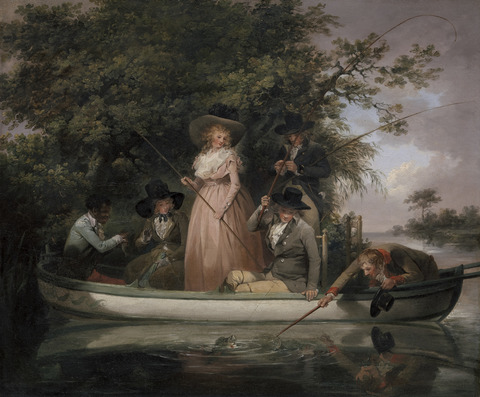
It’s a pleasantly refined sporting activity, suitable for ladies and gentlemen, with the pleasant result of dinner– presuming you manage both to catch a fish and not fall in. Standing up in boat seems unwise, and that hat surely casts an incredible and unmissable shadow on the water, but Morland’s party has caught a fish nonetheless.

Always something new to learn, and heaven knows I need yet another line of inquiry to pursue with all the others…though this might at least be a useful pursuit, if only in the meditative quality of an afternoon spent outdoors catching nothing.

George Morland, 1763–1804, British, A Party Angling, 1789, Oil on canvas, Yale Center for British Art, Paul Mellon Collection B2001.2.22

Flopsy Mopsy

Mop sellers, red chalk on paper, Paul Sandy, 1759. Museum of London 65.59/5#sthash.EaUTT9dg.dpuf
Mop sellers, red chalk on paper, Paul Sandy, 1759. Museum of London 65.59/5

They’re pretty consistent: mops appear to be made of fibers attached to a handle. These look like they’re simple string mops. A stick and string? A stick and rags strips? Something along those lines. But what kind of string? What kind of fiber? How was it attached?

I’ll confess that I have been too lazy to search collection for extant mops– no, seriously, if someone offered me an 18th century mop my first reaction after “Absolutely!” would be, “Wait a second…how can there be anything left of an 18th century mop? My own mops don’t last all that long….” so I assumed no such critter exists in captivity (feel free to prove me wrong, I could use an assist here). Instead, I went ahead with the daft notion of replicating what I saw in images.

Sandby helpfully supplies us with mop sellers who carry fuzziness on a stick. Most likely wool, since sheep were plentiful and cotton expensive in this period. But maybe not. In any case, a simple business.

Supplies assembled
Supplies assembled

After work on Saturday, I went mop-top-shopping. It was not one stop. An internal rant developed about how companies can call anything “wool” that is less than 100% wool, but I managed to contain myself and with enough hunting turned up hero cord, 100% wool yarn and 100% cotton yarn as well as dowels. Sadly, I could not find wool roving in any color but grey. So, making a mop from craft and hardware store supplies is a pretty easy thing, especially when you don’t have many tools to complicate the business.

IMG_6275

This is not my first rodeo where string is concerned, so I wrapped the yarn around a cutting board just the way you’d make a pom pom. How else will you get it all the same length (more or less)? The result: a somewhat sad hank in search of purpose, tied off in the more-or-less middle of the strands.

Secured temporarily with a rubber band, I tied the hank to the dowel with hemp cord. Then I turned the wool (and later cotton) back over itself, and tied it off again. I pulled as tight as I could manage, much to the chagrin of my now-blistered pinky finger. Small price to pay, though, for two new entrants in the experimental archaeology of cleaning. As I looked at the images in Sandby’s drawing and in the prints, I was pretty confident the mops are not tied off again in this second way, but one band didn’t seem secure enough. So, yet another compromise, but one that I hope will result in less hilarity from losing mop heads in the midst of washing floors.

Now, if I would but turn my attention to the lint, string, and yarn scattered about my floor at home…