
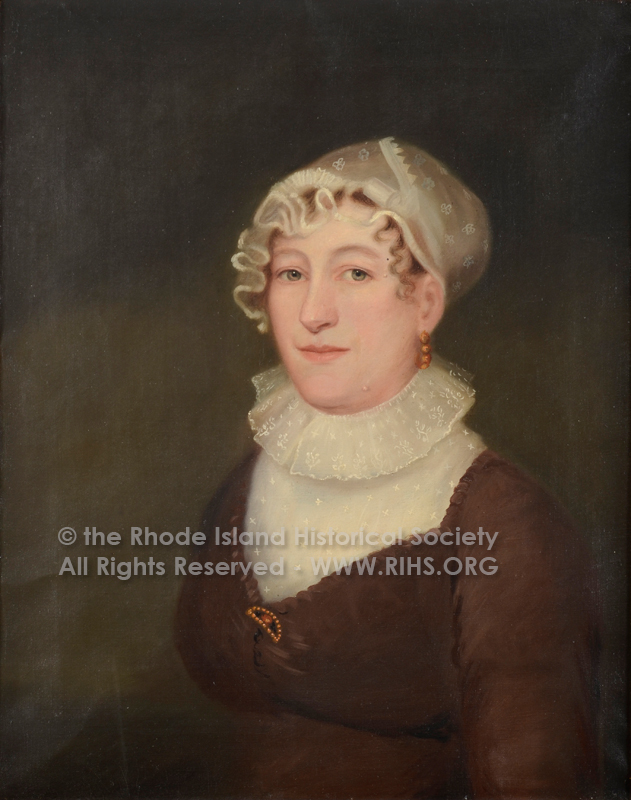
Frivolous Friday: The Pabodie Project

Mrs William (Jane) Pabodie. oil on canvas, 1813. RIHS 1970.60.2

Jane Jewett Pabodie, born around 1771, died 23 March 1846 is buried in Swan Point Cemetery on the Seekonk River in Providence. She was the wife of William Pabodie– which one? Well, it’s hard to tell until I really dig into the genealogy. At the moment I am so besotted with this image that all I can think about is what she’s wearing!

What she’s wearing….about that. I have some work– and some thinking– to do. The cap is slightly confounding. It’s a chance to learn a great deal more about early federal caps, which is good. I don’t understand it, which is unfortunate. The asymmetrical nature of the cap is new to me- or at least I cannot think of another example, so feel free to school me, people. But really: it is asymmetrical! With a ruffle on what is the right side of her head, and a… pinked? Van Dyked? Prairie pointed? band that runs from her left ear around to the back of her right ear? I’m confused. It would make more sense if the cap had slipped, but why would the Pabodies pay for a painting that recorded such a thing?

Honestly, I think the only way to really understand the cap is to make the cap. In muslin first, thankyouverymuch, I’m not that crazy.

Detail, Mrs William Pabodie. Oil on canvas, 1813. RIHS

The chemisette is more straightforward, being made of a sheer figured or embroidered cotton with a slightly gathered collar embellished with floral whitework embroidery. That I think can manage, at least in the basic construction (fabric, well, I’m looking).

Of course, why do I feel the need to manage all of this, with a deadline now less than eight weeks away? For a program, of course– I have only to write the copy for it. The idea (for me, anyway) is to replicate a portrait as closely as I can. Now, Mrs Pabodie and I are not exactly the same age, but I think I can pull this off…the cap, more troubling.

It’s an interesting project for me, not so much from the sewing point of view, but from a conceptual standpoint.

How close can I get? What does exactitude mean?

If I want to represent a character, what’s more important: understanding the clothing, or understanding Jane Pabodie? Constrained as I am by modern materials, unable to match these exactly, how do I navigate choices based on suppositions of what an artist meant to represent? Just my kind of conundrum.

Mendy Monday

Best not to be shiftless, so mending was in order. I knew this day would come, and soon, and after doing the post-Genesee wash, the moment had arrived for this shift.

Simple, classic patching. I hadn’t expected to wear a hole in a shift quite this soon, but four years of wear whilst working and sweating have taken their toll.

It’s a toss up, now that it’s mended, as to whether or not I’ll shorten the sleeves. They’re too short for some of my gowns, but fine for others. Ideally, I’d make a second shift for this time period (early Federal) and third for the late 18th century. I’m somewhat concerned because I have taken a notion to make a new dress for Salem, which is just around the corner.

IMG_7481

Now, it’s not this dress– and this may be a pelisse, after all– but I’ve become pretty obsessed with this image, and decided, what with it being summer and all, to finally cave in and make a white cotton gown.

IMG_7460
~thanks to Mrs B for the image~

This is madness, of course, because I am not someone who doesn’t spill on her clothes or happily and recklessly carry strawberry-eating babies. White. Sheer. Really sheer. I don’t know what possessed me, but once I had the idea and the image to inspire me, I could not shake the notion of a white cotton gown for summer. Perhaps the recent heat is to blame: thin, white cotton seemed cool and refreshing. We’ll see how that goes in a little more than a week. Until then, bright light and fine stitches keep me busy.

Bloody, Bratty, Boning

File_000Sometimes I am a terrible brat, as in this past weekend, when the autocorrect on my phone insisted that the proud four-letter Anglo-Saxon words I was typing were not what I meant to say. Darn tootin’ they were.

This is not my first rodeo with stays, but somehow I’d forgotten about the special stabby hell of boning the beasts. I’m machine sewing the channels for these, mostly because I calculated the time required to completely hand-sew them and realized I would not finish them before I needed them. I’ve rationalized this by acknowledging that I’m not using the hand-woven brown wool sateen I covet, but instead a dark blue wool twill.

I know, I know: there’s a reason staymaking was a man’s trade. My hands are pretty strong, but it took some doing to figure out how to slide the pieces in neatly without jabbing the ends repeatedly into the freshly re-opened split on my thumb.

d'oh! surgical tape made this *much* better later.
d’oh! surgical tape made this *much* better later.

It takes discipline to keep doing this, the way it takes some discipline not to eat ice cream for breakfast just because you can (though I did, just this week). Spencers and dresses are so tempting, but there’s not point to making a new dress of wonder unless I have the stays to wear it over: infrastructure is required.

The stomacher and the two front pieces are boned… six more pieces plus whipping and eyelets and binding, oh, my! It’ll be a race to have them done by June 24th:  Discipline’s the thing.

What’s it Worth Wednesday

Or, They’re Clothes, not Costumes.

This past weekend, I had a conversation with a friend about requests to borrow “costumes” we’ve made, sometimes for school children to wear, sometimes for movies, and sometimes for parties. We generally say no: these are hand-sewn clothes, and the replacement cost would be ridiculous– plus, we like them and wear them.

I hand sew because I get better control, but also because there were no sewing machines in the 18th and early 19th centuries. To get a garment right, you have to hand sew it, and that’s expensive. I took the time once to figure out what a set of clothes for the Young Giant cost– much to my dismay, and eventually, to his, as I became even more insistent that the garments be treated with respect.

IMG_3389

Last year, I sent the Young Mr off to Battle Road in a new suit, and the whole business of what he was wearing was quite expensive. Using $25/hour as a base for labor, here’s how the kid’s Battle Road suit breaks down:

Coat Labor: $1125 (estimated)
Coat fabric: $62.50
Buttons: $10.50
Coat lining & cutting: $90.00
Workshop: $125.00
Total: $1413

Let that one sink in for a while, will you? The 16-year-old boy ran around in a $1400 coat. Oh, and the breeches. Here they are.

Breeches labor: $300 (estimated)
Breeches fabric: $31.25
Buttons: $9.00
Total: $340.25

The blue suit is now up to $1753.25

Let’s add the shirt.

Labor:  $375.00 (estimated)
Fabric: $30.00
Buttons: $3.00
Total: $408

Shoes, hat and stockings:

Shoes: $119
Hat: $125
Stockings: $50
Neckcloth: $18
Glasses: $29.00
Lenses: $30.00
Total Accessories: $371

Grand total, with labor: $2532.25
Grand total without labor: $732.25

This wasn't cheap either.
This wasn’t cheap either.

So think about this the next time you attend an event with a lot of well-made garments: you are standing amid a lot of labor and love.

Sewing is a fairly simple enterprise (you’re pushing thread in and out of fabric, after all), but it takes practice to develop fine skills and speed. A well-made garment will never be cheap. The best investment you can make in your wardrobe is to invest in your skill set, and learn to sew.