Make Mine Menswear: The finished banyan

Banyan, 1750-1775. T.215-1992, V&A Museum
Banyan, 1750-1775.
T.215-1992, V&A Museum

Banyan or wrapping gown, either will do to wear as the year winds down. This project took longer than I wanted it to, mostly because I have a tendency to take on too many things at once and promptly get sick. I like to think of this ability as a gift.

In any case, this is a simple garment to make, made more fun by piecing– it’s the challenge that keeps you awake, when the majority of the work is in teeny-tiny back stitches.

I measured the subject and made up my own pattern, using the chintz banyan in Fitting and Proper and this one at the V&A as models.
img_6554

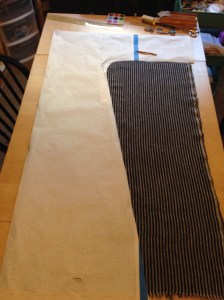
Patterning is a simple thing, really. Maybe too simple. Measure the gentleman’s chest, bicep circumference and arm length, neck, and back length. With those, you know how wide to made the body, the center back length you need to achieve, how wide to cut the neck hole, and how wide and how long the sleeves need to be. Really, not that hard.

You can use a diagram like this to start you off. I did wing the bottom width, guessing at the angle to give the garment a fullness similar to the chintz at the V&A.

I didn’t have quite enough fabric to accommodate the recipient’s full height, nor could I get enough of the red print lining material; I had to piece both the stripes and the lining.  Trying to match up the stripes was remarkably satisfying, both when I succeeded and when I was  little off. Life Goal: Dizzying, please.

Again with the two color lining.

It contrasted well with a blue woven coverlet, making a nice bright note as the rooms were prepped for What Cheer Day. This was the effect I had hoped to achieve waaay back in April when I failed to finish anything I wanted for the After Dark program thanks to a bout of strep throat.

By October, though, I was able to finish the entire item and make a matching cap, allowing Billie Bowen to recuperate in style from an evening at the Cold Meat Club.

Next up, using this as the base pattern: a wool bedgown, lined in wool, and pieced. More mis-matched stripes, please!

Dreams of Summer

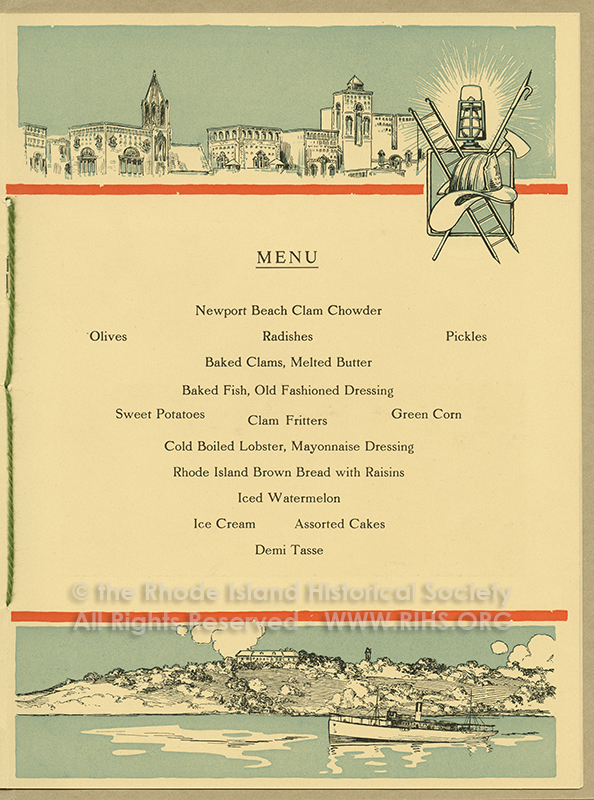
Clambake, International Association of Fire Engineers, 1916. RIHS Graphics Collection G1173

I will visit the beach in Rhode Island any time of year, even to the point of dragging Drunk Tailor there in January (I really like water). But as the wind speeds rise and temperatures drop, I begin to dream of summer, and especially of summer meals.

This 1916 Clambake program and menu is in the RIHS Graphic’s Ephemera Collection, and while not quite Wiener Werkstatte quality, the dramatic graphic style captures the zeitgeist of the early twentieth century.

Menu, International Association of Fire Engineers, 1916. RIHS Graphics Collection G1173

Inside, the menu captures the flavors of late summer New England, from the Baked Clams with melted butter to Green Corn, cold Boiled Lobster and Iced Watermelon for dessert. It’s time to start planning Christmas menus (I finally caved and brought in a tree, much to the delight of the feral cat), and fish is always on the list. Our tradition has evolved from the Christmas Eve bouillabaisse of my childhood through salmon with dill to a New York Times fishmonger’s stew. I certainly have the tureen for such a production, but the capacity is large, and with only three adults to eat the stew, I wonder at the sense of making up such quantities.

Tureen in the wild
Tureen in the wild
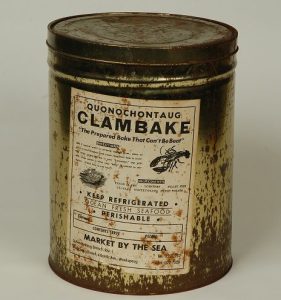
Quonochontaug Clam Bake Can ca. 1970. RIHS Museum Collection.

I could assemble a clambake for home, and boil it up on the stove in Don Draper’s 1962 kitchen– that’s a more recent tradition than the sand-pit variety– but it seems slightly mad, as all (potentially) good ideas can seem. It’d be July at Christmas, and although I’d miss the smell of the ocean, the cry of the seagulls, and the warmth of the sun on a late summer afternoon, it might be worth the effort.

Frivolous Friday: Fashion Flashback

IMG_6945
I don’t know about you, but the past ten days or so have been surreal in a way that I haven’t experienced in a dozen years or so. Numerous creative folks I know are working hard to find new, engrossing projects and sharing what they find with others. As always, Satchel Paige has excellent advice: Don’t look back, something might be gaining on you.

What project shall I take up again, to distract myself from the shorter days and colder temperatures?

This is actually making reasonable progress, and might even be done by early December.
dscn4571

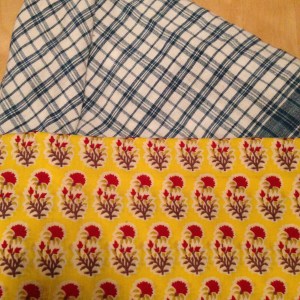
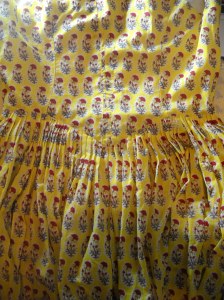
It’s satisfying work, pleating and stitching this lightweight cotton, tiny stitches in white linen thread. I’ve made some modifications to the pattern, but not many, aiming for a 1780-1782 style. Judicious cutting and generous friends will, fingers crossed, even yield a matching petticoat, which is very exciting indeed– and an unusual fashion statement chez Calash. Here, we focus on clash, but the fabric itself takes care of that for me.

Now, if only I had bright red morocco leather shoes to wear with this, that would be a sight indeed.

Would I Lye to You?

Now, really, would I lye to you?

img_7993Some people will tell you I overextend myself, and while those people may be correct, my enthusiasms compel me to do more, try more, travel more, and to that end I found myself preparing for an event by turning my 1962 Ossining kitchen into an experimental laboratory.

I was taken by Hannah Glasse’s receipt for cleaning pewter, copper, and tin in her section for The Scullion, so of course I had to try it. It’s simple enough: boil wood ash with unslaked lime for half an hour, let cool, and pour off the clear liquid. Easy-peasy, until you realize you have forgotten your high school chemistry, the Young Giant is not at home, and google searches for lime turn up too wholesome uses and unsavory quantities.

Happily, a more scientific brain than my own pointed out potash/pearl ash/potassium carbonate, which Amazon can provide in small quantities. Wood ash proved a little more challenging. Happily for me, I am one of those East Coast foodie fools with a backyard grill and a fondness for hardwood charcoal, so an overdue chore later, I had an enamel kettle of ash.

The receipt calls for “a pail” of wood ash to a “half- pail” unslak’d lime, boiled in four pails of soft water. Since “pails” is a general sort of term, I decided to use the quantity of wood ash I scavenged as the approximate measure of a pail, figuring that proportions mattered more than actual grams or liters. I have resigned myself to the fact that this is more art than science. Four pails of soft water included the remains of a few gallons of water stockpiled for hurricane preparedness years ago, bolstered with water from the tap.

Pail, schmail.
Pail, schmail.

Fortunately, art did not turn into science gone wrong. The boiling was rather placid, considering, and dissolved the fine ash and the potash. I filtered the liquid mixture through a screen (ok, the spatter screen for my frying pan) to ensure that when I poured off the clear, it would be as clear as possible.

By the time it had cooled, I had fished out appropriate containers into which I could “pour off the clear.” This recipe, seat-of-the-pants as it is, makes a fair quantity, a mason jar of which I have left with the Drunk Tailor so that he might better clean his officer’s pewter and copper, because, yes! This does work to brighten silver and copper. Tune in next time for details on getting shiny.

Front and a center: A liquor for cleaning pewter, etc.