Luxury and Fashion


Sometimes this is a hard hobby to love. My hands hurt, my creativity feels dead, and there’s no place to go all dressed up. After a long, unpleasant spring, I finally feel like sewing and playing. Drunk Tailor and I definitely missed some things we very much wanted to do, but now we’re reinspired, we could take baby steps back to our normal semi-hectic pace– except of course, we are plunging back in with three events in August after a whirlwind trip to Ticonderoga.

Wedding dress in cotton muslin ca. 1797. Nationalmuseet Danmark.

With the summer heat in mind, I ordered batiste and voile, thinking I would make the Tidens Toj gown, but when the fabric arrived, it seemed that the purveyor had confused the two fabric types, so a new plan was required. Alas, the trials of costume research and falling down the fashion magazine rabbit hole for hours at a time…

1798 Gown, watercolor by Ann Frankland Lewis, 1798. LACMA, Costume Council Fund (AC1999.154.1-.32)

Next up: an open robe or wrap-front gown over a matching petticoat, trimmed in blue-and-white Greek key trim, with a pair of pointy-toed ribbon-tied slippers and a sleeveless blue silk waistcoat, in three weeks or so.

The waistcoat construction is finished, scaled up from the original garment patterned in the DAR’s “An Agreeable Tyrant” catalog. I chose to line mine, possibly from pure habit of making men’s clothing, possibly because I’m not that great a teeny-tiny hemming and require a lining to hide my sins. With gold silk cord trim and covered buttons, I think it will have a pleasantly military vibe.

For the gown and petticoat, cotton in Virginia’s August heat seems like a solid choice, though by the time the layers are on and the sun is up, it’s possible that nothing will be really cool. (The majority of the day will be spent in air conditioning, so really, anything would be okay.) The trim arrived last night, and has a body that will need batiste (and not voile) for support. The combination causes me to entertain fears that this aesthetic is a little too boat-shoes-and-belts-with-embroidered-whales for 1797-1799, but when topped with something not unlike Drunk Tailor’s militia cap, the aesthetic will tilt from yachting to the Good Ship Lollipop.

A Six Word Story

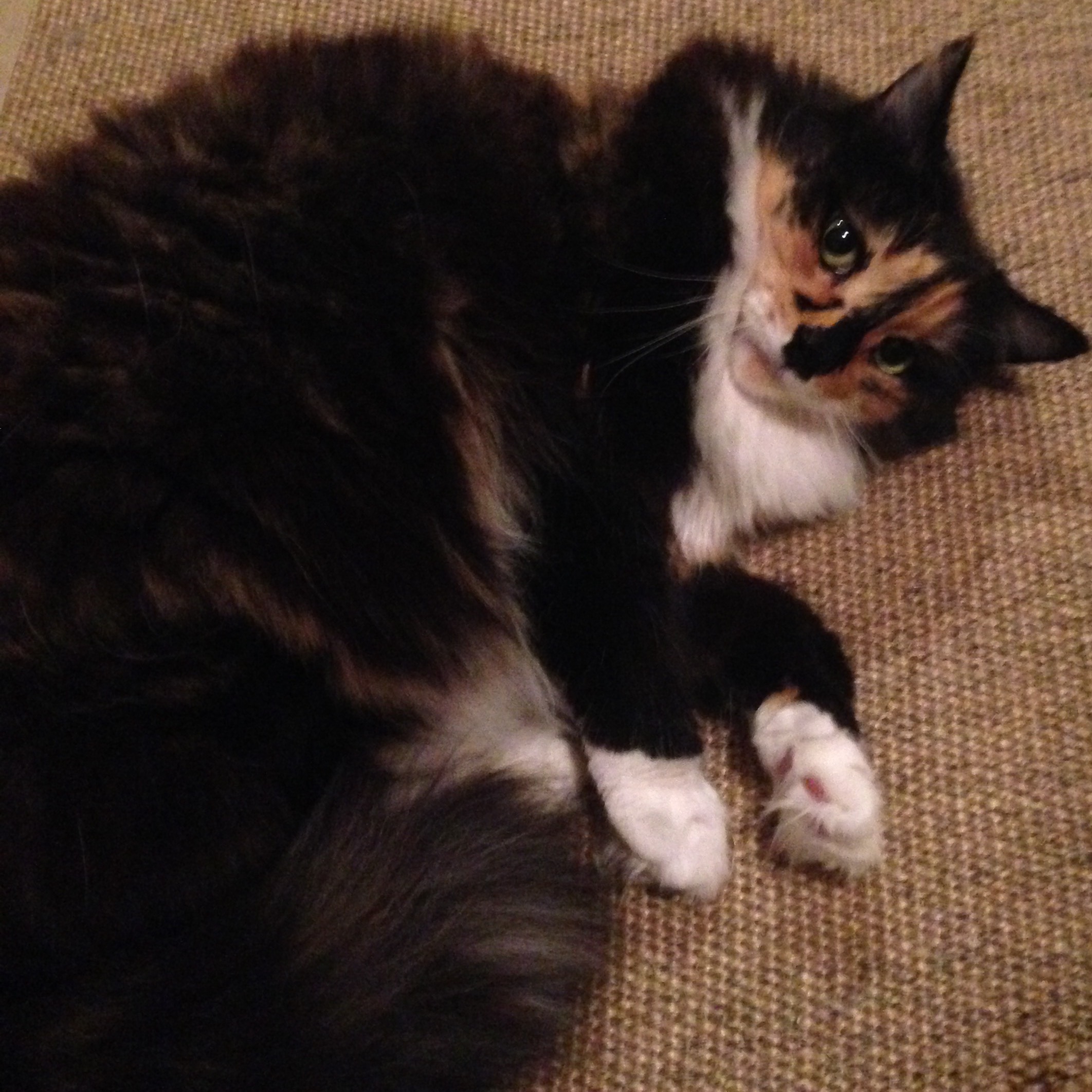
Lady Cat, AKA Lucky Edie, in her floofy prime

Six word stories. They’re foundation exercises in many writing classes, especially flash fiction classes. The most famous is probably Hemingway’s: “For sale: baby shoes, never worn.” So much packed into those six words, eight syllables. You can imagine a family, a room, clothes, a place of worship, a coffin, emotions. (Or a family, a room, an angry child, bare feet, and a pair of rejected multi-coloured sneakers if you’re me, who had a child who channeled his great-grandmother and thus was incredibly picky about his shoes at 16 months and refused to wear anything except solid red Keds.)

But I digress.

I have a six word story for you: My cat is dying of cancer.

Lady Cat on Sunday

Lady Cat, Lady Bird, Flirty Birdie, Lady Fat, Lucky Lady, Lucky Eatie: She has had many names since we scooped her up from the back yard of our Smith Street 3-decker in 2005 and brought her on up to the East Side (it is possible to literally re-enact The Jeffersons’ theme song in Providence). She was born under a sheet of plywood against a garage behind our house, one of three fluffy kittens born to a short-haired calico mother. She and her litter mates were like a dessert tray: one fluffy and biscuit coloured, warm, light brown; one, vanilla-cream coloured, soft ecru; and Lady, rocky road ice cream, pastry, caramel, cream, and chocolate, with a stripe down her nose like a monkey.

Lady and Socks: prelude to peace

She wasn’t easy to catch, but I managed, on the very last day we would ever be in that apartment, caught her and wrangled her into a cat crate where she spun around like the Tasmanian Devil in the Bugs Bunny cartoons. Eventually she settled down to watching me and the movers hustle the last pieces out of basement on onto a truck, and made the trip over the river and up the hill to a new, larger house.

As my son struggled with spelling homework, Lucky Lady and her arch-nemesis Whiskers (the cat who lived in the house behind us) became the stuff of legend– Whiskers more than Lady, but every week, as Whiskers stole doughnuts from dinosaurs, was stopped by the police, or generally misbehaved, Lucky Lady would often save the day, once by socking Whiskers with her powerful paw. Whiskers and Lucky saved us from second grade.

Dignity. Like Gene Kelly– and just as acrobatic.

Found feral, she was never fully tame, though she made decisions about not venturing outside in the snow again (after a night out in the cold) and she learned not to jump against the screens trying to get at Whiskers (she fell out of the first floor window once). We brushed her, and she adapted after the first few times, when she hissed and bit at the brush. She loved catnip, and eating feathers (I learned to keep my millinery supplies in a cupboard), and chewing wool (I learned to keep my wool in a cupboard). She learned, and we learned, and she is ours and we are hers.

One year, she got lasers for Christmas.

Now that she is terminally ill, we do what we can for her. She eats Trader Joe’s tuna for cats because she can keep it down; she drinks CatSure (she prefers premixed to powder mixed); we give her catnip. Sunday night she did not know what to do with the catnip, and ultimately fell asleep in the catnip without enjoying it.

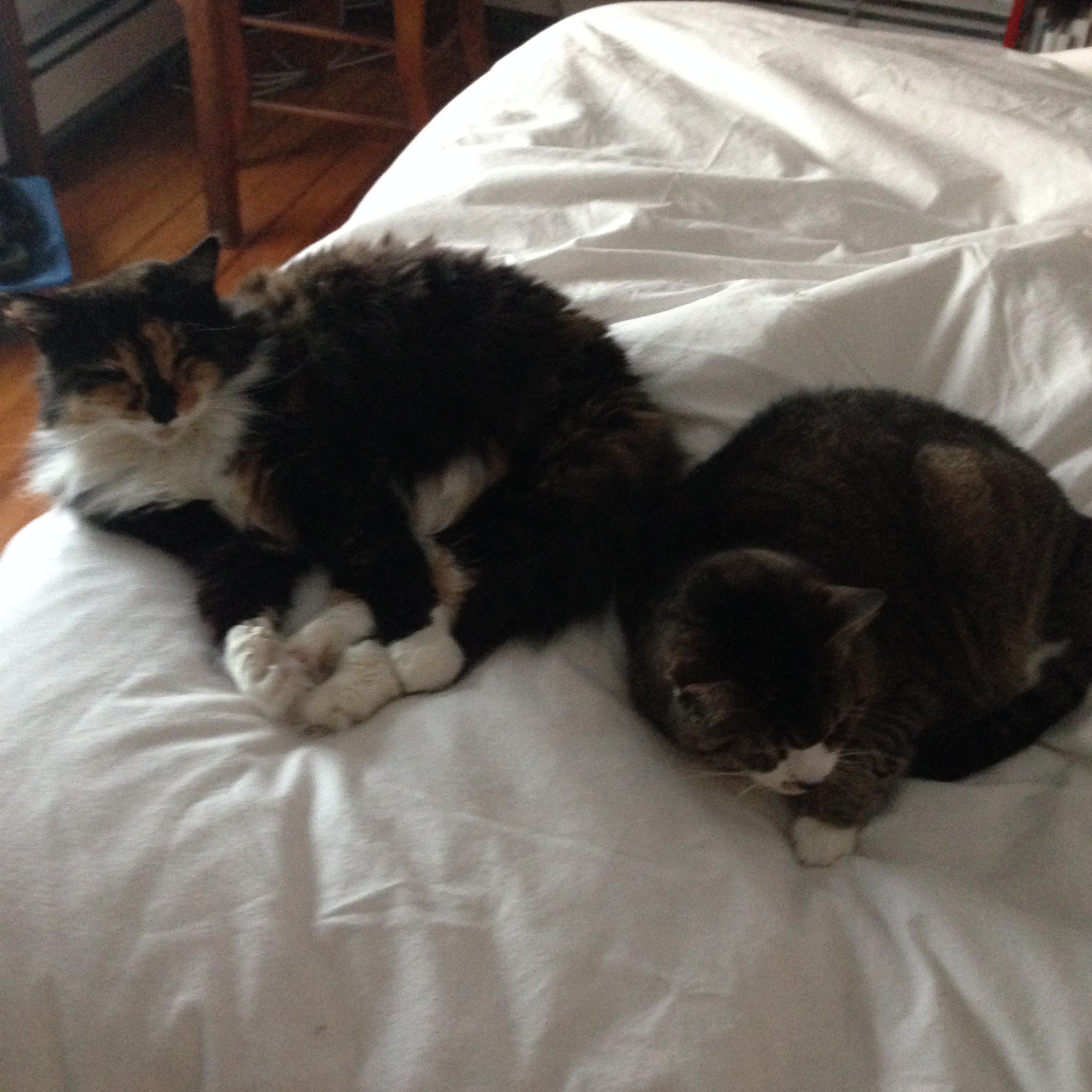
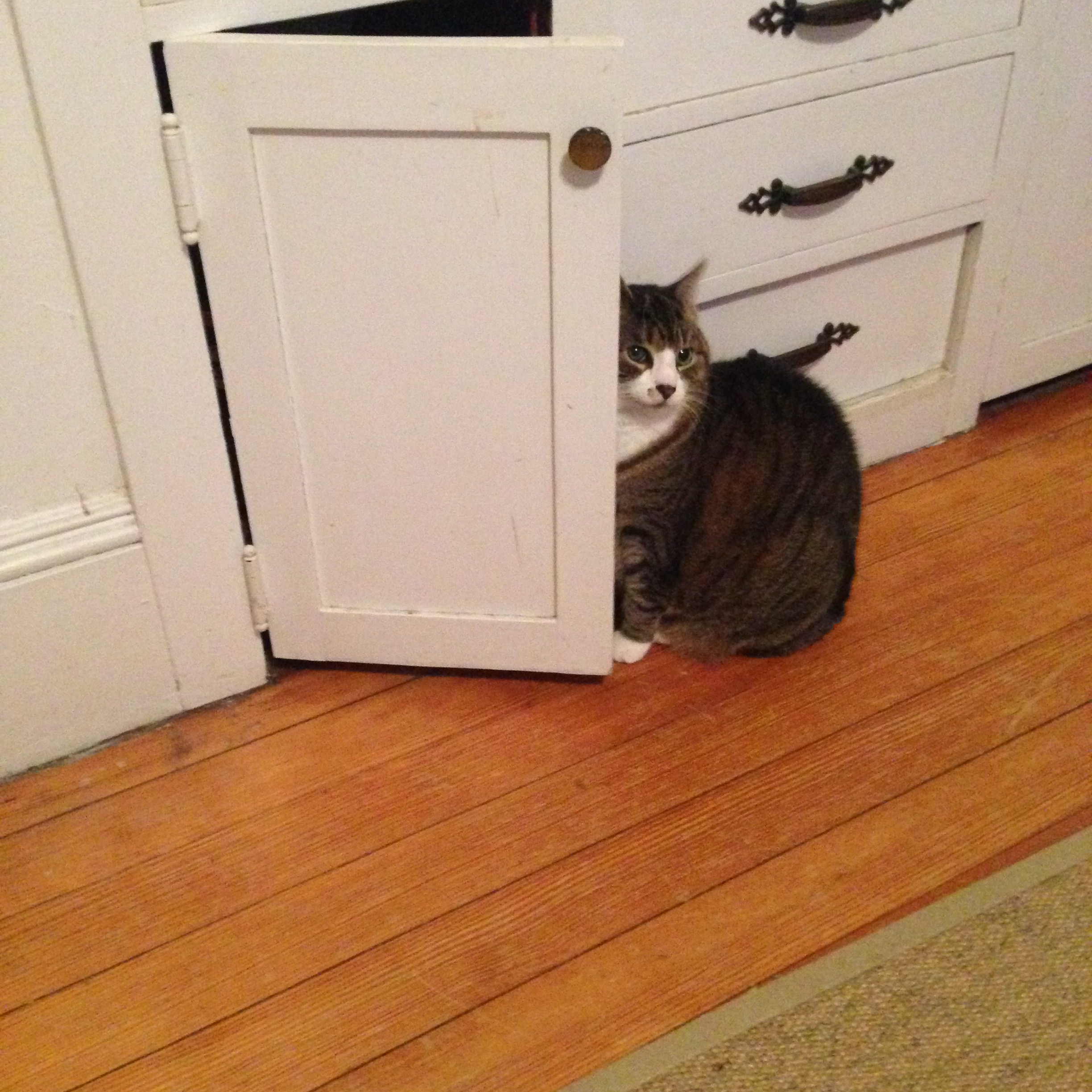
Socks, checking on the Time Machine

Her adopted sister Socks (the one-eyed, wobbly, film noir-loving, Nazi-hating tabby cat known as the Howling Assistant) died last summer. Lucky Lady will die soon, too, though we will keep her as comfortable as we can as long as we can. It’s hard to say how long it will be, and I feel wrenched and torn as I contemplate what Lady must endure and how much I will miss her, the last living connection to Providence I have with me in Alexandria. She’s more than a symbol, of course; she’s an independent being. But when Lady dies, a little part of me will go, too, and the past, and New England, will seem even farther away.

Didion, Despair, and Not Looking Back

Not everyone develops a relationship with a place that feels romantic, a relationship so intense, even when tortured, that when you leave, at last, as leave you must, you are torn apart by knowing the place abused you– and knowing you must go. Still: you love the place and cannot quite bear to not be there. It’s a complicated thing, and as with most tempestuous relationships, this tug of a place on one’s heart must be analyzed, objectified, studied, and understood. I thought I was making progress that way until I was given a chance to look back– don’t ever look back– and even though I did not look the basilisk full in the face, I was nauseated: waves of sadness and anger broke over me at reading a head line and image caption.

I stepped back to consider just what it was about the place and the situation that affected me so. Reading almost always helps. This time, I pursued literary criticism as a means to understanding. Van Wyck Brooks absent from the shelf at my local public library, I took hold of Joan Didion, and found myself rewarded.

The Seacoast of Despair” described my place perfectly.

‘Happiness’ is, after all, a consumption ethic, and Newport if the monument of a society in which production was seen as the moral point, the reward if not exactly the end, of the economic process. The place is devoid of the pleasure principle.

Devoid of the pleasure principle? In Freudian psychology, the pleasure principle is the instinctive seeking of pleasure and avoiding of pain in order to satisfy biological and psychological needs. Specifically, the pleasure principle is the driving force guiding the id. Didion states, “To have had the money to build “The Breakers” or “Marble House” or “Ochre Court” and to choose to build at Newport is in itself a denial of possibilities; the island is physically ugly, mean without the saving grace of extreme severity, a landscape less to be enjoyed than dominated.”

Indeed. Mean with the extreme severity, a landscape to be dominated. Those phrases define the principles that shaped my relationships with a few denizens of Newport, who, in truth worked and did not live there, but who seemed fully to embody, embrace, and imbue their personages with non-pleasure principled forces drove them to dominate others, and to consume, for their own use, much of what they encountered. Didion described my experiences and observations of Newport in language better than I could ever hope to conjure.

Three years ago this week, I came to a realization, first on a drive to Newport, and then on a train to Boston. I saved the tweets from that train trip.

I went to Boston that Saturday–it snowed; the train was an early one–to make a presentation at History Camp on work that related to Rhode Island and to Newport history. Earlier in the week, I’d had a vision in Newport that unsettled and delighted me, and informed those tweets.

“There was a for sale sign on one property (Sotheby’s Realty, of course), and for an instant, I imagined walking into the house and owning it, starting a life completely different from the one I live, with different people and places.”

Between that vision on Bellevue and Saturday’s train trip, I had enough exchanges with the object of my desire to form a fuller notion of what that vision meant. That understanding led to the tweets, which I posted as #fiction to protect the vision, and the desire, from the reality of my seemingly-unalterable situation.

The miracle here is that I had a vision, and have very nearly carried it out, despite not fully understanding how much of my standing life I would have to burn down to achieve that kind of freedom. It had not occurred to me that moving and changing  to achieve what I wanted–to no longer have a secret, to grasp those lapels nearly every night when I arrive home from work, and taste that accent on every kiss– it had not occurred to me how much I would have to destroy, or leave behind, and that in doing so, I would leave bones of my former soul to be picked over by opportunists ready to exploit an opening.

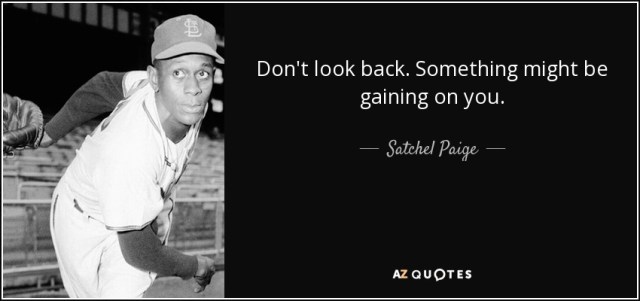
The consumption ethic: they have grabbed what they could not get while I was still there, and they run their paws over the work without fully understanding it. And that is where I can take my sole pleasure: the schadenfreude of watching them strive and fail, or perhaps the pleasure of watching them reach and grasp. Either way, I know I cannot look back. Something might be gaining on you, and it’s best to outrun those monsters.
Didion, Joan. “The Seacoast of Despair,” p. 157-158.  Reprinted in We Tell Ourselves Stories in Order to Live, New York: Everyman’s Library, 2006.

Wrap it up, I’ll take it

To be honest, I would love to wrap my self up and take this silk, but it is for a museum to display, so instead the box is wrapped and ready to ship.

I was lucky to be included in a message group started by a friend asking if any of us had a banyan or wrapping gown to loan. Well, no… but I can make one!

So I did.

My version is based on this 1750-1760 example at the Victoria and Albert Museum, of silk designed by Anna Maria Garthwaite ca. 1740-1750. To be honest, this is one of my favorite gowns, despite the fact that it bears no practical relationship to any part of my daily or living history life. A girl can dream, though…

Just a little bit scary, despite being able to get more silk if I really messed up.

In particular, I like the way the style combines the t-shape of a basic banyan with the pleats used to shape European women’s gowns. Tricky, right?

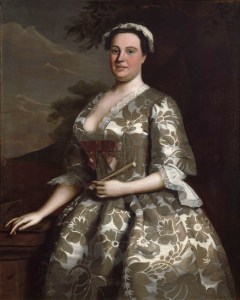
Ann Shippen Willing, oil on canvas by Robert Feke, 1746. Winterthur Museum Museum purchase with funds provided by Alfred E. Bissell in memory of Henry Francis du Pont. 1969.0134 A

I made a pattern in muslin (it took two) primarily by draping, reading the V&A description, and looking at the original images as large as I could get them. By the time I had a pattern, I was mostly convinced, but still intimidated by the silk. I’ve had my eye on this ever since I saw at the local store, for it reminded me strongly of the Anna Maria Garthwaite silk worn by Ann Shippen Willing (Mrs. Charles Willing) of Philadelphia in this portrait by Robert Feke.

In the interest of economy, I machine sewed the long seams and the interior (lining) pleats, though I would not if I wear to make this for myself. Once the main seams were done, I pleated and pinned again.

Then it was time for my one of my favorite activities, hand-stitching pleats. It’s impressive how the look of a garment changes (and improves) as you continue to work on it. The fullness of the gown with the inserted pleats is pretty impressive and very satisfying to wear. It sounds fabulous as it moves with your body.

Once the gown is fully dressed on a mannequin (that is, over a shift and petticoat), I know it will assume the more correct shape of the green gown at the V&A– it looks better even on me, although it is too small, being made for a mannequin representing an 18th century woman.

Portrait of a Woman Artist, c. 1735
Oil on canvas
40 x 32 5/16 in. (101.7 x 82 cm)
Restricted gift of Mrs. Harold T. Martin in honor of Patrice Marandel, 1981.66
Art Institute of Chicago

Along the way, I found another green silk wrapping gown or banyan, this time worn by a French artist.I can guarantee you I would never wear silk to paint in, but your mileage may vary, and if I had a maidservant and unlimited cash in 1760, perhaps I would emulate the Mademoiselle at left.