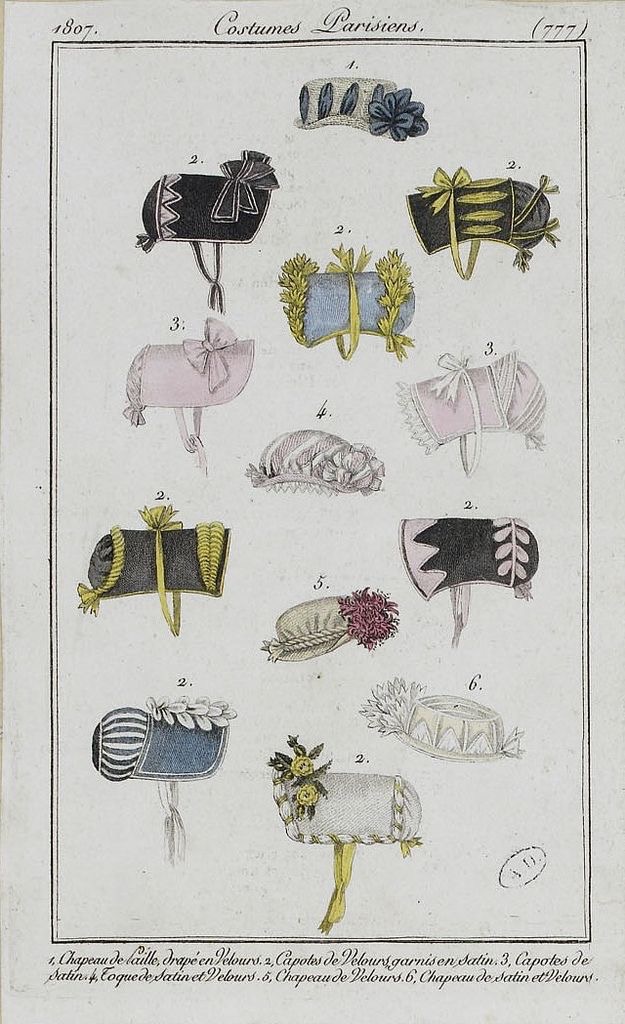
Capote de Velour garnis en satin

Costumes Parisiens, 1807

This plate has stuck with me for years: those mailbox shapes, in velour! In 1807, velour was not what we think of today (and I don’t mean Zapp Branigan). Valerie Cumming’s Dictionary of Fashion defines velour as “Wool or wool mixture cloth, soft and smooth with a closely-cut pile or nap resembling velvet.” Not having access to wool velour in the scrap bins at work, or in the fashion aisles at the local fabric store, I opted for velvet; the scrap bin provided pink silk taffeta, which I thought made a nice contrast to the texture and finish of the velvet. It is true that “velure” dates to the 17th century, and describes imitation velvet. The wool velour I’m familiar with from upholstery is too dense and heavy to drape well over a bonnet (it’s really made for sofas and armchairs), so erring on the hand of the fabric seemed a reasonable choice. Wool velour with silk satin would be an amazing textural contrast, but with this color combination, almost any fabrics will give a pleasant optical shock.
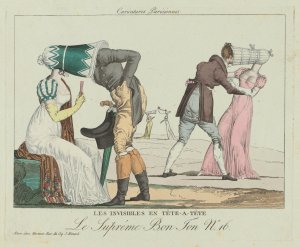
French 19th Century, Les Invisibles en tête-à-tête (Tête-à-Tête with Poke Bonnets), c. 1805, etching with publisher’s hand coloring in watercolor on pale green laid paper, Katharine Shepard Fund 2015.49.4

Shaping the brim was an exercise in paper and pasteboard, winging it a bit until I achieved a length and width that was mailbox-like but not too drainage tunnel. The cartoons of the period make clear that these are deep brimmed bonnets. I do like that the bonnet on the left is trimmed so like the ones in the fashion plate; the one at right is probably corded or reeded, judging by the ridges.
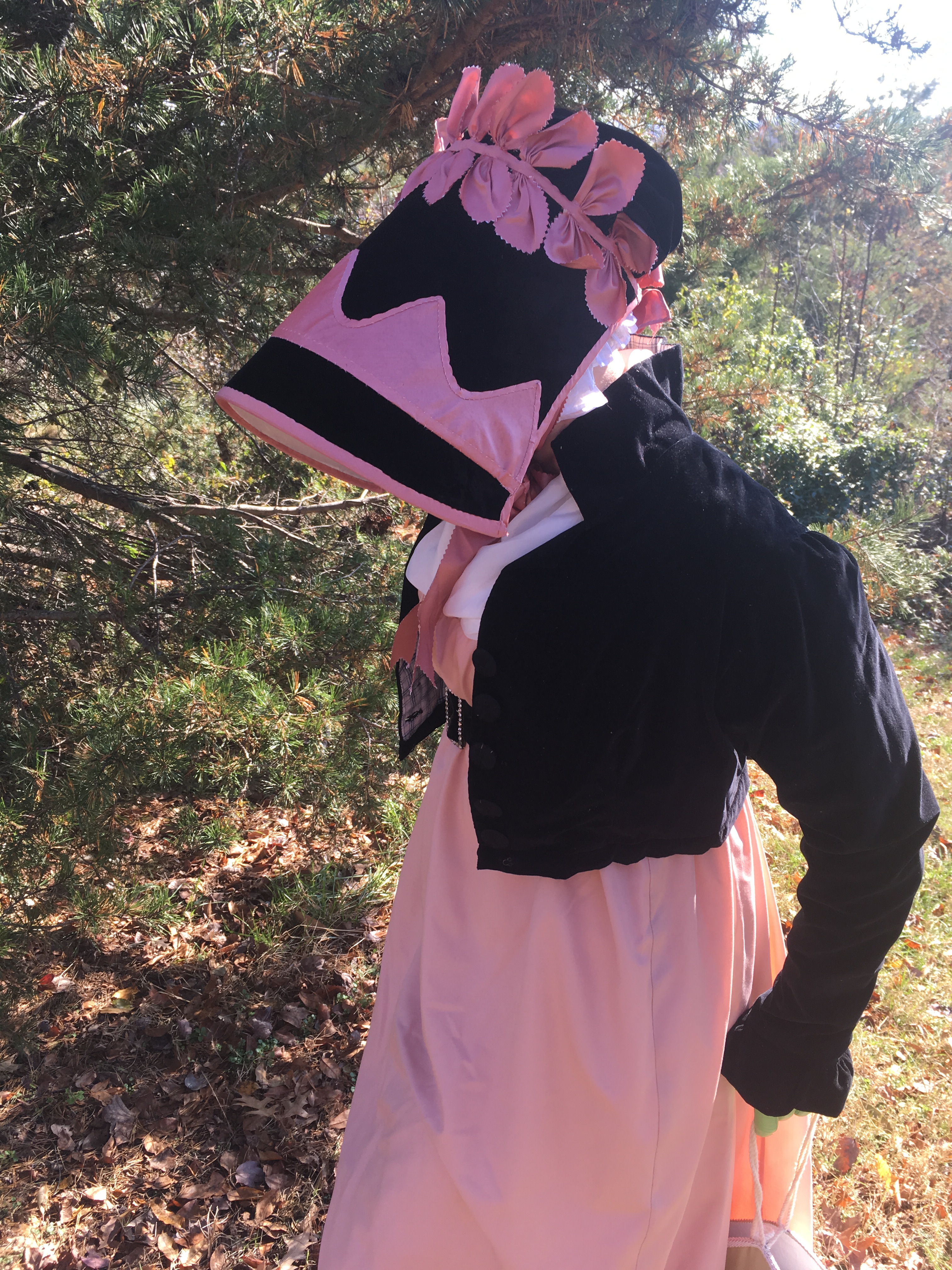
The trickiest bit was shaping the silk to the compound curve of the brim. Three patternings got me there– until I realized the silk needed body to hold up to binding, and took a short cut. Ask not of the sin of fusible interfacing, for I have learned my lesson. Yes, the silk piece shrank and no longer curved evenly from the front edge. Thank goodness Drunk Tailor was watching The Pacific, so any foul language I may have used was disguised by movie dialogue. The binding is bias-cut silk, easy enough. After the debacle of the Vandyke trim, I opted not to cut and bind the leaf shapes, but rather to cut the ovals with pinking shears and attach them along a silk band. Would I do it differently another time? Possibly, if only because I like to imagine the different ways an American milliner might interpret a French fashion plate.

Once I settled on making the bonnet, I decided it was time to finish a pink wool petticoat I started in 2015 after a trip to Mood. It’s a tropical weight Australian wool, according to its selvedge, and has a high-waisted bodice with a drawstring closure. I covered the bottom drawstring (and added some bling) with a black velvet belt closed with a period paste buckle. (Every now and then someone doesn’t know what they’ve got, and lets it go for a price I can afford.) On top, the gathered back cotton velveteen canezou/Spencer made for my first trip to Genesee. Having a wardrobe extensive enough to mix-and-match almost the way I do from my modern closet is pretty satisfying, if a little crowded.

This isn’t a bonnet for wearing while crossing a busy street, though it will successfully shelter the wearer and a cat from any sudden downpours, and one is unlikely to get sunburned wearing this. I didn’t find it distracting to wear– but I didn’t go far, and I had a companion. But what price fashion?

I Want [peppermint] Candy

A friend regularly sends me bonnet descriptions from the inventories she’s researching; one description was of a white silk bonnet with a red cherry silk lining from Rowan County, N.C. in the 1770s. Hot stuff, right? Less hot if you made it in white linen, but even North Carolina has winter sometimes. I made two, of course, in sightly different shapes.

Bonnet Number One

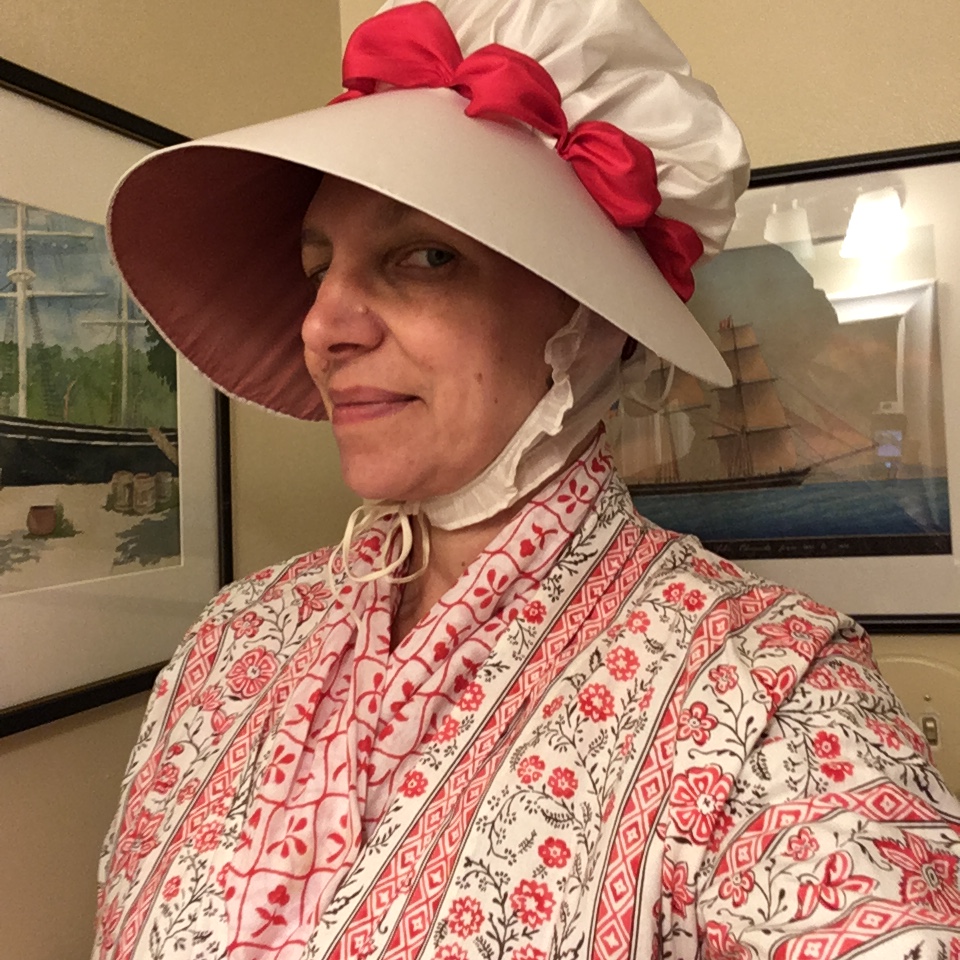
Strawberry shortcake? Whipped cream and cherries? You tell me, but I always maintain that bonnets are the cupcakes of costuming: pretty, fluffy, low-calorie and quick to make. 

Once she’d sent me the description, I got hung up on finally finishing my wrapping gown. 

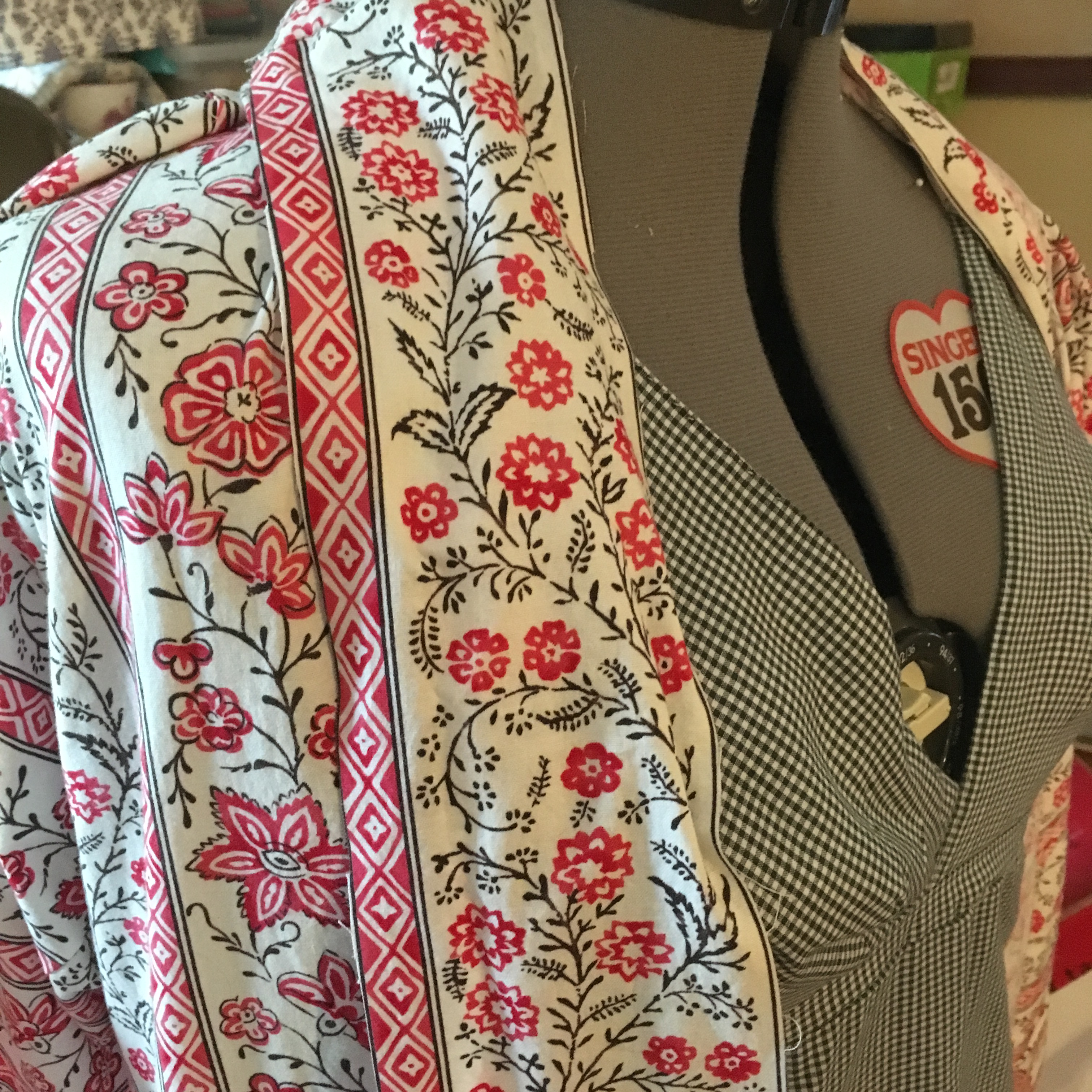
There are enough events where I sleep over that a wrapper for the morning is a useful thing. My characters don’t rate the silk of the one I made for Potts Grove Manor, but I used the same pattern with a reproduction cotton print from Burnley & Trowbridge. I love it– but I do feel a bit like a candy cane. 

Bonnet Number Two, Lampshade Style

Because I’ve seen so many instances of sun shade bonnet (herein known as “lampshade,” making one up in that form seemed like a good idea– and the crowning glory to the red and white striped wrapper. 

Now I really need a cherry red silk quilted petticoat to wear with this ensemble. Some other autumn, when I have more space and time perhaps. 

Black and Blue

Unlike some of my earlier posts, this Black and Blue refers to a different kind of historical effect: the purely aesthetic. (Yes, it is a departure for me. Moving below the Mason-Dixon line has been curious, as my encounters at the bank regularly make me wonder if I have stumbled into the Invasion of the Body Snatchers or Pleasantville. Surely real humans aren’t this nice! I thought the people of Rhode Island were just fine, but maybe my standards were warped by growing up in a Major Midwestern City.) In any case, times change and so do people. Onward, to the aesthetic!

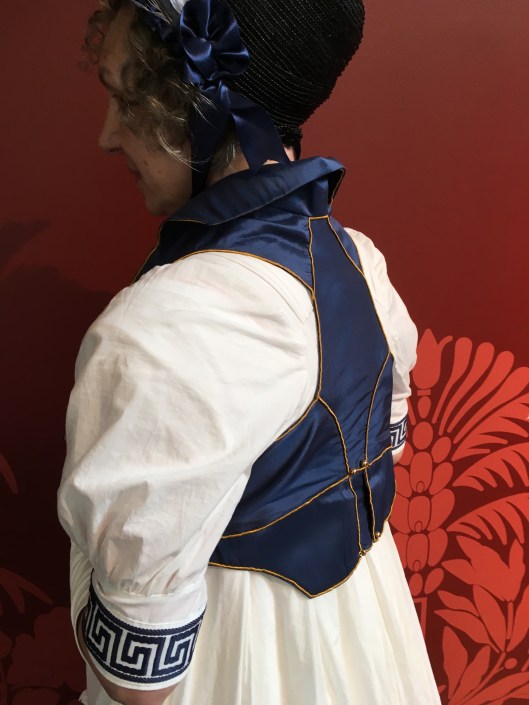
First, there was the new waistcoat. That should be enough to refresh an outfit, right?
Wrong.

The armscye sits way back over the shoulder blades

The set of the armscye didn’t coordinate with the white gown I made two summers ago, so a new item would be in order. I thought this would be the case in the muslin, but when I basted up the blue silk (selected because I had enough material to make a waistcoat and a cap), it was clear something new would have to go underneath.

The original waistcoat’s date of ca. 1797 helped narrow down my choices, and a 1799 fashion plate helped as well. Blue over white: pretty snazzy. I sketched up the plan for the white wrap-front gown, re-imagined that when I got batiste after asking for voile, and figured I’d be fine. A blue silk cap trimmed in black wool lace or gold silk cord still seemed like a good solution.


But the fashion plate showed a black hat or bonnet, and whilst trolling Etsy with a Manhattan in hand, searching for an 1830s-appropriate buckle, I took a look at one of my favorite shops, just to see.

Reader, I saw.

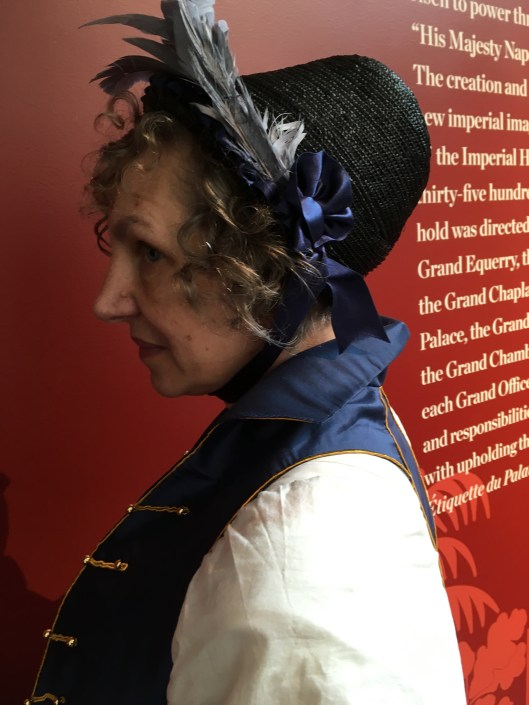
The “overly honest milliner” confessed that this style would not flatter everyone. Challenge accepted! In truth, though, I have a small head, and having cut my hair short for the summer, can (must) wear a slightly different kind of headware. I’ve also tried on enough of Anna’s millinery to know what will and won’t work for me, so I was pretty certain this bonnet would suit me well.

I trimmed it with some blue silk double-faced satin ribbon recovered from a failed bonnet attempt of several years ago, and then cast about for something else. Something different. Wednesday found me steaming feathers– as you do– while Drunk Tailor pulled KP duty. I hid the feather quills (more or less) with a ribbon rosette, and the considered fastening. Many early-nineteenth century bonnets don’t tie under the chin, and in any case, I didn’t have enough ribbon left to pull that off.

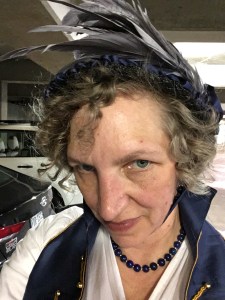
Parking lot selfie, with sweat, curls, and feathers. I like the way the feathers contrast with the curls.

The solution? Another rosette. On the feather side, I stitched the straight tail of the ribbon to the bonnet. The second rosette attached to the ribbon, which I then ran under my chin and pinned. Bonnet secured, more or less, though the feathers necessitate caution when exiting a vehicle.

Hair a la Titus and the Resting Bingley Face

Reader, it is hot where I live. June, July, and August are tiresome months here, humid and warmer than what I became accustomed to in New England. After a year, I realized I’d had enough of trimming my hair myself. I texted a friend with good hair, and found someone to liberate my neck. Excellent, right? Well…it’s all good until you want to dress up.

19th century history hair being somewhat mullet-like, my short in the back bob was not going to get the job done for last weekend’s Jane Austen Ball at Gadsby’s Tavern. What to do? Cap it, of course– there’s no way I could figure out how to tie a turban elegantly and reliably without giving up the hope of finishing some other projects I really want to finish this month. So, a cap/hat/sewn headdress. Aside from the examples seen in film adaptations of Jane Austen’s novels, what evidence is there for these concoctions?

ladies heads with various wraps and feathers
London Head Dresses, June 1804

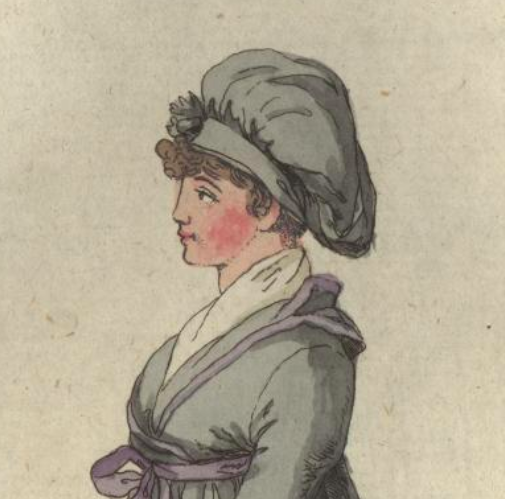
woman in a gray tam o-shanter cap
Detail, Plate 11, April 1799 Journal des Luxus und der Moden.

Enough, it would seem, to be getting on with. In addition to the 1804 Ladies’ Head Dresses plate, there are plates in the Journal des Luxus und der Moden showing headdresses and wraps, as well as an image of a pelisse and matching tam-o-shanter-like hat. These are simple enough to make, and I managed one in less than 24 hours.

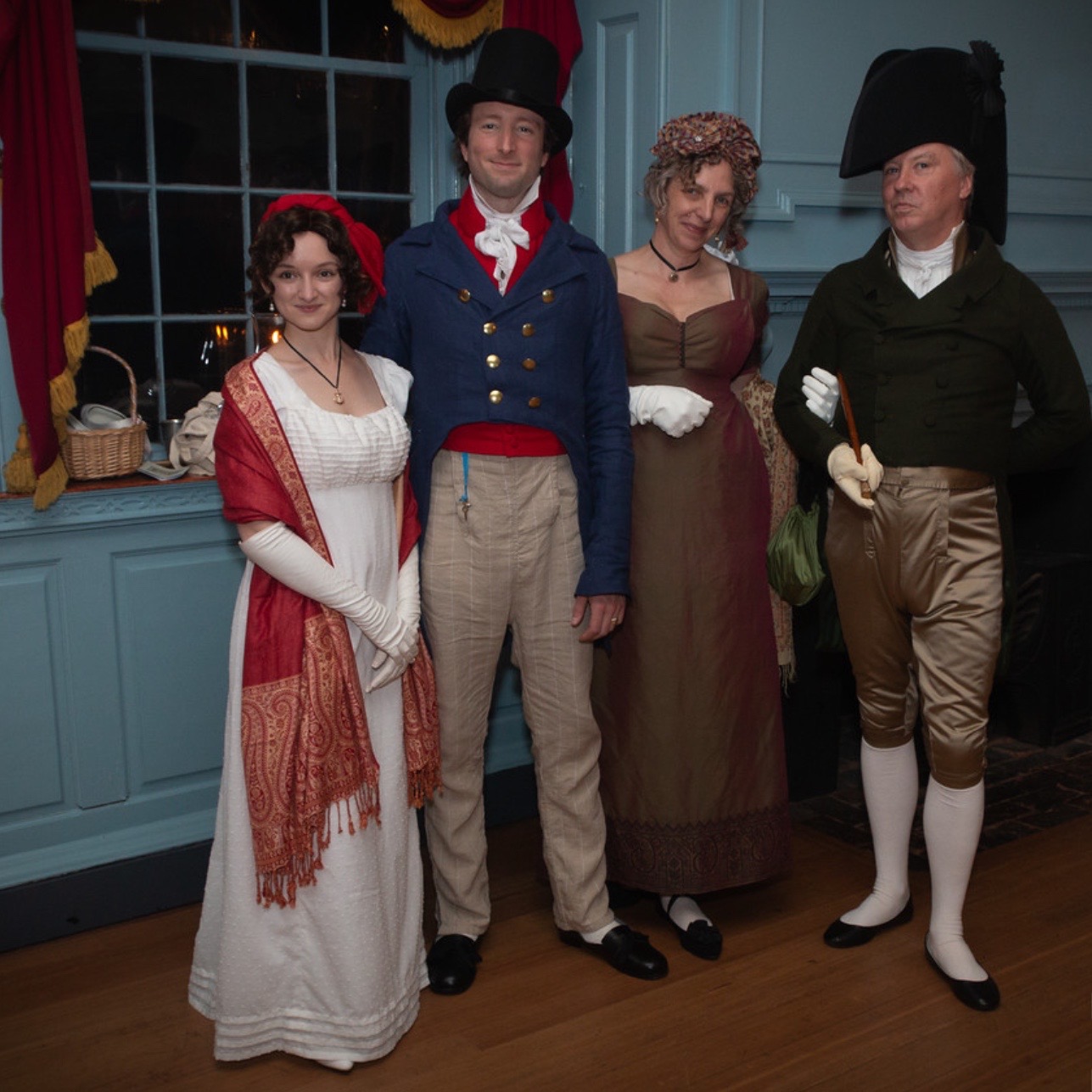
two couples in historical dress
I had no idea Drunk Tailor and I would color coordinate so well. Also, Dat Hat.

The fabric is left over from a gown I made to wear to a dance in Salem one spring, , but which happily coordinated well enough with the sari gown made for a photoshoot, and also worn to Salem for a dance. Briefly, the cap is made from scraps, ornamented with a two-layered rosette centered with a paste button, with the bulk of the caul gathered up and stitched down to hold the shape and embellished with three coordinating tassels looped onto a gold silk-wrapped cord. In the end, not too resting Bingley face, and a satisfactory cover for what I’ll call my hair a la Titus when I’m not in the current century. Drunk Tailor’s hat covered, somewhat, here.