The 1763 Project

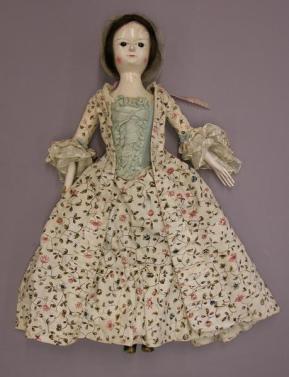
Doll, 1763. V&A, T19.36, T19P.36

Sweet, right? Who wouldn’t want to look (or at least dress–those pupils suggest something untoward, chemically) like this doll? And she’s 1763. Of course, my friend DC didn’t get the grant he applied for, so he has to try again.

Still, it seems the event will go ahead and I am stumbling on under the impression that I will have a chance to make myself something lovely for August. Of course, that comes only after I make the regimental menswear, so why am I typing and not backstitching? Because after a while, it’s just plain dull. Plus, doll! Printed cotton! Lightweight and lovely! And look: a hairstyle I can manage: birds’ nest.

Nice Petticoat.
Nice Petticoat.

What I like about this doll are her details. (The better written description is on the V&A website, but the better photos are at VADS.) She’s wearing a sacque (known also as a sack-back robe or a robe a la Francaise) and matching petticoat, a green silk quilted petticoat, a white linen petticoat, and a pocket that matches her gown.

The blue silk of her stomacher is used as trim on her sleeves, which are ornamented with flounces. Hallie Larkin goes into this well on her blog post about Changes in Cuffs. And that’s what stops me: the fine linen and the lace.
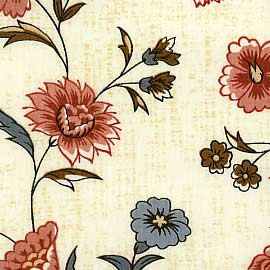
An actual reproduction, no less.

The gown itself, even a sacque, seems like something I can manage. (And yes, this is but one more piece of cotton sacque evidence.) A very similar fabric is available and if this sells out, there are variations on the theme. The blue silk stomacher can be managed: I have taffeta sources, and from making bonnets have learned the basics of the serpentine designs. I could make that. But those flounces–what about those?

Here she is from the V&A, ca. 1760, T.19-1936

Here’s the V&A description: “lace and cotton elbow ruffles.” Hmm. Cotton, perhaps that I can find in a fine, sheer weave. But the lace?

The more I think about this lovely gown, about the materials, and who would wear it, the more I think I’m better off sticking with lightweight wool and Sandby’s cherry seller...

I love a good challenge, but the lads need regimentals and their own 1763 apparel. Sandby’s woman wears a gown I’ve made before, so construction screw-ups will be fewer time will be shorter. And at least we can all wear whatever I make for various other celebrations and riots. New England had them in abundance in the 1760s and 1770s.

Details. All in the Details.

Detail, pair of pockets. Gallery of Costume, Platt Hall, Manchester City Galleries. MCAG.1922.2150

This image is from the fantastic VADS site‘s  gallery of pockets. I need new pockets, or a pocket update and overhaul, so I went looking for inspiration.

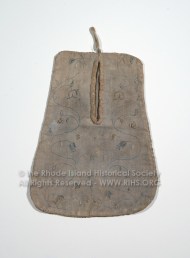
Child's Pocket, 1720-1760. RIHS 1985.1.9.
Child’s Pocket, 1720-1760. RIHS 1985.1.9.

This is a dangerous path to go down if you are as unskilled with a crewel needle as I am.

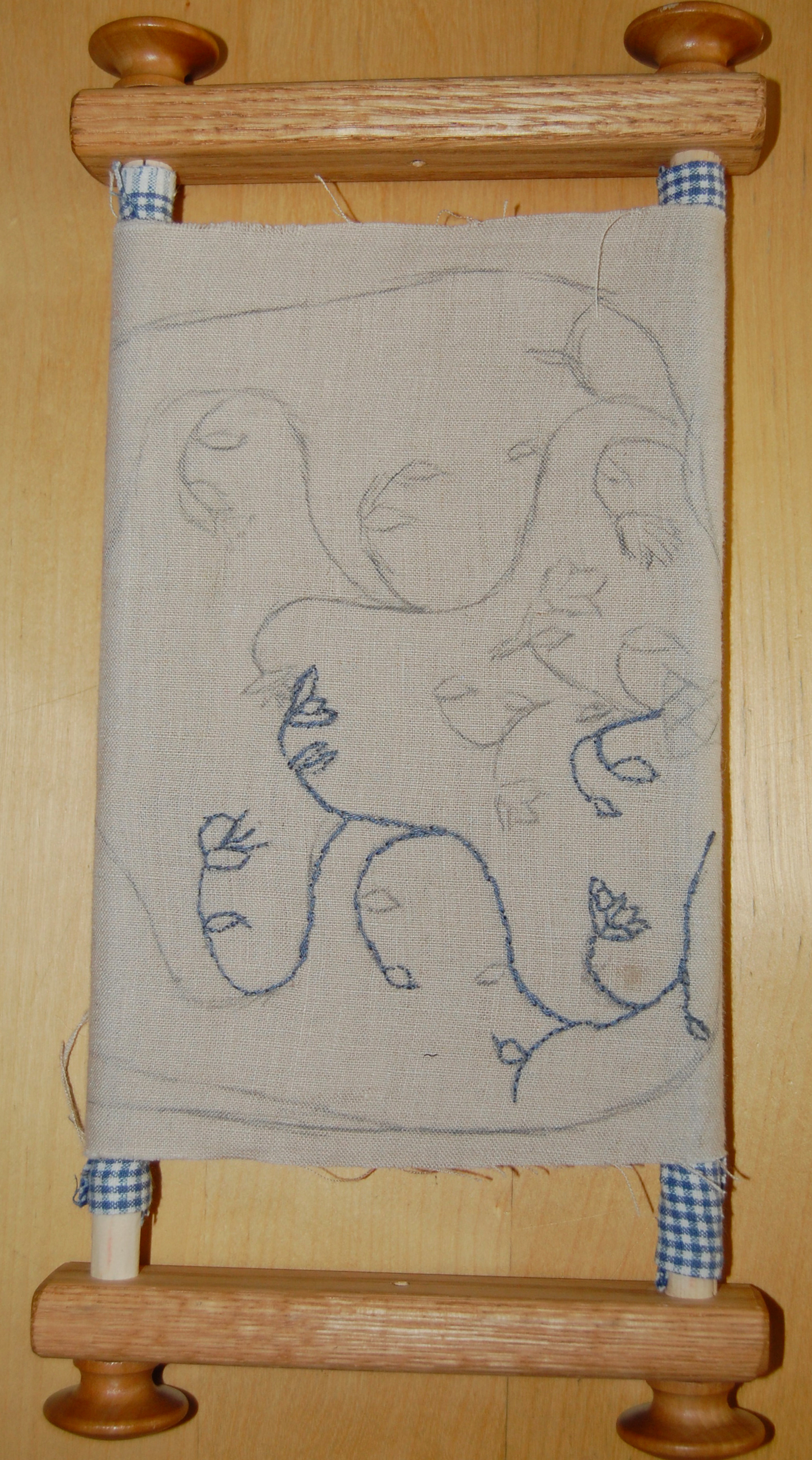
Sew18thCentury can do it– so, sew, lovely. Me…well, everything I knew about embroidery I learned as a child, and promptly forgot with puberty. So my skills remain appropriate for reproducing this, from a Rhode Island collection. The pocket is child-sized, at 14 inches, and the embroidery has a crabbed, angry look, as if the girl would much rather have been outside, chasing her dog or brother.  I can relate, at least to the dog part.

My copy, on the clearance-bin frame.

I  made a pattern of the embroidery, traced it onto linen, and started working on dredging up those long-forgotten skills. As a child, I had a sewing or embroidery book, but what I remember most about the projects I made was how far their finished form was from what I had envisioned.

Jane, and the Oldest Inhabitant

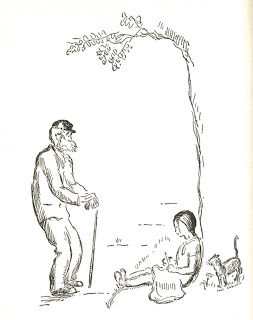
This is not an uncommon experience for children; my son has certainly experienced this, and even adults are subject to it. I think the best rendition of it, sewing-wise, is Eleanor Estes’ portrayal in The Middle Moffat of Jane Moffat attempting to make a “brocated bag” for Mama’s Christmas present.

The image of Jane sewing or crocheting under a tree while talking to Cranbury’s Oldest Inhabitant, a Civil War veteran, sums up every reenactment I’ve ever been part of… but I digress.

DSC_0283
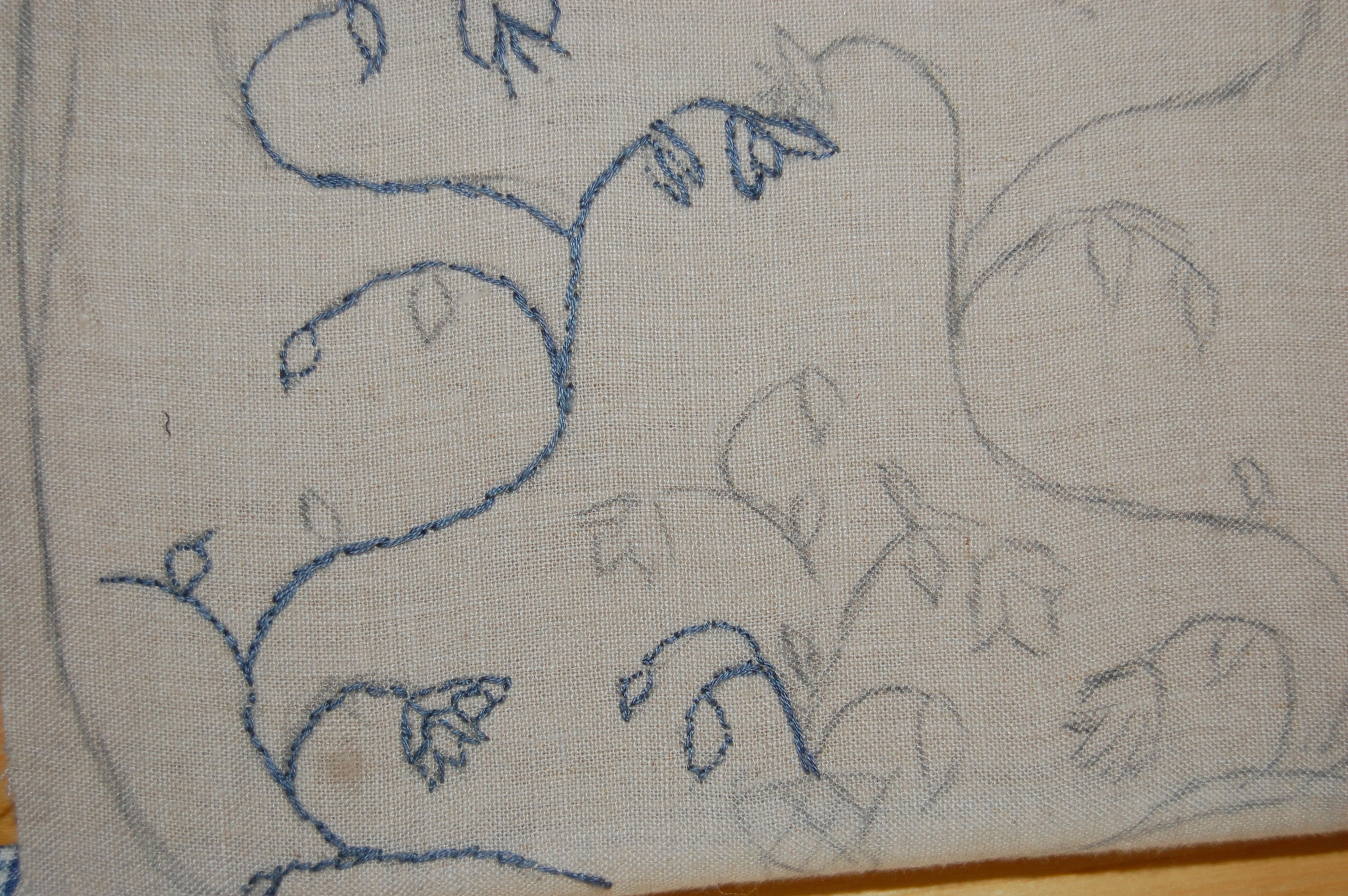
A detail. Sigh. I know, practice, but…

My embroidery stitches lack a lot, but most of what they lack is practice–and that’s what makes reproducing that RIHS pocket a perfect project for me. Pockets were “sampler” projects, and suitable for girls to learn on. This combines plain sewing with embroidery, and ends up as something useful and authentic, so what more can I ask?

Pocket, single, embroidered. Snowshill Costume Collection, National Trust (UK). mid 1700s. SNO1452

The VADS site has tons of images to inspire me, and with practice, someday I could manage something as beautiful as this. I need only make sure that it fits my time period and station–and for some events it will, but for most, the plain pocket or the crabbed-stitch embroidered pocket, are probably far more appropriate.

Shoulders and Sleeves

Dante's Own Infernal Sleeve of Poof
Dante’s Own Infernal Sleeve of Poof

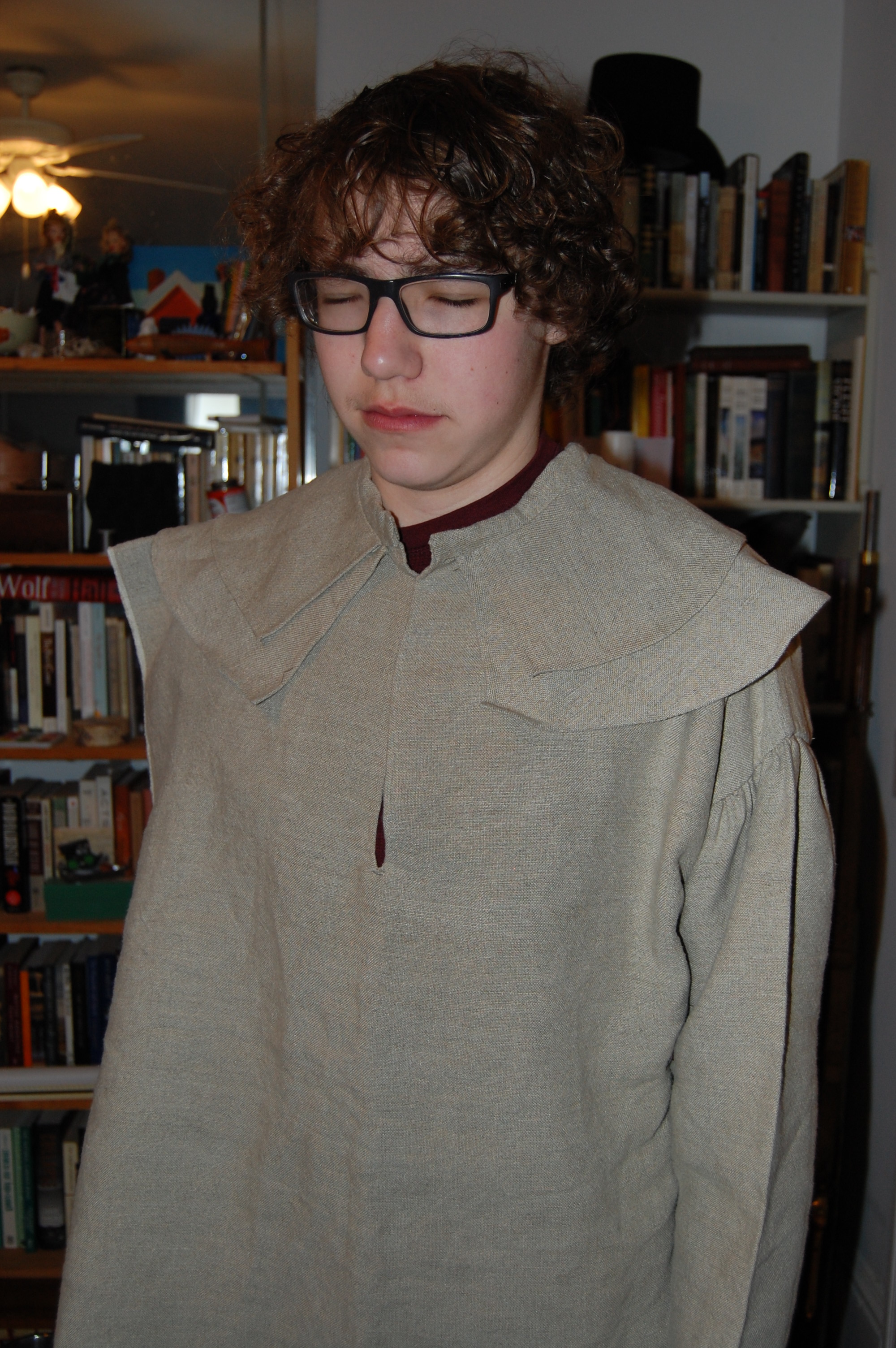
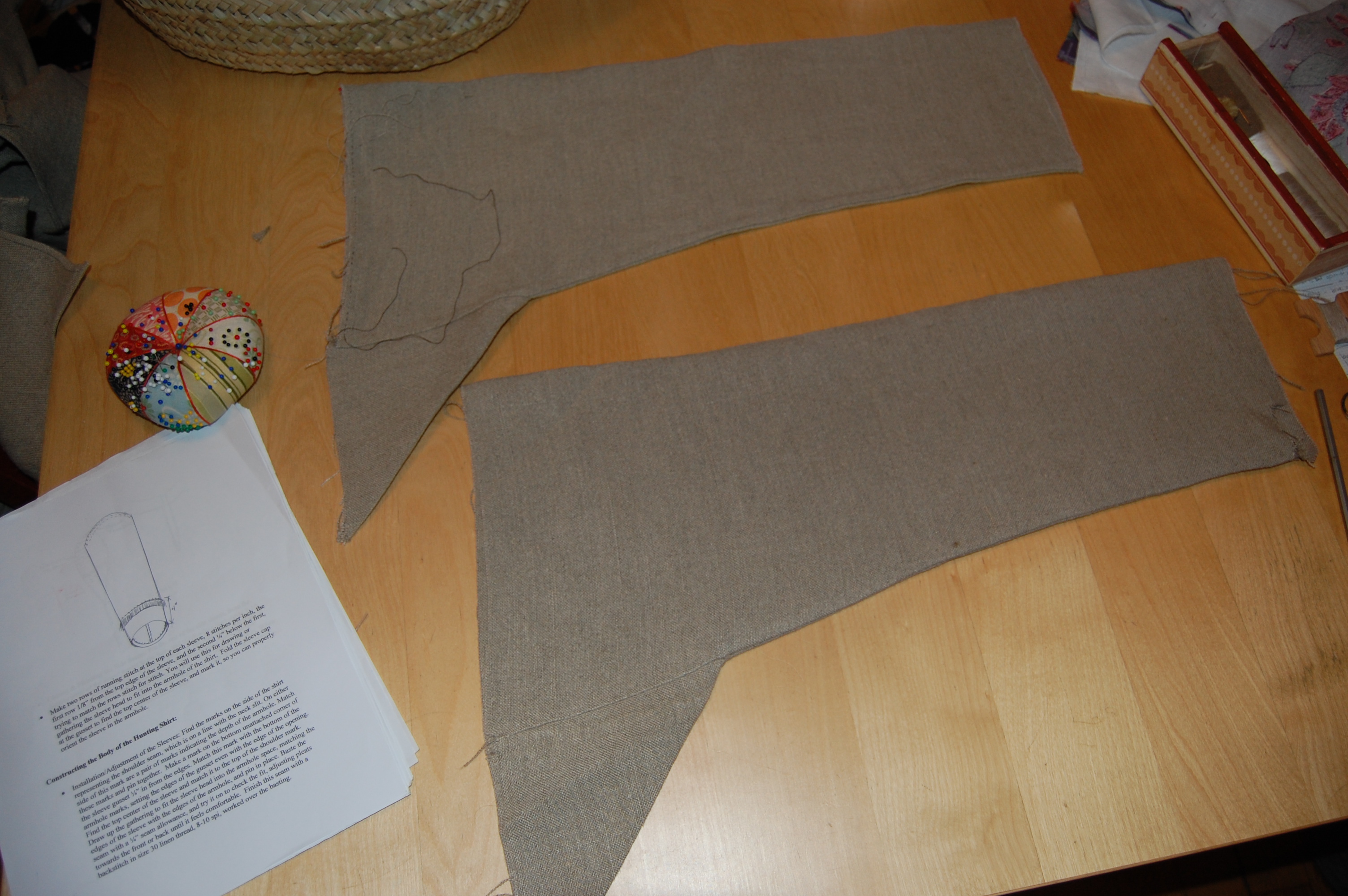
Twenty-four hours on, this is where we are: Poofy, shoulder-popping sleeve of doom. How can that be a uniform sleeve?

Well, Pilgrim, this is how:

Oh. They're all Infernal Sleeves of Doom.
Oh. They’re all Infernal Sleeves of Doom.

So glad I have that near-feral hunting shirt, because without it I would have ripped this out completely. Could the Poof of Doom be there to allow movement?

Subject was detained for photography.

Before school, even.

Arm out, doubts remain. Arm down, less terrifying.

I do feel sorry for him, but at the same time, I have to fit it to him.

It’s possible that the poof at the apogee of the shoulder is due to the intense pressing I gave this to retain the center line, and the fact that, despite washing, the linen is still pretty stiff. When I compare the two– the completed shirt and the in-progress shirt, I can see that while both display a tendency to drift up, the gathers on the adjutant’s shirt are more evenly distributed. You know what that means…and that’s why the sleeve is only basted in. Might as well change it now as on Sunday, because it must be done. So in the end, I am ripping it out completely, but with the knowledge that 1) the upward angle seems to be correct as shown in the finished garment, and 2) evening out gathers may reduce the Poof of Doom.

Sewing for the Adjutant

Falling In, OSV 2012

We were invited to join a Massachusetts regiment after the event at Old Sturbridge Village last summer, and we did. This has been a good thing, though it’s sometimes a little tricky to figure out which unit to “be” with. It is also a challenge because even though the Rhode Island unit has careful (if unwritten and slightly out-of-date) standards, the Massachusetts unit is another thing altogether.

Gathering the first sleeve head. Destination: Saturday afternoon
Gathering the sleeve heads. Saturday is soon!

The women last weekend kept asking what I was working on so assiduously. It was the hunting shirt (to become a frock) for the Young Mr for the new unit. Cut by the master, entirely hand-sewn by me. This is not something they would do.

“Sewing for The Adjutant, ” I said, “is another thing altogether.”

“Don’t even try. Who can sew like that? He’s a professional,” I was told.

What we're aiming for.
What we’re aiming for.

Well, yes.

So wouldn’t that be the very thing to reach for? It’s not like he’s not helpful. I have his shirt to copy, he answers my questions patiently, and I haven’t yet felt like an idiot.

The skill I have I owe in part to my mother and grandmother, and to the Dress U workshop with Sharon Burnston.  Stroke gathers, two-by-two stitching, using the tiniest needle possible are all things I learned or honed in Sharon’s workshop. And thanks to that workshop, this hunting shirt-(perhaps)-soon-to-be-frock is a great deal easier to tackle.

The other part of skill is practice. It’s as true for piano or soccer as it is for sewing. Just keep stitching, and it will come.

And after the fitting, the fringing. That's for someone else to do.
After fitting comes fringing. That’s for someone else to do.

What I find hardest is fit: not only is it hard for me to judge how much to take in a garment to achieve 18th century fit while maintaining enough ease for the wearer to swing an ax (or to accommodate teenage wriggling), alterations annoy me. I suspect that the key may well be not to fit at the end of a day, but at a beginning, or at least a middle. Fitting after a long day of sewing could make you think you were tossing away a whole day of work. It also feels, still, like taking a car to the mechanic or the cat to the vet. There’s something wrong, and I don’t quite understand it. Yet. But with Shoulders Roll Forward and Monkey Arms, I bet I’ll understand more soon.