
Two Words: Bed Sack

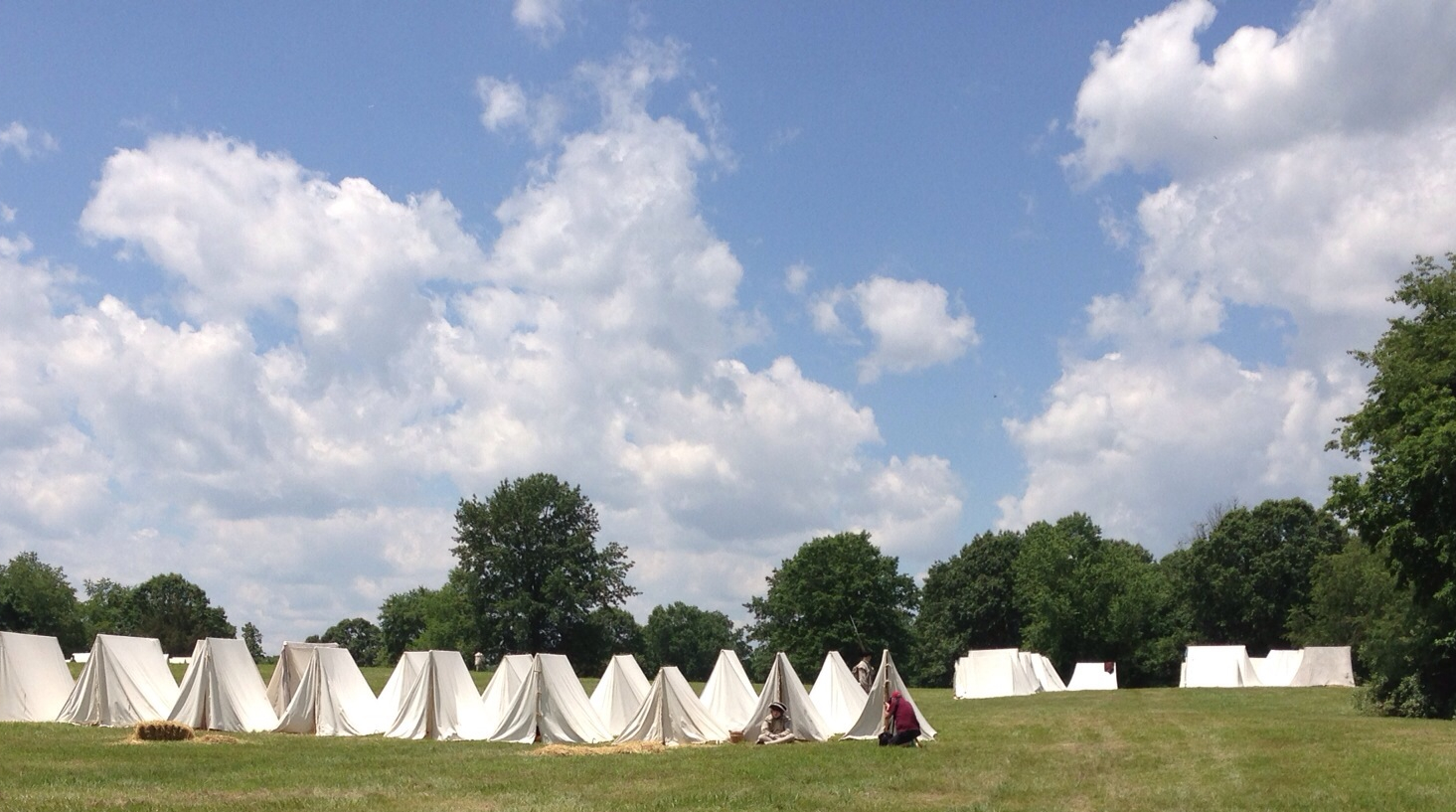
The Young Mr outside our tents

I’m making one. Or two. Whatever: I’m making them for famille Calash. Sleeping on straw and a sleeping pad is better than either alone, but I find with the arthritis that I need more warmth and more cushion than I used to require. True, I am self-padded, but the steel prosthesis does feel—it is only an illusion, but I feel this—closer to the surface, and thus colder, than bone. This makes for a Cranky Kitty, and it is far better for all concerned that Madam Commissariat be a Happy Kitty. I will forgo chairs and tables and other clutter—it is both authentic and pleasant to be unburdened—but I like to sleep well.

There’s a simple enough pattern in one of the Packet books, but the gist of the thing is this: Enormous Market Wallet. Interior common tent dimensions are about 6×6 or 6×7 feet, so you need to end up with something along the lines of 3×6 or 4×6 or 6×6 feet. The Packet suggests four pieces of ticken, each 30 x 80 inches, aiming for a finished size of 42×72 inches, with an center slit four inches wide and a couple feet or so long. (I used the 18th Century New England Life market wallet instructions for a guide in making ours, and will use the same idea for bed sacks.)

I’m not yet aware of extensive documentation of these for Continental troops, but there is one reference in a West Point waste book (see here, footnote three). Since we don’t allow fire in the tents, I am willing to compromise on cotton ticking for these, and (ssshh!!) machine sewing the seams, with a hand-finished slit edge. I might even borrow the serger from work to make really quick work of this business. They will truly hardly be seen, so although I know I am cutting corners, I don’t feel too wretched about it.
18th Century Sno-Cones

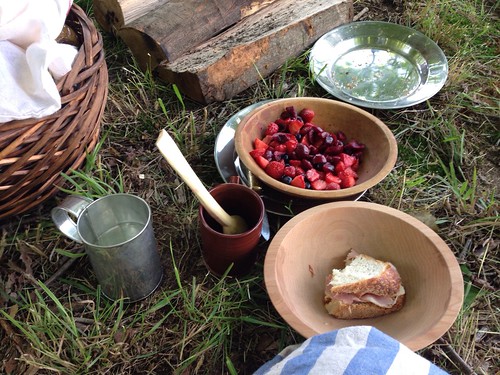
Nooning Saturday. Sandwiches and fruit

You may not have seen the Mad Men episode about the Sno Ball campaign, but chances are good you remember Sno Cones in paper cups from street vendors or Woolworth’s. On a hot August afternoon in Chicago, they were a treat waiting for the insufferably delayed Number 11 bus. On a warm New Jersey night, one can be inspired.

When the Wemrock Orchards truck came through camp Saturday evening, we bought another bag of ice—20 pounds!—and added ice to our pitchers. The Young Mr started crunching ice cubes, and The Adjutant observed, “You’re following the label’s advice: ‘Ice is Food’.” Mr S and I looked at each other and said, “I wonder if you could make a shrub slushy?” But what to beat the ice with? Musket butts were considered and rejected. And suddenly the Young Mr said, “We have a mallet!”

Indeed we do: Mr S made us a whacking great mallet with an enormous head. We ran to the tent to fetch the mallet and the flask of shrub, wrapped two handfuls of ice in the cleanest white cloth we had, laid it on Table (a clean, flat piece of firewood) and wielded the mallet. Just a small amount of shrub (recipe here) will do; it’s pretty potent stuff, even when non-alcoholic. I did not whack long enough, but shrub over crushed ice is a delicious, if highly unlikely for a common soldier, treat. The Adjutant is correct: the ice needed more whacking. But when he said, “I guess someone will have to make a mallet for the unit that’s flat on one side and serrated on another,” I figured we’d been accepted, crazy snow-cones and all.

Time Traveling

Girl with Pack Horse, Paul Sandby. YCBA B2001.2.1167

Once again headed south, this time with a more fully loaded vehicle and the Gentlemen of chez Calash. We shall return stinking and happy, I hope, and if not, there should be a good story in it. Farewell to any HSF Princess Dress dreams, and hello to Anne Carrowle, runaway, who still needs to re-set her sleeves but instead finished a pocket and fringe and basting and baking. Fingers crossed for good weather and happy camping.

Faces from History

Admiral Peter Rainer, MFA  04.1757
Admiral Peter Rainer, MFA 04.1757
Captain of HM 54th Reg't of Foot.
Captain of HM 54th Reg’t of Foot.

Meet Admiral Peter Rainier, painted sometime between 1778 and 1787. The curious thing about Admiral Rainier is that I know someone who looks uncannily like his portrait.

We found portraits in our collection that look like people we know, and there are people on the street who look like they stepped out of Sandby or Hogarth drawings, even if they’re not in period dress. Take a look: you’ll see it too.