Poetry in Papers

From the Newport Herald, 6/26/1788

It’s quite the poem, isn’t it? In October, I’ll be part of an 1800 event at work, and I will be portraying a housemaid, if not quite the housekeeper (we are still trying to sort out the domestic staff; what we can document is far too small a staff for the size of the house).

One of the things I will need is a name, and I thought perhaps I should check my instinct that “Kitty” was an acceptable name for women in the 18th century, and not just for sloops. So to the newspapers I turned, and among listings of the graduates of Philadelphia Seminaries for Girls, and ships cleared through the custom house, I found this poem. It reminded me of Mr S, and I recommend you read it aloud.

The early nineteenth-century maid. By William Brocas (1762-1837), pencil drawing c.1800 (National Library of Ireland)

So, a name: we’ll go with Kitty for now, and I can imagine building a complicated back story that pulls together all of the things I do, from running away outside Philadelphia to encountering soldiers and following them, to ending up a maid in a house in Providence. Except that what I believe about a life like that is this: It would be highly improbable, and I would look wa-a-a-y older than my actual years.

Instead of getting carried away with extreme historical fictions, let’s look at what we can know.

For one thing: clothing. Do you find yourself concerned, ever, that you focus so much upon your historic clothing? Well, you can stop. After a long and excellent conversation this week, think of this: the historical clothing you wear to events of any kind requires a lot of lead time. So you do have to think it through carefully, because every minute will count. It is also a visitor’s first impression of you, from a distance and up close. Getting it right matters, and since that takes so much time, you have to think a lot before you commit scissors to cloth. It does not necessarily mean that you’re a shallow, clothes-obsessed freak. There’s no 18th century mall to go hang out in and watch the leather-breeches boys  posing while they smoke clay pipes.

Benjamin West, Characters in the Streets of London, 1799, YCBA, Paul Mellon Collection, B1977.14.6314

I’ve just about convinced myself that the silhouette we’ve been wearing at the house and formerly at the farm is acceptable. I went looking through the turn-of-the century images I have on Pinterest and I think that a maid would have worn the fashionable silhouette. Another question is age (sigh); all the women in the Benjamin West are younger than I am.
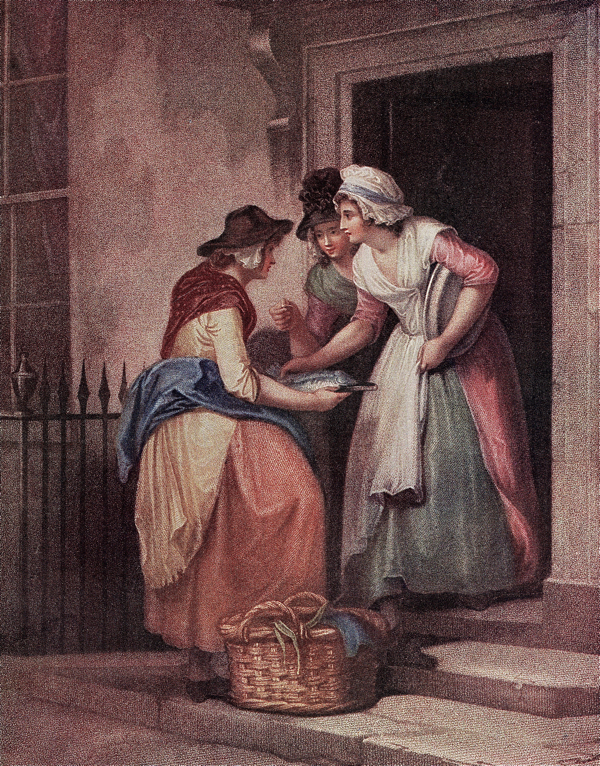
Francis Wheatley, Cries of London. New Mackerel, New Mackerel.

This print from a Wheatley (1792-1795) is useful, though he is such a genre painter and idealizes so much that I use him with caution. (Think of how much grittier–and funny–Sandby is: I trust Sandby more.) But, what can I learn from this? One thing is that I often think and dress more like the people in the street than the people in the houses. This will happen when you spend a lot of time outdoors, with soldiers: you are one of the people in the street. It can be a bit of a trap, historically speaking, and it’s good to challenge yourself to think about another class from time to time.

Back to the doorstep: what I learn here is that I need a white apron that I haven’t spilled on, a white kerchief, and a fancier cap. That cap will tie under my chin, because that’s the cap I see in Providence most often, and that’s the cap that will stay on. I’m not sure if these are maids–I think they are– but they’re women in a brownstone city house. And I can see from the clothes around me that they’ve been made for a woman who sells milk in the street, or works on a farm, or cooks over a fire. They’re not what the richest man in Providence would want his maid to wear answering the door.

You’ll have noticed, too, the different waistlines. The drawing from the National Library of Ireland and the Benjamin West have higher waistlines than the women in the Wheatley. Some of this will depend upon the available corsetry: I have stays that will work for the higher waistline, and I have stays for 1770.  I have a not-quite-right 1790s pair that need revision, but that’s not likely to happen: I have a brown and sea-green coat to make.
Authenticity, Reenacting, and the Mobile Museum

No stanchion here: the public marches with the exhibits

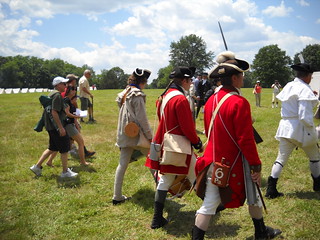
The more I think about issues of authenticity in re-enacting, the more I think about museums. Reenactments can be seen, as scholars have suggested, as “mobile monuments,” part of a culture of memorialization and commemoration of the past. “Recreated” battles, or battles staged on historic sites are not just the tactical weapons demonstrations they’re billed as, but rather ritual performances that commemorate notable events and connect practitioners with the past. They’re almost priests of the past, those men in uniform: they wear special robes, carry special equipment, and engage in practices arcane and exclusive–and denied to most women. (Indeed, the practice of women fielding reminds me of the history of women as deacons and eventually priests and bishops in the Episcopal church, but more about women in this hobby another time.)

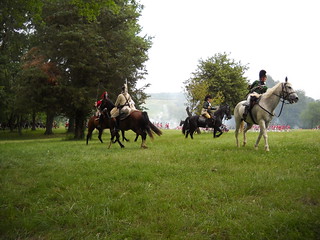
Dragoon battles are highly staged, for safety

That’s just the battles, though they are also museum theatre, vivid, smoky demonstrations of the ways of the past: what about the rest of the event?

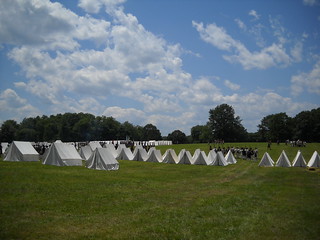
Reenactments, with their ranks of tents, kitchens, and varied participants, are in many ways mobile museums that set up at sites and provide “this weekend only!” semi-immersive experiences for visitors. There’s often a gift shop: the sutlers are there, and the site itself may have a shop, and push re-enactment themed items.

Each vignette or camp is like a gallery or object within a museum. Not all appeal to every visitor, some like Rangers, some like Redcoats, some like Rebels.

Continental camp at Monmouth

But in a world where museums and libraries are among the most trusted sources of information (online and otherwise), there are repercussions for the “mobile museums” of reenactments. If we accept a museum-like role, and see ourselves as custodians and practitioners of the past, we will need to also accept high(er) standards for material culture and presentation. That does not mean first-person interpretation by everyone at all events and it does not mean carrying actual 18th century goods into the field. That’s not good cultural stewardship.

It does mean doing the same hard work that museums do, researching and presenting oneself and one’s chattel with as much thought and care as possible. Who are you? Why do you have what you have? Where did you get it? Why does it look like that?

It means making one’s clothes and kit and accouterments as near to original as possible. The things we carry into the field, onto the stage of the mobile museum, should not look old. They should look used, but they will lack the patina of 235-year-old objects. They’ll represent the prelapsarian past of the objects, a time before they were painted with latex paint.

Can we, all of us, reach the highest levels of presentation? No. There are as many kinds of reenacting units as there are museums. Some are the Met, and have their owned branded truck. Some are your local historic site. Resources vary.

But just as most museums look to national accrediting organizations like the American Alliance of Museums for information on ethics, standards, and professional development, so too can the reenacting groups look to the umbrella organizations like the Brigade of the American Revolution, the British Brigade, and the Continental Line (the Big Three of 18th century reenacting). The BAR has an inspector, and unit inspection and re-inspection has a function similar to AAM accreditation.

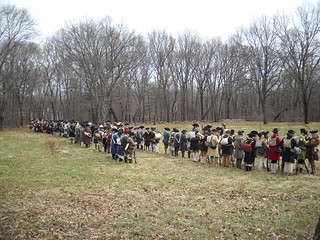
At Battle Road 2013

It’s not easy to become an accredited museum, but each museum that goes through the process learns, improves, and becomes stronger for having gone through the process of self-examination and, often, improvement. They meet standards. And like AAM, umbrella organizations can and do have standards, and the individual units have standards. Those are often online, and as individuals and other units strive to improve their impressions, following others’ well-researched and documented standards helps improve the entire field.

Peer-to-peer learning, public distribution of information, detailed and published standards of appearance, presentation and behavior: these exist, but not systematically, in the reenacting community. The more the Big Three can do to function the way the AAM does, the more I suspect we will see authenticity increase in the field.

Because it does matter: if museums and reenactors are trusted sources of information, we owe it to the public and our pride to create the best representation of the past that we can.

Hunting Frocks, Again

They’re not Mr S’s favorite thing, and I can understand why. Hunting frocks lack pizzazz, buttons, tape, lace, lapels, skirts and all the things that make him so fond of the Ugly Dog Coat worn by the 10th Massachusetts in 1782. (I think these are the coats captured from British supply ships and dyed at Newburgh and West Point in tanner’s vats.) But what he has right now is a hunting frock.

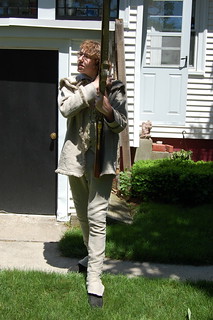
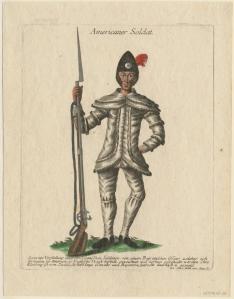
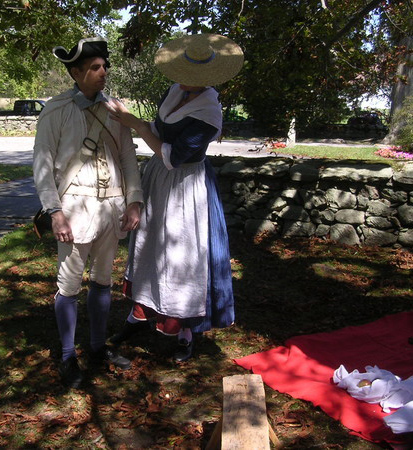
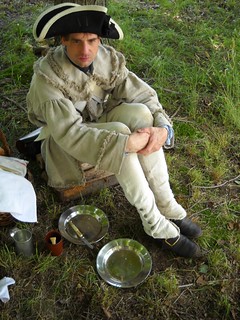
Here’s the kid in his new hunting frock, and a hand colored copper engraving by Johann Martin Will from 1776.

You gotta hold your tongue just right when you drill.
Americaner Soldat, Johann Martin Will. Ann S. K. Brown Collection, Brown University.

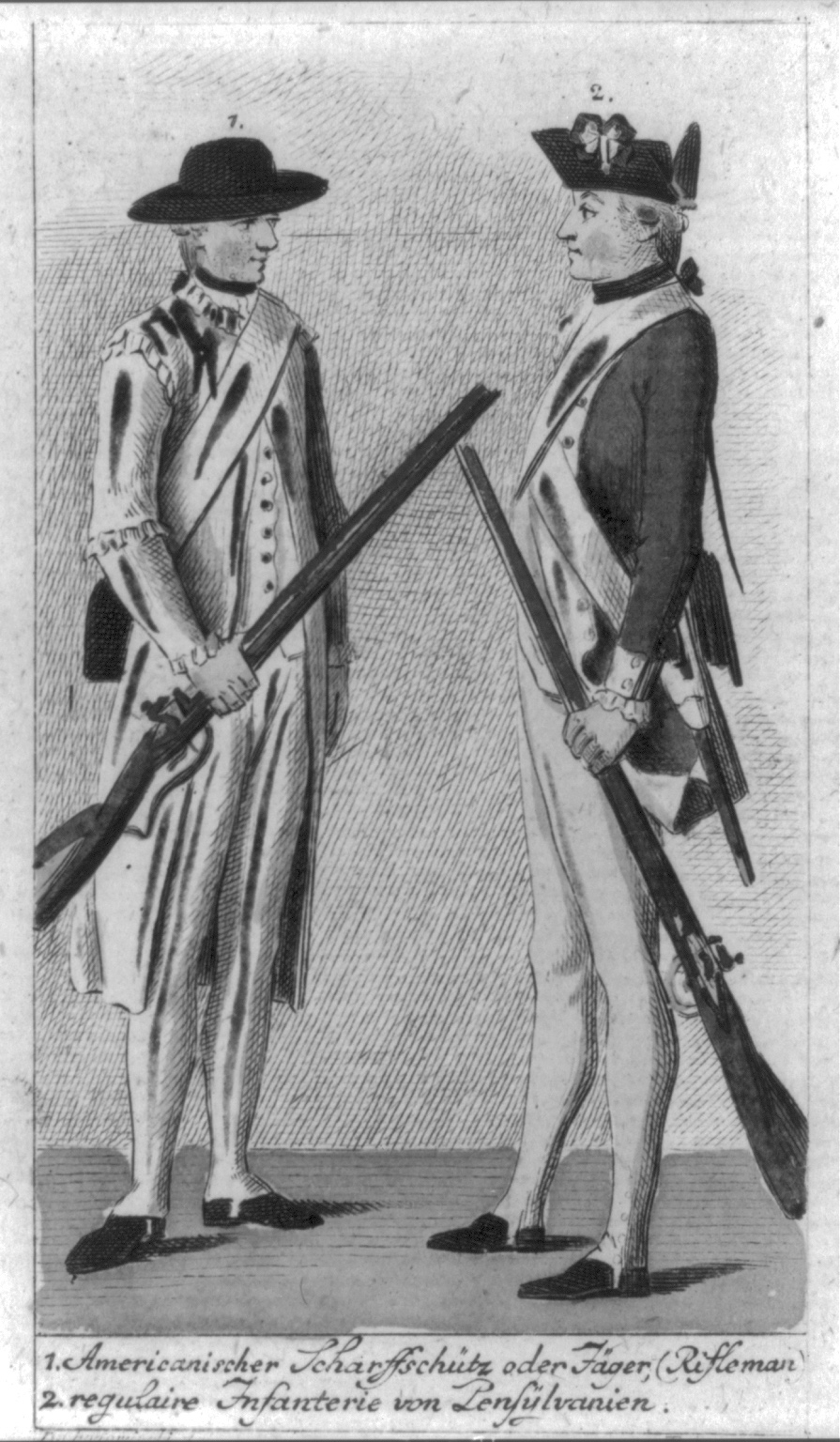
And then there are the colored and plain engravings, “1. Americanischer scharffschütz oder Jäger (rifleman) 2. regulaire infanterie von Pensylvanien,” engraved by Berger after Chodowiecki.

 Library of Congress
Library of Congress
Berger after Chodowiecki, Ann S. K. Brown Military Collection, Brown University
Ann S. K. Brown Collection

I started thinking about these again because not only am I reading Hurst’s thesis, but I’m fresh from helping the guys get dressed and arrange their capes and straps. I have been doing that as long as Mr S has been wearing historic clothing.

Early days of draping

Drapey capes

The hunting frock drifts if it does not have some kind of fastening at the neck. The two halves migrate in opposite directions, and while belts help, the light infantry bayonet shoulder belt does not contain the hunting frock as well as one might like. So the thing to do, I think, is to attach a loop and button at the neck to hold the garment in place. From the period engravings, I think that’s acceptable. The garments all look as if they are closed at the neck. From the evidence in the field, and from the images, I plan to make loops and attach buttons, and hope that will limit some tendency to wander.

The image of the two soldiers together suggests another wrinkle in the hunting frock quandary, since the left hand soldier’s out garment looks like a long pocket-less coat with applied fringe and only a very small cape at the neck. Thank goodness that soldier is a rifleman, and thus outside the realm of immediate relevance. (And on a side note, I know a gentleman who very much resembles the Pennsylvania infantry man: identical calves, and even a similar face.)

Authenticity: Sources II, or, Stripes!

In any decade, I love stripes.

Stripes. I love them, really, I do. Gowns, petticoats, cats. Why do I want to use them so much?

For the guys, because I can document what they’re wearing, at least based on their current state of residence and their current nominal “home” unit with the BAR.

Here’s why:

1777 Oct 22
An inventory of Searjeant George Babcock’s
Wearing Apparil who was Killed at fort Mercer
Octor 22d 1777 Belonging to Capt Thos Arnold’s Comp’y in Colo Green’s Regemt

Two Check Linen Shirts
one Pair of Striped Linen overalls
one Striped Cotton & linen Jacket without Sleeves
one flannel Jacket without Sleeves
one home spun Woolen Jacket without sleeves
one Linen & Worsted cotee
one Kersey outside Jacket Lined with flannel
one beaver Hat & one Pair of shoes
one Pair of blue worsted stockings
one pair of thread ditto
one pair of blue yarn Stockings
one Linnen Handkerchief
one knapsack

(Clothing inventory, Capt Thos. Arnold, Col. Christopher Greene, Rhode Island Regiment
RIHS MSS 673 SG 2, S1, SSA Box 1 Folder 13)

From RIHS MSS 72, Preserved Pearce papers,  Tailor's and Tavern account books, 1778-1781.
From RIHS MSS 72, Preserved Pearce papers, Tailor’s and Tavern account books, 1778-1781.

This inventory has formed the basis for many of the clothing choices I’ve made for Mr S and the Young Mr from their check linen shirts to their blue stockings. I was criticized for the size of the checks of their linen shirts (too small! I heard), but feel vindicated time and again by the extant garments I’ve found (aprons, mostly) in this period. The checks are small.

The best piece of evidence I found was serendipitous: whilst going through tailor’s books Thursday, looking for stays, I found a scrap of blue and white checked linen used as a binding. The biggest lesson from that scrap is that I need a deeper, more indigo-rich blue and white to begin with.

The “Striped Linen overalls” in the inventory are definitely on the list of things I’d love to make, along with the “Striped Cotton & linen Jacket without Sleeves.”

One of my favorite garments of all time. Boy's frock, ca. 1760-1770. RIHS 1959.6.1
One of my favorite garments of all time. Boy’s frock, ca. 1760-1770. RIHS 1959.6.1

There are extant Rhode Island garments from made of blue striped linen, documented to the period we interpret, and another one, recently acquired (coming soon to a database near you!) from which a pattern has been taken.

After a while, though, blue stockings and checked linen shirts seem…ordinary. Common. You might start to wonder if they’re just another re-enactorism, they’re so ubiquitous.

It’s worth checking again to see that these are, in fact, common garments, probably as prevalent then as they are now.