Once Upon A Time…

Betsy Ross and friends: A Child Guidance Educational Activity

This is the third set of these paper dolls (Educational Activity) I have owned. The very first set was given to me by my mother, Lo, at the Dawn of Time, in the Dark Ages known as the 1970s.

I wore them out.

A new set was purchased, probably once again at Marshall Field’s, possibly in the book department. They now reside in an attic outside Philadelphia (how appropriate).

From this Educational Activity flowed many more home-designed outfits and home-made paper dolls of historical and literary origins, which have led to this moment, when I make myself and my family into historical characters, make us outfits, and set us in motion with friends and colleagues in scenes of historical play-acting, by which I mean Educational Activity.
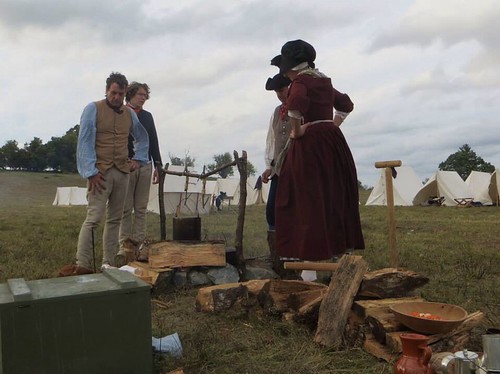
Cooking at Saratoga: very Educational. Photo courtesy D Molly Ross.

I like to think that the clothing we wear is more correct than the “Authentic Costumes” advertised on Betsy Ross’s box, but there is always more to learn. I am in no way denigrating Betsy Ross, or paper dolls, or suggesting that I see my family, friends and colleagues as paper dolls. But I do know that as long as I have been playing, I’ve been playing history and reading history, and drawing history, and using books and paintings and yes, even paper dolls, to figure out the world present and past.

If January Jones played Betsy Ross...
If January Jones played Betsy Ross…

Even though I always thought I wanted Betsy’s birthday cake gown, the one I really liked was the work gown. The “construction” of her garments confused me even as child: how the heck does that kerchief work? And the bodice front? Never mind, have a slice of dress, I mean cake. (Field’s had a cafeteria that served slices of pink-iced layer cake that I somehow conflated with the paper dolls, thanks to the shopping trips my mother and I made.)

Memory and fact, impression and citation: when we reenact the past as an Educational Activity, we should remember that some will walk away enlightened, and others will walk away thinking about birthday cake. Our job, beyond getting the facts right, is to engage our visitors, to interest them, and to excite their imaginations. What they do from there is up to them, but we will know that we have done our best to present them with a scene that can take them one step closer to being there.

Order!

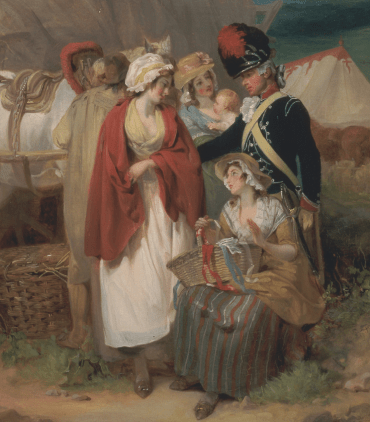
Francis Wheatley, 1747-1801, British, Soldier with Country Women Selling Ribbons, near a Military Camp, 1788, Oil on canvas, Yale Center for British Art, Paul Mellon Collection

You know you’re taking something seriously when you’re willing to pay for the privilege of reading a primary source. The microfilm I ordered from the Phillips Library arrived a week or so ago and I managed to snatch an hour or so between meetings to read and print some of the most interesting pages. I get a week or so more before the reader at work goes to storage, and then I’ll have to go haunt another library.

This is the kind of stuff I will happily read at bedtime, though it should also be noted that I will read regimental record books at bedtime, or runaway ads, so we may not share tastes in literature.

I was willing to pay for the film because I wanted to read the books in full to get a better sense of the context in which Bridget Connor was operating. (Delightedly, I realized last night as I fell asleep, of course there’s no death record for her in Massachusetts. She was expelled from camp at Newburgh, so why would she walk all the way back to Massachusetts? Why not set up a new life in New York? A whole new place to look for her!)

Beyond Bridget, there’s a wealth of detail in the Stephen Abbott Orderly Books.

Thomas Sandby, 1721-1798, British, Encampment at Maestricht, 1747, Pen in black ink, over graphite with gray wash on medium, moderately textured, beige, laid paper, Yale Center for British Art, Paul Mellon Collection

“Regl Orders 5th June 1782
the Regiment will make Every preparation
to March on Fryday the Soldiers are to
Clean there arms to Morrow and pack up
there Clothing.. The Commedants of Com
apanies are Directed to Send the tent poles
which are Finished to Morrow by 12 oClock
to the Landing where the tent Lay the Guard
with the tents will pitch a No of tents Suff
iciant to Cover the Straw and what ever Bag
gae is Brought previous to the march”

This helps us get a picture of the camp, and from the order about the tent poles, I think we may gather that there were plenty of tent poles NOT expected to be finished. (My colleagues enjoyed that part when I read it aloud at work.)

Regimnl Orders June 6th 1782
the Regiment will turn out to Morrow Morning
at the Beating of the Revelee and to March
By Six oClock they are to pack there cloth
ing and kook there provisions this Evening
when they have arivd on the Ground for Encam
ping the officer commanding on the Spot
will order a partry if Forty men from the Reg
iment a Capt and two Sub’s to Command them
to Return to the Encampment in order to asist
in Bringin on the Baggage the Soldiers
are to Carry there kittles in there hands and
are to Leave there arms and pakes &c at the
New Encampment any Soldier who is found
Plundering another pack is to be tyd up and
punished with out Trial..

Carry their kettles in their hands, their provisions cooked the night before. Now, wouldn’t that change an encampment’s appearance? Let alone tied up plunderers…

Criss Cross

Dolly Eyland, by Alexander Keith, 1808. (c) The New Art Gallery Walsall; Supplied by The Public Catalogue Foundation

I like Dolly. The colors, the textures, the style of her gown, shawl and cap all please me. She’s rocking some serious class for a woman headed towards a certain age. And she’s wearing a cross-front gown, which is what I settled on for my Quaker costume. 

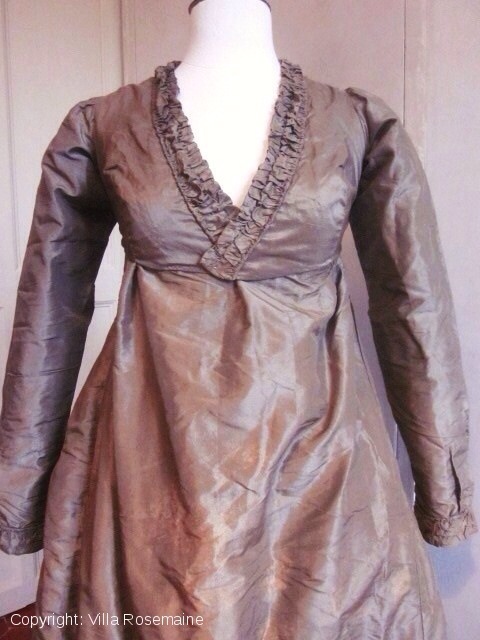
Taffeta dress, ca.1800-1810, Originally found on Villa Rosemaine site, where it does not appear now.

The trouble with making a gown based on an artistic sketch in a book is that you don’t have the most complete sense of what that garment looks like, or how it goes together.

Not to worry, I went ahead anyway, because this is as close to Everest as I will ever get.

But I wanted comparable garments to help guide me. Ages ago I found the gown at left on a French costume site. That’s helpful, in that it explains the trickiness of assembling and wearing this style of garment. Three pieces coming together in the front may be one piece too many. 

In making up my pattern, I used the pattern for the Spencer as a starting place because I knew that the set of the sleeves and arm scye were what I wanted. No reason to re-invent that process!

That left me with the luxury of concentrating on the neckline.

That took a few goes with the tracing paper and muslin:  I did lose count after a while. There may have been tears, there definitely was swearing. Mr S at one point made jokes about this process appearing on the Discovery Channel’s “How it’s Made” as “the Quaker dress.” He’s really very patient, and I do understand the selective deafness he’s had to develop as a defense against the dark arts of sewing historic clothing.

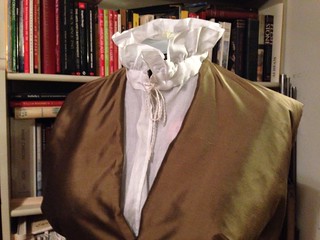
Thank you, Cassidy, for the chemisette!

Eventually, I had a decent lining and even some silk bodice fronts. I fiddled with the fronts, and settled on gathers instead of pleats, but couldn’t quite figure out where the casing went. Some days I can process drawings into objects, some days I can’t. I’d just about reached the point of cutting it all up into the gown I always make when I discovered that the excellent women of the 19th US had patterned the gown from the drawing, too. (If you don’t already use this site, I highly recommend it. Excellent work.) Those pattern pieces look like my pattern pieces, so I decided it was worth carrying on with what I have.

Who was Bridget Connor?

Detail, James Malton, 1761-1803, A Military Encampment in Hyde Park, 1785, Watercolor with pen in black ink, with traces of graphite on moderately thick, moderately textured, beige, laid paper, Yale Center for British Art, Paul Mellon Collection. B2001.2.999
Detail, James Malton, A Military Encampment in Hyde Park, 1785. YCBA Paul Mellon Collection. B2001.2.999

Who knows? She’s hard to find, though I am told and have real hope that the microfilm of the Abbott orderly books that chronicle her misdeeds in wending its way to me down the dirty, salt-and-sand covered highways of southeastern New England.

Where have I looked for her and Francis Connor, whom I presume is her husband?

Francis appears in Soldiers and Sailors of Massachusetts, for seven months’ service. That’s all I can find.

Well, crap, right? This genealogy stuff in Massachusetts is hard work—there are so many more people and towns than we have here in Li’l Rhody—but diligence and method pay off, and when you figure you’ve about exhausted the primary sources you can access for now,[1] you turn to secondary sources.

Lest you think I dislike Deborah Samson, note that I found her life a useful source in thinking about Bridget, as well as Book of Ages and Jane Franklin Mecom’s life. I’ve also been re-reading Holly Mayer’s Belonging to the Army.

Crippled soldier with family. Etching, London (?) ca. 1760. Lewis Walpole Library, 760.00.00.16

The common denominator: poverty, and the resulting lack of choices. This is useful for Bridget, because her story is probably one of necessity. Most women who followed the Continental Army, and worked for it, were from the lowest ranks. [2] These are women who would do what was necessary to survive, and as Mayer notes, “would rather steal than starve.” [3]

I’m not suggesting that Bridget, who would likely have received rations, needed to steal shirts to survive: I rather think she was attempting to leverage her position and profit by ill-gotten gains. But how did she end up in the Army to begin with? Massachusetts in 1782 is not New York in 1780, or Rhode Island in 1778.  What drove her to (presumably) follow Francis Connor?

Late in the war, maintaining troop strength is more difficult. The fervor of patriotism has cooled, and recruiting sergeants find it harder to fill the ranks.[4] There are bounties to be had, and the economy has suffered. Could Francis have been a property-less laborer who enlisted for the bounty? Nothing talks like cash. And, if the couple were tenants somewhere, without Francis’ income, Bridget might not have been able to maintain a home. Laundry doesn’t pay that much.

Why didn’t she stay with family? Could they have been indentured servants? Could they have been immigrants? My guess is that Bridget had no family, and if Francis had family, Bridget got on with them as well as she did with the officers of the 10th. I think she had nowhere to go, no way to survive without Francis.

Did they love each other? Did they like each other? Were they grifting together? I don’t know—but Francis Connor deserts the same day Bridget Connor is expelled from camp, so they’re bound together in some way. No matter what, Bridget was assuredly dependent on Francis.

Knowing so little about them opens up a world of possibilities, and the “opportunity” to do a great deal more research on the context of 18th century Massachusetts populations and enlistments. My best guess is that they’re an unpropertied laboring class couple from Boston, source of many of the relatively unstable and non-homogenous companies that made up the 10th Massachusetts. I also think they don’t have family, and might be former indentured servants. I have guesses about their religion and country of origin, which could be why the records are so hard to find. [5]

Looking for Bridget, and not finding her, leaves me with more and more questions, and I’m happy about that.


[1] She’s in the Abbott Orderly books, at least. Other Orderly Books to follow, as time and funds permit.

[2] Mayer, Belonging to the Army, page 122.

[3] Mayer, page 127

[4] How do you think Deborah Samson got in, passing as a boy? That’s 1782 for you.

[5] The Catholic Diocese of Rhode Island maintains separate historical vital records, and when we cannot find someone in the usual town records, we ask the genealogist if their family is perhaps Catholic or Quaker. Lack of evidence can be a suggestion of faith in my home state. But could these two be Irish Catholic in Massachusetts in 1782? I have no idea, but it seems a great stretch and a great question all at once.