You can join the fun this year by providing mail for the HMS Acasta‘s mail bag at the Jane Austen Festival. Maybe you can’t go, but why shouldn’t your letter?*
Read more here about the suggestions for types of letters, and the characters to whom you may write. It’s on my list of neat things to try to get done.
*Hot tip: Jo Baker, author of Longbourn, will be there. Creative writing, author talks and dressing in high-waisted gowns? Why am I not going? (Because I have too much to do in July!)
Pocket ca. 1784, American cotton, wool Brooklyn Museum Costume Collection at The Metropolitan Museum of Art, Gift of the Brooklyn Museum, 2009; Bequest of Marie Bernice Bitzer, by exchange, 1996 MMA 2009.300.2241
Sharon Burnston, on the Historic New England site, points out that “Pockets thus represent the kind of dilemma that objects of material culture can present to scholars. Much is known about how and when these items were made, but evidence of how they were used remains fragmentary and tantalizing.”
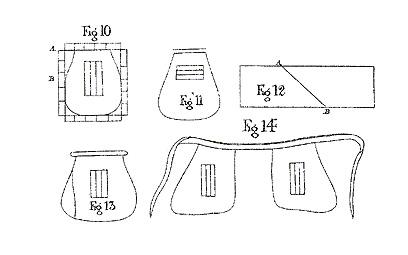
As we can see from this diagram from the Workwoman’s Guide, pockets could take many shapes, and the extant evidence bears this out. There are oblong pockets, and more rectangular pockets, rounder pockets, longer and shorter and wider pockets. One suited one’s self, and cut one’s pattern to one’s cloth.
A pair of silver buttons A pair of buckles A pen knife Thimble Coins A silver spoon A pair of scissors Keys Needlecase Biscuit Nutmeg and grater Smelling bottle An orange or an apple A pocketbook Comb Snuff box Jewellery Needlebook Pocketbook Paper Pen or pencil
When Pamela runs away, she takes with her, in her pocket, two handkerchiefs, two caps and five or six shillings.
Of all the listed things, what might Bridget have carried? Some of the things she carried would be needed, but others would be wanted.
Female court martial : held upon the conduct of an admirable lady. [London? : s.n., 1757] Lewis Walpole Digital Library 757.03.00.04+
Everything I think I know about courts-martial I learned from the movies (The Caine Mutiny and Breaker Morant, or Paths of Glory) but thankfully I can realize that knowledge is probably not so applicable to Bridget and her context.
Thanks to Yale, it’s easy enough to find the Rules and Orders for the Continental Army, as set down by the Continental Congress in 1775. I don’t have to know this, the guys know it, but it’s helpful for me to understand what’s happening. I also figure Bridget would have known how the system worked (or should have) since she was part of it, and would have observed life around her. In the same way that I understand the organizational politics and policies of my workplace, she and the soldiers would have understood the rules and regulations under which they lived and worked.
“Art. XV. Whatsoever non-commissioned officer or soldier, shall be convicted, at a regimental court-martial, of having sold, or designedly, or through neglect, wasted the ammunition, arms, or provisions, or other military stores, delivered out to him, to be employed in the service of this Continent, shall, if an officer, be reduced to a private centinel; and if a private soldier, shall suffer such punishment as shall be ordered by a regimental court-martial.”
There you have it: they sold provisions or “other military stores” delivered to them to be employed in the service of the Continent, and suffered such punishments as were ordered.
And Bridget? Well, for one thing, she should have known she was subject to the articles, rules, and regulations. She was one of those “all persons whatsoever.”
“Art. XXXII. All suttlers and retailers to a camp, and all persons whatsoever, serving with the continental army in the field, though not inlisted soldiers, are to be subject to the articles, rules, and regulations of the continental army.”
Technically, I cannot find anything stating outright that one could not buy issued goods from the soldiers to whom it had been issued, but since selling it was wrong, receiving was wrong, too.
We know from the final punishment that Bridget probably breaks yet another article:
“Art. XL. No person whatsoever shall use menacing words, signs, or gestures in the presence of a court-martial then sitting, or shall cause any disorder or riot, so as to disturb their proceeding, on the penalty of being punished at the discretion of the said court-martial.”
I think the “the Insolence to the officers of [the 10th Massachusetts] Regiment” may have taken place at the court-martial, given the swiftness of her punishment.

 Gentle Readers, would you be writers?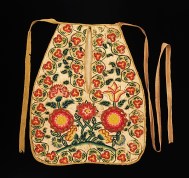


![Female court martial : held upon the conduct of an admirable lady. [London? : s.n., 1757] Lewis Walpole Digital Library 757.03.00.04+](https://kirstenhammerstrom.com/wp-content/uploads/2023/03/9cfa8-femalecourtmartial1.jpg?w=640)
 Kirsten Hammerstrom
You must be logged in to post a comment.