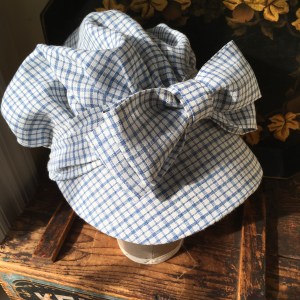
Here’s a question: what about those linen bonnets? Am I making that up?
As it happens, nope.
Linen bonnets appear in ads from the 1760s to the 1780s, sometimes described as white, and sometimes as check. There’s even a white diaper bonnet! The thing to remember is that so far I haven’t found these in New England, but that’s because I’m using runaway ads, and those are far less common in New England. There’s plenty of check linen fabric in New England– but if there were bonnets, those references may be in inventories I haven’t had a chance to dig into.
Maryland Gazette, (Annapolis)June 4, 1772
Another possibility in the regionalism of linen (checked or white) is climate. A friend and fellow blogger sees the linen bonnets in coastal North Carolina, which makes sense in terms of weather. It’s warmer and even more humid on the North Carolina coast than it is on the Rhode Island coast, and I’ve found linen to be much cooler than silk. This same regionalism may apply to what we see from Philadelphia to Frederick, Maryland.
Maryland Journal, August 21, 1776. I love this one because Rosannah is as tall as I am!
As I tabulate data, trends will emerge; as it happens, I’ve already seen that half the bonnets I’ve entered are linen and half are silk. Those references are from the Mid Atlantic and coastal South, with only one from Rhode lsland (and that a “blue cloth” bonnet), so there’s lots more data entry to come. For the moment, though, it’s safe to say that a checked, white, diaper, or dimity linen bonnet is documentable from 1758 to 1780 from Philadelphia south to Wilmington, North Carolina. The fiber persists, but shapes will change.
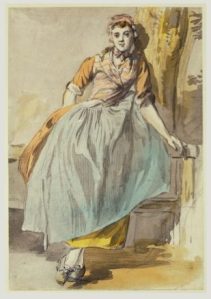
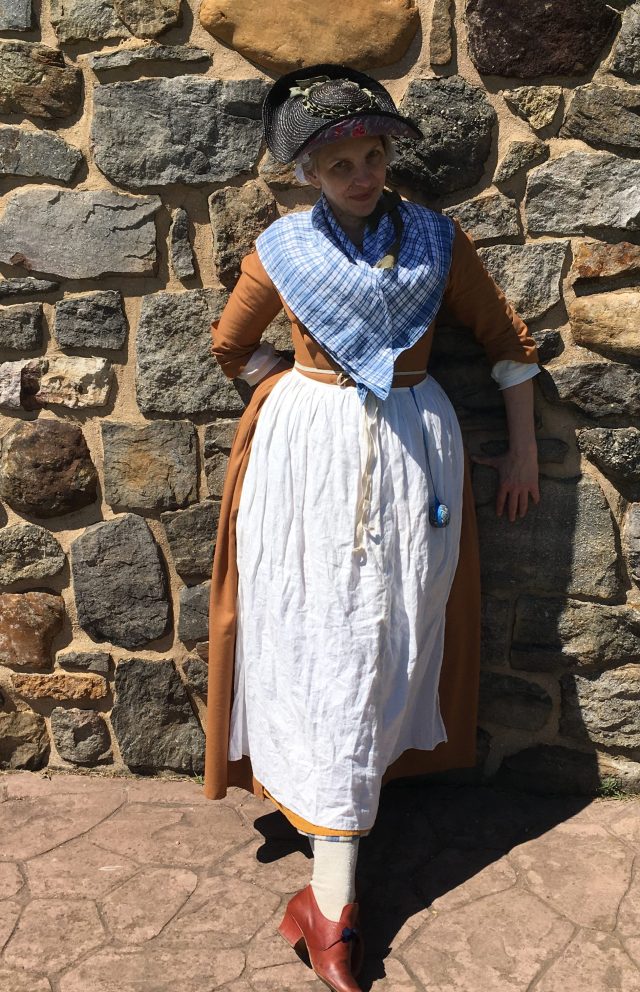
Did I really need another English gown? Well….that cinnamon Virginia cloth, though. Reader, I saw it and I bought it, because: Paul Sandby. The color of the cloth struck me as being about as close as I am likely to get to this image, and since I own a yellow petticoat and suitable accessories, it seemed nearly a necessity.
At this point, I’ve made enough gowns that I can pretty much fit the shoulder and sleeve myself (especially since I sprang for the new dress form). I’ve lengthened the sleeve, and tweaked the shoulder strap to compensate for the curve in the original (a straight-cut piece works better for me). Future sleeves will need to be made a little wider across the bicep, as I have gained some muscle.
In progress
Shopping with a basket at Fort Fred. (photo by Denise Wolff)
The fabric pleats well, though the edge has a tendency to fray a bit, as I learned when I made the first gown I ever really liked. But these fabrics have much to recommend them in color and weight, bridging seasons and locations–the weather in the South being rather different from that in New England. That gown was good for cleaning in Trenton and hiking in Rhode Island, but really needs to be taken apart and remade (at some future date).
As I made this gown, I thought about what I told The Giant when he said, “I wish I was a better writer.” It’s butt in chair that makes you a better writer, and a better seamstress, or a better tailor, and better at just about anything other than an active sport. Practice, and patience, are what it takes to improve. The first things I made were not nearly as nice as the things I can make now, many gowns, dresses, coats, caps, and bonnets later. Sewing is a discipline and a craft, and perseverance pays off.
The Fort Frederick Market Fair is the place to wear new clothes and shop for curiosities, I took the opportunity to wear the new gown with some older favorites, including the best neck handkerchief I’ve ever had (hand woven by a friend), and a hat made ages ago that is finally achieving a salty patina suitable for someone of my usual station. That’s one of the best parts of perseverance: putting old and new together for a new and different look.
The historical costuming/living history/reenacting hobby can be a daunting one to pick up. When I started, I was fortunate to have a background making things, including sewing my own clothes, as well as a career that taught me research skills, and gave me easy access to primary sources. Those factors made skill building relatively easy, though I definitely had a learning curve specific to what I was doing. As the season opens and people start to ease into new units, I thought about things I found that made this hobby a little easier to manage, and skills easier to acquire.
Same years….
different class levels
Know who (and when) you are. When you step into the past, who are you? Where are you from? What year are you representing? With answers to these questions, you can begin to sort out what you need to know, and where you need to look for answers. What you’ll wear in North Carolina is not what you will wear in coastal New England. The styles of 1750 are not the same as those of 1780– and fashion information traveled quickly from England to America. American colonists were as stylish (or more so) than their English counterparts. Wearing a gown 20 years out of date without alterations is only going to work well if that gown really shows its age (and you do, too).
Learn to do research. If you are going to strike out totally on your own, you need to be able to do research and sift through the sources you find to understand and interpret them appropriately for your situation. What is right for Costume College may well not be right for a camp follower, no matter how accurate the fabrics or construction. It seems so obvious (and in the case of a silk sacque back gown, it really is) but in other ways it’s not. Jackets aren’t going to be right in New England, and calicos are more common in Philadelphia and Rhode Island than they are in Boston.
Lance needles: the best I’ve used.
Rowenta steam iron
Buy good tools. Really: tools matter. Sharp shears, sharp thread snips, good, sharp needles, sturdy pins, a pin cushion, a cutting grid, a steam iron, a sleeve board, a sturdy ironing board: all of these things make my sewing life so much better. (I actually own three ironing boards: a full size board, a table top board, and a sleeve board and use them all.) Tailor’s hams are also useful– that’s what I steam my caps on.
Ruffle attachment in progress. Possible thanks to the material and the needle.
Use good materials. Good fabric is expensive, but what’s your time worth? If you calculate the per-wearing cost of a garment, you’ll find that the “cost” decreases over time. One of my favorite gowns is made of $2.99/yard fabric from a mill store in Rhode Island. (I was very lucky to find a woven check that matched one in a RI sample book.) I bought five yards, so $15. I’ve worn that gown more times than I can count, and it is perfectly filthy. If we calculate $450 for hand sewing, the total cost is $465. Since April 2014, I have worn that gown 12 times (that I recall), making the per-wearing cost $38.75. I’d call that a good value. If we count just the yardage, it’s $1.25 a wearing and honestly, you cannot do better that that.
When it comes to shifts, the ultimate per-wearing cost is even less. My most recent shift of hand-woven linen with vintage linen sleeves would have been $450 in materials, and $425 in hand-sewing. $875 seems crazy, right? Consider the shift I made in 2011, worn to almost every 18th century event I’ve attended (I had two); I’ve worn that shift….45 times that I can recall. That’s $20.83 per wearing, a better value over time than the $2.99/yard gown. If a soldier’s coat can cost $800, and you are going to every event your soldier goes to, an $800 shift is as good a value as the coat, and possibly more essential.
Cost aside, the value of good materials is in the time they save in making. Well-woven linen is easier to sew and will need less mending over time. Sharp shears cut cleaner. Sharp needles sew better, and smaller needles give you finer stitches.
d’oh! surgical tape made this *much* better later.
Learn to sew with a thimble. Your fingers will thank you. I use a leather thimble with a metal tip (from the quilting notions section) and it helps. Thimbles are essential when sewing heavier fabrics like broadcloth and indispensable if you make your own stays (and you can expect bleeding even with a thimble).
Practice patience. Learning a new skill, or refining one you already have, takes time. It isn’t always fun. I get sick of sewing, and have to switch to something else (like cutting out, or research, or patterning) or take a break. Recognize that frustration is often the moment before you master something new, but also know when frustration means it’s time to stop. Just as we build muscle on rest days, our brains process skills when we stop. Then, the next time we pick something up, we’ll be stronger, or more skillful, than if we hadn’t stopped. (This New York Times article was helpful, and inspired this post.)
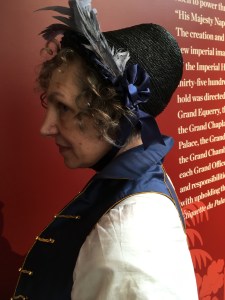
A purchased bonnet because it’s one I can’t make.
Buy what you cannot make. I thought I needed to make everything myself (with the exception of men’s hats and buttons) but that’s just not true. If you can’t manage fine sewing, buy a cap! If you hate assembling tricky things, buy mitts or a bonnet. I bought caps when I couldn’t make them as well as I wanted, and it saved me hours of frustration. I love flamestitch pinballs, but I can’t manage that needlework yet; lucky for me, I know someone who excels at it, so I can buy from her. Other people have skills, and buying things from them will save you time and frustration, so you can focus on what you really want to do.
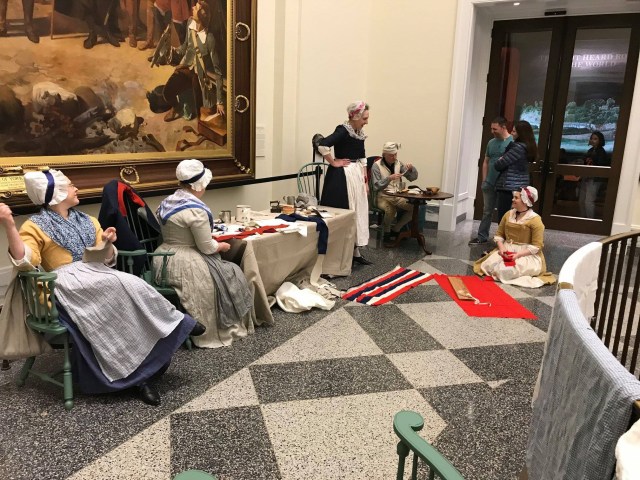
Saturday’s arrangement. Image courtesy of the Museum of the American Revolution
The biggest challenge in interpreting Rebecca Young and the shop she ran was not how flags were made (an appointment at the Cultural Resource Center of the National Museum of the American Indian answered that question*), but rather how to make sewing interesting, and how to create a more interactive experience for ourselves and for visitors. Some of my favorite living history experiences involve playing off other interpreters and the public, especially when trying to convince visitors to pick a side, carry a message, or share a secret. Saturday’s set up made that harder, with Rebecca’s shop of women behind a table (we wanted to be sure to be open to visitors, and not make the dreaded reenactor circle), and with Drunk Tailor rolling cartridges in a niche.
Nobody puts Drunk Tailor in a niche.
But what we saw on Saturday– a day with 800 visitors–was that boys between roughly six and 16 skipped from Drunk Tailor to the tailors, bypassing a table of women altogether. Older men (say, 45+) visiting alone also skipped our table, while the majority of our visitors were girls and women. This was not a surprise. Children begin to develop gender segregation around ages five to six, and sewing is often dismissed as “women’s work,” as the table of tailors experienced. These cultural biases were somewhat compounded by the nature of our work.
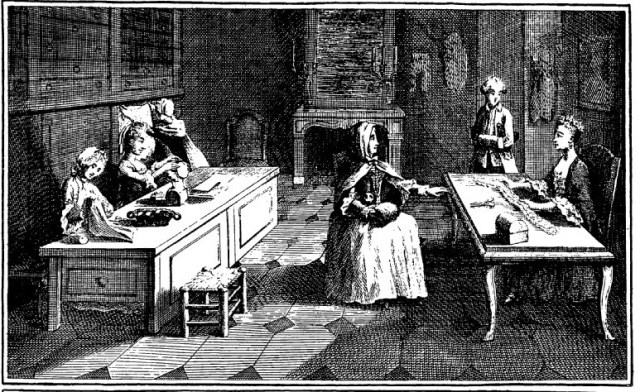
Tailor’s Art: Containing the men’s suits tailor, the skin breeches, the women & children’s body suit, the seamstress & the fashion merchant / by M. de Garsault, National Library of FranceSunday’s set up. Image courtesy of the Museum of the American Revolution
Sewing is one of those tasks that is downward-facing, internal, and meditative (until the thread tangles or snaps). It’s dull to watch, really; the exciting parts of sewing and making are draping, fitting, and cutting. Cutting. There’s something to that.
Combining the desire to interact more with our co-interpreters and the need to disrupt expectations of sewing, we rearranged the tables on Sunday, moving Drunk Tailor to our end of the atrium, postulating that his tea table and powder keg were in the yard of the townhouse, while we pushed our table closer to the tailors and against the railing, pulling our chairs to the side. We also draped shirts and fabric over the railing to display shirts and their component parts, along with bunting. While this “messed up” the atrium, it helped create a context for our work.
Sunday, workshops in a row (house). Image courtesy of the Museum of the American Revolution
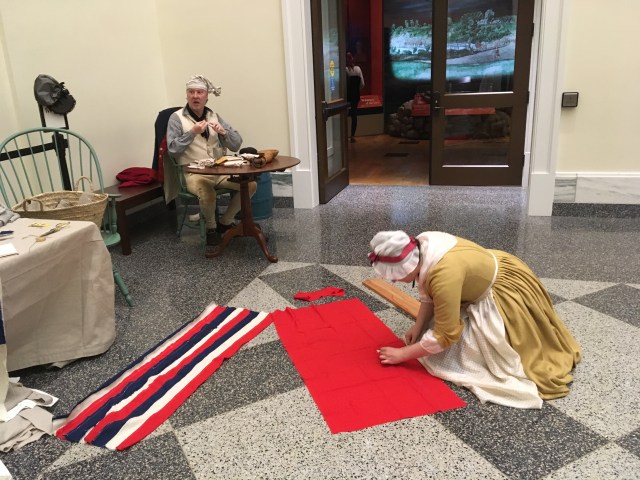
But the best, most participatory change was Mistress V cutting flag strips on the floor, with the help of two young boys. This literally disruptive activity (you had to walk around her) changed perceptions of what we were doing, and helped people imagine assembling a large item (a Continental Standard) in a small rowhouse room.
If we take the Betsy Ross house** as an example of a Philadelphia rowhouse, , its exterior dimensions, roughly 16 x 25, yield an interior per-floor area of not more than 400 square feet. The Star-Spangled Banner was 30 x 42 feet; a second “storm” flag was 17 x 25 feet, large enough to cover the floor of a room in Betsy Ross house.
Dining Table (drop-leaf, gateleg table), probably Pennsylvania, 1750-1770. Walnut, oak. Philadelphia Museum of Art, 1994-20-60
While we do not know the exact dimensions of the flags Rebecca Young and her shop produced, it seems likely that any flag would have exceeded the size of a domestic table, since even drop-leaf dining tables of the period are not usually more than 52” x 41” or about 15 square feet (4.3 x 3.5 feet). The limited size of the table, and the need for multiple feet of cutting space makes it likely that flags larger than 3 x 5 feet were cut and pieced on the floor.
This combination of thought experiment and interpretive change up was reasonably successful, giving us greater understanding as we talked about assembling goods in pieces and working in a small shop while interrupting the visitor’s expectations.
*More on this another time.
**You have to start somewhere– and while I’m on #TeamYoung when it comes to flag making, Rebecca’s rented house has long been razed.
Research and primary source materials on Rebecca Flower Young were provided by Matthew Skic of the Museum of the American Revolution; compiled information used by gallery educators at the MoAR was compiled and provided by Katherine Becnel of the MoAR.











 Kirsten Hammerstrom
You must be logged in to post a comment.