Making Plans….

I have set my sights on being at Van Cortlandt House Museum’s Second Annual History and Culture Fair on Saturday, September 21. This is a bit of a stretch: It’s farther than Philadelphia, where I’m scheduled to be the following weekend at the Museum of the American Revolution– and I want tweak that impression and its material culture a bit, too. Still: setting up a ca. 1777-1780 milliner and mantua maker or merchant display has been on my to-do wish list for years, and I’m pretty sure I can pull this off as long as I modify/upgrade items already in my closet.

There are enough images to provide good inspiration and ways to start accessorizing.

Several prints  from the British Museum provide guidance.

It’s clear– as I knew already– that my accessory game requires major upping. But this is solvable! It’s not ideal, being in a situation where I can’t buy new fabric, and I don’t have the time to make up the fabric I do already have in the garment styles I need. This is no time to start a new patterning project!

So this means making accessories to upgrade a gown and petticoat already on hand and known to fit (though they should be fit-tested once again before committing!).

Which dress? Why, Nancy Dawson, of course. She’s the brightest and most stylish gown I have. Thankfully, I have upgraded my cap collection, and could even– probably– manage a new cap in the time allotted.

So what do I need? A well-decorated, possibly floofier cap, a LBB (™) of the kind worn in “The Rival Milleners”, a breast knot or bow, a new fine silk or cotton apron, and some kind of sleeve treatment.

The maid in the back of “A Morning Visit,” carrying in the tea tray, demonstrates the more understated upgrades I think I will be able to manage in the time I have. In a year, a trimmed silk gown can happen. In a month, it cannot.

The main upgrade I’d like to make is to add a red silk quilted petticoat, since they appear in so many prints with cotton print gowns, including a print of Nancy Dawson herself.

Miss Nancy Dawson, aquatint print. Victoria and Albert Museum. E.4968-1968

I almost assuredly have red silk in my stash: the question is, can I find it, back it, and quilt it in time? Probably not. So there are choices to be made, like the sensible one of simply upgrading sleeve finish and apron and adding bow knots.

Those are just the upgrades I hope to make to my personal kit! I need a dome top trunk (underway; I need the one I have for Elizabeth Weed), and there are inventory items to make that have been on the list for a while.

All of this has to get done while I’m splitting my 55-60 hour weeks between commissions and a retail gig (which I am trying to streamline!).

Once again, I start down the path of madness. Won’t you join me? I think it’ll be a blast!

Women in Business


One of things I’ve struggled with in living history is reconciling my own life as a 21st century working woman and feminist with interpreting the lives of 18th century women.

Mrs. James Smith (Elizabeth Murray)
John Singleton Copley (American, 1738–1815) 1769

It takes a while– and a bunch of reading– to get past the notion that these women lack agency in their own lives. Sure, there are notable exceptions: Abigail Adams, Mercy Otis Warren, and Elizabeth Murray, but those wealthy Boston women aren’t the kinds of women I’m interested in portraying. What about more everyday women? What about the women more like me? They’ve proven harder to find, but not unfindable–though even they, by dint of being findable, are more exceptional than the vast majority of 18th century colonial American women.

Elizabeth Weed carried on her husband’s business as a pharmacist, noting that she “had been employed these several years past in preparing [his receipts] herself,” and was therefore well-equipped and trustworthy to carry on in his business. Rebecca Young advertised as a flag maker, and as a contractor, made flags, drum cases, cartridges and shirts for the Continental Army, thanks to her brother Benjamin Flower’s position as a Lieutenant Colonel.

In researching Elizabeth Weed, I read about other women running businesses in Philadelphia, and practicing as “doctoresses” in nearby New Jersey, demonstrating that Mrs. Weed operated in a context of other successful women, including some practicing medicine, or at least “medicinal arts.” What I would really like is to track down the records of a mantua maker or milliner in 18th century America, and not only because I make and sell gowns and bonnets, but because in doing so, I’m carrying on with the kind of work that my grandmother and great aunts did.

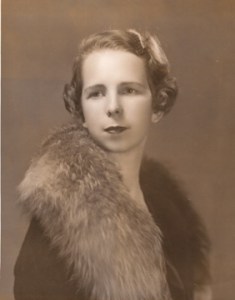
Elsa, Studio Portait ca 1935

For fifty years, my grandmother ran a dress shop in western New York state, dressing the women of Jamestown and the surrounding counties in fashionable and flattering clothes. My aunts made hats and accessories in their own shops, completing the look. I come from a family of makers (including a great-grandmother who made her own shoes), who care deeply about fit and helping people look and feel their best. My grandmother ran a successful shop for fifty years, until she sold it in the mid-1970s. I have many fond memories of sorting costume jewelry upstairs, and gift-wrapping boxes in the basement, with a rack of ribbons in all colors handy on the wall.

She was exceptional in her own way, though you will be hard-pressed to find much (if anything) about her on the interwebs, but maintaining a business through the Depression and World War II was challenging. She gave back, as a member of the YWCA and Women’s Hospital boards, recognizing the importance of sustaining the community you’re part of. When I portray Elizabeth Weed or Rebecca Young, or the Hawthorns of Salem, I think about my grandmother. Maybe it’s a step too far to say the living history work I do or the business I’ve started honors her and the other working women of my family, but I like to think that it helps make visible women who, though now forgotten, were as important to their own communities as she was.

A Little Black Bonnet


Practically everyone needs one, and like the Little Black Dress, the little black bonnet flatters practically everyone, too. In finishing up some inventory projects, I went back to basics and made up a black silk taffeta bonnet with trimming inspired by “The Rival Milleners.”

The Rival Milleners.

Really, it’s a look that’s hard to resist, the black bonnet with poufs and bows. I’ve always loved my black bonnets, but now I might need to trim another one up for myself– if I can only make the time. Up on Etsy if you want one for yourself (along with some other colors, too).

Living the History Life

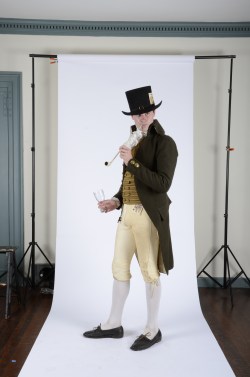
man in historical clothing smoking a pipe
Pre-event PR photoshoot. Photo by J. D. Kay

The recent BBC video making the rounds on social media got me thinking about how we live our lives, and what commitments we make to being our true selves, how we follow our bliss, if you will. It takes a lot of courage, willpower, and hard work to achieve one’s deepest inner dreams and although I have taken some steps towards mine, I have not let go all the way (as one does not when one is putting a child through college). 

I think about this desire to be true to one’s own internal vision, and I think about my friend Justin, who found a place and fell in love with what he saw, past and future. It’s hard work to run a farm and a business, but Justin does it beautifully, with grace and integrity. What he achieves makes me ache with want, not for the house, or the frozen cat’s water dish, or the work, but for the courage. 

Working with Justin pushed me into places where I found, if not fear, at least discomfort. As we said, It isn’t history till it hurts. The first What Cheer Day we ran, I remember standing behind the door on the second floor landing of the servants’ quarters, knowing it was show time. I looked at Justin and said, “What the hell have we done?” terrified to go out and “be” John Brown’s housekeeper. But, out we went, and it was amazing. That work inspired me to push myself harder, to try the things that scared me and made me uncomfortable. That’s where the meat is, and the truth: where things hurt.

woman and man in historical clothing looking at a book
The housekeeper was caught reading naughty novels. Photo by J. D. Kay.

As with all things I tackle, I could push myself harder, not to sew better or more authentically (that’s the easy part, really) but to live the way I want to, authentically. To decide what matters and what doesn’t, and stick to it. That’s the real lesson of these men, and why they’re inspiring. I just happen to prefer the one with mud.