Bellevue Avenue: in Newport, that’s a fancy street. I don’t spend much time on fancy streets anywhere I go, but I had a meeting at a museum on Bellevue so there I was, curving out onto the point on a wet, grey day that made everything look like a WPA photograph.
Newport, R.I.: Ochre Point, Cliff Walk. Library of Congress, LOT 9192. It can feel like Rebecca.
Bellevue runs down the eastern side of Aquidneck Island; the houses look out onto the water of Easton Bay, or across the street at each other, in the rare cases where they’re even close to facing.
It was a kind of mysterious trip; the rain curtained the street, hiding facades better than fences, and even listening to the kind of music I like, I could have slipped into an afternoon of pre-code films on TCM.
CALLBOX IN MRS. BERWIND’S BATHROOM – The Elms, Bellevue Avenue, Newport, Newport County, RI. Library of Congress, HABS RI,3-NEWP,60–29
There was a for sale sign on one property (Sotheby’s Realty, of course), and for an instant, I imagined walking into the house and owning it, starting a life completely different from the one I live, with different people and places.
Isn’t that what we do, or try to do, when we dress in these funny clothes and inhabit these historic places? We’re trying to slip the bonds that tie us to the mundane, quit the quotidian, and live a different life and time.
I wouldn’t want to live in the Elms or Marble House, but moments of imagining, and truly inhabiting, a different world are what make living history so appealing for interpreters and visitors alike.
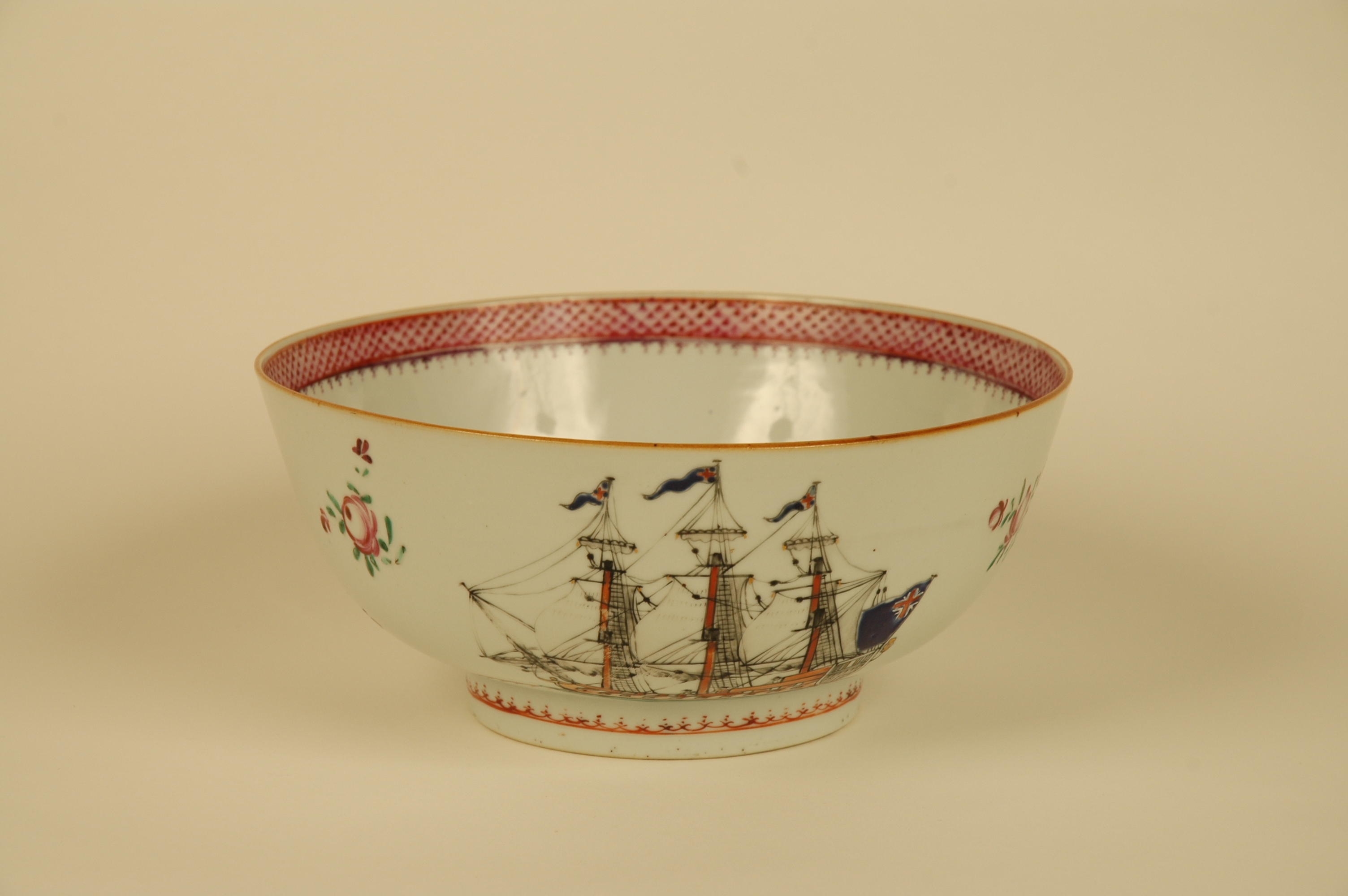
Chinese Export Porcelain bowl for the American market, 1790-1810. RIHS collection
I went to Newport yesterday for a History Space program on material culture. I don’t know why I was nervous, really, because I love stuff. I try not to accumulate too much stuff in my own life, and to be a careful curator, but really: beautiful objects make me really happy, and I love talking about “the thingness of things.”
Living history is fun for me for a lot of reasons, some esoteric and personal. I spent a lot of time in school thinking about images of America, and what they meant (it was the age of semiotics and Derrida) so creating living history personae and clothes and based on images and research is a way of making art of history, or else dressing up in funny clothes and enjoying loud noises.
Historical research is most fun when it asks questions– the journey is as good as the destination–and there are good questions to ask the things you carry with you or use in living history. (They’re probably good to ask if you’re in a mood to downsize at home, too.)
What is it?
When was it made?
Who made it?
What is it made of? Where did the materials come from?
Where did you get it? When did you get it?
How does it work, what does it do?
What does it mean to you?
If you can answer those questions, you’ll be a lot closer to knowing the why of what you have.
It’s the stories we tell about our objects that give them meaning: sometimes it’s who made or used a thing, sometimes the story has a meaning that you can’t tell from the object itself.
Think of this: I crossed the Pell bridge last night to come home, the road climbing into a storm cloud, the car lashed with rain and wind on a road surface daguerrotype-reflective and hard to read. The buffeting gusts on the car reminded me of the carpenter who didn’t like crossing the bridge to work in Portsmouth. Still, he told a story about crossing the bridge in storm on a motorcycle, with a girl riding behind him. The wind would rise, you’d both get scared, and she’d squeeze closer. He shivered inside his t-shirt as he told the story, with a tiny smile, and you knew he’d gone to Newport in that weather, on that bike, with that girl, on purpose.
You’d never get that story just from a jacket, a helmet, or a bike, but somewhere, there’s a object tied to that story.
Where will you be on March 28th, now that the LTB muster is cancelled? How about HistoryCamp 2015? You can register here for free if you volunteer or for a nominal fee otherwise.
You can check out sessions here, but I know there’s a really good one on living history…because I’ll be presenting along with Elizabeth Sulock of Newport Historical Society in the Risky Business: Living History Events in Tradition Museums session. There’s a lot of other good stuff, too, so if you’re in the area, why not register so you can check it out?
I wrestle a lot with myself, which sounds much sexier and more athletic than it is, when it’s your patience and conscience. It’s a constant fight with my own brain and animal nature, like Snowy pondering a bone.
It’s hard to keep sewing for an ever-taller young man who refuses almost all attempts at fitting. (Especially when your calloused fingertips and split thumb keep catching on the silk buttonhole twist.)
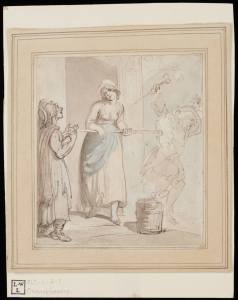
It’s hard to have program ideas and then realize you will end up as the maid, serving a meal to a group including some people you might not like. (Don’t you think that must be a fairly authentic emotion, historically?)
It’s hard to put aside plans for your first pretty silk dress because someone doesn’t want to go where you want to go.
It’s hard to embrace the importance and meaning of interpreting the ordinary in a culture that celebrates the unique.
I come to that and stop: mission.
Watercolor by Thomas Rowlandson, 1785? Lewis Walpole LibraryDrawings R79 no. 7
You can take anything too far, of course, and an occasional silk gown and turn around a dance floor might make being the maid a little easier, but in the end I know that what’s important to me is representing the people who have been forgotten.
That same impulse may be part of what drives the splintering into ever-smaller groups with every-different coats, but walking the cat back also leads me to think that lace, tape, and shiny buttons may be part of the equation, too. Are those uniforms the gents’ equivalent to cross-barr’d silk sacques? As in any culture, it is easier to have your cake and eat it, too if you’re a guy.
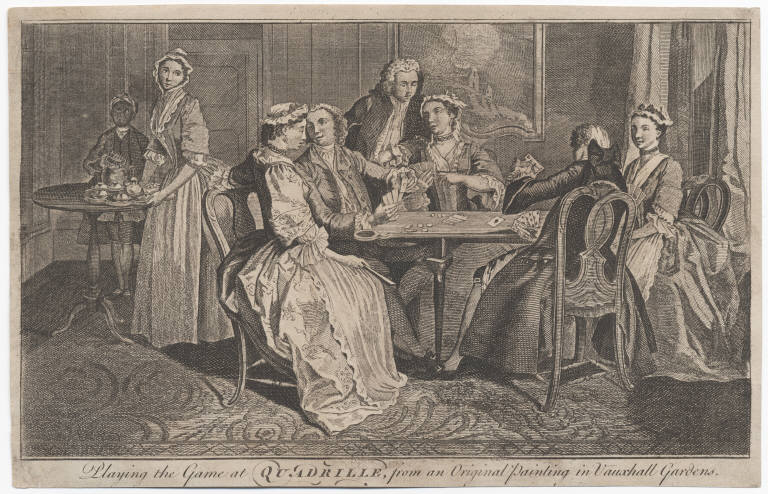
For most of us women inhabiting the past, if we’re not baking cake, we’re serving it.
Playing the game at quadrille : from an original painting in Vauxhall Gardens. London : Robert Sayer, ca. 1750. Lewis Walpole Library, 750.00.00.14
It’s a funny thing to want a break from work you find important, but as with anything, variety and perspective are important.
She looks wistful, doesn’t she? The others are whist-full.
In a world of individualists, each trying to stand out, quotidian celebrities– cast a skeptical glance at your social media feed and tell me I’m wrong–our impulse may not be to inhabit the background. But most of us are the background. We’re large only in our own minds, stars of the movies of our lives that flicker past our eyelids. And that’s ok: that’s noble, even, to live a small, thoughtful life.
Silver Pocket Watch of Meriwether Lewis, 1936.30.5
Once upon a time, when I worked in Missouri, I was fortunate enough to spend a lot of quality time with some amazing artifacts.
Meriwether Lewis’s refracting telescope.
William Clark’s compass.
Meriwether Lewis’s pocket watch.
William Clark’s Account with John Griffin for thread, cloth and other articles including a hat for George and shoes for Mary. (July 1820, William Clark Papers, B13/F5, MHS)
Account of expenses in “horse keeping,” 1829- 1831. Request to Clark to pay to Mrs. Ingram, with request to serve as receipt. On same document: ADS Dashney to Major Graham, 26 June 1826. Order to pay William C. Wiggins. (1831 Dec 13, William Clark Papers, B14/F2, MHS).
There are letters to one of Clark’s sons, trying to get him to stay at West Point. There are bills for bolts and iron work for Clark’s house. Yes: there are amazing things in the collection as well, and historians of all kinds can do amazing work in the papers.
But they are ordinary. They are daily life played out in the first third of the nineteenth century in St. Louis, bills and accounts punctuated by letters from famous people and news of wars and explorers. But after processing the family’s collection, what struck me more than anything was how ordinary they were, how quotidian.
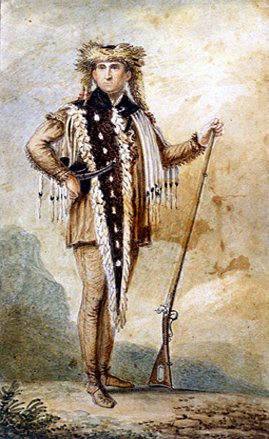
Meriwether Lewis in Indian dress. engraving after St. Memin, 1807.
Lewis was fabulous, interesting and mysterious. I don’t know what really happened on the Natchez Trace, but I know what happened in St. Louis. William Clark kept living, paying his bills and stumbling sometimes, refusing a role as territorial governor before accepting it. He got boring. And for that, I love him more than Lewis.
There’s real value in interpreting the everyday, ordinary people, in bringing work and working people to life in the past. I don’t always love repressing my ego, but I know that a nostalgic view of the past can be dangerous. I meant backwardly aspirational when I first wrote it, and I mean it now: most of us would not have been merchants wearing silks and velvets and superfine wools.
After wrestling with my ego and silk dress disappointment most of this afternoon*, I’ve found satisfaction in the thought of expanding my understanding of working class women. If really digging into interpreting the world of the marginal makes me uncomfortable, it must be worth doing, and doing well.
*Thankfully whilst performing useful tasks like running errands and thus wasting little real time on this nonsense.

![Marble House, Newport, R.I. Bain News Service, Glass plate negative, 1910-1915. Library of Congress. LC-B2- 3547-5 [P&P]](https://kirstenhammerstrom.com/wp-content/uploads/2023/03/e9e65-marble-house.jpg?w=640&h=464)






 Kirsten Hammerstrom
You must be logged in to post a comment.