Hot Topic

I’m of an age (none of your beeswax, thanks for asking) where most of the clothes in the shops are simply not for me. Not only am I picky about labor standards, fabric and construction quality, the styles aren’t for me. I’m too old. I create enough havoc walking (falling) down the street as it is that I do not need to look like the mid-life crisis I’m having involves a desperate search to recapture my youth through H & M or Hot Topic or whatever-the-kids-are-wearing clothing. I’ve achieved “a certain age,” and as with my everyday closet, my living history wardrobe has to reflect my age as well. Pity, really.
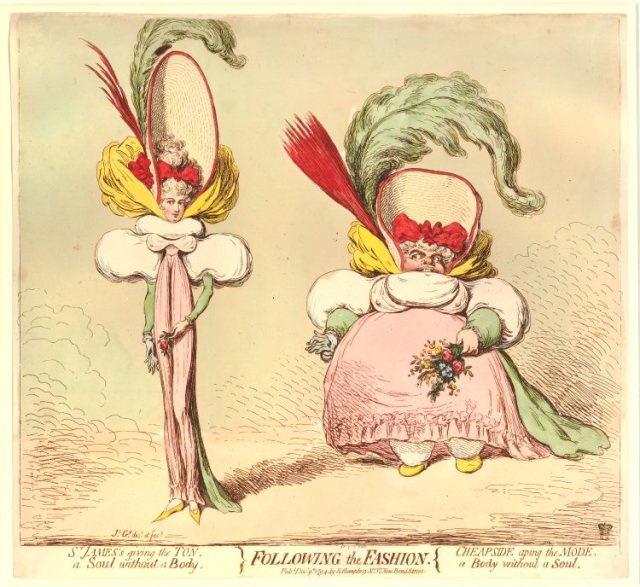
Following the Fashion. Hand colored etching by James Gillray, published by Hannah Humphrey, 1794. British Museum 1851,0901.706

But more’s the pity here: I don’t have a clear idea, really, how age was perceived in the various decades I interpret. I have a clearer idea of how different body shapes and class levels were perceived and taunted, though sometimes body shape is an analogue for age.

Is this my daughter Ann? Pen and ink print study by Samuel Hieronymus Grimm, 1774. British Museum 2011,7084.56

There’s a classic image that juxtaposes age and youth.  Here’s how the British Museum describes this image:

‘Is this my Daughter Ann?’; satire on fashion. A street where, before a house [on the right], over the door of which the name ‘Love Joy’ is written, a sedan chair has been brought, in order to carry away a young lady, who, in a towering toupée, and other articles of fashionable attire of this period, is leaving the house in company with a young soldier, who caresses her as they go; she looks fondly at him. An old woman, in what was then an ‘old-fashioned’ costume is interposing to prevent the departure of the damsel. 1774

Okay… “An old woman, in what was then an ‘old-fashioned’ costume.” You will note that the old woman is wearing what we typically wear here in New England to represent everyday clothing for middling and lower sort American colonists for most of the 1770s. I don’t want to put too much stock in the cataloger’s description, because I’m not sure that print curators or curatorial assistants always know as much about material culture as they think they do. And we know that six weeks is not six years when it comes to transmitting fashion changes and updates across an ocean. I think “old fashioned” might not be exactly or entirely right as a descriptive phrase.

What does the old woman’s clothing really signify? That she’s rural and not urban? That’s she’s poor? That she’s old? How ‘old fashioned’ is that costume by 1774… in a context other than London courtesan couture? And how do we translate the clues we have trouble deciphering into a dress code for living history?

Is this my Daughter Ann, mezzotint by James Watson after S. H. Grimm, published by Sarah Sledge, 1774. British Museum J,5.104

Well, happily, there’s a verse under the image in this print.

Is this my Daughter Ann

The Matron thus Surprised exclaims,
And the deluded Fair One Blames
But had the Mother been as Charming

She had Thought the Mutual sport no harm.
This Moral’s an undoubted Truth
Age envies Still the Joys of Youth

So this print is not about fashion. It’s about sex. (Well, duh. You were wondering when I’d bring that up.) It’s also, in a way, about hypocrisy, isn’t it? But the verse gives us the clue that the mother’s clothes are meant to be matronly.  “Conservative because of her age” might be a better descriptive phrase than “old fashioned” in that catalog record.

But does that mean that those of us who have achieved “a certain age” might also consider whether we, too, should be dressing in a more “conservative because of her age” style? I don’t really know.

But look here: Zoffany, ca. 1762.

David Garrick and Mary Bradshaw in David Garrick's "The Farmer's Return". Johann Zoffany, ca.1762. YCBA B1981.25.731
David Garrick and Mary Bradshaw in David Garrick’s “The Farmer’s Return”. Johann Zoffany, ca.1762. YCBA B1981.25.731

Here we’re looking at a rural woman ten to twelve years before “My daughter Ann.” The costumes are very similar; maybe the mother in Ann really is just old fashioned.

Here’s another version of “My daughter Ann,” this time more clearly fashion focused, without the sexual overtones.
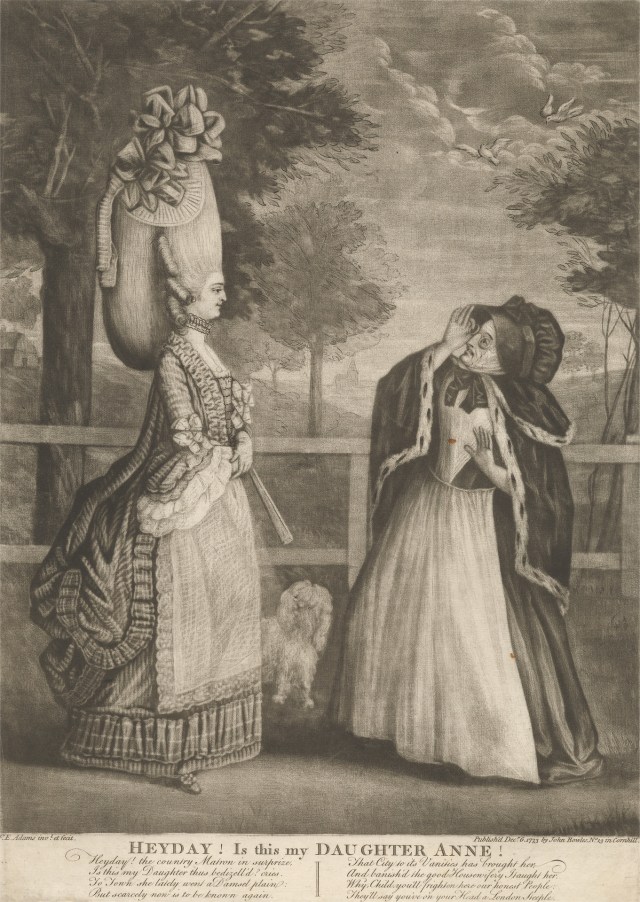
Print made by Francis E. Adams, active ca.1760–1775, British, Heyday! Is This My Daughter Anne!, 1773, Mezzotint and etching on medium, moderately textured, cream laid paper, YCBA, B1970.3.820

Yale helpfully provides a transcription of the verse at the bottom:

HEYDAY! Is this my DAUGHTER ANNE! | Heyday! the country Matron in surprize, | Is this my Daughter thus bedizell’d? cries. | To Town she lately went a Damsel plain: | But scarcely now is to be known again. | That City to its Vanities has brought her, | And banish’d the good Housewifery I taught her. | Why, Child you’ll frighten here our honest People: | They’ll say you’ve on your Head a London Steeple.

My best guess is that this print is skewering both Anne and her mother: Anne, for being so outlandishly fashion-forward, and her mother, for being so far behind. But again, that’s only a guess.

Women’s Lives in Early America: Symposium

Eventually, the to-do list will catch up with you. Vague ideas about things you’d like to make turn into thoughts about why you don’t have whatever the thing is. Dreams of summer are supplanted by the nagging of cold feet– I failed to take my own advice last Friday, for once, did not wear wool socks or stockings.

But beyond cold feet, I find the end of January to be when distractability kicks in: too many ideas! Too many desires! Too many things I want to do!

One of the things I agreed to do, and to which I am really looking forward, is this:

Beyond Boom-Boom Sticks & Fancy-Dress Balls:
​Women’s Lives in Early America

12540948_804654542978767_8510278909445058027_n

You can learn more about the presenters here, and register here.

For me, winter is a time to revamp my wardrobe and interpretations, rethink my accessories and objects, and get ready for a busy living history season.  This will be a learning experience for me as much as anyone else: another chance to interrogate, rethink, and reconsider what I’m doing, and why.

Transparent Visions

With armloads of cash, the NPYL has, as I’m sure you know, digitized thousands of items which are now available on a ridiculously procrastination-worthy (it’s research, I tell you) site.

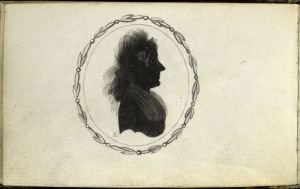
Carl H. Pforzheimer Collection of Shelley and His Circle, The New York Public Library. (1795 - 1834). Portrait silhouette.
Carl H. Pforzheimer Collection of Shelley and His Circle, The New York Public Library. (1795 – 1834). Portrait silhouette.

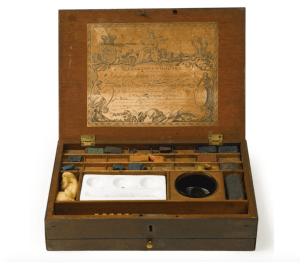
In my current quest for watercolor boxes and miniature inspiration, I found the Anne Wagner album particularly interesting. The pages in the book compile verses, mottoes, collages, locks of hair, and a portrait silhouette. In all likelihood, Anne Wagner had a watercolor box not unlike this one coming up at Sotheby’s on Thursday.

Lot 738, Sotheby's Sale N09466 REGENCY MAHOGANY PAINT BOX BY W. REEVES & WOODYER, FIRST QUARTER 19TH CENTURY
Lot 738, Sotheby’s Sale N09466
REGENCY MAHOGANY PAINT BOX BY W. REEVES & WOODYER, FIRST QUARTER 19TH CENTURY

Every young lady of some means would have had a watercolor box suited to her station (they came in a variety of sizes), and young ladies with leisure time occupied themselves with diaries, commonplace books, amateur silhouettes, and paintings. Diana Sperling is one of the better-known examples of amateur artists, with drawings occasionally appearing at auction. The best of these watercolors give us a literally transparent look at the long 18th century from inside.

 May 25th. Henry Van electrifying - Mrs Van, Diana, Harry, Isabella, Mum and HGS. Dynes Hall.
May 25th. Henry Van electrifying – Mrs Van, Diana, Harry, Isabella, Mum and HGS. Dynes Hall.

Museums try to connect the people of the past to the people of the present, and sometimes in focusing on similarities critical differences are missed.

It’s not just that the people of the past accepted racism, slavery, and sexism. They literally saw the world differently. I’ve watched contemporary amateur artists try to recreate the imagery of the past, and it’s hard. I wonder, as I try my own had at the task, if we can manage it. Color sensibilities were different; taste was different (checks from hell, remember?). My own style is more graphic and bold than an 18th or 19th century artists’– more Fairfield Porter than Edward Malbone.

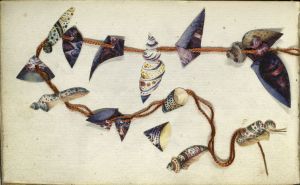
Carl H. Pforzheimer Collection of Shelley and His Circle, The New York Public Library. (1795 - 1834). Threaded shells.
Carl H. Pforzheimer Collection of Shelley and His Circle, The New York Public Library. (1795 – 1834). Threaded shells.

We are, each of us, products of our environment and our time. Can we really recreate the past? We can dress correctly, carry the right stuff (or almost no stuff at all), but how can we overcome our own thought barriers, our own vision? I think it’s by attempting that effort that we can do better at replicating the past whether we try in four dimensions, or in two– and acknowledge the unbridgeable gap to the past.

Mr Hiwell Chased by a Chihuahua, and Other Minor Disasters

Of course we can read maps. GPS has not spoilt us at all.

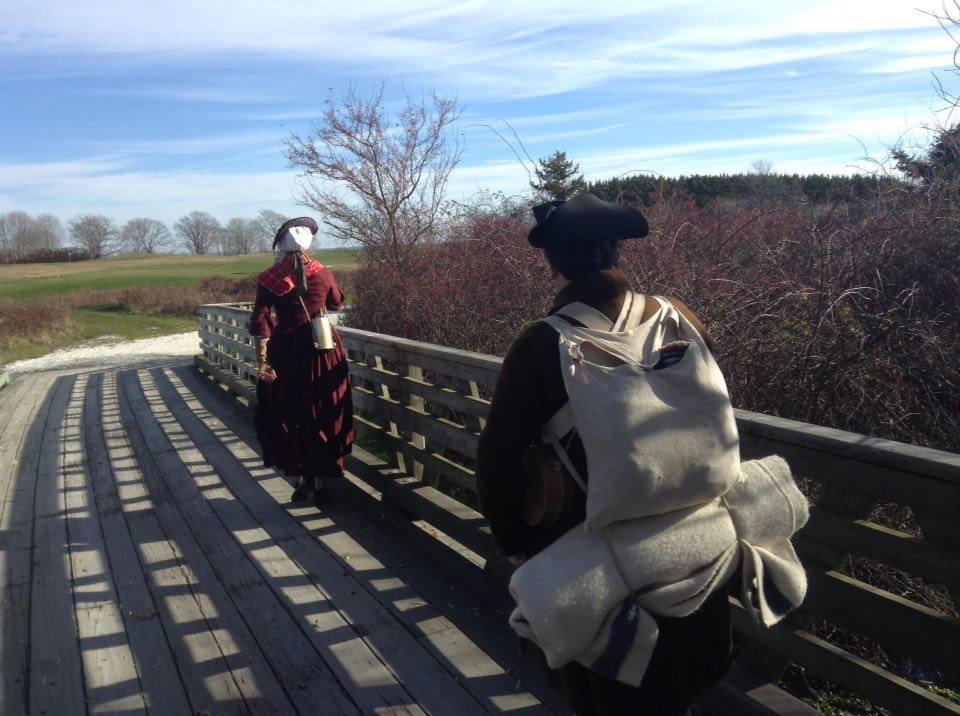
Bored over the Thanksgiving holiday weekend and possibly jealous of images we might have seen on social media, Mr HiWell, Low Spark, and I concocted a plan. Or perhaps I made a suggestion that seemed like a good idea at the time. Screen caps of message threads indicate that I probably was the root of the evil of getting up early Saturday morning to put on historical clothing and take a multi-mile walk.

File_006

We know it was at least seven miles, and may have been nine…we went off the trail in a couple of places. But the lads are going to Trenton, and need to get in some walking time, and now that it’s shotgun deer season, the number of places we can safely hike are fewer. There’s no blaze orange in broadcloth– yet.

And this wasn't the squeeziest photo op.
And this wasn’t the squeeziest photo op.

The walk began harmlessly enough, through corn fields and brush. We forded a stream the easy way (I suggested fording a la the 40th but the lads opted for the bridge.) The Sakonnet Greenway Trail maintained by the Aquidneck Land Trust is pretty mellow. Flat (unusual here), relatively free of traffic noises, and used by dogwalkers, it seemed safe. Then we met the golfers as the trail skirts the edge of the Newport National Golf Course. We were too nice and said yes, they could have photos with us. Of course, they had clubs and we didn’t.

File_002(2)
We could have ridden in style.

When we went off trail to loop up to East Main Road, we encountered many homeowners and many barking dogs. When we told one woman we were off to a Paul Revere and the Raiders tribute band concert, she noted that “the kicks get harder to come by.” Further on up the road, two boxers charged the fence that enclosed their yard, startling us– but the real danger came from the chihuahua that charged up the road after us, barking madly. The children’s rhyme about “the beggars have come to town” seemed all to relevant.

The Kitty Who Walked Alone

By the end of the walk, there were many references to Captain Sobel and Currrahee, though I thought more of Rudyard Kipling’s The Cat That Walked By Himself.

But when he has done that, and between times, and when the moon gets up and night comes, he is the Cat that walks by himself, and all places are alike to him. Then he goes out to the Wet Wild Woods or up the Wet Wild Trees or on the Wet Wild Roofs, waving his wild tail and walking by his wild lone.