A Tisket, A Tasket: What Basket?

Nancy had a great question: What did middle class ladies use to carry their shopping?

But here’s the thing: they didn’t carry the shopping, because they didn’t do the shopping– not the big shopping, anyway.

La Pourvoyeuse, oil on canvas by Jean-Simeon Chardin, 1739. Louvre Museum.

La Pourvoyeuse by Chardin shows a woman returning from market in 1739. No basket. A bundle or bag with a fowl in it, head down. Unwrapped loaves of bread. But clearly a servant.

From waste books, it’s pretty clear that people are sending their “boys” and “girls” (servants or slaves) to fetch liquor. That will come home in bottles, like the ones at the feet of La Pourvoyeuse. And I think it comes home just in their hands, but perhaps- and more likely not– in a basket. A floppy basket, usually for floppy birds.

Balthazar Nebot, active 1730–1762, Spanish, active in Britain (from 1729), Fishmonger's stall, 1737, Oil on copper, Yale Center for British Art, Paul Mellon Collection
Balthazar Nebot, active 1730–1762, Spanish, active in Britain (from 1729), Fishmonger’s stall, 1737, Oil on copper, Yale Center for British Art, Paul Mellon Collection

Baskets have come up before. So this is part of a larger argument. Mostly, we see servants marketing. Middle class ladies certainly shop– what is the class level of this woman (above)?— but so many things can be delivered, or are peddled door-to-door, and servants are so common, that I think we don’t yet fully understand shopping in the 18th century.

After the meteoric rise of consumerism, after department stores, yes: shopping is more like what we do. But in the pre-ice box and pre-packaged era, meat cannot be bought and frozen, and milk will not last all that long. Things were brought home one at a time, or a few at a time, many times a week. And middle class ladies bought small things– ribbons, almanacks, shoes– and bring them home in their pockets, just in their hands, or, I would guess, wrapped in a bundle of paper (a pair of shoes) or in a band box (a bonnet) if the things are not delivered.

A long winded way to say, I don’t know: but I’m pretty sure middle class ladies sent their servants out frequently so the ladies didn’t carry baskets and the servants used bags, aprons, and their hands.
Frivolous Friday: The Pabodie Project

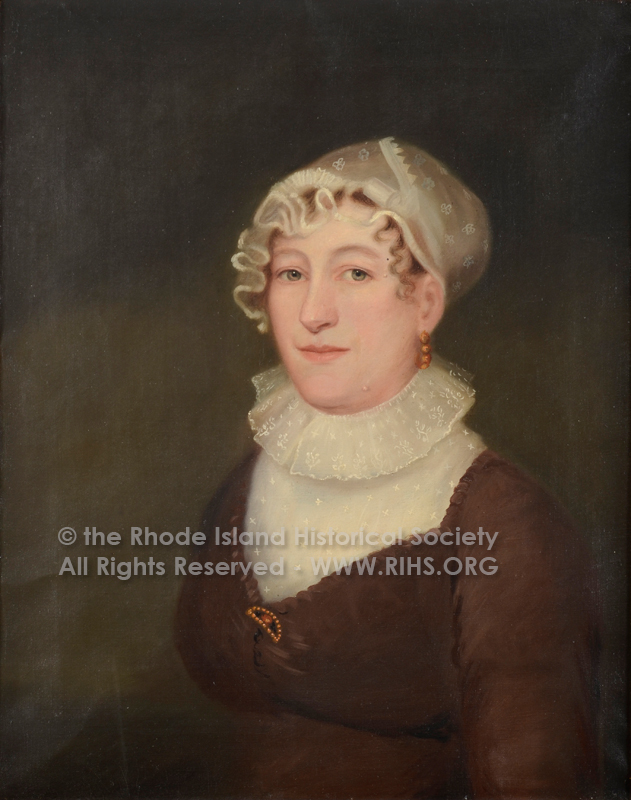
Mrs William (Jane) Pabodie. oil on canvas, 1813. RIHS 1970.60.2

Jane Jewett Pabodie, born around 1771, died 23 March 1846 is buried in Swan Point Cemetery on the Seekonk River in Providence. She was the wife of William Pabodie– which one? Well, it’s hard to tell until I really dig into the genealogy. At the moment I am so besotted with this image that all I can think about is what she’s wearing!

What she’s wearing….about that. I have some work– and some thinking– to do. The cap is slightly confounding. It’s a chance to learn a great deal more about early federal caps, which is good. I don’t understand it, which is unfortunate. The asymmetrical nature of the cap is new to me- or at least I cannot think of another example, so feel free to school me, people. But really: it is asymmetrical! With a ruffle on what is the right side of her head, and a… pinked? Van Dyked? Prairie pointed? band that runs from her left ear around to the back of her right ear? I’m confused. It would make more sense if the cap had slipped, but why would the Pabodies pay for a painting that recorded such a thing?

Honestly, I think the only way to really understand the cap is to make the cap. In muslin first, thankyouverymuch, I’m not that crazy.

Detail, Mrs William Pabodie. Oil on canvas, 1813. RIHS

The chemisette is more straightforward, being made of a sheer figured or embroidered cotton with a slightly gathered collar embellished with floral whitework embroidery. That I think can manage, at least in the basic construction (fabric, well, I’m looking).

Of course, why do I feel the need to manage all of this, with a deadline now less than eight weeks away? For a program, of course– I have only to write the copy for it. The idea (for me, anyway) is to replicate a portrait as closely as I can. Now, Mrs Pabodie and I are not exactly the same age, but I think I can pull this off…the cap, more troubling.

It’s an interesting project for me, not so much from the sewing point of view, but from a conceptual standpoint.

How close can I get? What does exactitude mean?

If I want to represent a character, what’s more important: understanding the clothing, or understanding Jane Pabodie? Constrained as I am by modern materials, unable to match these exactly, how do I navigate choices based on suppositions of what an artist meant to represent? Just my kind of conundrum.

Mop It Up

"Useful occupations: Women's work, sewing, spinning, washing, ironing etc," illustration from Basedow's 'Elementary Work', 1770. Etching by Daniel Chodowiecki — at LACMA
“Useful occupations: Women’s work, sewing, spinning, washing, ironing etc,” illustration from Basedow’s ‘Elementary Work’, 1770. Etching by Daniel Chodowiecki — at LACMA

Mrs. Boice is at it again, folks: you can register now for a workshop in just a few weeks where you can learn more than you thought you’d ever want to know about getting ready for winter, laundry, caps, games, and dancing. Thought honestly, I think you can never know too much about these things, which is why I keep trying!

Yes, it’s what I think about: how did women prepare houses for winter? How did they get things clean? It was a lot of hard work, and is often underrepresented in historic sites both domestic and military.

You can learn more about the weekend online or download the detailed flier.

Filthy Friday: Rolling with a Purpose

“It looks like you rolled in dirt,” I said to the Young Giant when he dumped a gritty mess on my lap.
“I did,” he said, “but it was rolling with a purpose. We dug a fire pit, and then I had to keep the fire going. So I was on my belly in the dirt.”

file_000

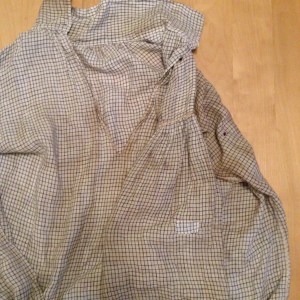
This was followed by, “Mom, you need to mend my shirt.” But first, I needed to wash that shirt.

file_004

I’d like to wash that shirt right out of my hair, but there it is: it’s got to be attended to.

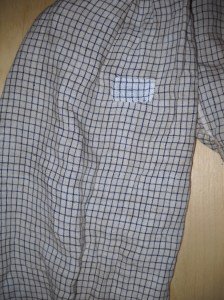
I did what mending I could before I washed it, since some areas seemed more likely to disintegrate further in the wash.

That’s clean linen verus dirty linen, the 18th century wrestling match. Patch secured, I very nearly packed this into a priority mailing container for delivery to the esteeméd Red Shoes Laundry, but I took a deep breath, and put the lobster pot back in the cupboard. (Yes, I considered boiling this on my stove top on a 95° day. Wouldn’t you?)

Instead, I trekked down to the cool of the basement and ran the water as hot as it gets and added Oxiclean (used by some of the finest weavers I know when they encounter dyes less fast than anticipated.)

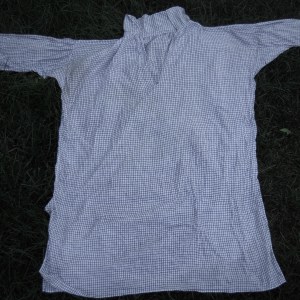
The first tub achieved a kind of colloidal slurry of mud and sweat and soap. Delicious. Five rinses and an overnight soak later, dirty shirt became just a shirt again.

file_008

I took advantage of the clear weather to dry this outside on the grass, hoping the later sunlight would aid in whitening.

Wondering about that patch? Wonder no more, compare:

It’s another one of those “is it done? it’s perfect” situations. I’d love to wash my clothes with historically correct methods, but for now, the shirt’s clean enough for final mends and wearing in October. The winter should give me time to figure out stove top washing.