Stick-to-it-iveness

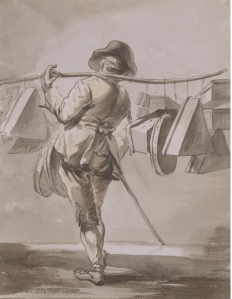
Band Box Seller, pen and watercolor by Paul Sandby, n.d. The Huntington Library, Art Collections, and Botanical Gardens, 67.18

It has been a long time since I participated in a traditional “reenacting” event, the kind with tents and pew and kettles and a TWD but here we go, borne back into the past to where it all began, more or less. I remain as uncomfortable as ever in the camp follower role, constantly questioning the likelihood of my being a follower, and the activities I would participate in. It’s a historical personality disorder, trying to figure out who one was, complicated by all the modern politics of gender roles, relationships, and unit rules.

Now that I’ve switched sides, Bridget Connor is no longer open to me. By nature I’m a townie, happiest in a mercantile endeavor if I’m not able to take on the role of an officer’s servant.

So what to do? Petty sutlery is much on my mind, for I have need of the money and a habit of making things. Lately, i’ve been band-boxing, so I was delighted to find the Huntington had digitized this Sandby drawing of a band-box seller, placing the trade firmly in the middle of the 18th century. Triangular boxes for cocked hats, circular boxes for bergeres, rectangular boxes for gloves and (neck)handkerchiefs, I presume.

I’ll have band boxes and a bonnet or two in addition to a custom order delivery, coral, glass, and garnet necklaces for girls and women, pincushions, handkerchiefs, possibly garters, and, if my hands hold up, boxes for hats and bergeres, all on a stick. Look for me between the 17th and the 7th, hindering or helping laundresses.
Reap what you Sew

Too big!

Lampshade: She’s been the Holy Grail of bonnet making.

There were several failures in the winter of 2016, and some revisiting of the Whale-Safe Bonnet as I tried to figure out the brim and the caul. My first efforts made a caul that was waaaaay too small. That’s not necessarily a bad thing, as I’ve made plenty of too-big bonnets. (Too small did not make the move from RI to VA, but trust me: too small a caul was far too small.)

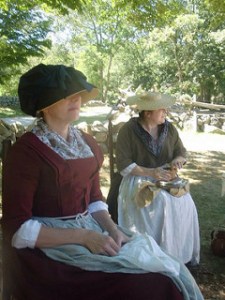
This morning, I took another look at George Stubbs’ paintings of working women. I know the lampshade-like bonnet is pre-1770, but where are we at the end of the Revolutionary War period? Well, BIG was in, obviously. (We can have a healthy debate about the likelihood of these gowned women depicting actual working women, but for now, let’s stick to bonnet brim shapes.)  They’re a little cone-like, aren’t they? With generous (yuuuge) cauls, though.

Now, I have gone about this all a bit backwards, which is to admit that I picked up the shellacked brim of yesteryear that did make the move down to VA, and decided to make it up as a bonnet yesterday. The brim is easy– trace and cut with a seam allowance– but the caul? I winged it, using a selvage edge for the inside of the back drawstring (I like my headwear to be adjustable and pack flat) and economized on fabric to leave plenty of taffeta left over. So there’s nothing particularly well-researched about this, except for all the years of looking and thinking and drawing and making that came before the moment I threw this all together yesterday afternoon watching North by Northwest and drinking a Manhattan.*

Making this up raises more questions: how individually fitted were bonnets to wearers? Did caul and brim size vary depending on wearer? What’s the class line below which a woman doesn’t have a bonnet, but only a hat? How quickly did styles change? The sort-of-conical black bonnet is seen on “older” women in paintings well past the height of the style. But as I’ve asked before, what do we really understand about the portrayal of age in art? Are we really reading the symbols correctly? How well do we grasp the semiotics of the 18th century? All of those questions are present when we try to replicate the past using only visual sources. Yes, there is an extant 18th century black silk bonnet at Colonial Williamsburg, and we can use that in conjunction with images to make the things we wear. But pondering all of these questions makes me think it’s time for another troll through collections in Great Britain, just in case new cataloging has put old bonnets online.

*See my other blog, TipsyMilliner, for more.

Milliner’s Shop Redux: A big, visual project

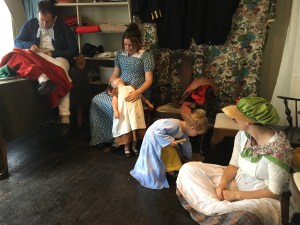
The complete ensemble, under supervision.

When I first moved to Providence, I lived in Fox Point, a slightly fringy-dingy neighborhood of Portuguese and Cape Verdean immigrants and their descendants that was cheap enough for students (and even today remains imperfectly gentrified: Providence, I love you dearly). As my then-boyfriend and I walked my dog, we passed a man whom I later came to know as the Block Captain, who remarked to my boyfriend, “Beeg wooman.” Any project I take on is, therefore, big, since I am nearly six feet tall.

Although I have schemes for a Big New Century Project (a complete 1585 ensemble), I’ll take a shortcut instead to my current enthusiasm and write about last weekend and the 1811 fashion plate reconstruction, which happily includes one of my favorite visual sources, early 19th century fashion plates — thanks to Scene in the Past’s albums and Ackemann’s Repository on the Internet Archive.

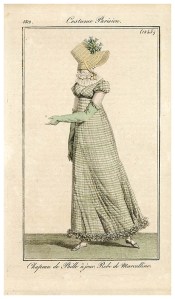
I’ve written about the canezou plate before, but not since I (mostly) completed it on the trip up to Salem. This 1811 plate appealed to me first because of the bonnet (checks!) and the necklace (lapis!), but then realized that the canezou and its petticoat were within my ability to complete.

The ensemble also seemed suitable for a summer day in Salem, which, while usually more humid than hot, calls for cool, lightweight, clothing that can withstand a potentially sweat-drenched day without melting.

From start to finish was three weeks: canezou, bodiced petticoat, necklace, bonnet, and shoe trims, all a vernacular rendition of a high-fashion image, adapted to the materials at hand– though I did have to order bonnet taffeta from India, which arrived just in time– much faster than I could have expected in 1811 Salem!

Setting up the shop for the fourth time was as much fun as the first time, and a little easier, given the practice I’ve had. I shared the shop with a tailor, Mr. B, of hat-making renown which made for a nice contrast interpreting men’s and women’s fashions and purchasing habits.

Packing up hat stands, bonnets, accessories, and furniture and driving them 470 miles is a kind of madness, but interpreting women in business and early shopping is one of my favorite historical enterprises.

To Name a Thing is to Know theThing: Vocabulary Exercises

Today’s CoBloWriMo prompt is vocabulary, which in my case usually means blue, NSFW, or unprintable in the New York Times according to their Style Guide, (but now OK in the New Yorker, thank you Tina Brown).

Captain Haddock proclivities aside, I find myself trying to remember to use period-correct terms as I work, which means trying to figure out what the terms mean. It isn’t always easy, but there are number of printed and online sources.

Here, for example, is the Robe de Marcelline fashion plate I’ve been obsessed with since at least 2011, when Sabine made hers. I finally tracked down some dark green gingham fabric in Framingham, but, d’oh! It’s cotton and not marcel(l)ine.

Google Books provides many useful lookups, through dictionaries and, best of all at the moment, The Dictionary of Fashion History, which helpfully illuminates marceline as “a brilliant but slight kind of sarcenet.” That helps narrow down “lining fabric for women’s clothes,” and confirms that this is a lightweight, probably plain weave, silk.

That doesn’t solve my fabric issue, but given that I am still lack full-time work outside the house, Imma stick with my remnant table cotton. But at least I know what I *should* be using, and have expanded my vocabulary along the way.