There is Power in a Union

Most readers know that I have a fairly extensive museum background: my entire working life has been spent in museums. Over twenty-six years (right outta school, folks–this is the only life I’ve ever known), I worked my way up from Curatorial Assistant to Director of Collections. I’ve seen a fair number of museum directors and museum crises (deaccessioning, anyone? financial retrenchment? sexual harassment suits and countersuits?), I’ve hired and fired people, managed some large and rewarding projects, and met some amazing donors, researchers, and colleagues.

I still remember when I was front-line staff in the research collection, when you were on the phone 75 times a day, when patrons would walk in, stamp their feet and declare, “My taxes pay your salary! You have to do what I want!” Guess what? We didn’t, and that four cents didn’t go as far as you think.

When I see commentary on FB about the unionization at Plimoth Plantation, and read comments by people stating that until someone can PROVE that the director is making six figures and that the workers are TRULY in danger, they cannot support the unionization of workers because, well, the workers signed up for the poor pay; they knew what they were getting into; and it’s a MUSEUM, so it’s special, I wonder what those commenters are thinking, and what their work lives have been like.

Organizing a union is not an easy thing, so do not imagine that the workers at Plimoth rushed into this willy-nilly like they were voting for prom king and queen. It takes months of effort to canvas employees– work that must be done off-site and after working hours– to talk to them about working conditions and the benefit of union protection. Union reps go with employees who act as the ambassador, and on-site relationships can be testy when the person you thought was your friend and ally resists or resents your unionization effort. I know, because I’ve done it. In 1993-1995, the Missouri Historical Society went through an attempt to form a union that ultimately failed at the ballot box.

One moment that will always stick with me came after the union drive failed.  During the drive, an employee in Development argued with me that she didn’t need a union to protect her; her boss was nice. I pointed out that her boss wasn’t always going to be there; staff changes, and to have happy employment at the whim of one person was risky: a union offered protection from change at the whim of the director or your immediate supervisor. She was one of the “No” votes. Some months later, after her boss had been let go suddenly, and replaced by a more demanding woman with far less tolerance and far more quirks (and the original boss had been no peach), she approached me at a staff meeting. “You were right,” she said. “I see that now.”
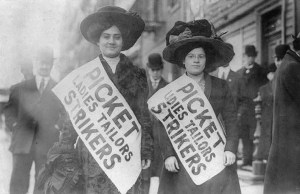
There are two lessons in that experience: one, that it’s hard to imagine another person’s situation unless you’ve lived it, and two, that humans are bad at imagining, anticipating, or preparing for change (except those of us with anxiety disorders, who plan multiple responses to any situation). Unions help workers by setting rules that protect them from change, and by having input into things like, oh, HR manuals, where the worst case is that every policy statement ends with, “Or at the discretion of the director.” As much as museums need directors’ “vision” and leadership, museum employees often need protection as they try to implement those visions.**

Here’s the thing: on the 2015 Form 990 filed by Plimoth Plantation, the Executive Director’s salary is listed as $142,896*. Costumed interpreters are seasonal, often paid minimum wage ($11 in MA right now), and contribute directly to the museum visitors’ experience. Yes, the Director is responsible for raising funds, maintaining happy donors, and has overall responsibility for the museum’s success. Let’s say, realistically, the Director works 60 hours a week. For the 2015 tax year, that was $45 an hour. (For a 40 hour week, the base “wage” would be $68/hour.) Should  a director earn 4 or 6 times what front line staff earn? I suppose it’s better than the difference that exists in for-profit entities, but why are the interpreters paid so little? What about Colonial Williamsburg, another place where wages are low and expectations high? What about at the New-York Historical Society, where an archivist can make less annually than in a similar position in a similar organization in much lower cost-of-living Rhode Island?

When a museum pays its director six times what front line staff are paid, what does that tell us about its priorities? Does that imply that the director is more valuable to visitor experience than the interpreters, maintenance workers, and craftspeople? When was the last time the director spent a day over a fire, graciously fielding “gotcha” questions and recreating the past to inform the public? I’ll grant you the director probably does have days when she can’t pee for hours because she’s stuck in a meeting with droning donors, or on endless, useless, frustrating conference calls. And I further understand that the director bears the final responsibility for the museum’s financial health and visitor experience, but when was the last time a director got canned when a guest complained (reasonably or not)?

Why have we decided that museums get a pass? Why have we decided that the work is worth our (or others’) personal sacrifice? Why do we persist in making those excuses, even though we know MPA and MBAs are running museums using the tools and precepts of peak capitalism?

*You need an account, but I highly recommend searching Guidestar before you apply for a job with any 501(c)3. Form 990s (the non-profit annual filing form with the IRS) give you great snapshots of financial health– and an idea of what the top dogs make, and how an organization’s finances have changed over time. I never apply for a job without checking the financials.

** More on this another time– both HR policies and the “visions” of various directors.
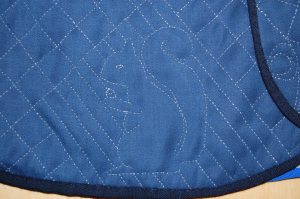
Squirrel!

It’s astonishing to me, in a way, that I haven’t posted about this before, but shockingly, I have not. Remember the need to keep warm in Princeton? Tested on at Ti? A compromise?

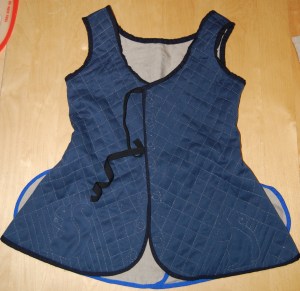
I updated that garment and wore a nearly-completed version at Ti last February but never wrote about the new version: the Squirrel Waistcoat.

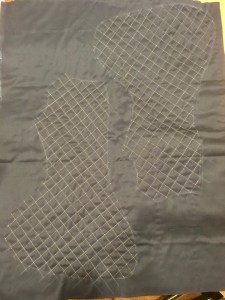
Wool hand-quilted to a wool backing and lined with wool, I wore this almost finished at Fort Ti last February, and found it comfortable and cozy. I had imagined its state to be far worse than it was: with a lining in need of piecing, mangled seams, your worst nightmare come true. But no: all it really needed was some binding adjustment, not surprising considering that I stitched the binding by candlelight while chattering away with friends over cider.

The back pieces weren’t bound at all, but because I’d imagined this needed so much more work than it did, I put it aside until now, when I know I will want it for a weekend in Trenton, and another at Ti in December. All it took was a little time, and accepting that the bindings will not match.

This wasn’t a long, involved project, really, though I spent lunch hours and evenings working on it last January and February. It is, as so many things are, about patience. Patience and good needles.

The construction was based on the quilted waistcoat I made two years ago, with a pattern derived from Sharon Burnston’s research, using fitting adjustments I’d made to an earlier jacket pattern (long since abandoned due to living in New England).

I don’t fully remember how it fits best, over or under my stays, but I’ll get a couple of opportunities to test drive the layers in the next two weeks. And in the meantime? Squirrel!

Gathering Thoughts

Someone must watch the baggage.

You only live once, as they say, so you might as well enjoy yourself, and have a nice apron while you’re at it.

At last I have finished the one I made to serve as a demonstration model for the apron class I taught for Crossroads of the American Revolution. Plain, unbleached linen (osnaburg), it will be a good, serviceable garment well suited to getting dirty through use. There’s a lot to be said for filth, and my first-ever apron has acquired a fine patina of stains and wear.

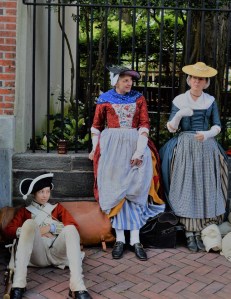
So why make a new one, aside from needing a teaching aid? Especially when you already HAVE a checked apron that’s looking used, and you have others in your wardrobe: why? One reason was the sheer cussedness of making the plainest, dullest, least-pretty item as finely and carefully as I could. Another was that the more I looked for apron data and examples, the more I noticed plain linen aprons. Yes: the preponderance of aprons are check, but looking at Sandby again made me realize that plain was documented, and under-represented in living history.

Sandby shows working women in checked and in blue aprons, but he also seems to depict women in plain, unbleached linen aprons, particularly the women in the street scenes. All the more reason to make up a plain apron, when your preference is portraying the urban underclass.

It’s also a good chance to hone one’s skills and keep in practice when you’re avoiding sewing the things that need sewing, like new shifts. And a basic project is meditative in a way that a new pattern is not: making stitches small and even is to sewing what scales are to piano playing or singing.

The first supervised apron I ever made is described here, and I’m pleased that my skills have improved since.

Stroke gathers are worth practicing, since they’re used on shifts and shirts as well as aprons; I’ve even used them on early 19th century garments to evenly distribute fine cotton lawn across the back of a gown. Sharon Burnston explains them here. I don’t know that there’s any one “trick” to them aside from patience and even stitches, but that “trick” will take you far in assembling pretty much every hand-made garment.

We Have Data

My assistant misunderstood the exercise, and is disappointed that we will not be turning the government over to him.

Data Cat says it’s clear: Cats Rule.

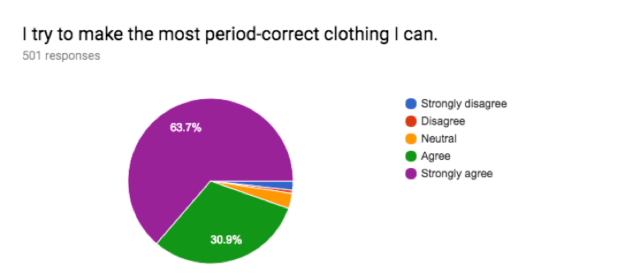
What is clear is that 501 people from around the world (really: people responded from the US, Canada, Australia, Europe, Great Britain) were interested enough to see what we could find out by asking questions about what, how, and why we make and wear these funny clothes. I’m immensely grateful that Google tools are easy to use, as I can present Graphs Without Tears:

Here’s how that breaks down:
Strongly disagree: 1.8%
Disagree: 0.6 %
Neutral: 3%
Agree: 30.9%
Strongly agree: 63.7%

That is, 94.6% of respondents agree that they try to make the most period-correct clothing they can. The “strongly disagree” folks (9 of them) are interesting to me, because it’s a position that’s foreign to me. (This is why recording your email was an option, so I could clarify the data.)

Next, let’s look at Authenticity:

Here’s how that breaks down:
Strongly disagree: 2.6%
Disagree:.2 %
Neutral:1%
Agree:32.3%
Strongly agree:63.9%

And on the use of Primary Sources:

Yes: 94.4%
No: 5.6 %

When I dug into what sources people use, and consider “primary sources,” I realized I have more questions to ask, and there are some folks who could use some research help. Not handed to them on a plate or in a slideshow, but in terms of process, and in recognizing primary versus secondary sources, and how they can be used together for maximum understanding.

Then I asked, Why is documentation important to you? 

Those responses will also inform another round of questions. Many were very revealing of thought processes and approaches; some made me a little sad. A couple of people said, essentially, I don’t want other reenactors to laugh at me.  I think we can do better than that, right? Let’s try empathy on for size, and be as helpful as we can in guiding people to an understanding of what they want to do, and how best to go about it.

Because the answers varied in length, I started reading them to discern the essence of the response, and I came up with five categories; the sixth slice represents the answers left blank.

Accuracy: 73.4%
Immersion: 11.6%
Learning: 6.1%
Respect (of ancestors, history): 4.0%
Personal (fun; satisfaction): 0.5%
No answer: 4.5%

Accuracy is the main reason documentation matters to people, and they gave good answers for why accuracy mattered.

I want to have the resource itself, rather than someone else’s interpretation of it. If everyone bases their impression off of somebody else, rather than going to the source first, it becomes a game of telephone.

It’s like medical documentation. If it’s not written down, it didn’t happen. There’s enough open source imagery and documents on the internet, let alone physical ones or surviving garments, that there really is no excuse for wild supposition.

Because everything else is unsubstantiated conjecture or hearsay and feels inauthentic to me and to those around me.

Because I use my impression to communicate about history, and history is grounded in factual, accurate information.

Documentation is the truth behind the fiction of a living history impression.

Immersion had interesting answers, too:

I want to accurately portray my impression for the public. As an added bonus, wearing the correct clothing and using period correct items, helps me connect with the people I portray on a personal level.

Because the point of living history (to me) is to recreate the past enough to learn from the visceral experience of *living* it, so it needs to be pretty accurate! Documentation is how I can know if what I’m doing is accurate (or close to accurate).

It tells us a lot about the larger picture of what was going on: trade, manufacturing, diplomacy, economics

Learning:
Because if we’re teaching people history, teaching them something that’s wrong is a disservice and an embarrassment on our part. We have the ability to learn what’s correct.

Researching and documenting my impression is why I am proud to put on my clothes. I enjoy the challenge and detective work that comes before I ever cut into any fabric.

Respect:
We owe it to our ancestors to tell their stories as accurately as possible.

For the class of person I represent, documentation can be very difficult to get at. Some documentation indicates that the garment(s) in question possibly existed, 3 pieces of documentation is ideal, but 2 will sometimes do, depending on my instincts about something. I have regretted only going for two in the past because my intention is generally to represent something very common. Documentation is important because it shows respect for the historical people I am trying to represent, it shows respect for my own work and time and it shows respect to the hobby (which, in historical circles, is often far more important than people give it credit for).

There’s a lot to think about in considering what you all think about, and I am really grateful for your help! As I look at the answers over the next days/weeks, I’ll let you know what else I see, and once I figure out how to ask the next round, there will be more questions! Thanks again! (And if you didn’t get to participate this time, no worries: you can join in next time; the easiest way is to follow the Kitty Calash FB page, but I’ll also post a link here.)

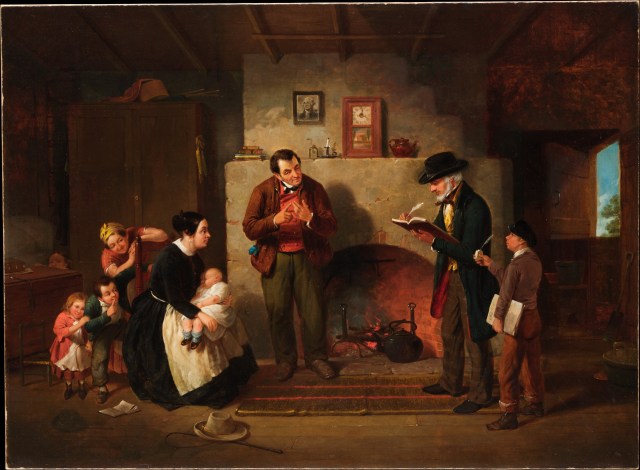
Taking the Census. oil on canvas, 1854. Francis William Edmonds. Gift of Diane, Daniel, and Mathew Wolf, in honor of John K. Howat and Lewis I. Sharp, 2006 2006.457 Metropolitan Museum of Art.