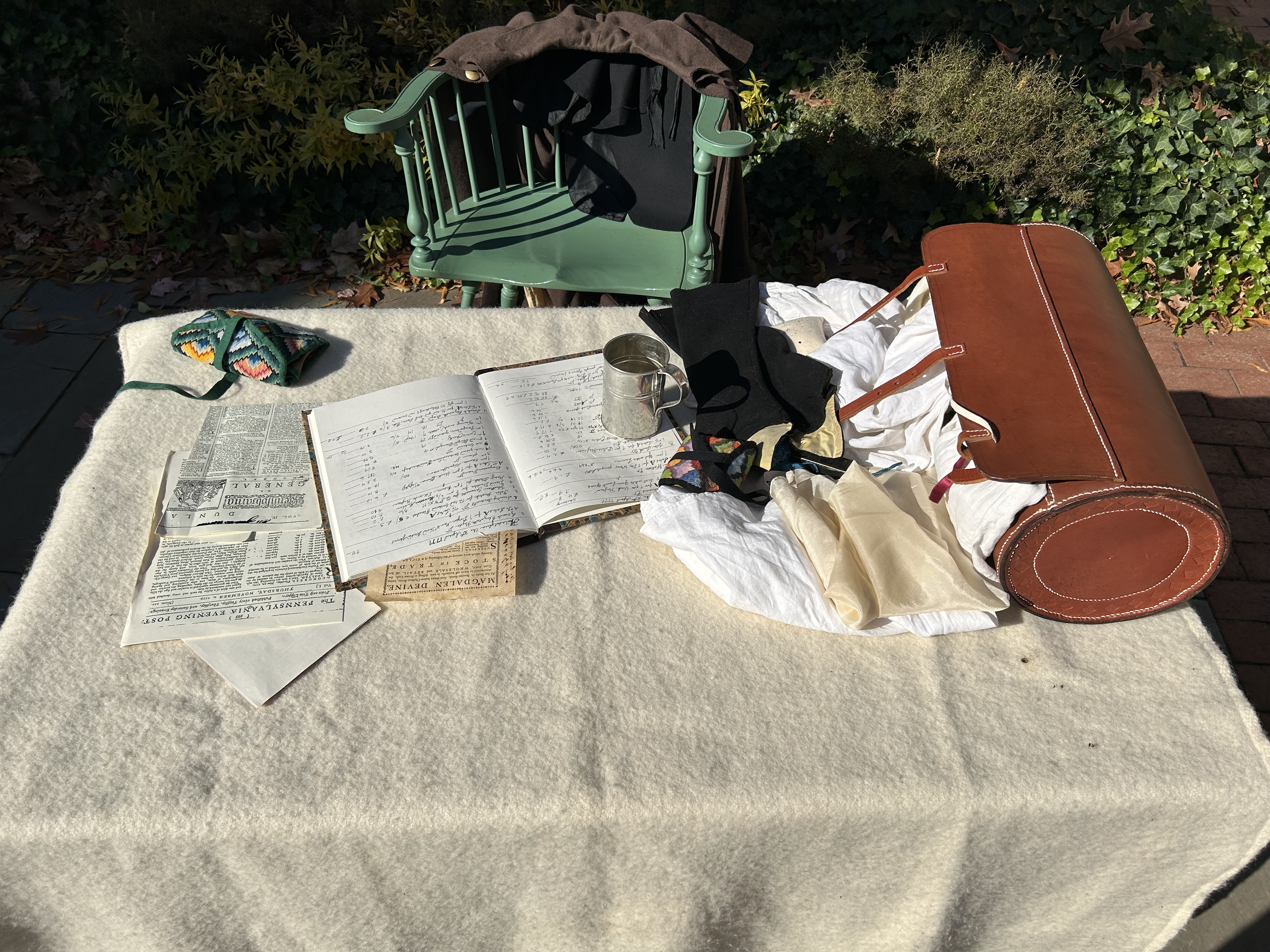
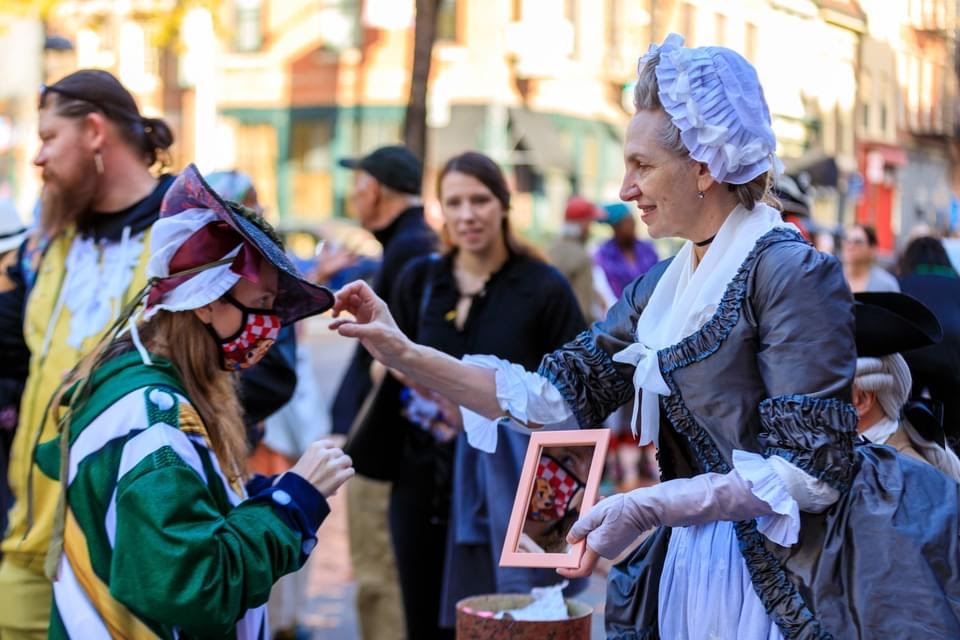
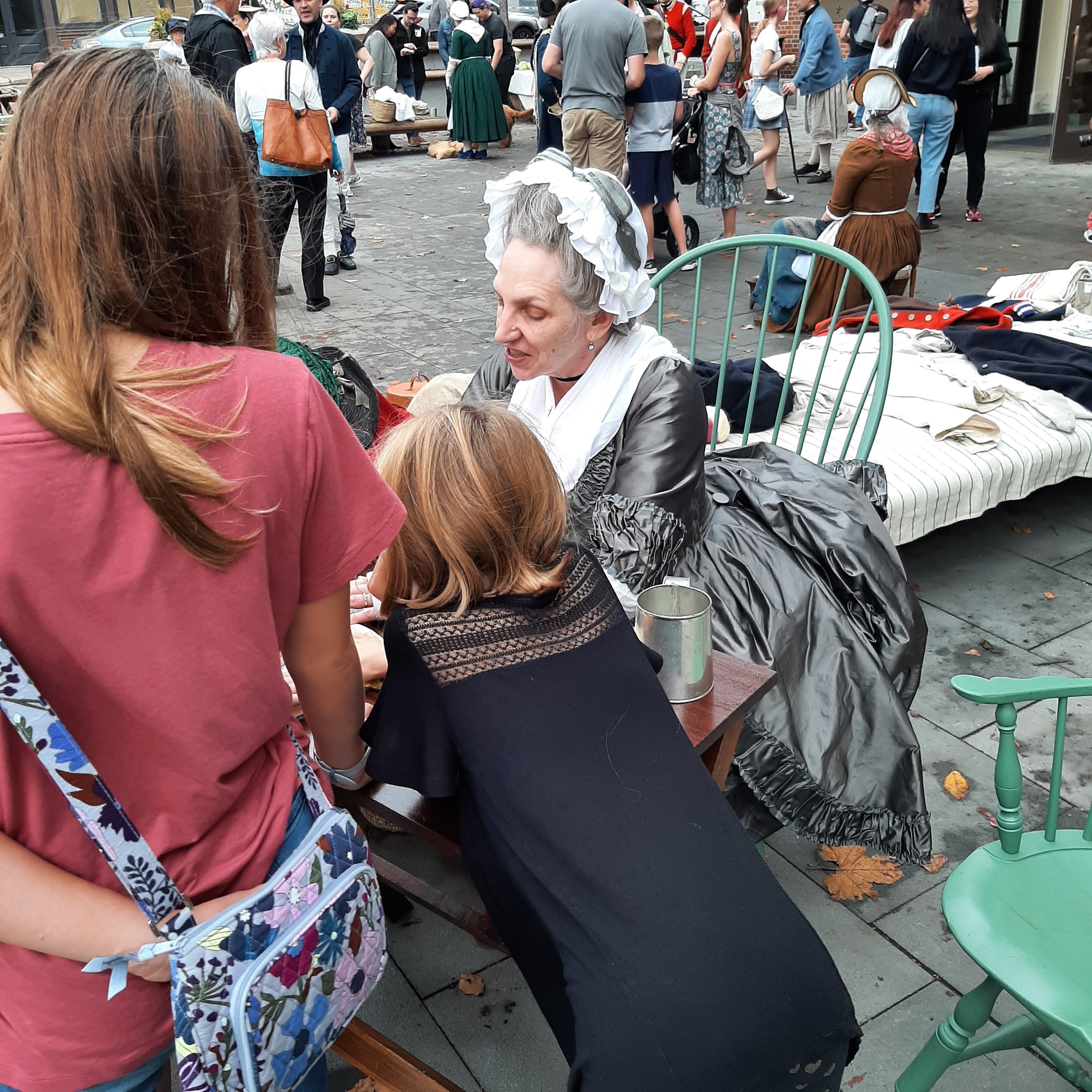
This past weekend (November 1-2) at the Museum of the American Revolution’s Revolutionary City (Pre-Occupied) event, I was pleased to represent Magdalen Devine, a feme sole trader in Philadelphia who ran a mercantile business between 1762 and 1775. Devine’s situation in 1775 reflects the tensions and uncertainties felt by many at the start of the American Revolution, and continues to resonate today.
Broadside, Magdalen Devine, printed by John Dunlap, n.d. [1775] Historical Society of Pennsylvania, Ab[1780]-16
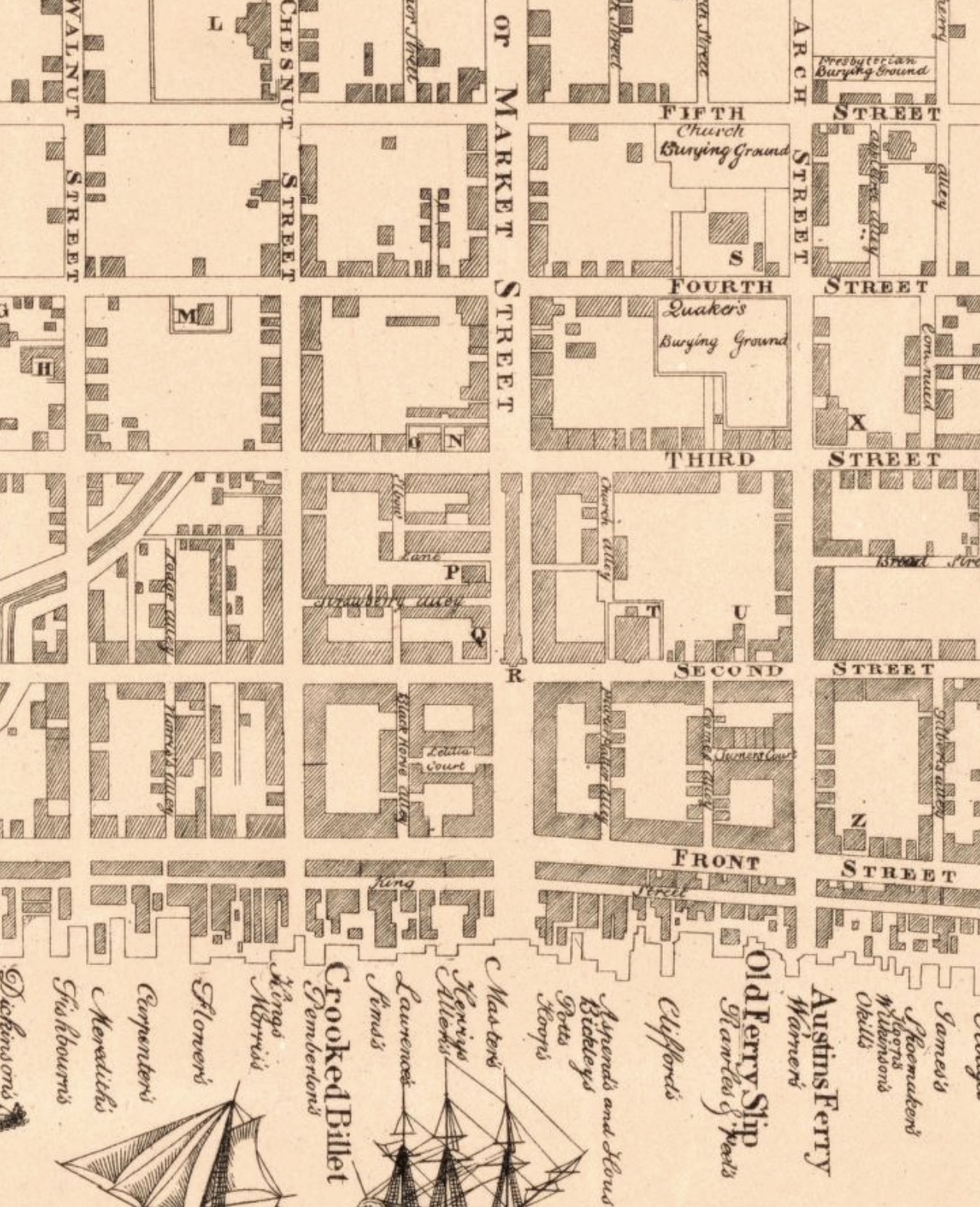
In 1775, Magdalen Devine, “being determined to leave off business,” advertised that she was selling “at Prime Cost, for CASH ONLY, WHOLESALE AND RETAIL, all her STOCK IN TRADE.” Devine first appeared in a Philadelphia newspaper ad in September 1762, selling imported goods with her brother, Frances Wade. By the following spring, the siblings had dissolved their partnership, and Magdalen had set up her own shop in Second Street between Market and Chestnut.
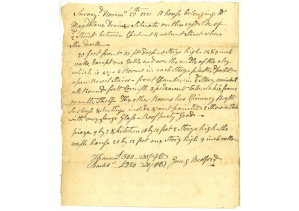
Devine’s ads reflected a keen sense of merchandising, including woodcuts illustrating printed and check fabrics and tightly wound fabric bolts. For more than a decade, Devine imported and sold goods on Second Street, eventually moving into a house she owned that was equipped with “two show windows with very large glass,” probably among the first instances of London-style shop windows in Philadelphia.
Fire Insurance Survey, “A house belonging to Magdelane Devine.” Insurance Survey S01561
For more than a dozen years, Devine traveled between Philadelphia and London, selecting, importing, and selling “a large and neat assortment of European and India goods.” The chintzes, linens, cottons, and woolens that Devine imported represented the wide range of textiles available, many with specific applications from jean cloth for clothing enslaved workers, tickings for mattresses, and hair cloths for sieves along with the chintzes, taffeties, and superfines that dressed the city’s elite.
By April 17, 1775, she had “determined to decline business, as she intends for England shortly” and published ads in the Philadelphia newspapers calling in debts. Although she initially gave debtors two months (until mid-June), in August she was still in the city and advertising her intention to put debts “into a lawyer’s hands” if not paid within two weeks. An August 30th paper reprinted her ad of August 1, suggesting that the debt collection was not going as she’d planned in April, and the weeks and months kept stretching ahead. The ad placed on August 30th suggests she planned to leave not later than September 15th.
This slideshow requires JavaScript.
Unfortunately for Devine, mid-September saw a slowdown and stoppage of ships coming in and going out of Philadelphia. By September 18th, no ships were reported outward bound from the city. Magdalen Devine was stuck.
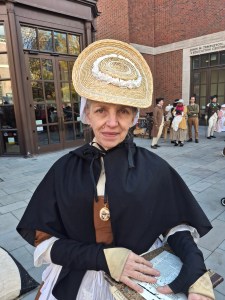
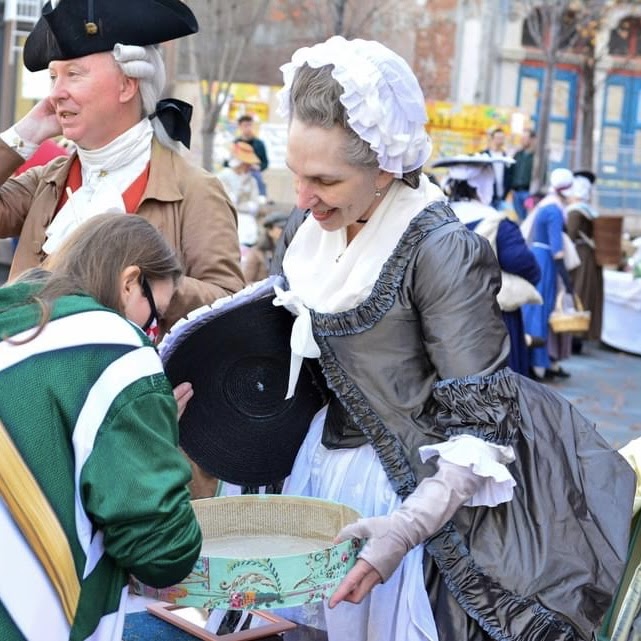
“Magdalen Devine” dressed in brown silk with a new straw hat.
Did she get out on an early September ship bound for Cork or Dublin, and make her way from there to England? Perhaps, but it seems more likely that she miscalculated and was caught in the city as insurers, shippers, and sea captains struggled to make sense of the news from Boston, Providence, and London. Newspapers published English threats to burn all the port cities of the American colonies, and warships plying coastal waters from North Carolina to Maine surely made sailing seem unwise.
Why did Magdalen Devine decide to close her business and leave Philadelphia for England? Just one year before, in 1774, she had acquired the shop with the “two show windows.” What made leaving a good idea? The threads are hard to find, let alone pull, but perhaps her childhood and young adulthood in Dublin suggested that the violence the British were willing to use against a rebellious colony. Famines and strikes in the 1740s prompted British reprisals against a country that served as a laboratory of colonialism.
With my ledger in hand– and a fabulous new hat.
In the absence of passenger lists, it is hard to know whether Devine made it back to England in 1775, or whether she had to wait until 1783. We know she made it to London, because her death is recorded there in late 1783.
In 1769, Philadelphia had roughly one tavern for every 120 residents. They were clustered most densely in the area Chestnut and High (now Market) Streets, west from the Delaware River to what is now 5th Street. One of the oldest, the Crooked Billet, is called out on the 1762 map of the city by Nicholas Scull, reprinted and now at the Library of Congress. Run for decades by Rebecca Terry, the Crooked Billet primarily served the sailors and men in the maritime trades. Terry was not the only woman with a tavern license in the city—at least three other women, including Sarah Hayes, were long-time tavern keepers.
Sarah Davies Hayes owned two pieces of property on Elbow Lane and another on Chestnut Street; a Quaker, she married Richard Hayes in 1741. He seems to have been a shopkeeper, based on the probate inventory made after his death at the age of 34 in 1748. The inventory includes a side saddle, wearing apparel, a cradle, a fowling piece, and “remains of shop goods.” What kind of shop remains a mystery, as Hayes left no trace in newspaper advertisements beyond an ad placed by his executor in January 1749. Sarah Hayes bought one piece of property on Elbow Lane in 1761, and the second in 1763; the Chestnut Street property was purchased in 1771. Hayes is listed in tavern license petitions for decades (see the Historical Society of Pennsylvania’s Tavern and Liquor License Records (1746-1863)) and appears in tax lists as an innkeeper or tavern keeper from the 1760s until at least 1780.
A sign. It’s only 20″ x 12″ overall.
Tavern keeping was not an unusual occupation for a widow in the 18th century, even if she did not inherit the business from her husband. Some colonies, like Virginia, thought widows particularly well suited to the business, given their skills in household management and stereotype as sensible and moral (and not merry) matrons. In Philadelphia, licenses were issued annually (at a fee of £1/10) to those who successfully passed the scrutiny of the licensing board. (You can see a list of petitioners here.)
The history of the Seven Stars is hard to follow: Benjamin Randolph Boggs (HSP AM.3032) places it at 20 Bank Street, which the Mapping West Philadelphia Project gives as a calculated modern address for property owned by Sarah Hayes, which seems clear enough, though modern streets can be hard to map against historic property lines.* Tyler Putman dug into the history of this parcel and Elbow Lane in general. (Spoiler: there’s nothing to see at 20 Bank Street.) Here’s how Boggs starts his history of the Seven Stars:
“A short distance below the White Horse, also on the west side of the lane, at the spot now covered by the structure know as No. 20 Bank street, stood in very early times a small tavern known as the Sign of the Seven Stars, occupying a lot having fifteen frontage and a depth of fifty-six feet. John Eyre, or Eire, purchased the ground as a vacant lot from Ebenezer Large, currier, on September 19th, 1733 … Eyre was a joiner or carpenter by occupation, and upon his lot he erected a brick dwelling in which he kept a tavern, meanwhile working at his trade.”
After Eyre’s death, his widow, Mary, sold all the brick house and all his other property, as ordered in his will. Jacob Shoemaker purchased 20 Bank Street, lot and improvement and almost immediately re-sold the property to Mary Eyre, who continued to keep the tavern. Boggs describes a number of real estate transactions, concluding with the sale of the property and tavern to Thomas Rogers, “who succeeded her as proprietor.” How this squares with Mary Eyre’s appearance in the 1771 list of petitioners who received a tavern license is beyond me. Bogg’s data comes from Philadelphia Deed Books and newspaper advertisements, though he notes that the Seven Stars “may have been open down to the outbreak of the Revolution, but the newspapers of the period disclose nothing further about it.” (HSP AM.3032, Chapter 20, p. 498-499).
Settling the Affairs of the Nation. Winterthur Museum 1973.0561
Who kept the Seven Stars? Was it really at 20 Bank Street? Tax records and directories show a lot of taverns and inns on Elbow Lane, so even if the selection of Seven Stars as a name and Sarah Hayes as a proprietor is somewhat random, I know at least that Hayes, the Seven Stars, and the Lane were all real, existed together over three decades, and overlap in some possibly complicated way involving deeds, ground rents, insurance, and competition. Hayes will do to represent the archetype of the widowed tavern keeper of the Revolutionary City.**
Tavern Interior, oil on panel, 1762, John S C Schaak. Sold by Bonhams.
The material world of taverns is much more satisfying to research and compile, though I did get hung up on which shape of bottle held which kind of alcohol, how beer was distributed from the brewery to the customer, and at what level of tavern one would find a Monteith bowl and a silver lemon strainer. The questions are legion: how many glasses? How many mugs? Were basins used on tables the way dishes were washed in early Federal New England? Prices posted or not when the Pennsylvania legislature and provisional government did fix prices in 1778? Some of these questions are answered in paintings from the Sea Captains in Surinam to the John S. C. Shaak Tavern Interior, others can only be guessed at until I find an inventory, if there is one to find.
Then, how do you communicate alcohol to visitors? They can’t taste anything so you can only let them smell the oleosacrum that’s the basis of punch, or the shrubs and cordials popular at the time. Happily, these come in beautiful colors and enhance a table display. My hope with a bench at the table was to invite visitors to sit at the tavern table, and with refinement, perhaps I can achieve that in the future. Reenactors, at least, can bend an elbow at the Seven Stars.
*There’s a compelling argument that someone could untangle the confusion between Jacob Shoemaker’s lot, 20 Bank Street, the lot Sarah Hayes owned, and just who owned the Seven Stars, and where, exactly, it was, but I am not that someone.
**If you are thinking at this point that I have a problem with research and perhaps belabor a question, you are correct. My superpower is overthinking anything.
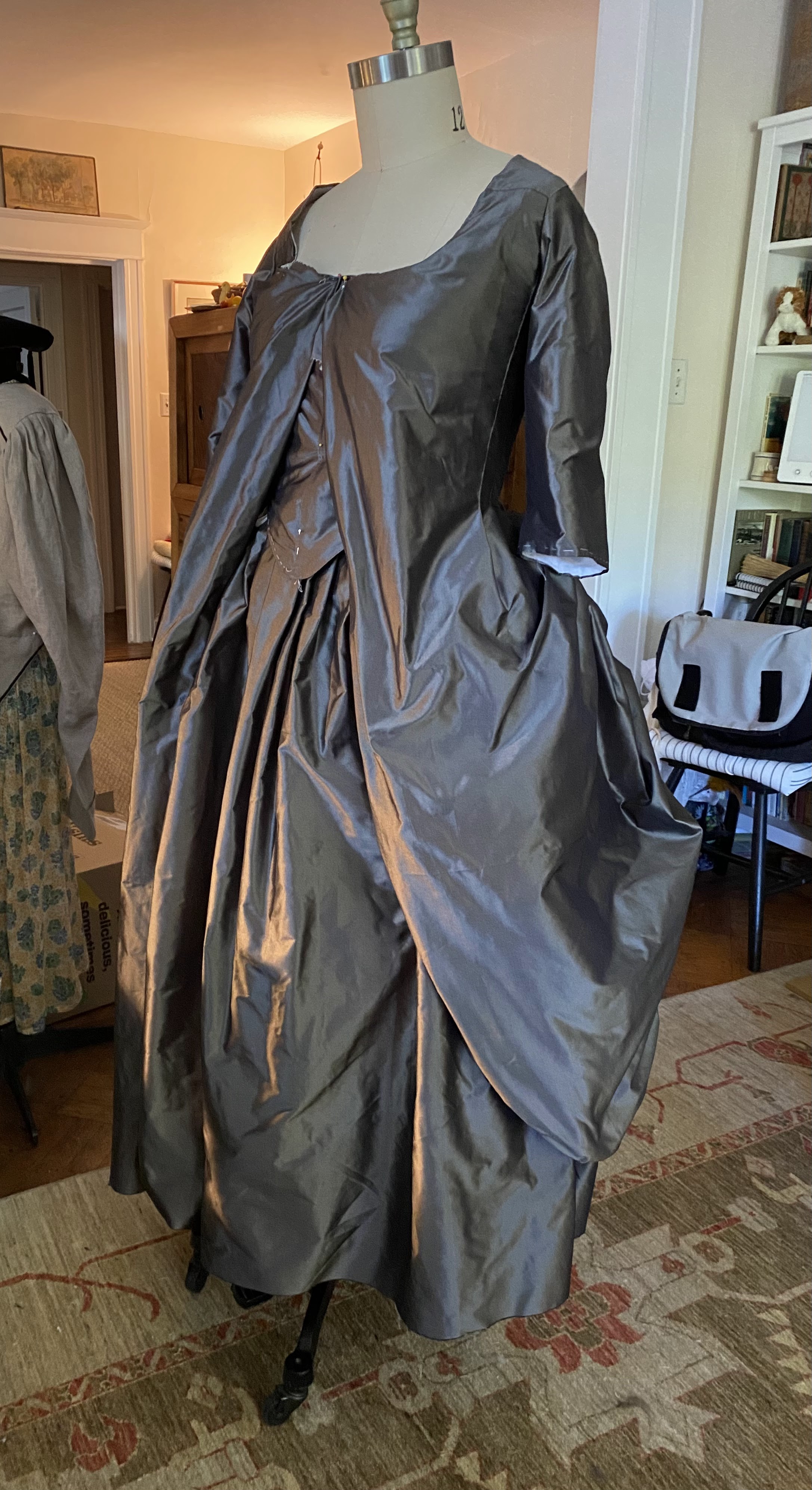
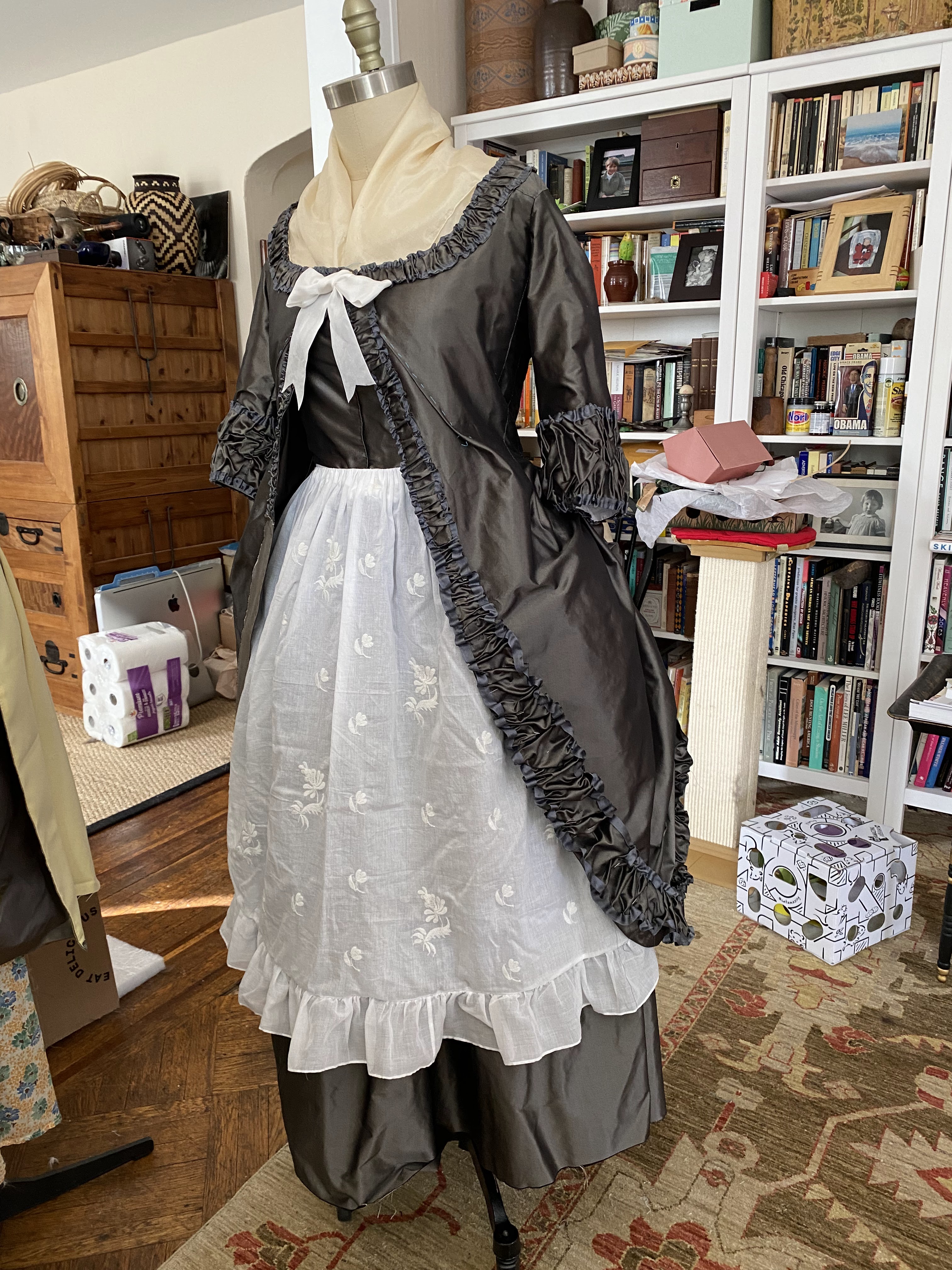
Technically, the polonaise. I was supposed to be part of a Burnley & Trowbridge master class way back in … March 2020. Not that year, Satan. Fortunately, it did happen, in August 2022!. I was so glad to be part of the pilot master class for this gown, and back sewing in a class, even as I was intimidated by the form. (I am a maker continually in want of confidence, except for the times when I overextend myself.)
After an introductory lecture, we had a trip to view extant garments at Colonial Williamsburg, which is truly a delight. (I can’t collect 18th-century pieces; only a few early 19th-century things occasionally dip into my price range.)
There’s nothing quite like looking at an original. You can see sloppy stitches and fine sewing, mistakes and alterations, stains, mends, and bright original colors in hidden seam allowances. Every garment tells a story, even without provenance, and sometimes those stumbling stitches give me the confidence to just keep sewing.
Background and References
To understand the history and style of the polonaise, Kendra van Cleave and Brooke Wellborn’s article, “Very Much the Taste and Various are the Makes” (Dress, 39:1, 1-24) is the place to start. Kendra published an accessible summary here, if you can’t access the article. The main thing to know is that the gowns are made much like men’s coats (two back pieces, with pleats; bodice fronts that fall away from the body like a man’s coat, and that meet the back with side seams and pleats) and while the skirts are looped up, looped up skirts do not make a polonaise!
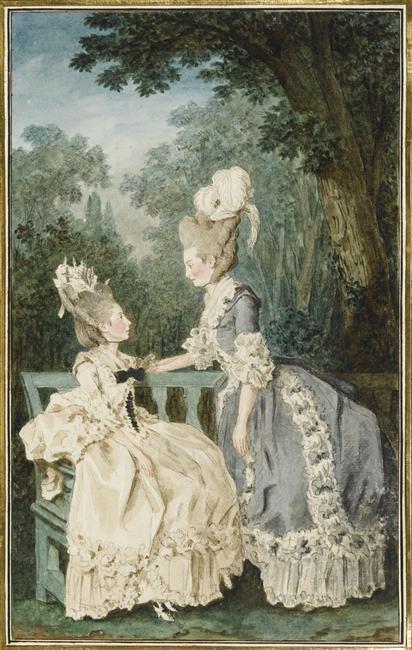
The other thing to know is that these appear earlier than we sometimes think. In the 1771 Louis Carrogis watercolor, both Mmes les Comtesses de Fitz-James et du Nolestin wear polonaise gowns (right). In the English world, the May 1775 Lady’s Magazine describes “nightgowns in the French jacket fashion, flying back, and tying behind with large bunches of ribbons.” (Ladies Dress for May,” 235. (1775). Despise these early references, we know the polonaise is not taking New England by storm, but it does appear in Philadelphia by 1778. This put the form within my interpretive range, so I felt more comfortable tackling the gown: I knew I would have a place to wear it. (What I will do with the redingote underway or the polonaise à coqueluchon I crave remains to be seen; at least the polonaise hoodie is a plausible stretch for Philadelphia.)
To the Making
You get where you need to go however you can
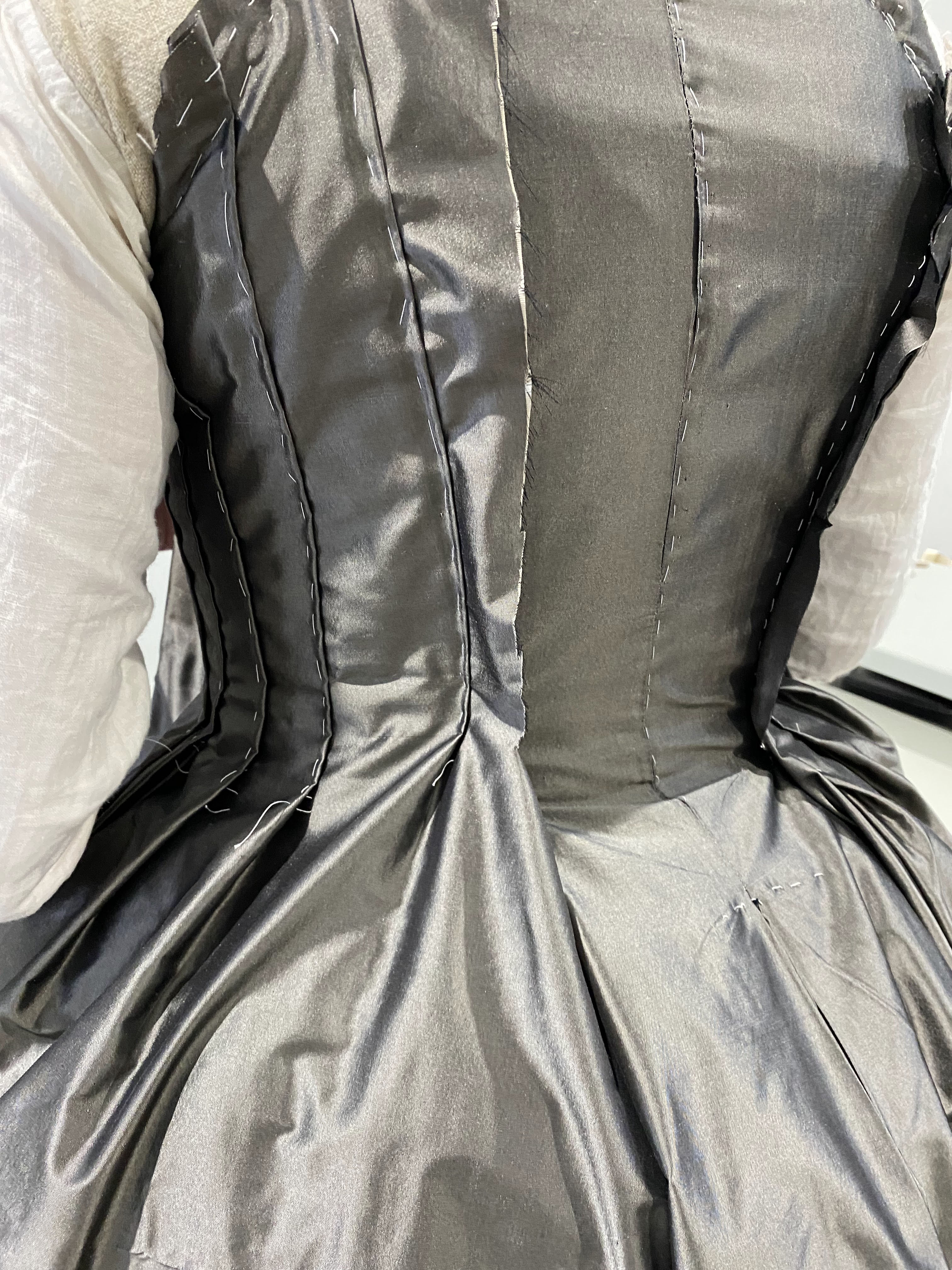
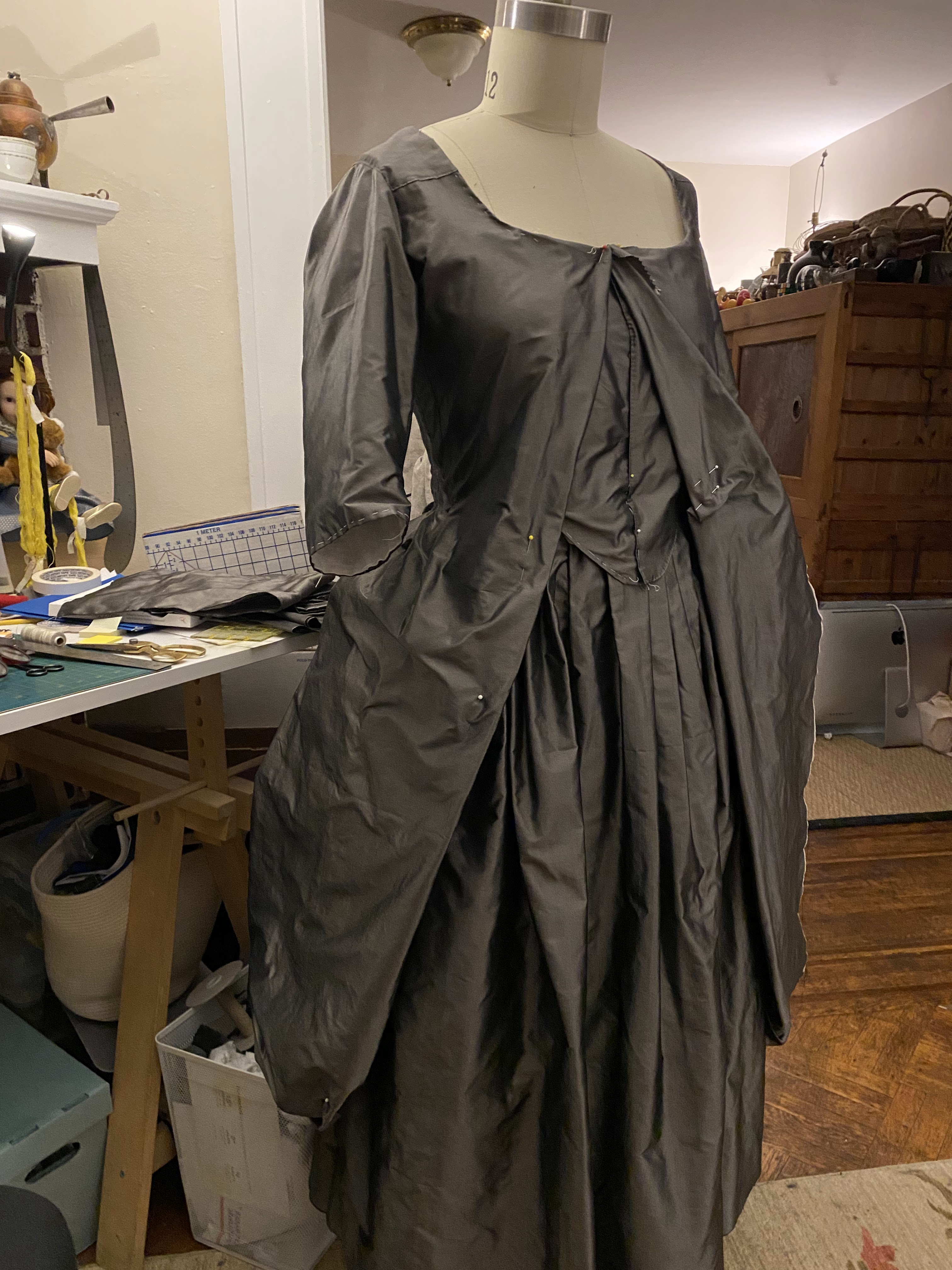
Starting with basic shapes from the last B&T pre-pandemic workshop, updated to reflect the rollercoaster of pandemic weight and tweaked yet again, I cut the backs and stitched the center back seam. The front bodice shape is cut wider, and in one piece with the skirts, as it will be pleated to fit the body. The fullness of the skirts ends up pleated at the side and back seams much the way a man’s coat skirts are pleated, only more generously. So the body of the gown is cut from four main pieces (two fronts, two backs) along with the sleeves and sleeve straps. That’s it. In some ways, this is a simpler form than the English gown, though the fitting feels trickier because it’s not happening in vertical back pleats that many of us default to. It is a gown best made to you by someone else (hence the workshop) or by you on a well-fitted mannequin.
I chose a dark grey silk taffeta from Silk Baron, purchased in November 2019 just after I registered for the class. By the time I was actually packing for class, I’d started a new job, moved to a new city, and helped Drunk Tailor move to a new place. I had no idea where I’d put 8 yards of silk— purchased before prices really jumped. Reader: when we moved BK, I’d stashed it under my bed, handy for the class. I did not rediscover this cleverness until all other locations had been searched and a mild panic had set in.
Beginning
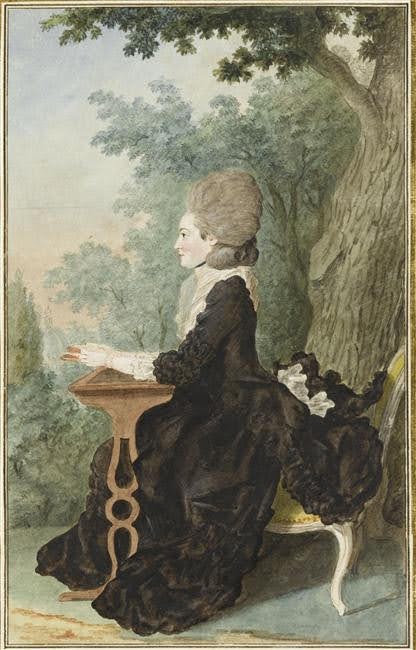
The inspiration was a watercolor drawing by Louis Carrogis of a woman in a black or dark grey gown. Back in 2019, I think I was thinking of a polonaise for a widow, but I don’t recall. In any case, there it was: dark grey silk. Off we went.
The back was simple enough, with a straightforward center seam and inverted box pleats; with that and the lining/front bodice pieces as a foundation, the fronts were pleated to fit. Basting was key to keeping this all in place, and yes, I discovered just how asymmetrical I am.
Stitching the side pleats was straightforward, and satisfying as the gown began to take the polonaise shape. Once the side bodice seams are set, the skirt seams can be stitched (you would’ve basted them already). Then you can start working on the buttons and cords that control the pouf of the skirts.
Much of the shape is determined by the rump, which is essential for this fashionable profile. I used the Scroop Frances Rump largely because it is free and that was much faster than fiddling about patterning this myself. It’s stuffed with horsehair for upholstery, which adds more warmth than you’d expect as you work on this in August in the steamy mid-Atlantic. I also used my red silk quilt petticoat for shape, continuing the warmth theme, and the cat added her fur, just to make sure all the hair and warmth bases were covered.
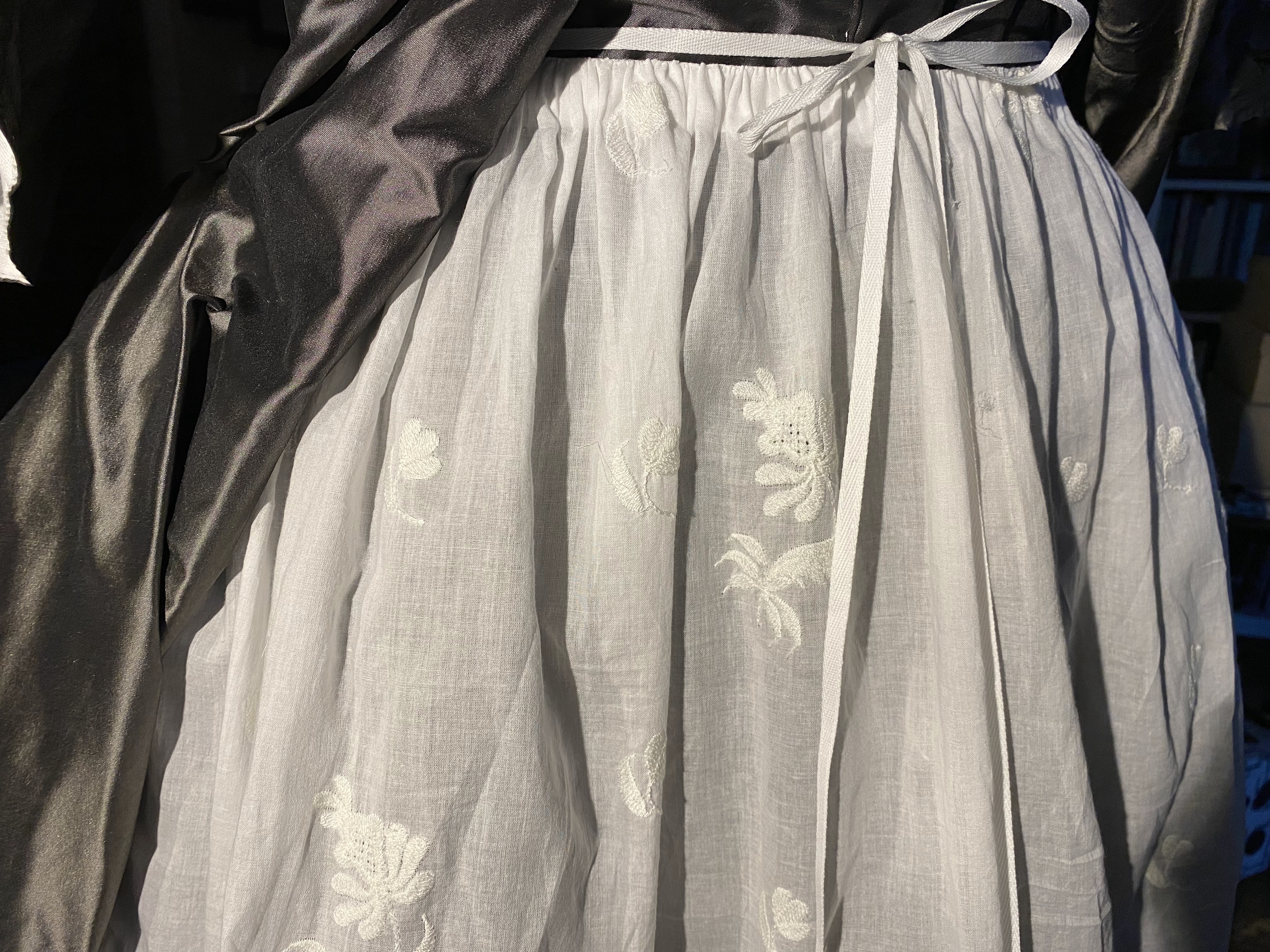
The sleeves were made from the shape I’d gotten in that last pre-pandemic workshop, so they were pretty easy. Setting them was another matter; fortunately, I had help. The construction from here on is standard 18th-century gown making, with a should strap piece and a binding piece for the back. Cutting the skirts seemed beyond me, so I diverted into a fancy apron.
A Diversion
Sprigged muslin or lawn was a common apron fabric for the decorative aprons worn by the better sorts and seemed appropriate to my milliner. She needed to be fancy but practical since I was imagining this ensemble as comfortable but fashionable workwear. Is there a 21st-century analog? The 20th-century analog for polonaises might be the velour Juicy Couture tracksuits a certain kind of upper-middle-class woman wore to go shopping with friends on a Saturday: expensive, trendy, and comfortable.
I imagined Ann Pearson Sparks projecting her currency in fashion trends by wearing this style while wearing an apron as she trimmed bonnets. That’s a fantasy as far as it goes since I have no immediate evidence of Ann’s clothing, only educated guesses based on readings in costume history and Philadelphia in the 1770s. The apron fabric is a reproduction from Burnley & Trowbridge, trimmed with a plain cotton lawn, also from B&T.
That brought me to October, a full six weeks after I started this project.
Cutting the fronts
I knew I’d initially cut the fronts too long, longer than a fashionable proportion, and I knew, too, that I had to get trimmin’ because this gown had to be wearable in four weeks. (Admittedly, I took another workshop along the way because a spot opened up and I grabbed it.) I started by pinning the fronts to gauge the length I wanted, and then there was nothing to do but trim. The change (improvement) was immediately apparent.
Trim it!
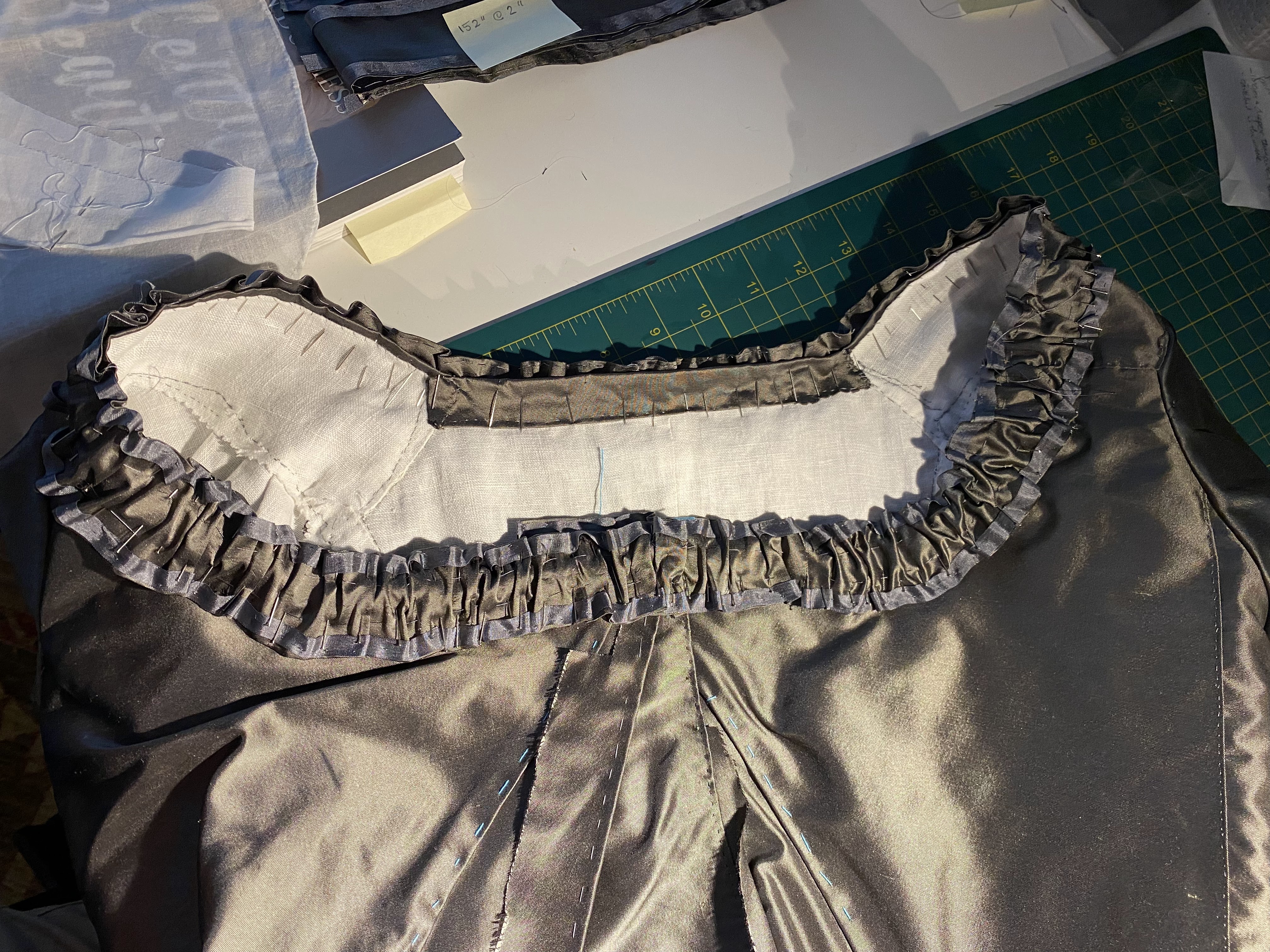
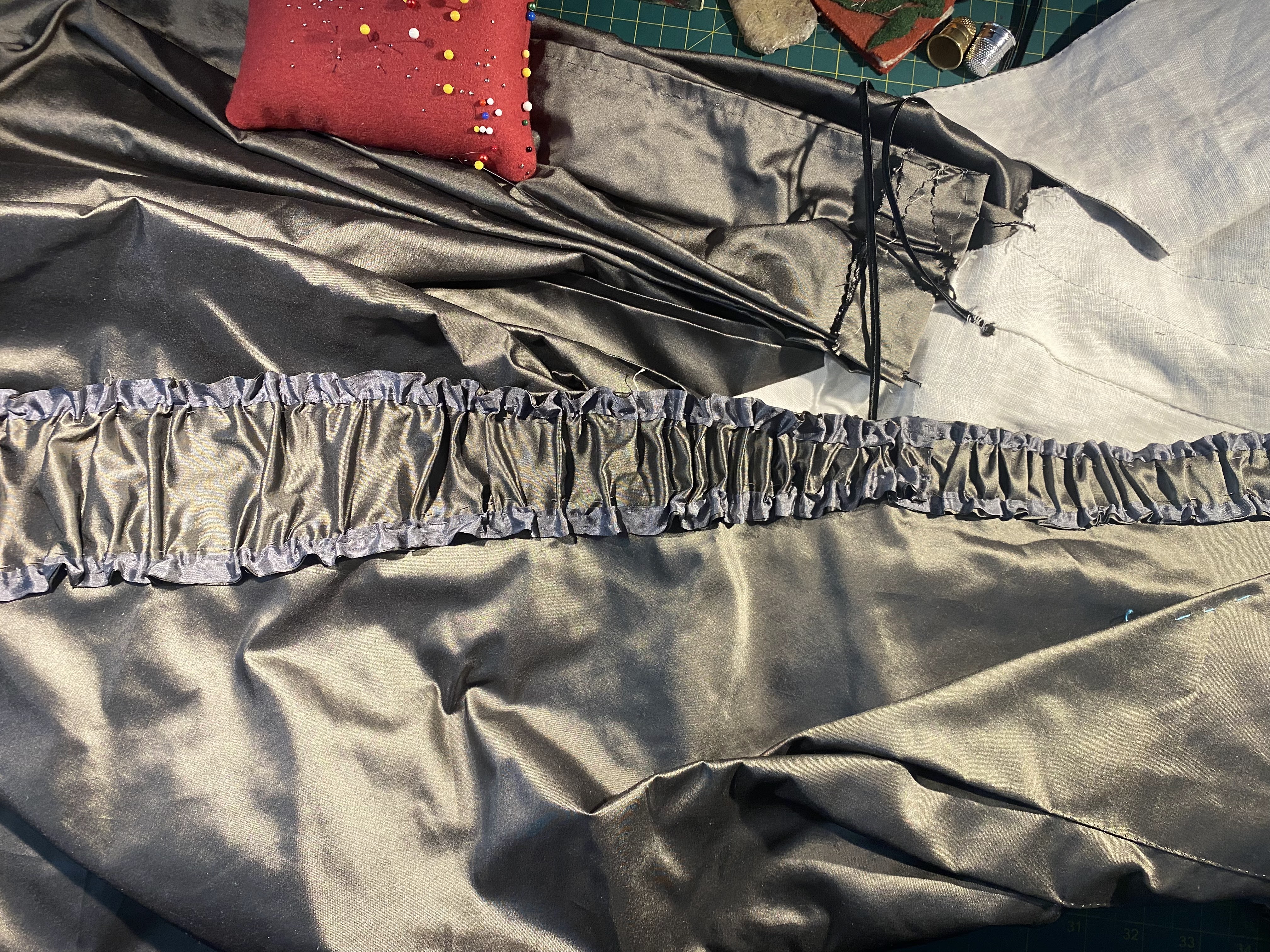
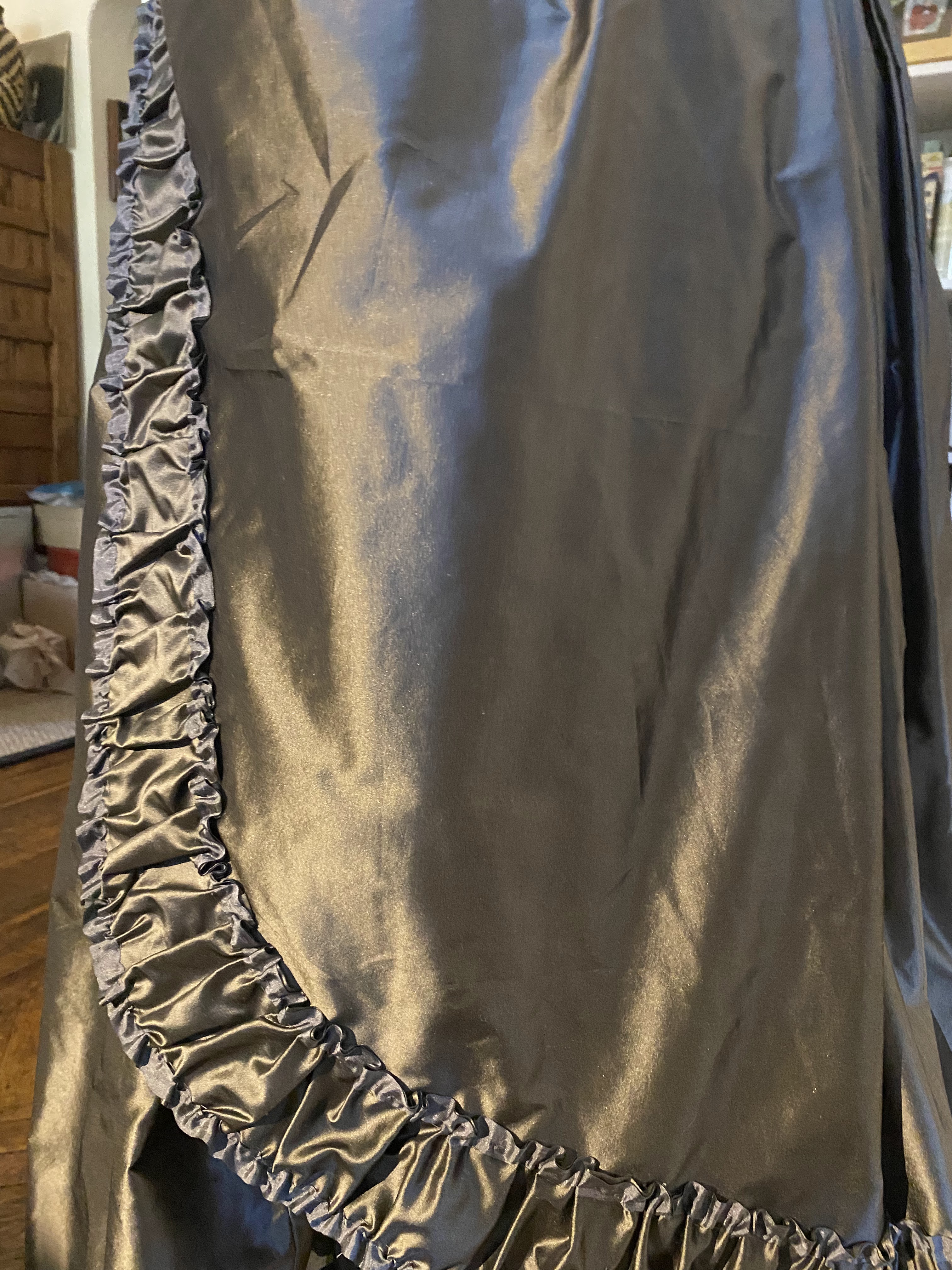
Trimming the fronts also gave me the fabric I needed to trim the gown. I’d decided on self-trim because as much as I love how gauze looks, the hemming seemed insurmountable. My first impulse was to pink the edges and gather the trim. This failed because I could not get sharp pinking irons in the shape I wanted, and my assistant’s tests with pinking shears didn’t look right, somehow. Pinking was abandoned as too much work for the results, so I bought some plain weave silk ribbon, and set about binding the edges.
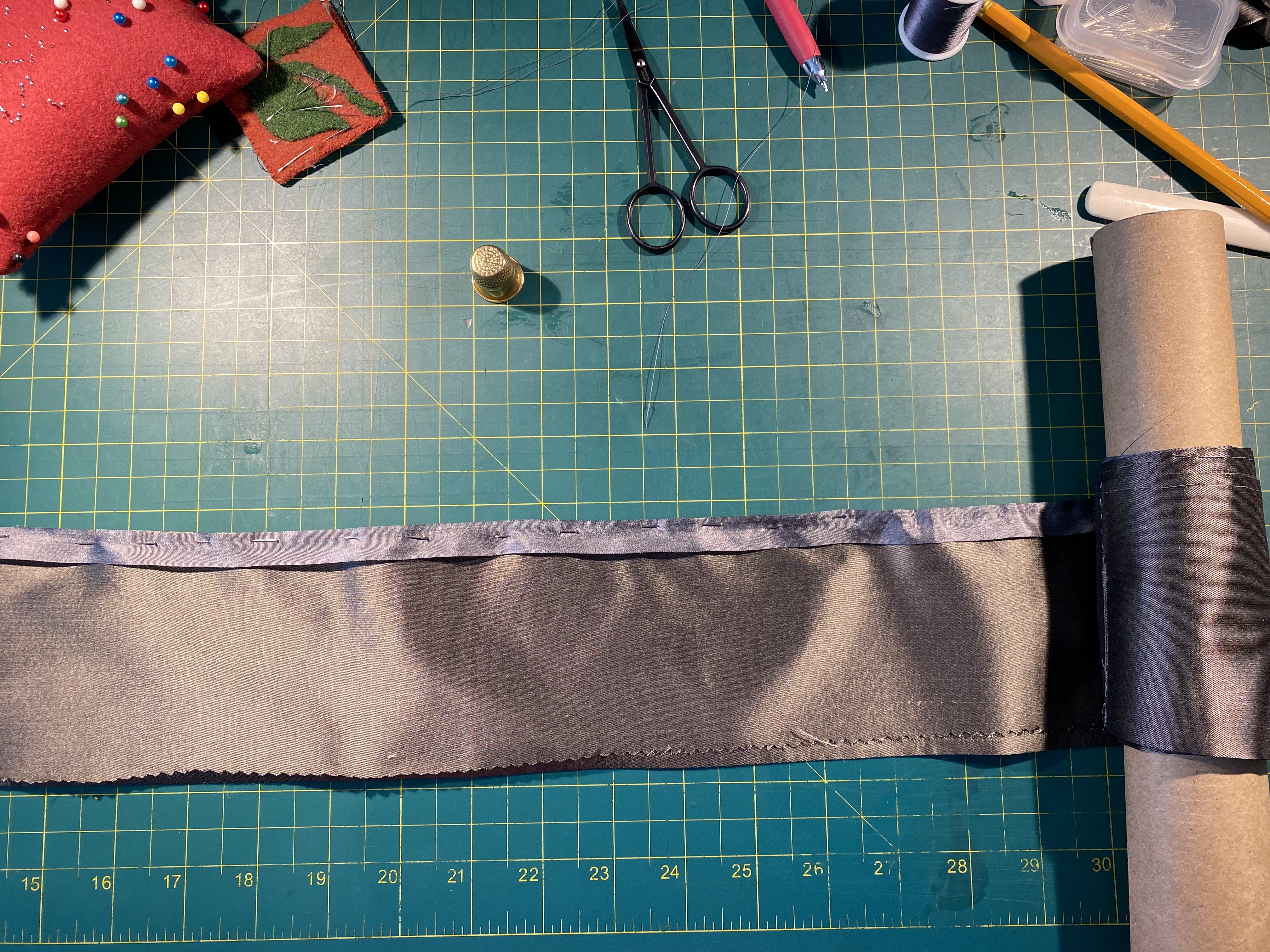
I needed two widths of ribbon because the trim was scaled, from two inches at the neck and upper bodice opening to four (?) inches at the gown hem, with a full eight inches of ruffle on the petticoat. After starting the trim on October 8, I finished it on November 2. Three and a half weeks, while working full-time and undergoing an outpatient procedure at the end of October. (Yes, I had surgery the Monday before a two-day event, worked full-time, and went to a workshop while addressing debilitating anemia. I am not the most sensible human around.)
To manage the trim– there were yards and yards of it– I rolled it around empty toilet paper and paper towel tubes. Judge not, this made the wrangling easier. The ribbon was stitched on with silk thread using a running stitch, and the same stitch was used to attach it to the gown.
In the end, it’s probably not as complicated as I thought it was (though I am hesitating before I lay out and cut another one). It is certainly a fun and comfortable gown to wear, and I absolutely love it. It’s delightful to see the skirts behaving the way they’re portrayed in period art, puffing up and filling a chair, thanks both to the rump and the fullness of the skirts.
I accessorized the gown with a silk handkerchief, a cotton gauze cap, and silk mitts as well as the sprigged apron. The handkerchief is pinned closed with a fouled anchor stick pin, which, together with the cap trimming, emulate a Charles Willson Peale portrait at the Met. The hair is as high a roll as I can manage, over a homemade cushion, with hair extensions for fullness and buckles (side curls). High rolls and powdered hair were the very thing in 1777 Philadelphia, so I knew I had to manage it somehow. The Cadwaladers once purchased 12 pounds of hair powder from Ann Pearson’s sister Mary Symonds, so obviously, hair powder was required. While 12 pounds initially seemed excessive, by the time I’d done my hair twice, 12 pounds seemed like it could go pretty fast.
Yesterday was #difference day in Pinsent Tailoring’s #modernlessmarch challenge, and while I’m not participating, finishing up a cap order yesterday got me thinking about what makes a difference in what I make.
I fished out the very first cap ever made, and here’s what’s made a difference:
1. Practice. Make more things. Make practice pieces. The more you sew, the better you get. That is the only way to get better.
As with writing, “butt in chair” is what will make a difference, and there is no short cut. But the more you sew, the better you get.
and here is linen
Cap the Recent
2. Materials. Buy the best materials you can afford. This first cap was made of linen from JoAnn’s, while the most recent cap is made of linen cambric from Burley & Trowbridge.
Here’s silk
Selecting the right material for the task is critical, and higher quality materials will give you a better result. Silk and linen will give you very different results (yes, silk caps are a thing. They show up in inventories and ledgers in the Carolinas). Even poor and working-class women’s caps were made of finer materials than we can typically get today, so for caps, you are looking for a fabric that combines fineness of weave and thread with crispness.
Cap the First was made nine years ago, while Cap the Recent was finished this week. The first real cap breakthrough I had was in 2016, with the Cap of Floof, made with a finer material that allowed me to make smaller seams and successful whip gathers for what felt like the first time.
Floof!
and more Floof!
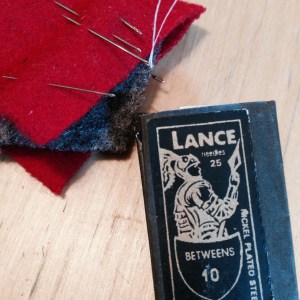
Lance needles: the best I’ve used.
3. Tools. The smaller the needle, the smaller the stitch. You want to use the smallest needle you can (different sizes are appropriate for different fabrics; thicker fabrics need longer needles). It can take time to get used to using a smaller needle, but the practice (see point 1) will pay off. Appropriate thread (finer for finer fabrics), a thimble, and sharp thread snips will make your work easier. A good iron is another necessity, and while you can substitute a rolled towel for some pressing forms, tailor’s hams and sleeve boards also make life easier and sewing smoother.
All of these things take resources, whether time or money, but the rewards are worth the investment.


















 Kirsten Hammerstrom
You must be logged in to post a comment.