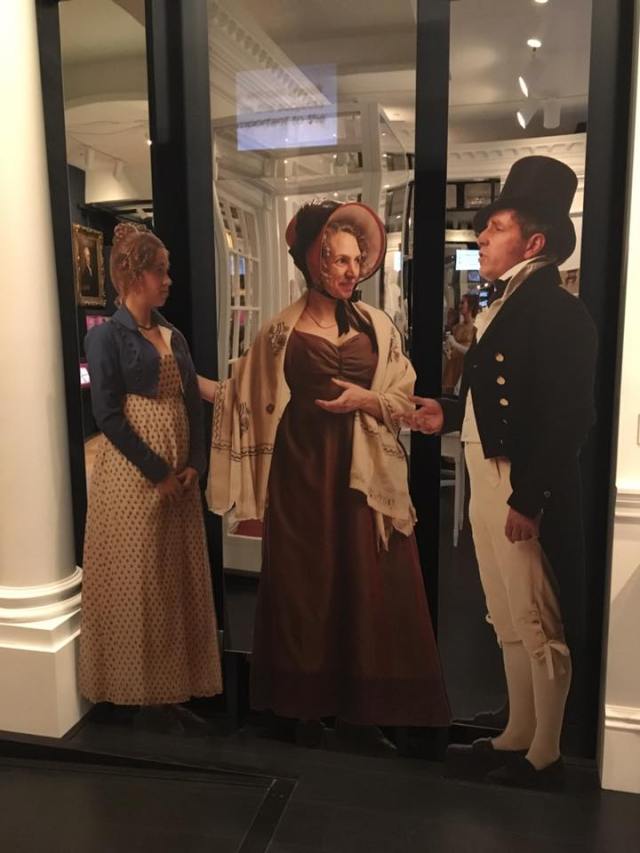
Fave Friday: Full-On Federal


Favorite Era? Easy-peasy! Federal, of course. Whether furniture or fashion, the early Republic is my thing. I spend a fair amount of time in the 18th century, since there are so many events in that time period, and while I loved the story of the American Revolution as a child, the early Federal* period intrigues me more. Furniture, porcelain, wallpaper, and clothing from 1790-1820 all appeal to me, as well as the notion that women’s roles were in flux in the earliest decades of the United States.
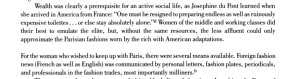
“American Women and French Fashion,” from The Age of Napoleon

I love the idea of women in mercantile businesses and trade, and the way that milliners provided access to fashion (and you can read more about that in The Age of Napoleon).
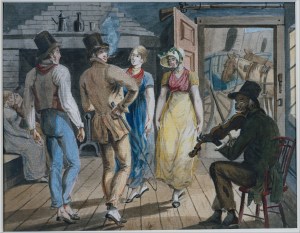
Merrymaking at a Wayside Inn, watercolor on paper by John Lewis Krimmel. 1811-1813. Metropolitan Museum of Art, 42.95.12

I also love the way that American women (and men) translated European high style into a vernacular, as seen in John Lewis Krimmel’s watercolors of Philadelphia and surrounding areas.
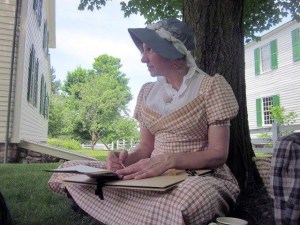
This is a time period I’m comfortable in (yes, the stays are part of that comfort) but aside from comfort and aesthetics, I think it’s also because for a brief time, women had slightly more freedom than they had previously.

It was short-lived, and Republican motherhood was confining in its own way before the “cult of womanhood” blossomed fully. But ideals of freedom and fashion very briefly aligned, and for that, I love the Federal– and vain creature that I am, I think it suits me.

*pre-Andy Jackson, amirite?
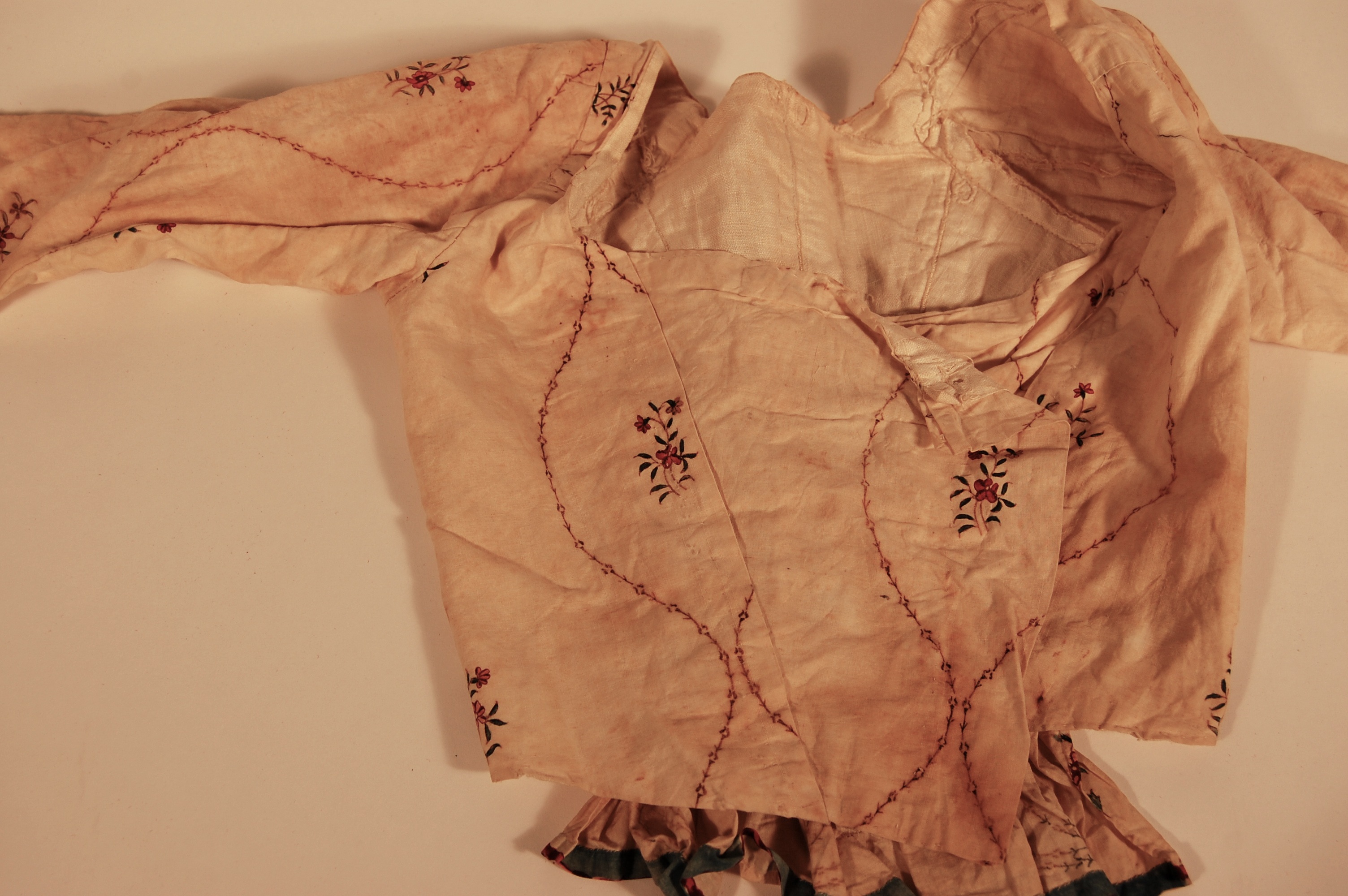
I Fall to Pieces: Extant Garment Fragments

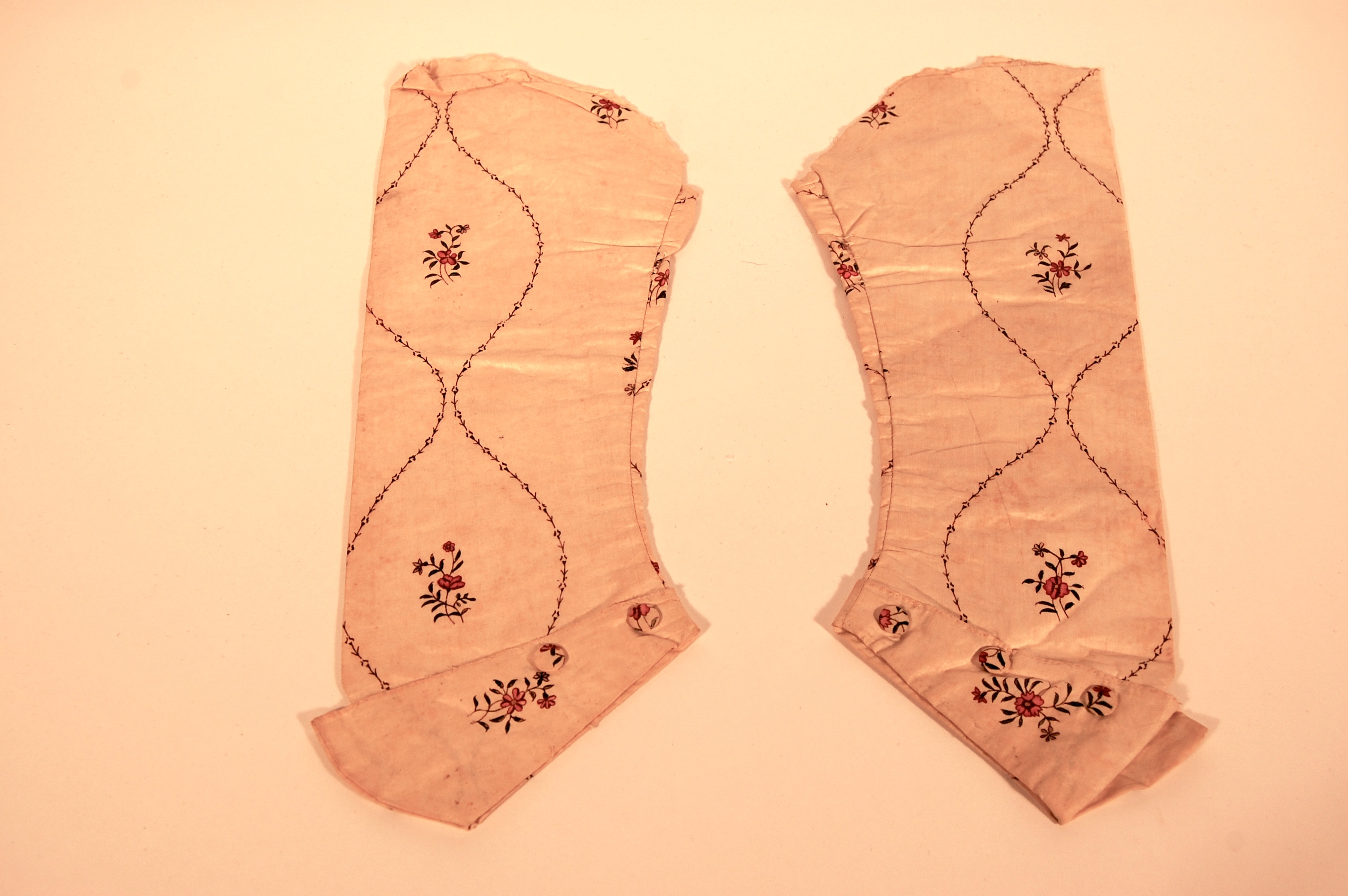
Bodice, painted Indian cotton, 1780-1795 RIHS 1990.36.27
Bodice, painted Indian cotton, 1780-1795
RIHS 1990.36.27

Once upon a time, not very long ago, when I worked in a historic house museum, I was asked to present at a conference in Worcester. I chose to talk about these fragments, and I still like to think about them. The delicate fabric was saved as a pair of sleeves, a bodice with a tiny peplum, a skirt.

Sleeves, removed from bodice 1990.36.27. RIHS 1990.36.25A-B
Sleeves, removed from bodice 1990.36.27.
RIHS 1990.36.25A-B

The pieces appear to have been part of a pieced-back closed-front gown with a matching petticoat circa 1785. I think someone decided (quite rightly) that the style was too passé for 1795, and altered the gown significantly.

Not only is there evidence of new sleeves being fitted into the gown’s armscyes, we have the sleeves-that-used-to-be. And my dear! No one is wearing sleeves like that this season!

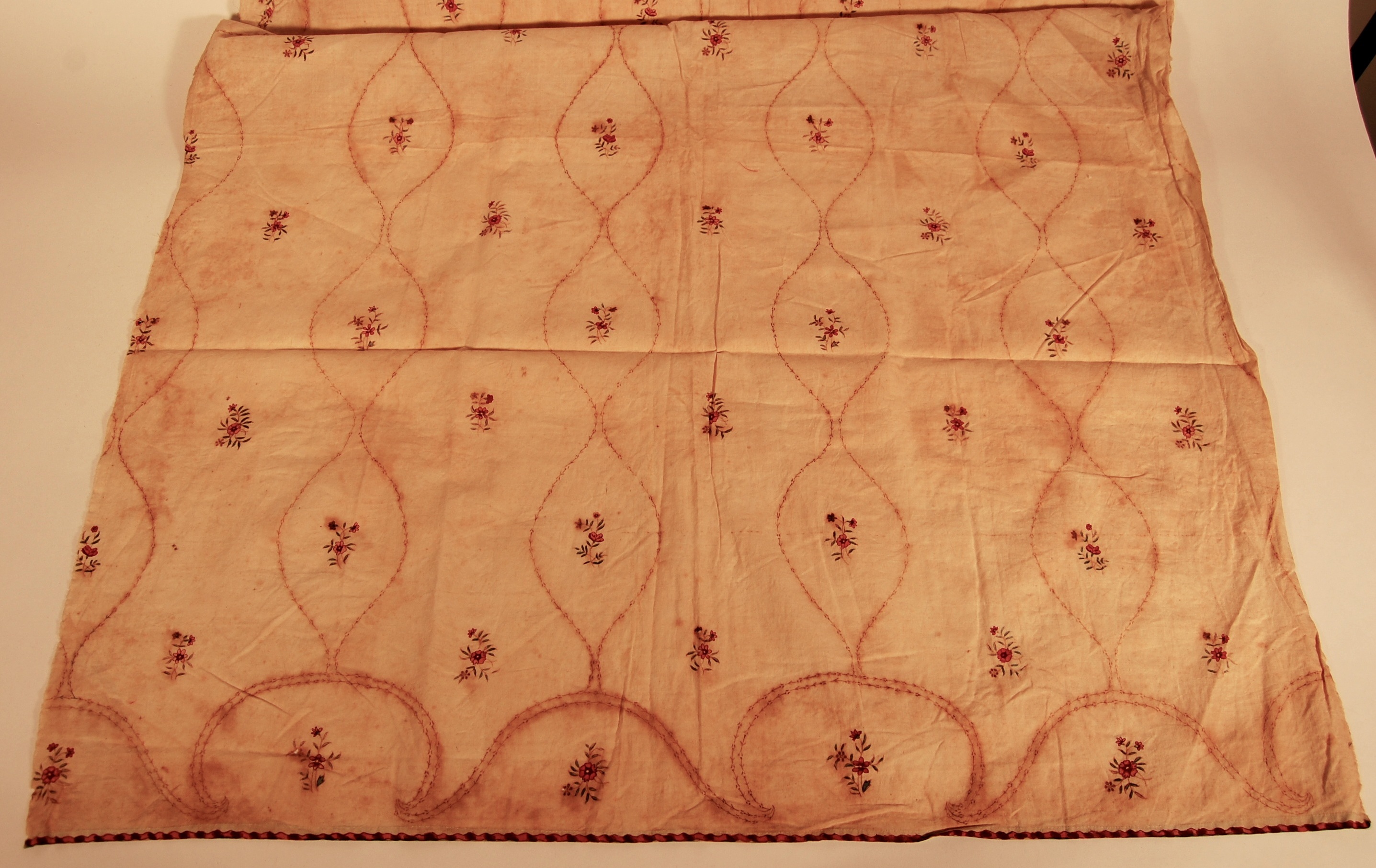
I find these garments in limbo really fascinating. Was that bodice finished and worn with a matching petticoat? (Yes, there’s a panel of that left, too; what a lovely hem!)

Skirt panel, painted Indian cotton. RIHS 1990.36.33
Skirt panel, painted Indian cotton.
RIHS 1990.36.33

Who wore the gown? Was it Sally Brown, born in 1773? And did she alter it, or did her sister’s mantua maker, Nancy Smith? We can only guess at this point, as so many documents remain in private hands. The alterations are not as finely done as the original gown, so I think there are two hands at work here– whose were those hands? There’s always more to think about and learn.

In case you’re wondering, thanks to the Met, we can see what the gown probably looked like in its first incarnation, and then what the alterations were meant to achieve. (Link to the gown on the left; link to the gown on the right.)

Cross my Heart

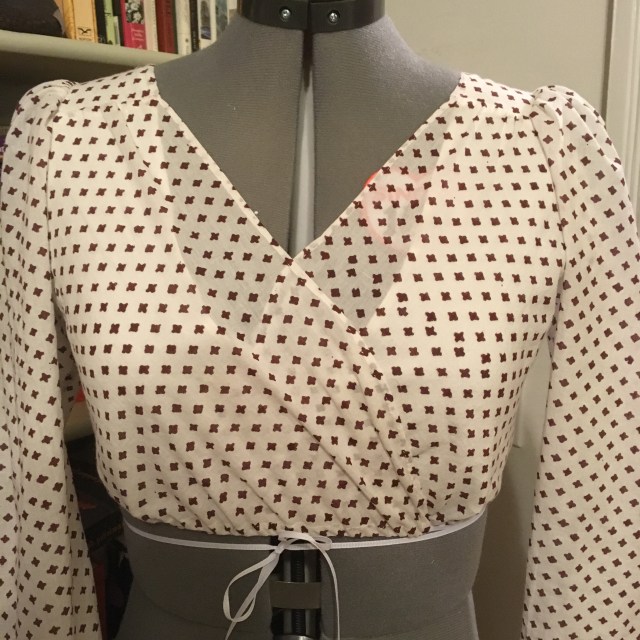
The goal is on the left. How far have I made it? Well… I have been busy. We started on the right, remember?

In executing the final plan, I did choose to cut a lining to support the lightweight fashion fabric; I didn’t think it would look, drape, or wear well without a lining.

The adaptation is truly that, and not a copy, in this instance. The lining means that the finished piece will have more of the appearance of a drawstring fitting than an actual drawstring across the back.

The sleeves, thankfully, were pretty straightforward, and I’m one of those odd people who really enjoys cutting and setting sleeves, so there you are. It took me about six days to get to this point, and then work came to a halt. I have other centuries I’m playing in, and am determined to finish that yellow dress to wear this weekend. When and where else can I look like a person of means than the Fort Frederick Market Fair?

True Confessions of the Frivolously Fashion Obsessed

Skeptical cat is skeptical

I promised you something, didn’t I, the last time I wrote?

Well, set your skepticism aside for the cat, because here’s the scoop on the messy process of getting from page to pattern to garment.

I started with the pattern from the book, which furrowed my brow a few times until I became accustomed to the style. Everyone drafts and scales patterns a little differently; it’s like getting used to local idioms. (It’s a bubbla, here, not a water fountain and not a drinking fountain. Go figure.)

But I digress. It seemed pretty simple, especially since I have some experience scaling things up, both from Sharon Burston on taking a pattern from an original garment (plot your points like an archaeologist) and from architecture school (redraw Le Corbusier’s maison from these two tiny drawings, draft an axonometric, and make a model). With Corbu behind me, you’d think this would be a piece o’ cake.

Delightfully, you would be wrong. Creative swearing, brow furrowing, and endless distractions (yes, some 28mm 17th century soldiers will be wearing Timberlands) provided the usual soundtrack and experience. Challenging, not easy, which means I hope I might actually have learned something.

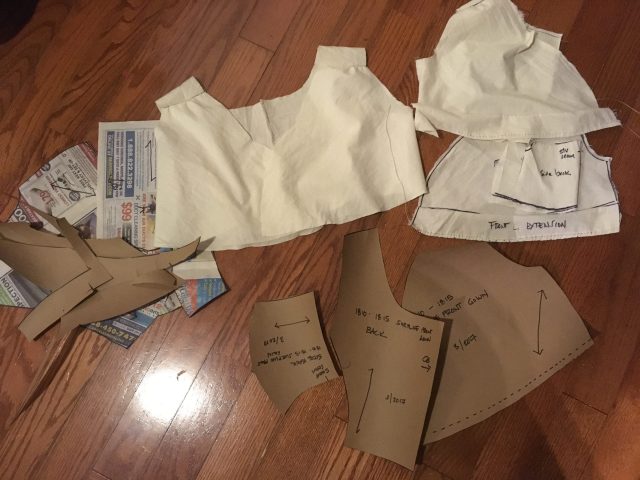
Kind of a mess, right? Here’s what I did: I scaled up the pattern in the book once I’d figured out that the measurements were, incredibly, just about what I make my Federal-era dress pieces. I used the newsprint ads that come in the mail because they are abundant and free. That’s more challenging than gridded or plain paper, but free is free. With a ruler and a pencil, you can make your own grid.

After the paper patterns were drafted, I checked them against the drawings in the book, and made free hand corrections. I’ve learned that my eye is sometimes better than my math whether I am hanging paintings or making patterns.

From the tweaked newsprint pieces, I cut muslins to stitch up and try on over my stays. You MUST fit over the proper undergarments, or the exercise is pointless. These resulted in some additional tweaks and alterations accomplished at first with pins, a Sharpie, and Drunk Tailor’s patient assistance.

What then? Another round with some adjusted pieces to yield another muslin. It’s from that final fitting muslin that I transfer changes to the newsprint and then, finally, to craft paper. I was ably assisted once again by the Most Dangerous Cat in the World.

That’s what you’re left with: scraps, a muslin that’s true, and the pieces to make it. But have I made real progress on real fabric? Of course! But that’s another post.