Chintzy Follow Up

I was thinking about what one would want to know in order to get any clarity on what Dutch chintz or jackets (or short gowns) in the ads could mean. There’d be the question of where the runaway came from originally (Netherlands or one of the German states). What the writer of the ad meant by chintz. And jacket/short gown/gown-that-is-short/caraco, and what that might really mean. And what the provenance is (really) for extant garments. Chintz is the easiest part there. And the blue Dutch chintz could be something like the Den Haan and Wagenmakers: 

I don’t know enough to draw a conclusion any more spectacular or detailed than “clothing other than gowns was worn by working women, and it was sometimes of calico or chintz.”
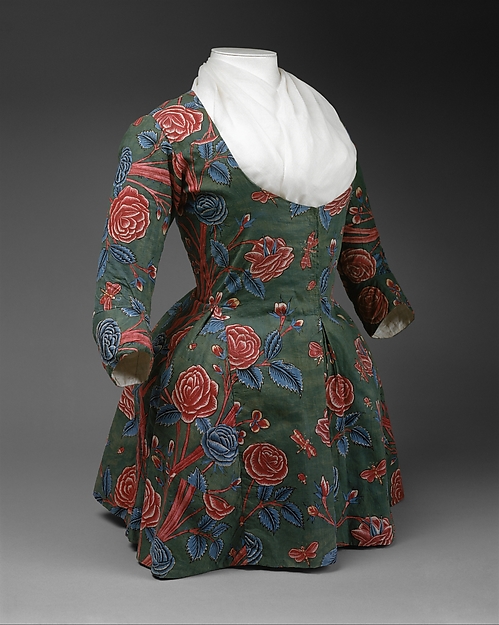
 

The catalog record for the jacket/caraco at the Met doesn’t say who owned it or how they know the origin is the Netherlands. It would be helpful to know if that meant just fabric, or fabric and finished garment.

Laying out this jacket and the ones at Snowshill, and the other examples in collections, would be interesting and might be revealing. Same with the short gowns in the world, from Williamsburg to Genessee Country Village.

Over time, I hope to see and learn enough to get a little closer to understanding something, and it might be more about the origins of people in the early US, and not anything about clothing. It will depend on how hard I work at it, and where I look.

Watson Farm

20120703-061241.jpg Sunday afternoon we decided to go to a farm, and chose Historic New England’s Watson Farm on Jamestown. It was a good choice, I think, and perhaps this will be the summer of historic farms and landscapes.

I always wanted to be Tasha Tudor when I was little, live in a historic house, wear historic clothes, eat historic foods, perform historic chores. We lived in a ca. 1875 house in Chicago, so of course I wanted 1875 clothes for my school, which was also ca. 1875, at least in part. Fortunately, I did not get them, children being even less tolerant in the Dark Ages of my youth than they are today.

So Watson Farm’s ca. 1790 date and traditional methods appealed to me, and appealed to Mr. S, who wanted just “farm,” and the Young Mr. was just stuck with the decision.

20120703-061408.jpg The farm is largely uninterpreted. HNE provides a brochure and map for a self-guided tour, and there are cows, sheep, chickens, ducks, and cats scattered about the landscape. The fields are pasture, with the farm managers maintaining a vegetable garden for their own use. In terms of learning, it was not a stellar experience and knowing what I do about the farm, I can see why. With 285 acres that need to remain untouched, you can’t plant signs everywhere despoiling the landscape and getting in the way of cattle. In terms of beauty, it was outstanding.

The brochure takes you on a roughly 2-mile walk through the fields and down to the shore of the island. (There is a shorter loop option.) The view was lovely and on Sunday, with weather coming in from the west, the sky was dramatic and it was just about like walking in a Thomas Hart Benton painting.

I think the best moment for me was hearing the cows eat. I don’t remember ever hearing a cow eat grass before, but it was a wonderful sound, “like eating a whole lot of celery, with a pillow over your head,” said Mr. S. Well, sort of. I wish I’d made a recording of it, because it is a sound very few people ever hear anymore. Even the most urban among us can encounter police horses snuffling in their feed bags, and reenactors can visit the dragoon’s horses at battles. But cows snuffling up and chewing grass–that’s another kind of almost-lost sound altogether.

And that’s the whole point of these historic landscapes, preserving the things that would otherwise be lost: not just the vista, the plants and the animals, but the sounds the animals make, the smell of hay toasting in the sun, the sandy prints of burrowing animals, and the truly otherworldly, out-of-time experience of stepping off the asphalt path.

Tea Party Madness

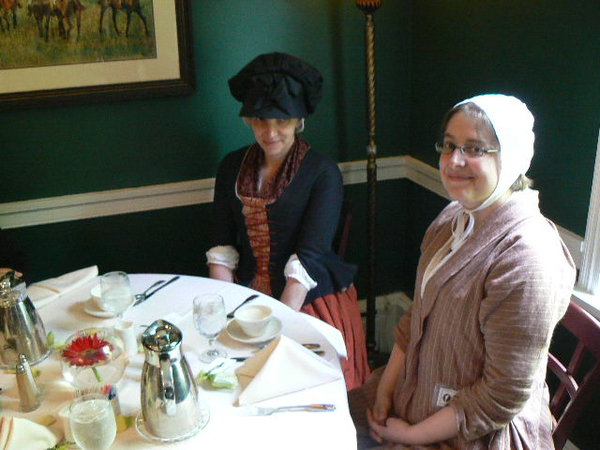
There they are, those lower sorts! We had tea, with delicious scones and excellent company in the form of booksellers from Brooklyn. We don’t get out to tea very often, and it was a pleasant introduction to more old-fashioned notions of parties.

This is a useful thing, because the known bonnet wearer must prepare cake and punch for an as-yet-unknown quantity of guests to include the Second Helping Regiment. Perhaps the historic recipes are not so far off in quantity after all..

The clip is from The Compleat Housewife: or, Accomplish’d Gentlewoman’s Companion. A similar recipe appears in The Art of Cookery Made Plain and Simple, by Hannah Glasse. You can find it on the Colonial Williamsburg website, along with a translation for the 21st century cook. I think I’ll try it, and I’ll have to start soon to get it right by the end of June.

Now for a punch recipe for an unknown quantity…