Remembrance of Transit Past

Yesterday was staff day at work.  We went, by donated careening bus ride, to the Essex Steam Train & Riverboat. We did not get a ride in a steam-powered seaplane, but the combination of bus, train and boat was pretty entertaining. More sitting than most of us care for; one member of our party said, “This is an old person’s tour–it’s all sitting.” She’s practically a professional shopper, so she’s good on her feet in fairly high heels.

But what struck me, standing by the platform at the station is Essex, was that we were in a museum of transport past, and that it was somehow very strange to be in a place that historicized a means of getting around that many people still use every day. Except for the 6 tons of coal part, my husband takes the train to Boston every day, and has for more than 10 years. And when we first moved back East, I rode the train, too. In the dark ages of grad school, I commuted by rail. The last year at RISD, I had a job in Natick, MA, teaching at a boarding school as a visiting artist, and the question was, how to get there?

The answer was easy, the MBTA of course. I took the commuter rail to Back Bay or South Station, caught the Framingham line out to Natick and walked up the hill from the station to school. Sometimes I’d get there early enough for lunch, and pack extra grilled cheese sandwiches into my tool bag.

I liked the train commute and some of my favorite memories of pulling into Providence are from that year. The conductors were more lax, then, and would let me ride in the vestibule with them while the car door was open, watching the sunset over the west side of town. This was pre-Home Depot and Providence Place Mall and the 6-10 connector, pre-development along Royal Little Drive, pre-development in Pawtucket, so the view was a lot better. The Citizens Bank building was still under construction, it was just a steel frame that the sun would shine through at the end of the day.

All through school, I took the train to New York and then to Philly, enjoying the view of the CT coastline, its loneliness and isolation, the kind of romantic juxtaposition of the marshes and wetlands with the harsh rocks and cold grey skies of the coast. There was a little house the train passed, and every time I saw it I would think, “Someday I’d like to live in that house.”

That never happened, but when I got the job in RI, and we moved east from St. Louis, my father was working in Boston and New York, but living in Noank, CT,  just down the road from the little house. Providence was 45 minutes away by car, but Mr S and the Young Mr (then known as the Monkey) needed the car to get anywhere outside of Noank. The grocery wasn’t very big there and they needed to be able to get into Groton and Mystic, so how was I to get to work? On the train.

I took Amtrak from New London to Providence, and the train would get in around 9:10 (supposedly) and end up back in New London around 6. There were schedule changes, and the bridge at Old Saybrook tended to freeze, and there were coworkers who  didn’t get me to the station on time, and evenings spent at the RISD Library on the laptop waiting for the next train. It worked out, though, since I was writing a book at the time.

The monthly pass that was definitely cheaper than driving, and I walked around Providence when I needed anything. The conductors all knew me, and were very kind. Here’s a tip: be nice to the conductors, and you can ride free if you forget your pass. I’ve even gotten free trips to Boston when they were on duty. The view from the window was pretty much the same, though now there were McMansions and condos in Stonington. The wetlands were still there, and the coves, the nesting raptors and the shore birds. One morning I even saw a harbor seal swimming in a cove, whiskers poking up above the surface. That is definitely the coolest thing I’ve ever seen on a commute.

And then there was a museum to set all that in the past, as if to say that way of life is over. The train we were on was truly steam-powered, and that is a thing of the past. The car was from 1914, with seats that switched direction, though I remember riding on seats like that either on the MBTA back in the dawn of time, or else in Chicago.

What will I do next? Why, make a 1914-1919 traveling costume and go back to Essex to ride the train again, of course. Might as well be a museum exhibit if you’re going to travel temporally.

Images and Ideas

If the museum date is mutable, what to do? How to take non-illustrated Vogue for the Lower Sorts and turn it into an actual plan for a garment? By using period images.

Anne Carrowle runs away in 1774 in “an India red and black and white calicoe long gown,” but what does that mean?

Start with the negatives: It means she is not wearing a short gown or a bed gown or a jacket. She’s probably wearing what we most commonly think of women wearing, an ankle- or near-ankle length dress, open in the front (remember that the petticoat is described!) that pins to a stomacher or is fastened with bands or a band over a handkerchief.  (Excellent info on the topic At the Sign of the Golden Scissors blog.)

 When I start thinking about a gown for 1774, I start looking for earlier images. Not too much earlier, but a range. In this case, Anne left England in 1769, so 1769-1774 seems like a reasonable time frame. I made a Pinterest board for 1765-1774 ideas, which is easier than posting them all here.

To the left is a robe that’s clearly open: it’s hanging open. Laundry-work, women washing at Sandpit Gate, Paul Sandby, 1765; watercolor. Royal Collection.

1765 gets us closer to the time period, and it is before Anne left England, and it’s likely from the class she was born into. But it is early.

The two prints above are both from 1774; on the left, note the maid’s gown, which hangs open and has robings. On the left, the old woman asleep wears a gown laced over a stomacher.

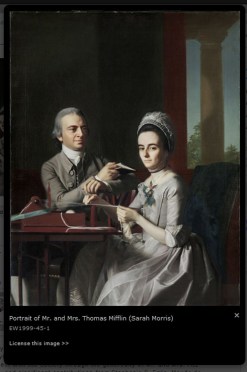
But best of all perhaps is this image, of Thomas Mifflin and his wife, Sarah Morris Mifflin, painted by Copley in 1773. Thomas Mifflin (1744-1800) and his wife, Sarah Morris Mifflin (1747?-1790), were the only Philadelphians painted by John Singleton Copley. Mifflin was an ardent patriot and by the time this portrait was made, had established himself as a successful merchant; later he rose to the rank of major general in the Continental Army, and was elected the first governor of Pennsylvania after the United States achieved independence.

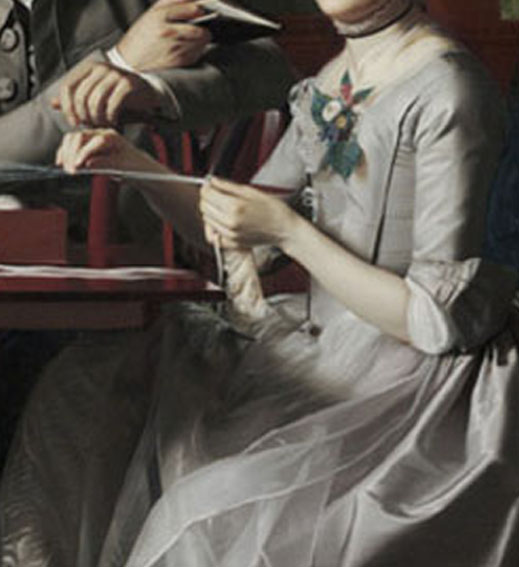
Why does this work for me? Because these are Philadelphians, and my woman ran away from the Philadelphia area. The detail really shows that Mrs. Mifflin is wearing an open robe with robings and stomacher over a quilted petticoat with a filmy white apron. This is multiple tiers above Anne Carrowle, but the style is what I’m aping, not the materials (obviously silk).

Another Copley portrait, of Mr. and Mrs. Isaac Winslow, depicts a woman in a gown with robings and a stomacher. Jemima Winslow is 41 in the painting, putting the style into my ballpark, and better still, the gown is of a patterned fabric.

Below is a detail of the fabric and stomacher. Though it will be a vastly simplified version, I think I have a model for my dress.

What time is that dress in the museum?

Guess what: they might not know for sure. Many garments donated to museums are given without clear dates, especially older garments donated in the 20th and 21st century. That means that dating the garments is, well, tricky.

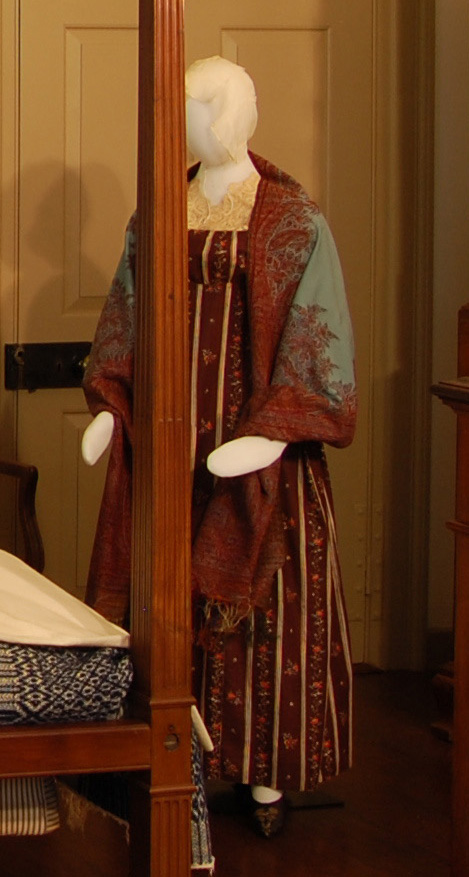
You can find many dated to 1776 by donors. Everybody wanted to be associated with such an important event…especially around 1876, and 1976. Where I work, a dress like the one to the left was given to us with the firm statement that the fabric had been brought from England to RI (how did that work with Newport blockaded?), and that the dress was from 1776. Clearly, it is not.

To the right is Deborah Sampson’s dress, possibly her wedding dress: Don’t know who she was? Read here.

Deborah Sampson’s is a closed-front round gown. Look at the catalog record, and you’ll also note the date: 1760-1790, a thirty-year spread. Why is this? Fabric gets remade, for one thing. Deborah Sampson Gannett’s dates are 1760-1827, so if this is her dress, we know she didn’t wear it in this size or style in 1760. But fabric can easily pre-date a garment. The V&A sometimes had three dates for their Spitalfields silk gowns: the date of the fabric, the date it was first made into a garment, and the date it was altered into a new style.

Sampson marries in 1785. That seems like a plausible date for this dress, given its style. That’s where the 1790 comes in; yes, it could be that late, it’s conservative in New England and makes a nice ending to a “circa” date. So how else might this dress be dated? 1785-1790? 1780-1790, fabric possibly earlier? Given the database I know HNE uses, the date field is a little tricky (we use the same one). If I were to catalog the dress, I think I’d use 1783-1788. Why 1783? Because we know Deborah Sampson was probably not wearing dresses in 1783: she was in the Army roughly 1778-1783. I’d add 5 years to that because it encompasses the date of her marriage, 1785, and indicates that I’m not convinced or have no firm documentation that this was in fact her wedding dress. That’s just how I would approach this if the dress was in my museum and is not intended as a criticism of HNE’s cataloging. And it’s not to suggest that my own catalog records don’t need work, because they do.

What does this mean for researchers and costumers? When I do research, because I know how the process can work, it means I’m often skeptical, or wish that the reasoning behind the date was explained—especially behind a 20 or 30 year range. It also means you have to fact check yourself, with independent verification. For that, I use period images, which I’ll explore in another post.

Smelling the Past

20120919-053844.jpg
What did it smell like? I think that’s something many of us would like to know about the past. We can, with some hard work and luck, know what it felt like (clothes, furniture, household furnishings can be touched with an appointment in some museums). We can know what the food tasted like–and last weekend’s event at Coggeshall provided excellent examples of that, since we ate meals based on traditional receipts and made with vegetables and meat grown on the farm. Musicians play period music on period instruments, deportment books, plays, and letters give us insight into how things sounded.

But what did it smell like? That seems more elusive, but just as important. Smell is critical to forming memories, and recent research has highlighted links between odors/scents and the formation of memories, especially episodic and emotional memories, and summarized well here and here. So knowing what the past smelled like–and that is a crazy big generalization–would help us understand the way people experienced their lives and formed memories, like Proust and his madeleines.

But it’s easy, you say, the past smelled of horse dung, urine, and wood smoke, and to a degree it did. But yesterday, sitting on the hill of the John Brown House watching weather slowly come in from up the Bay, I thought of the smells of Providence. The lawn smelled of dry mowed grass, because it had been mowed in the sun on Monday. The wind smelled of fish and salt water as it whipped up off Narragansett Bay, and I thought of the smell of the shift, apron and shirt washed at the farm on Saturday, and realized we forget the smell of laundry.

When we unpack from an event, the house smells different: things reek of wood smoke, sweat, and black powder, and sometimes rain. The smoke smells a little different each time, depending on the wood we burn. But the things from the farm smelled really different, and it was the laundry. It smelled of fat.

Basic soap is made of fat rendered with wood ash and lye, though fancy soaps used olive oil instead of animal fat. So my laundry smelled of the soap that was used, just as it does today, but this soap had both a softer and a stronger odor. That is, there wasn’t the bite of chemical backlash you get with some detergents, but one shirt, one shift, and one apron, folded, created a marked island of scent in the corner of the room.

If I had been sitting in mowed grass on the slope of Power Street 213 years ago, I would have smelled my self (wood smoke, laundry soap, sweat), the grass, and the fishy wet wind from the Bay in addition to whatever was rotting in the midden or festering the street where the horses had been. Spices and oranges on the docks might add to the wind from the Bay, and I like to think that all together, in the 18th century, Providence smelled like possibility.