The Line of Beauty

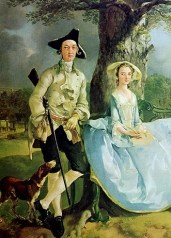
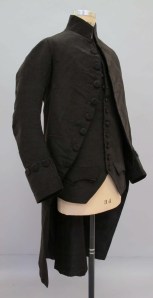
In considering menswear, I found this suit at the Met. Incredibly plain, it reminds me of classic Balenciaga: all about fabric and drape. It also reminded me of Hogarth’s Analysis of Beauty, and the serpentine line.

You could also call it the Ogee curve, and it’s found in the serpentine legs of 18th century tables, and does not come from, “Oh gee, that soldier’s got nice legs.”

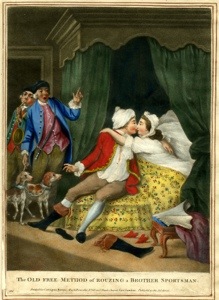
In this variation on the theme, the contrasting lining emphasizes the lapel line, but the overall effect is less elegant. It’s about materials, too, not just cut. There’s so much to learn just by looking, really looking, at clothes and paintings from the past. There are subtleties we miss as we rush past, and miss because we haven’t read enough to understand what we’re being told.

So much hides in plain sight, because we don’t see the world the way the tailors and painters and engravers saw it. I don’t pretend to have the key to that world, but it’s worth looking for, mostly just by looking.
Veterans and Votes

20121127-080442.jpg
On Wednesday last, I met with two fantastic colleagues, one from my own house, and the other from the local living history farm/museum. We went over topics and themes and ideas about history, and we tried to stay focused…but it was hard, because really, all three of us think the 18th century is hot stuff, and the thing we most want to share with the rest of the world.

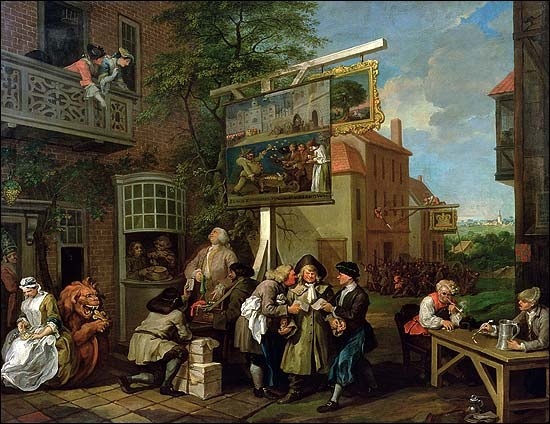
At one point, our farm based colleague reminded us that his people (tenant farmers) would not have been able to vote. And I realized, as the conversation quickly hopped to the westward migration of Rhode Islanders–some to take occupation and ownership of Western Reserve lands given as bounty for Revolutionary War service–that there were plenty of men who served in the Continental Army who, at war’s end could not vote.

Let that one sink in for a moment: in Rhode Island, only property owners could vote. A man who served with the Rhode Island Regiments who did not own property fought, in some cases for eight years, but at war’s end, could not vote. They could not participate in the democracy they might have sacrificed not only time and profit but their own bodies to achieve.

One man, one vote was not the law in Rhode Island until after the Dorr Rebellion of 1841, when white male property owners AND men who could pay a $1 poll tax were granted suffrage.

Universal suffrage rights aside, what did voting mean to the men who fought in the Revolutionary War? How did the people of the late 18th century understand their rights, and they role in democracy? It was far different from what we take for granted in America now, which is different from how democracy was understood just 100 years ago.

Again, we could delve into how Senators were formerly not chosen by popular vote or argue about the electoral college, but what I wonder now, as I ponder the men who portray Rev War units, is to what degree those men understand how very different the men of the past were from the men they are today. It is not just breeches and “Good Days” that make us different. The way we think– how we see the world and how we see ourselves– is fundamentally different.

I Love a Man in a Uniform

Maybe it’s about the musket?

But that’s not my man, that’s Brian. Nice uniform, though, right? Blue broadcloth with white facings and pewter buttons, a cap with a red cockade, fitted white overalls: what’s not to like? (Making one, that’s what, and one is in my future.)

After getting Mr S’s workman’s jacket to the brink of buttons and buttonholes, we looked at it and said, “It’s so…plain. Where are the contrast facings? The tape and the lace? Should it be so much, well, one color?” Peacocks suddenly made sense.

It’s not about the musket. It’s about the buttons. And the breeches.

I spend my 18th century time with men in uniforms, and I forget the role of line, fit, and color in determining style. I see it in paintings, and in lovely coats in museums, but one thing we don’t have a lot of are paintings of middling and lower men who look stylish. Of course not! They couldn’t afford paintings, and style–refinement at least–was associated with class and gentility. There was a coded language, and clothes said a lot about the wearer.

So what did uniforms say about men, and how much could civilians, especially women, read the symbols? Hessians, with their tall brass hats, and grenadiers, with bearskins, are dressed not just to impress, but to overwhelm, visually. At Fort Lee last year, my mother was distinctly impressed by, and a little frighted of, the Hessians and Jaegers: the uniforms worked as intended.

Facings and frocks: Rhode Island stands out

Light Infantry troops wanted to set themselves apart, and used their cut-down caps and short jackets to achieve immediate visual distinction.

Working men used what they had: checkered or printed handkerchiefs, patterned waistcoats, and better buttons were some of the ways they dressed up their clothes. I know brass buttons will be in my sewing box soon, the sooner the better, say the men I sew for.

Warm in Bed

20121117-044602.jpg Last night, I leaned back on the pillows and felt the cold seep through my shirt. Our house, at 62 or 64 degrees, is warmer than the 58 degrees Moses Brown recorded in the early 19th century and warmer than the mid-50s temperatures some people I know still keep. But I have layers I can wear, wool or wicking space-age materials, and will wear anything to bed to keep warm. What did people wear in the 18th century? How did they stay warm in bed?

One solution was the bed warmer, the long-handled brass pan filled with hot coals and swiped over the linen sheets of a bed just before the sleeper hopped in. This method required strength, speed and a steady hand, and worked best if someone other than the sleeper could do the swiping. Heat would dissipate quickly while a warming pan was stowed safely.

Another option was heated stones or bricks wrapped in fabric and tucked into the foot of the bed. That sounds good to me now, cold as my sheets can be. Jane Nylander writes in “Our Own Snug Fireside” that some people perceived warming the bed as a sign of weakness, and it is hard to document such a mundane act.

Truly quotidian details are hard to find in written primary sources: people in the past took their daily lives as much for granted as we take ours. How often do our diarists today record whether they wore socks to bed?

In the collection at work, we do have one woolen flannel shift from the early part of the 19th century. I suspect I will want to copy that for January.